⏱ 20 min read
Most enterprise API governance is theater. ARB governance with Sparx EA
There, I said it.
A lot of organizations claim they “govern APIs,” but what they actually do is review OpenAPI files late in delivery, argue about naming standards, and publish a style guide nobody reads after sprint three. They call it architecture. It’s mostly post-facto linting with committee energy.
The real problem is simpler and more uncomfortable: most enterprises do not govern the design system behind APIs. They govern surface artifacts. They review JSON shapes and URL paths, but they do not govern the underlying meaning of services, resources, events, identities, dependencies, and constraints. So every team invents its own mental model. And then the integration estate turns into a very expensive argument.
If you want API governance that actually scales, you need to think more like a modeler and less like a reviewer. This is where UML metamodel principles become surprisingly useful. Not because anyone wants a revival of giant UML binders from 2003. Nobody misses that. But because the metamodel idea—the idea that you define the types of things architects and engineers are allowed to create, and the rules between them—is exactly what API governance has been missing.
In plain English: what this means
Here’s the simple version.
A metamodel is just a model of the modeling language. In enterprise architecture terms, it means defining the core concepts your organization uses consistently:
- what counts as an API
- what counts as a domain service
- what counts as an event
- what counts as a consumer
- what counts as an identity boundary
- what relationships are valid between those things
So instead of saying, “Please use kebab-case in your path names,” you say things like:
- every API must belong to a business domain
- every externally exposed API must map to a trust boundary and IAM policy model
- every event published to Kafka must have an owning bounded context
- every synchronous API dependency must declare resilience expectations
- every customer data resource must declare data classification and retention constraints
That is metamodel thinking applied to API design governance. EA governance checklist
And yes, it sounds abstract at first. But in real architecture work, it becomes very practical very quickly. It gives you a way to stop debating individual APIs as isolated snowflakes and start governing them as instances of a shared enterprise design language.
Why API governance usually fails
Let’s be blunt about the common failure modes.
1. Governance happens too late
Architects often review APIs after implementation has mostly happened. By then the important decisions are already frozen:
- domain boundaries are wrong
- IAM assumptions are embedded
- Kafka topics are overloaded with mixed semantics
- cloud deployment patterns are already chosen
- consumers have built against unstable contracts
At that point, governance becomes a cosmetic exercise. You can clean up descriptions and naming. You cannot easily fix conceptual damage.
2. Teams govern syntax, not semantics
This is the classic enterprise anti-pattern.
You get a 70-page API standard covering:
- URI naming
- versioning notation
- pagination style
- error code format
These things matter. But they are not the hard part.
The hard part is semantic consistency:
- What is a Customer?
- When is Account a resource versus a capability?
- Is Payment Initiation a command, a resource state change, or an event trigger?
- What identity claims are required to perform an action?
- Which systems are systems of record?
- Which events are facts and which are notifications?
Without semantic governance, syntax standardization gives you beautifully formatted chaos.
3. Architects confuse repositories with governance
Publishing APIs in a portal is not governance.
Having an API gateway is not governance.
Owning a Kafka schema registry is not governance.
Running IAM centrally is not governance.
Those are enforcement or enablement mechanisms. Useful, necessary, but secondary.
Governance starts with a conceptual model of what is allowed to exist and how it relates. That’s the metamodel.
4. Every integration style gets governed differently
REST is reviewed by one team.
Kafka events by another.
IAM scopes by security.
Cloud service exposure by platform.
Data contracts by analytics.
And nobody ties them together.
This is one of the biggest mistakes architects make in modern enterprises. They treat APIs, events, identity, and cloud exposure as separate governance domains. In production, they are one system. The consumer doesn’t care that your internal org chart split responsibility across four architecture boards.
Why UML metamodel principles matter, even if you dislike UML
A lot of architects hear “UML” and mentally leave the room. Fair enough. UML was often abused. Teams generated diagrams because process demanded it, not because design needed it. But the useful part of UML was never the notation itself. It was the discipline underneath: defining a set of concepts, relationships, constraints, and extensions. UML modeling best practices
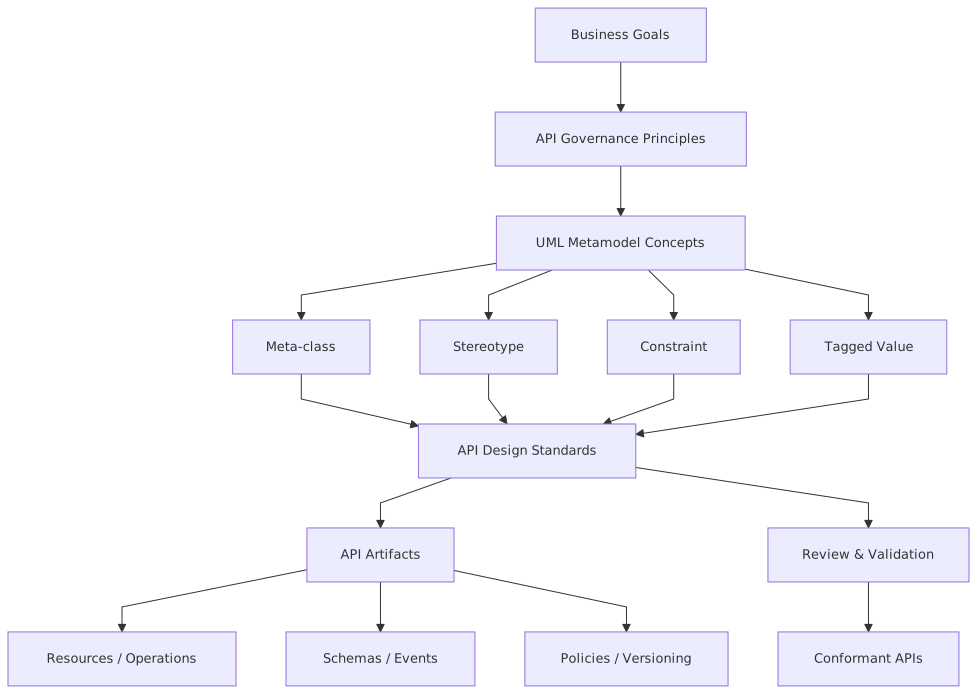
That is exactly what enterprise API governance needs.
The metamodel principle says:
- Define the kinds of elements that exist.
- Define what properties they must carry.
- Define which relationships are valid.
- Define constraints that can be checked.
- Let teams create instances within those rules.
That’s it. Very architectural. Very practical.
For API governance, your metamodel might include elements like these:
- Business Domain
- Capability
- Service
- API
- Operation
- Resource
- Event
- Topic
- Consumer
- Identity Boundary
- Policy
- Data Classification
- Deployment Unit
- Cloud Exposure Pattern
And then you define relationships:
- a Service belongs to one Business Domain
- an API is exposed by one Service
- an Operation acts on one or more Resources
- an Event is emitted by one owning Service
- a Topic carries one or more Event types under explicit compatibility rules
- an API crossing an Identity Boundary requires Policy mapping
- a Consumer may depend on an API or subscribe to an Event
- a Deployment Unit hosts one or more Services in a cloud environment
Now governance can move from subjective review to structured design.
The shift: from style guide to architectural language
This is the real value.
Without a metamodel, governance is basically a set of opinions.
With a metamodel, governance becomes an architectural language.
That language lets you answer enterprise questions consistently:
- Which APIs expose regulated banking data?
- Which Kafka events are authoritative business facts?
- Which services sit behind customer IAM versus workforce IAM?
- Which APIs violate domain boundaries?
- Which cloud-native services are exposing internal implementation details?
- Which consumers are tightly coupled to synchronous dependencies?
That’s what enterprise architecture is supposed to do. Not just review diagrams. Create a shared design system for the estate.
A practical metamodel for API governance
Let’s not overcomplicate it. In real architecture work, the metamodel has to be small enough to use and strong enough to matter.
Here’s a practical starter set.
This table is not theoretical fluff. It’s the basis for review checklists, architecture repository structures, automated policy validation, and exception handling.
How this applies in real architecture work
This is where a lot of articles go vague. Let’s not do that.
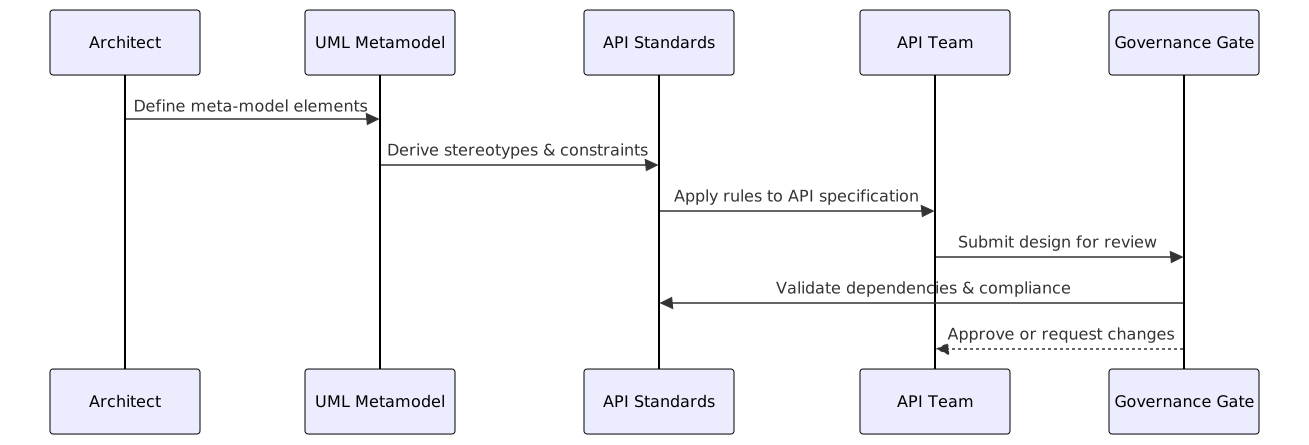
In real enterprise architecture work, UML metamodel principles help at five points. UML for microservices
1. During domain decomposition
When teams start carving out services, the metamodel forces clear ownership.
For example, in banking you often see “Customer API” become a dumping ground for:
- profile
- KYC status
- marketing preferences
- authentication identifiers
- product holdings
- contact history
That is not one cohesive resource model. That is a political compromise masquerading as design.
A metamodel-based review would ask:
- Which domain owns each part of customer data?
- Is this API exposing a canonical enterprise customer, or a local projection?
- Which identity boundary applies: employee, customer, partner?
- Which service is authoritative for updates?
Those questions expose bad decomposition early.
2. During API contract design
Instead of reviewing only path structures, architects can review contract semantics.
Say a team proposes:
POST /accounts/{id}/freeze
Fine. But what is that operation in the model?
- a command against an Account resource?
- a case-management action requiring human approval?
- a fraud-control action crossing a separate policy domain?
The answer matters. It affects IAM, audit, event publication, and consumer expectations.
Metamodel governance forces the team to classify the operation correctly, not just define the endpoint neatly.
3. During event-driven design with Kafka
Kafka makes bad architecture scale faster.
That’s not Kafka’s fault. It’s ours.
Enterprises often create topics like:
customer-eventsaccount-eventspayment-events
Then many teams publish loosely related event types into them, with inconsistent keys, mixed retention assumptions, and no real ownership. Consumers reverse-engineer meanings from payloads. It works until it really doesn’t.
A metamodel approach asks:
- Is each event a business fact or just a technical notification?
- Which service owns the event definition?
- Is the topic aligned to a domain aggregate or just convenience?
- What compatibility policy applies?
- Can multiple services publish to this topic, and if so under what rule?
- What consumer obligations exist for PII handling?
This changes Kafka governance from “please register your schema” to “please prove your event belongs in the enterprise model.”
4. During IAM and zero-trust design
API governance that ignores IAM is amateur hour.
In real enterprises, especially in banking, the hardest API problems are often identity and authorization problems. Not payload problems.
If your metamodel includes Identity Boundary and Policy as first-class elements, then every API design has to answer:
- Is this internal-only, partner-facing, or customer-facing?
- What token issuer is trusted?
- Are scopes enough, or do we need claims-based ABAC?
- Does this operation require step-up authentication?
- Is the caller acting on their own account, or under delegated authority?
- How does service-to-service identity differ from end-user identity propagation?
Now your API governance is tied to reality. Security teams stop being the people who show up at the end and say no.
5. During cloud platform decisions
Cloud adds another layer of accidental inconsistency.
Teams expose APIs through ingress controllers, gateways, service mesh, serverless endpoints, private links, and internal load balancers. Each pattern implies different operational and security characteristics.
If the metamodel ties API type and identity boundary to cloud exposure patterns, governance becomes concrete:
- customer-facing banking APIs must go through managed gateway and WAF controls
- internal low-latency service APIs may use mesh-native exposure
- partner APIs require stronger onboarding, throttling, and contract lifecycle controls
- event publishers to Kafka must use approved identity and network paths
That’s architecture. Connecting contract design to runtime consequences.
A real enterprise example: retail bank modernization
Let’s take a realistic example.
A retail bank is modernizing core channels. It has:
- mobile and web banking channels in the cloud
- legacy core account systems on-prem
- Kafka as the event backbone
- centralized IAM with customer and workforce identity separated
- dozens of domain teams exposing APIs through a shared platform
Sounds familiar because it is.
The initial state
The bank says it has API governance. In practice it has:
- an API style guide
- an API gateway team
- a Kafka platform team
- a security architecture board
- domain architects working independently
Problems start showing up:
- multiple “Customer APIs” with different identifiers
- account balance exposed differently across channels and internal apps
- Kafka topics carrying mixed event semantics from several systems
- IAM scopes designed per squad, not per business capability
- cloud-native orchestration services exposing unstable internal APIs
- downstream teams tightly coupled to source system quirks
Every committee thinks the issue belongs to someone else.
The metamodel intervention
The enterprise architecture team introduces a lightweight governance metamodel.
They define these core types:
- Domain
- Capability
- Service
- API
- Operation
- Resource
- Event
- Topic
- Consumer
- Identity Boundary
- Policy
- Deployment Pattern
Then they define rules such as:
- Every API and Event must have a single owning Service.
- Every Service must map to one primary Domain and Capability.
- Every externally consumed Resource must declare whether it is canonical, local, or projected.
- Every Operation must be classified as Query, Command, or Administrative Action.
- Every Event must be classified as Business Fact, State Change, or Notification.
- Every API crossing customer or partner boundaries must map to an IAM policy model.
- Kafka topics cannot contain events from unrelated ownership domains without explicit exception.
- Cloud exposure pattern must align to identity boundary and data classification.
This is not heavy modeling. It’s disciplined vocabulary with governance teeth.
What changed
Customer APIs got split correctly
Instead of one giant customer service, the bank clarified:
- Identity Profile Service owns authentication-linked identifiers
- Customer Party Service owns legal party data
- Preferences Service owns communication and marketing preferences
- Customer 360 Projection API exists as a read-optimized aggregation, clearly marked as a projection, not system of record
That one distinction—canonical versus projection—reduced a lot of confusion. Teams stopped trying to write back through read models. Amazing how often that still happens.
Account events got cleaned up in Kafka
Previously, several systems published to account-events.
After metamodel governance:
- Core Account Service owns authoritative account lifecycle facts
- Ledger Service owns balance adjustment facts
- Channels publish only notifications or workflow events, not canonical account facts
- topic naming and partition keys align to ownership and consumption patterns
- schema compatibility policies are defined per event classification
Consumers now know which events are facts they can rely on and which are merely signals.
IAM stopped being bolted on
Customer-facing APIs were mapped to a customer identity boundary. Workforce servicing APIs were mapped separately. Delegated access use cases, like a call center agent acting on behalf of a customer, were modeled as explicit policy relationships rather than hidden implementation detail.
That changed API design in practical ways:
- operations requiring stronger verification were separated
- token claims were standardized around business meaning, not squad preference
- audit obligations became visible at design time
- over-broad scopes were reduced because operations were classified more precisely
Cloud deployment patterns became intentional
The bank stopped exposing every service through the same pattern.
- channel APIs exposed via managed gateway with throttling and fraud controls
- internal domain APIs stayed private with service mesh controls
- Kafka producers and consumers used approved network and identity paths
- aggregation services in the cloud were marked as projections with clear dependency rules to avoid accidental re-centralization
This sounds obvious. It usually isn’t in large programs.
The result
Not perfection. Let’s be serious. No enterprise gets perfection.
But the bank reduced duplicate API creation, improved event consistency, shortened architecture review cycles, and had fewer late-stage security redesigns. More importantly, architecture conversations got better. Teams argued with a shared vocabulary instead of vague intuition.
That is the underrated value of metamodel-based governance: better arguments, earlier.
Common mistakes architects make
Architects are not innocent in this mess. We create a lot of it.
Mistake 1: Making the metamodel too academic
If your metamodel requires a training course and a glossary app, you’ve already lost.
The model should clarify delivery, not become its own priesthood. Keep the number of core element types low. Use terms teams already recognize. Add rigor where it changes decisions, not where it flatters architecture maturity slides.
Mistake 2: Treating REST APIs as the whole universe
Modern enterprises run on multiple interaction styles:
- synchronous APIs
- Kafka events
- batch interfaces
- identity protocols
- internal service contracts
If your governance model only covers REST, you are governing maybe half the architecture and pretending it’s all of it.
Mistake 3: Ignoring identity as part of the design model
I’ll say this strongly: if IAM is not represented in your API governance model, your governance is structurally incomplete.
Identity boundary, trust context, policy obligations—these are not implementation details. They shape the API itself.
Mistake 4: Letting platform standards define business semantics
Another common failure. Teams adopt gateway templates, Kafka templates, cloud service templates, and then assume the platform pattern is the business design.
It isn’t.
Platform standards are delivery accelerators. They should instantiate the metamodel, not replace it. The business meaning of a Payment Authorization API does not come from your ingress controller defaults.
Mistake 5: Creating one canonical model for everything
This is where I’ll be a bit contrarian.
Enterprises love the fantasy of a single canonical enterprise model. Usually because it sounds tidy in governance decks. In practice, forcing one universal model across all domains often creates more damage than inconsistency would have.
Use canonical definitions selectively, where the business truly needs a shared meaning. In many cases, bounded context with explicit translation is healthier.
The metamodel should support this nuance:
- canonical resource
- local resource
- projection
- translated external representation
That is more honest than pretending every object in the enterprise means the same thing everywhere.
Mistake 6: No enforcement path
A metamodel without operationalization is just architecture poetry.
You need ways to apply it:
- design review templates
- API catalog metadata
- Kafka schema registration policies
- IAM onboarding checklists
- cloud deployment guardrails
- architecture decision records tied to exceptions
Not all enforcement should be automated, but enough of it should be machine-checkable to matter.
What a good governance flow looks like
A practical flow usually looks like this:
Step 1: Classify before designing details
Before endpoint design starts, teams declare:
- domain
- service purpose
- consumers
- identity boundary
- resource/event types
- data sensitivity
Step 2: Review conceptual fit
Architecture reviews focus on:
- ownership
- domain alignment
- semantic overlap
- trust boundary implications
- sync vs async suitability
Step 3: Design contract within approved patterns
Now the team uses:
- API style standards
- event schema standards
- IAM policy templates
- cloud exposure patterns
Step 4: Record metadata in the repository
Each API/event gets registered with metamodel-aligned metadata.
Step 5: Enforce selected rules automatically
For example:
- no external API without declared identity boundary
- no Kafka topic without owner and event classification
- no production exposure without data classification and policy tags
Step 6: Manage exceptions visibly
Some designs will break the model. Fine. Enterprises are messy.
But exceptions should be explicit, time-bound, and reviewable.
That last part matters more than people admit. Hidden exceptions become standards by accident. ArchiMate in TOGAF ADM
Contrarian thought: governance should slow some teams down
We hear a lot about “paved roads” and “developer autonomy.” Good. Necessary. But some API designs should be slowed down.
If a team wants to expose regulated banking data externally, publish ambiguous account events to Kafka, or create a new identity interaction pattern in the cloud, I do not want frictionless autonomy. I want architectural friction. On purpose.
The current fashion is to treat all governance as bureaucracy and all speed as virtue. That’s childish. Mature architecture knows where to optimize for speed and where to optimize for correctness, trust, and long-term coherence.
Metamodel-based governance helps because it applies friction selectively. Low-risk internal patterns can move fast. High-risk cross-domain designs trigger deeper checks.
That’s better than either chaos or centralized paralysis.
How to introduce this without causing revolt
Do not start by saying, “We are introducing a UML metamodel for API governance.” You’ll lose the room in five minutes.
Instead:
- Start with pain points teams already feel:
- duplicate APIs
- conflicting events
- IAM redesigns late in delivery
- unclear ownership
- hard-to-find dependencies
- Define a small shared vocabulary.
- Put the vocabulary into existing architecture workflows.
- Tie it to practical artifacts:
- API catalog fields
- Kafka topic registration
- gateway onboarding
- IAM design review
- cloud deployment patterns
- Automate only what is stable.
- Keep the metamodel visible but lightweight.
You are not trying to teach formal modeling. You are trying to make enterprise design coherent.
Final thought
Good API governance is not about making every OpenAPI file look neat. It is about making the enterprise understandable.
That requires a model of what exists, what is allowed, who owns it, how it relates, and where the constraints are. UML metamodel principles give you that discipline, even if you never draw a single UML diagram.
And honestly, that’s the point. The value is not in the notation. It’s in the architectural posture.
Define the language of the estate.
Govern the meaning, not just the syntax.
Treat APIs, Kafka events, IAM, and cloud exposure as one design system.
And stop confusing style guides with architecture.
Because in the end, enterprise API chaos is rarely caused by bad JSON. It’s caused by bad ontology.
FAQ
1. Do I really need UML to govern API design this way?
No. You need the principles of a metamodel, not necessarily UML diagrams or tools. The useful idea is defining element types, relationships, and constraints for API design. You can implement that in repositories, review templates, catalogs, and guardrails.
2. How is this different from an API style guide?
A style guide governs syntax and presentation: naming, versioning, error formats, pagination. A metamodel governs semantics and structure: ownership, domain alignment, identity boundaries, resource classification, event meaning, and allowed relationships.
3. Can this work in event-driven architecture with Kafka, not just REST?
Yes, and it matters even more there. Kafka estates often drift into semantic confusion because transport is easy and ownership is fuzzy. Metamodel-based governance clarifies which events are authoritative, who owns schemas, what topics represent, and how consumers should interpret contracts.
4. Isn’t this too heavyweight for agile teams?
It becomes heavyweight only if architects overdesign it. A small metamodel with 8–12 core concepts is usually enough. In practice, it reduces delivery friction because teams make fewer bad assumptions early and face fewer redesigns later.
5. What should I model first in a bank or regulated enterprise?
Start with these: Service, API, Event, Consumer, Identity Boundary, Policy, Resource, and Domain. In regulated environments, identity and policy need to be first-class from day one. If you skip those, you’ll spend the program cleaning up preventable mistakes.
Frequently Asked Questions
What is a UML metamodel?
A UML metamodel is a model that defines UML itself — it specifies what element types exist (Class, Interface, Association, etc.), what relationships are valid between them, and what constraints apply. It uses the Meta Object Facility (MOF) standard, meaning UML is defined using the same modeling concepts it uses to define other systems.
Why does the UML metamodel matter for enterprise architects?
The UML metamodel determines what is and isn't expressible in UML models. Understanding it helps architects choose the right diagram types, apply constraints correctly, use UML profiles to extend the language for specific domains, and validate that models are internally consistent.
How does the UML metamodel relate to Sparx EA?
Sparx EA implements the UML metamodel — every element type, relationship type, and constraint in Sparx EA corresponds to a metamodel definition. Architects can extend it through UML profiles and MDG Technologies, adding domain-specific stereotypes and tagged values while staying within the formal metamodel structure.