⏱ 19 min read
Let me start with the unpopular truth: a lot of UML deserves the bad reputation it has. UML modeling best practices
Not because modeling is useless. Because most enterprise teams turned it into theater. Boxes nobody updates. arrows nobody trusts. sequence diagrams that describe a fantasy system instead of the one actually running in production. Then someone says, “Code is the only truth,” and honestly, after looking at enough stale architecture repositories, I get why.
But that conclusion is too lazy.
If you’re doing real architecture work in a bank, an insurer, a government platform, a large SaaS estate, or any company with too many teams and too much risk, code is not enough. It’s necessary, yes. It is not enough.
UML still adds value when it helps people reason across boundaries that code alone does not show clearly: ownership, trust zones, integration contracts, lifecycle timing, failure propagation, identity flows, and the ugly social fact that ten teams all think they own the same thing.
That’s the real argument. Not “UML versus code” as if one must win. The useful question is this: UML for microservices
Where does modeling still reduce enterprise risk faster than reading code?
That’s where it belongs.
The simple version first
For the SEO version, plain and direct:
UML is still useful in enterprise architecture when it explains system structure, interactions, responsibilities, and risks faster than code can.
It is most valuable for:
- cross-team communication
- complex integration design
- security and IAM flows
- event-driven systems like Kafka
- cloud platform boundaries and deployment views
- governance and change planning
It is least valuable when:
- it duplicates code line by line
- nobody owns updates
- it exists only for approval gates
- it is too detailed to maintain
- it tries to replace implementation knowledge
That’s the short answer.
Now the deeper one.
Why this debate keeps happening
Developers often say, “The code is the model.” They’re not wrong. Code is the executable truth of behavior. If I want to know whether a Spring service retries on timeout or whether a consumer commits Kafka offsets manually, the code tells me more than a polished diagram ever will.
But enterprise architecture is not only about implementation behavior.
Architecture sits in the space between systems, teams, controls, and time. A lot of architectural failure is not caused by bad code. It’s caused by:
- the wrong service owning a business capability
- circular dependencies between domains
- security assumptions nobody validated
- hidden synchronous dependencies inside an “event-driven” design
- IAM models that break at scale
- cloud topologies that violate latency or residency constraints
- integration patterns that work in a test environment and collapse under operational reality
Code can reveal some of that. It rarely reveals all of it in a form that multiple stakeholders can understand quickly.
That’s where modeling earns its keep.
And yes, UML specifically can still help, though not in the bloated, textbook-heavy way many architects learned it.
Strong opinion: most UML use is too low-level and too late
Here’s one of the core mistakes architects make: they model implementation details after the design is already obvious.
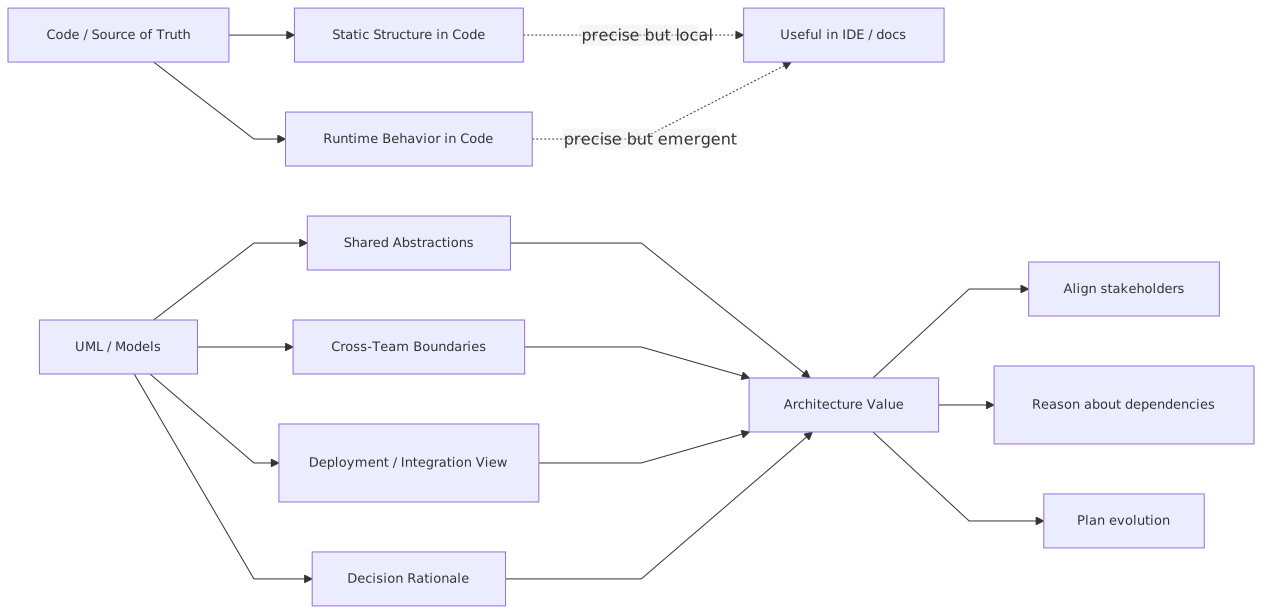
That is wasted motion.
If your class diagram just mirrors Java packages, congratulations, you created a worse IDE. If your sequence diagram documents a REST call chain developers already know, and it doesn’t expose timing, fallback, failure handling, or trust boundaries, then it’s decorative. Maybe useful in a workshop. Not architecture.
The useful modeling happens earlier and at a higher level:
- before teams build contradictory assumptions
- before security gets surprised
- before platform costs explode
- before event contracts become permanent accidents
- before “microservices” quietly become distributed spaghetti
This is also why the anti-UML crowd sometimes wins the argument. They are reacting to bad modeling, not to the idea of modeling itself.
UML is not the point. Abstraction is the point.
Another contrarian thought: architects sometimes defend UML too hard.
You do not need to worship UML. You need to communicate architecture clearly.
Sometimes that is UML. Sometimes it’s C4-ish notation. Sometimes it’s a deployment sketch on a whiteboard. Sometimes it’s a trust boundary diagram that is only half-UML and half-common sense. Purists hate hearing this, but enterprise work rewards usefulness, not notation purity.
Still, UML remains relevant because it provides a shared visual language for a few things that matter a lot:
- component relationships
- runtime interactions
- deployment/runtime allocation
- state/lifecycle behavior
- responsibility boundaries
Use the parts that help. Ignore the ceremonial overload.
Where modeling still adds real value
Let’s get concrete.
1. Cross-team system boundaries
In enterprise environments, the hardest problem is often not “how does this function work?” It’s “who owns what, and where does one system stop?”
This is where a component diagram or a simplified logical architecture diagram still matters.
Code inside one repo cannot tell another team:
- whether your service is the system of record
- whether your API is authoritative or just cached
- whether your Kafka topic is a public enterprise contract or an internal convenience
- whether IAM decisions happen centrally or locally
- whether a cloud service is a shared platform capability or a one-off team asset
That is architectural knowledge. It needs representation.
2. Event-driven architecture, especially Kafka
Kafka is one of the best examples of why code alone is not enough.
A producer service can be perfectly implemented and still create terrible architecture.
What matters in a Kafka-based enterprise landscape is not just producer code or consumer code. It’s:
- event ownership
- topic naming and purpose
- schema evolution rules
- ordering assumptions
- replay implications
- idempotency expectations
- dead-letter handling
- exactly-what-is-public versus internal
- coupling through event semantics
You need a model to show that.
A sequence diagram or interaction diagram can be useful here, but only if it shows the things architects actually care about: asynchronous boundaries, eventual consistency, retry behavior, compensating actions, and who is allowed to subscribe.
Without that, teams tell themselves they built decoupling while they actually created hidden dependency chains.
3. IAM and trust flows
Identity and access management is where bad diagrams go to die. And where good diagrams save projects.
In enterprise IAM, code tells you what one application does. It does not easily show the end-to-end trust model across:
- workforce identity provider
- customer identity platform
- API gateway
- token exchange
- service-to-service auth
- role mapping
- privileged access paths
- cloud-native policy enforcement
A UML sequence diagram, or a simplified authentication/authorization flow model, can make this understandable fast. Especially for auditors, security architects, platform engineers, and delivery teams trying to agree on where authorization actually happens.
And this matters. Because one of the most common enterprise failures is mixing authentication, authorization, and entitlement logic across too many layers.
4. Cloud deployment reality
Cloud architecture is where architects often say, “We don’t need UML, the infrastructure-as-code defines everything.”
Again, partly true. Terraform and Kubernetes manifests define a lot. They do not explain intent very well across a whole estate.
For architecture work, deployment diagrams still have a role when they show:
- workload placement
- network segmentation
- resilience zones
- data residency boundaries
- shared services
- ingress/egress paths
- managed service dependencies
- blast radius
If you’re moving a banking workload to cloud, regulators and operational teams do not want a pile of YAML as the first explanation.
They want to know:
- where sensitive data lives
- which services are internet-facing
- where keys are managed
- what happens when one region fails
- what the dependency path is from mobile app to ledger update
That’s architecture communication, not implementation detail.
A useful rule: model what changes slower than code
Here’s the simplest practical rule I know:
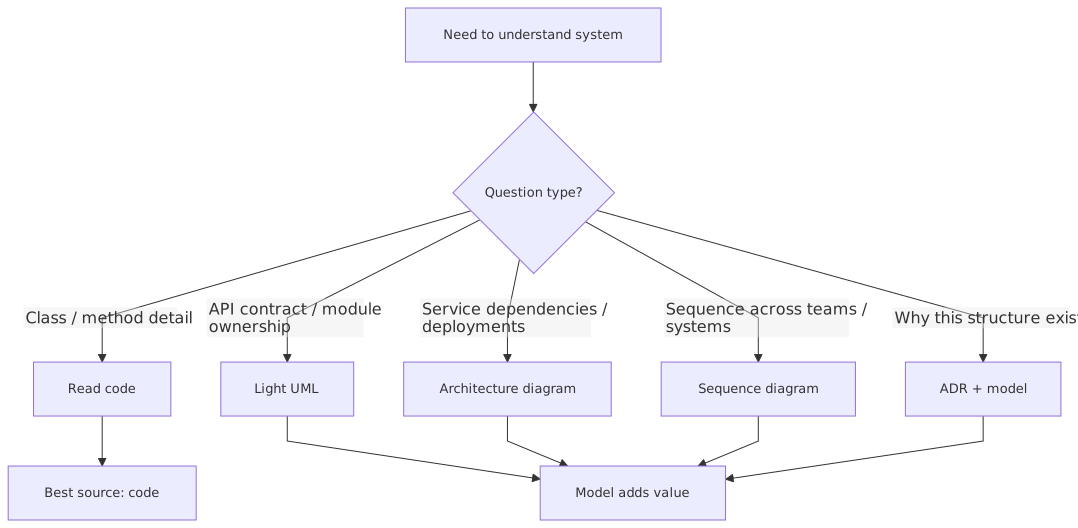
If something changes slower than code and affects many teams, model it.
That usually includes:
- domain boundaries
- integration patterns
- trust relationships
- event contracts
- deployment topology
- ownership and responsibility
- failure paths
- lifecycle states with business consequence
Things that change very fast and are local to a team? Usually leave them in code.
This one rule would eliminate half the useless UML in corporate repositories.
What real architecture work looks like
Architecture is not drawing pictures after the fact. It is making trade-offs visible before expensive mistakes become normal.
In real work, modeling adds value in five practical situations.
During target-state design
When a bank wants to modernize customer onboarding, there are usually too many systems already involved:
- digital channel
- CRM
- customer master
- sanctions screening
- fraud services
- IAM platform
- document management
- core banking
- notification systems
- analytics feeds
If you let each team proceed from local code understanding, you get a mess. Duplicate customer identifiers. Multiple sources of truth. Security holes around identity proofing. Kafka topics being used as integration shortcuts because they were available.
A high-level model forces the right arguments early:
- Where is the customer profile mastered?
- Which events are authoritative?
- Is onboarding synchronous, asynchronous, or hybrid?
- Where is consent stored?
- Where is authorization evaluated for staff versus customer actions?
- Which cloud services are permitted for PII handling?
That is architecture work. And a decent set of diagrams is often the fastest way to do it.
During solution reviews
A lot of architecture review boards are painful because they review documents, not design risks.
Good models focus the review:
- Is the service introducing a new trust boundary?
- Is this Kafka topic enterprise-visible or team-private?
- Does this workflow create hidden synchronous dependency under load?
- Is this IAM integration using the enterprise token pattern or inventing a local one?
- Is deployment violating resilience or residency constraints?
A one-page model can expose risk faster than fifty pages of template text.
During incident analysis
This is a neglected use case.
When systems fail, the code is essential for debugging. But architecture models help explain why the failure propagated.
If a payment event in Kafka gets delayed, and downstream AML screening, customer notification, and ledger reconciliation all depend on it in different ways, a model of event flow and dependency timing tells you where operational fragility exists.
In practice, some of the best architecture diagrams are born after outages. Pain improves honesty.
During mergers, platform consolidation, and cloud migration
This is where code-first ideology usually collapses.
No one can read the code of 200 systems and infer a coherent enterprise target state. You need abstraction. You need models. You need a way to compare current-state structures and identify:
- duplicate capabilities
- incompatible identity models
- overlapping APIs
- topic sprawl in Kafka
- shared database anti-patterns
- hidden batch dependencies
- cloud landing zone mismatches
Without modeling, consolidation becomes guesswork with PowerPoint branding on top.
During governance without becoming bureaucracy
I’ll say something architects don’t like admitting: governance often exists because organizations do not trust teams to make cross-cutting decisions well. TOGAF roadmap template
Sometimes that distrust is deserved.
Models help governance when they are lightweight and decision-oriented. They hurt when they become compliance art.
The difference is simple:
- good modeling supports decisions
- bad modeling supports templates
Common mistakes architects make
This is the part where I get a bit blunt.
Mistake 1: Modeling for completeness instead of clarity
Architects often think more detail means more rigor. Usually it means more decay.
The best enterprise diagrams are selective. They leave things out on purpose.
If everything is shown, nothing is highlighted.
Mistake 2: Confusing notation quality with architectural quality
A flawless UML diagram can still represent a bad architecture.
I’ve seen beautifully drawn banking integration models with impeccable stereotypes and line styles that still hid the fatal issue: the customer onboarding journey depended synchronously on five downstream systems and would never meet resilience targets.
Pretty diagrams are not insight.
Mistake 3: Duplicating the code structure
This is the classic failure mode.
If your model reproduces packages, classes, and controllers exactly, developers will ignore it because the repo already does that better. And they’ll be right.
Model decisions, boundaries, and consequences. Not implementation trivia.
Mistake 4: Not modeling failure and security paths
Architects love the happy path. Operations pays for that optimism.
Any useful sequence or interaction model in enterprise systems should show:
- timeout or retry behavior
- fallback paths
- dead-letter or poison message handling
- authentication and authorization points
- trust boundary crossings
- audit generation
- compensation where consistency is delayed
If your model only shows success, it is not architecture. It’s marketing.
Mistake 5: Treating Kafka as magic decoupling
This one deserves special attention.
Architects regularly model Kafka as if publishing an event automatically removes coupling. It doesn’t. It changes the coupling.
You may reduce temporal coupling and increase semantic coupling. You may remove direct API dependency and create stronger dependency on shared event meaning, schema governance, and lifecycle management. architecture decision records
If your model does not make that visible, you are fooling yourself.
Mistake 6: Ignoring ownership
A diagram without ownership is half a diagram.
In enterprise systems, every component, topic, API, policy store, and identity mapping should have clear ownership. If not on the picture, then in the associated metadata.
Otherwise nobody knows who can approve change, who handles incidents, or who governs compatibility.
Mistake 7: Producing diagrams nobody can maintain
If the update cost is too high, the model dies. Always.
You should prefer ten useful diagrams that can survive six months of real change over one “complete repository” that becomes fiction in three weeks.
A real enterprise example: retail banking onboarding with Kafka, IAM, and cloud
Let’s make this real.
Imagine a large retail bank modernizing customer onboarding. The current process is fragmented across branch systems, legacy CRM, web onboarding, sanctions screening, fraud scoring, and core banking account creation. They are moving parts of the workflow into cloud, using Kafka for event distribution, while keeping the ledger and some regulated customer data on-prem for now.
This is exactly the kind of environment where people say either:
- “Just read the services and APIs,” or
- “Let’s produce 200 architecture diagrams.”
Both are bad instincts.
Here’s where modeling actually adds value.
The situation
The target design includes:
- a cloud-based onboarding orchestration service
- workforce and customer IAM integrated via enterprise identity platform
- Kafka topics for customer-created, KYC-verified, fraud-assessed, account-opened events
- API gateway for synchronous calls from channels
- sanctions and fraud engines, one internal and one vendor-hosted
- on-prem core banking platform
- centralized audit and observability stack
Now, if you only look at code, each service might seem fine. But the architecture questions are bigger:
- Is onboarding orchestration a business owner or just a process coordinator?
- Are Kafka events authoritative business facts or process notifications?
- Can fraud and sanctions outcomes arrive asynchronously after account creation starts?
- Where is customer consent stored and enforced?
- Which IAM token is used from mobile channel through orchestration to downstream APIs?
- Which systems can subscribe to customer-created events?
- What happens if Kafka is available but the core banking API is degraded?
- What data can legally transit through cloud-managed services?
These are not code-only questions.
What the useful model showed
The architecture team created only a small set of living diagrams:
- Capability and ownership view
- Component and trust boundary view
- Sequence diagram for onboarding happy path and failure path
- Deployment view across cloud and on-prem zones
- Event contract catalog with ownership and retention rules
That was enough.
The sequence model exposed a major issue: the team had assumed “asynchronous onboarding,” but account opening still depended synchronously on fraud scoring because product policy required the result before account activation. So the architecture was not truly asynchronous. Kafka was being used for surrounding notifications, not for the critical decision path.
That changed everything:
- resilience expectations were corrected
- fraud SLA became a critical dependency
- fallback policy was explicitly designed
- customer communication timing was changed
- operations added targeted monitoring on fraud latency, not just topic lag
Then the IAM model exposed another problem. The mobile app passed a customer token to the API gateway, but downstream service-to-service calls were inconsistently using token propagation in some paths and service credentials in others. That would have broken audit traceability and fine-grained authorization. The model forced a decision:
- customer identity context for business authorization
- service identity for workload authentication
- explicit token exchange at gateway boundary
- centralized claims mapping for entitlements
Again, that is architecture value. Not because a UML sequence diagram is magical. Because the model made ambiguity visible.
What would have happened without modeling
Without those models, the bank likely would have:
- overestimated decoupling because Kafka was present
- built inconsistent authorization behavior across services
- struggled in audit review to explain trust boundaries
- hidden a synchronous critical path inside a supposedly event-driven design
- discovered data residency conflicts too late in cloud deployment
This is exactly why modeling still matters in enterprise work.
Where code wins, clearly
Let’s be fair.
There are many areas where code is better than UML, and pretending otherwise makes architects sound dated.
Code is better for:
- exact business logic
- validation rules
- algorithmic behavior
- framework configuration
- retry implementation specifics
- transaction handling details
- serialization mechanics
- edge-case behavior
- actual runtime truth
If I want to know whether the Kafka consumer is idempotent, whether offsets are committed after persistence, or how an IAM claim is transformed in code, I want the implementation.
Architects should stop pretending diagrams can replace this. They cannot.
The healthy model is this:
- code explains execution
- models explain structure, intent, and consequences
That division is enough. You don’t need ideology.
A practical comparison
Here’s the table most teams actually need.
That’s the balance.
What to model, specifically
If you’re an enterprise architect and want a practical checklist, model these things first:
1. Component view
Show:
- major services/applications
- ownership
- key interfaces
- trust boundaries
- system of record indicators
2. Runtime interaction view
Show:
- sync vs async
- critical path
- retries and timeouts
- Kafka publish/consume steps
- authorization checkpoints
- audit events
3. Deployment view
Show:
- cloud accounts/subscriptions/projects
- VPC/VNet/network segments
- managed services
- on-prem links
- regional placement
- resilience design
4. Information/event view
Show:
- authoritative events
- schema ownership
- retention
- public vs private topics
- PII classification
- downstream consumers
5. IAM/trust view
Show:
- identity providers
- token issuance
- federation
- token exchange
- service identity
- policy decision points
- privileged admin paths
That set covers most enterprise risk better than giant UML repositories ever did.
A note on “living documentation”
Everyone says they want living documentation. Few design for it.
If a model is meant to live, it needs:
- clear owner
- limited scope
- update trigger tied to change process
- versioning
- easy editing
- ruthless pruning
Otherwise “living documentation” becomes a polite phrase for “dead diagram we haven’t archived yet.”
My bias: fewer diagrams, updated intentionally, linked to real decisions and standards.
The contrarian bottom line
Here’s my strongest opinion: the real problem was never UML. The problem was architects using diagrams to compensate for weak thinking.
When architects are vague, they hide behind notation. When they are clear, even a simple model becomes powerful.
So yes, code is the truth of implementation. Fine. But enterprises do not fail only at implementation. They fail at coordination, ownership, trust, integration, and operational design. That is where modeling still earns its place.
And in those areas, UML — used selectively, imperfectly, pragmatically — still adds real value.
Not all the time. Not everywhere. But absolutely more than the “code only” crowd wants to admit. ArchiMate in TOGAF ADM
If you are working on banking platforms, Kafka integration estates, IAM modernization, or hybrid cloud transformation, and you think architecture can be done by reading repos alone, you are underestimating the problem. Probably by a lot.
Use code for what code is good at.
Use models for what architecture is actually about.
And stop drawing diagrams nobody needs.
That’s the job.
FAQ
1. Is UML still relevant in modern cloud-native architecture?
Yes, but selectively. It’s useful for showing boundaries, trust zones, deployment topology, and runtime interactions. It’s not useful when it just mirrors microservice code structures.
2. What UML diagrams are most valuable for enterprise architects?
Usually component diagrams, sequence diagrams, and deployment diagrams. Occasionally state diagrams for lifecycle-heavy domains. Class diagrams are often overused and low value at enterprise level.
3. In event-driven systems with Kafka, what should be modeled?
Model event ownership, topic purpose, schema governance, subscriber boundaries, retry/dead-letter handling, and where eventual consistency affects business outcomes. Don’t just draw arrows and call it decoupled.
4. How does UML help with IAM architecture?
It clarifies authentication flows, token exchange, service-to-service trust, authorization points, and audit context. This is especially useful in enterprises where identity spans workforce, customer, API, and cloud platform layers.
5. When should architects skip UML and rely on code?
Skip UML when the question is local implementation behavior, detailed business logic, framework configuration, or exact runtime mechanics inside one team-owned service. Code, tests, and API specs are better there.
Frequently Asked Questions
What is the difference between UML and ArchiMate?
UML is a general-purpose modeling language primarily used for software design — class structures, sequences, components, states, deployments. ArchiMate is an enterprise architecture language covering business, application, and technology layers. They are complementary: ArchiMate for cross-domain EA views, UML for detailed software design.
When should you use ArchiMate instead of UML?
Use ArchiMate when you need to model cross-domain architecture (business capabilities linked to applications linked to infrastructure), traceability from strategy to implementation, or portfolio views for stakeholders. Use UML when you need detailed software design — class models, sequence interactions, state machines, component interfaces.
Can ArchiMate and UML be used together?
Yes. In Sparx EA, both exist in the same repository. ArchiMate models the enterprise landscape; UML models the internal design of specific application components. An ArchiMate Application Component can link to the UML class diagram that defines its internal structure, maintaining traceability across abstraction levels.