⏱ 21 min read
Most enterprise architecture models are decorative fiction.
That sounds harsh, but let’s be honest. In a lot of organizations, UML diagrams get created because someone needs a slide for a steering committee, or because a delivery gate says “architecture artifacts required.” Boxes appear. Arrows multiply. A few stereotypes get sprinkled on top. Everyone nods. Then the real system gets built somewhere else — in code, in Terraform, in Kafka topics, in IAM policies, in tribal knowledge.
The problem is not UML itself. The problem is that most teams never understand the metamodel underneath the notation, and they almost never put serious validation around their models. So the model becomes drawing, not architecture. And a drawing has no power unless somebody can prove it is internally consistent, traceable, and useful for decisions.
That’s the core argument here: if your UML model is not based on a clear metamodel and validated with explicit rules, it is probably not architecture. It is just enterprise wallpaper.
A simple version first, because this gets abstract fast.
The simple explanation
A UML metamodel is the structure behind the structure. UML diagrams show things like components, classes, interfaces, nodes, actors, deployments, and relationships. The metamodel defines what those things actually are, how they relate, and what is allowed.
Think of it this way:
- A diagram is a picture.
- A model is the set of elements and relationships behind the picture.
- A metamodel defines the kinds of elements and relationships the model is allowed to contain.
Then comes model validation. Validation means checking whether the model is:
- syntactically correct
- semantically meaningful
- aligned to enterprise standards
- complete enough to support architecture decisions
- consistent with reality
That last one matters more than people admit.
In enterprise architecture, this is not academic. If you are modeling a bank’s payment platform, a Kafka event backbone, a cloud landing zone, or IAM trust boundaries, weak models create real risk. You get broken dependencies, bad access designs, compliance gaps, failed migrations, and integration surprises that cost real money.
So yes, UML metamodels sound theoretical. But in practice, they are one of the few ways to stop architecture from turning into pretty nonsense.
Why architects should care more than they usually do
A lot of architects are comfortable talking about principles, target state, patterns, and operating models. Fewer are comfortable talking about modeling rigor. Some even dismiss it as “tooling stuff.”
That is a mistake.
If architecture is supposed to guide implementation, then the model must be more than suggestive. It needs structure. It needs rules. It needs enforcement. Otherwise, architecture gets bypassed by engineers who are rightfully skeptical of artifacts that cannot survive contact with delivery.
This is where the UML metamodel matters. It gives you a formal basis for saying: UML modeling best practices
- this application component may depend on that service interface
- this data object is owned by one bounded context, not five
- this deployment node cannot host that workload due to regulatory constraints
- this IAM role cannot be assumed across this trust boundary
- this Kafka consumer group should not subscribe to that topic because it violates domain ownership
Without a metamodel, those are opinions. With a metamodel plus validation, they become architecture controls.
And yes, that sounds controlling. Good. Enterprise architecture should be selective and opinionated. Not bureaucratic, but definitely opinionated.
What the UML metamodel actually is
At a practical level, UML gives you a language for modeling systems. But UML is not just a bag of diagram types. It has a formal underlying structure, defined by a metamodel. The metamodel describes concepts such as: UML for microservices
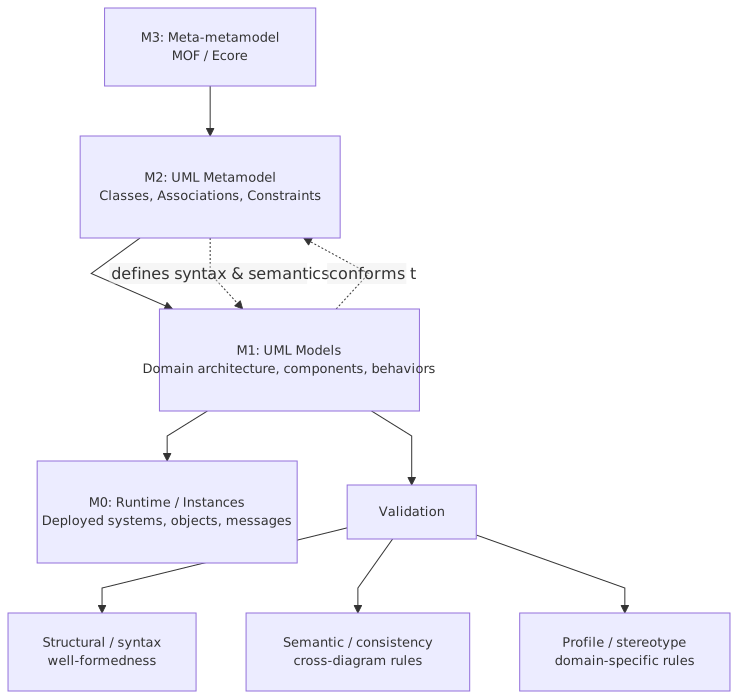
- Classifiers like classes, components, actors, nodes
- Relationships like association, dependency, generalization, realization
- Behaviors like activities, interactions, state machines
- Properties like attributes, operations, ports, multiplicities
- Constraints that govern valid combinations
This matters because the same model element can appear in multiple diagrams. A component on one diagram and a deployment on another are not supposed to be disconnected visual artifacts. They refer to the same underlying model elements.
That is the first place many enterprises go wrong: they treat each diagram as an independent graphic. It isn’t. Or at least, it shouldn’t be.
A healthy architecture repository uses the metamodel to maintain consistency across viewpoints:
- logical view
- application integration view
- deployment view
- security view
- data lineage view
- operational view
If your “customer service” appears as three different boxes in three different diagrams with slightly different names and relationships, you do not have multiple views. You have multiple truths. And that is how architecture loses credibility.
The real value: controlled abstraction
One contrarian thought here: most enterprises use too much UML, not too little.
They model every detail, every class, every sequence, every environment, every integration, every actor. The result is a swamp of half-maintained diagrams. Nobody trusts them because nobody can keep them current.
The answer is not “more UML discipline” in the sense of drawing more things. The answer is better abstraction governed by a metamodel.
A metamodel helps you decide what is worth modeling and what is not. In enterprise architecture, the useful level is usually not code design detail. It is the level where decisions live:
- what systems exist
- what business capabilities they support
- what integration contracts connect them
- what data they own
- what trust boundaries apply
- what deployment constraints matter
- what standards they must conform to
You do not need a UML class diagram for every microservice unless you are doing solution design. But you absolutely may need a metamodel that says every application component must have:
- an owner
- a lifecycle status
- a deployment environment
- a data classification
- a set of interfaces
- a security zone
- a resilience tier
That is architecture gold. Not because it looks elegant, but because it makes validation possible.
UML metamodel in enterprise architecture terms
Let’s translate this into the language real architects use.
A practical enterprise UML metamodel often extends standard UML with stereotypes, tagged values, and constraints to represent enterprise-specific concerns. For example:
<> <> <> <> <> <>
Purists sometimes dislike this because they think UML should remain pristine. I disagree. Enterprises need models that fit enterprise reality. If your metamodel does not represent event topics, identity roles, cloud tenancy, or data sensitivity, then it is not serving modern architecture work.
The trick is to extend UML carefully, not recklessly.
Here’s a useful way to think about it:
That stack is where architecture becomes operational.
Model validation: the part everyone skips
Now to the uncomfortable bit.

Most architecture teams say they validate models. What they usually mean is someone looked at the diagram and said, “seems fine.”
That is not validation. That is visual reassurance.
Real model validation happens at several levels.
1. Syntactic validation
This checks whether the model conforms to the metamodel.
Examples:
- a deployment relationship connects valid element types
- a component does not realize a node
- a port belongs to a valid classifier
- a stereotype is applied only where allowed
This is the minimum bar. Most tools can do some of it.
2. Semantic validation
This checks whether the model makes sense in domain terms.
Examples:
- a Kafka topic should not be modeled as a database
- an IAM role should not own business data
- a customer master data store should have a single system of record
- a payment authorization service should not depend synchronously on a batch reconciliation engine
This is harder. Tooling helps, but enterprise semantics need custom rules.
3. Policy validation
This checks alignment to standards, controls, and architecture principles.
Examples:
- regulated workloads must deploy only in approved cloud regions
- internet-facing services must terminate through approved ingress controls
- PII-bearing systems must map to key management and audit controls
- cross-domain Kafka subscriptions require data ownership approval
- IAM federation paths must comply with identity trust policies
This is where model validation becomes directly useful to risk, security, and platform governance. EA governance checklist
4. Completeness validation
This checks whether the architecture model is complete enough for decision-making.
Examples:
- every application has an owner and lifecycle state
- every interface has protocol and SLA metadata
- every data store has classification and retention policy
- every cloud workload has environment and account mapping
- every critical integration has failure-handling strategy
This is boring work. It is also the difference between architecture that can answer questions and architecture that just consumes budget.
5. Traceability validation
This checks whether model elements connect across layers.
Examples:
- business capability maps to application services
- application service maps to deployment environment
- deployment maps to IAM roles and network boundaries
- Kafka topic maps to producer and consumer domains
- security control maps to regulated data stores
Traceability is often mocked because people overdo it. Fair criticism. But no traceability at all is worse. In a regulated enterprise, especially banking, traceability is not optional.
What this looks like in real architecture work
Let’s move from theory to reality.
Imagine a retail bank modernizing its customer onboarding platform. The target architecture includes:
- cloud-native onboarding APIs
- Kafka for event distribution
- centralized IAM with federated workforce and customer identities
- multiple bounded domains: onboarding, KYC, fraud, customer profile, notifications
- regulated data with strict residency and audit requirements
A typical architecture team will create:
- a context diagram
- a component diagram
- a deployment diagram
- maybe a sequence diagram
- maybe a security view
Fine. But without a metamodel and validation rules, these diagrams drift almost immediately.
What a stronger modeling approach would enforce
The enterprise metamodel might define:
<> <> <> <> <> <> <>
And then validation rules like:
- Every
<must have exactly one owning domain.> - Every
<must be hosted in an approved region and linked to encryption control metadata.> - Every
<exposing external APIs must be associated with an IAM trust pattern.> - No
<may synchronously depend on more than one external regulated domain for core transaction processing.> - Every critical onboarding flow must have an asynchronous recovery path for downstream failure.
Now the model starts doing real work.
When the fraud team proposes subscribing directly to onboarding events and then republishing enriched events into a shared topic, validation can flag that the ownership of the new topic is ambiguous.
When the IAM team proposes a role assumption path across cloud accounts that bypasses the standard broker account, validation can flag a trust policy violation.
When the platform team places the document-verification store in the wrong region, validation can flag data residency non-compliance before deployment.
That is architecture earning its keep.
A real enterprise example: banking, Kafka, IAM, and cloud
Let me make this more concrete.
A bank I’ll describe generically had a strategic event-driven architecture program. The goal was sensible enough: reduce point-to-point integrations, publish domain events over Kafka, move customer servicing systems onto cloud platforms, and standardize IAM around enterprise federation and workload identities.
On paper, it looked modern. In practice, it was chaotic.
The initial state
Each domain team modeled systems in its own way:
- some used UML component diagrams
- some used C4-style diagrams
- some used Visio boxes with no semantics
- some documented Kafka topics in spreadsheets
- IAM trust relationships lived in cloud templates
- data classification lived in a GRC system
- deployment topologies lived in platform diagrams
No single model joined these concerns.
The result was predictable:
- duplicate Kafka topics carrying overlapping customer events
- consumers depending on fields with no contract ownership
- IAM roles proliferating without clear trust boundaries
- cloud workloads deployed in patterns that violated security zoning
- architecture review boards arguing over diagrams that could not be validated
The turning point
The bank created an architecture metamodel that was intentionally modest. This is important. Not ambitious. Modest.
It did not try to model everything. It focused on the elements needed for control and design coherence:
- application component
- domain
- event topic
- API interface
- data asset
- IAM role
- cloud account
- network zone
- deployment runtime
- control classification
Then it defined a set of mandatory attributes and relationships. For example:
This changed the conversation.
Now architecture review was not “I don’t like this diagram.” It became “this model violates three explicit rules.” Delivery teams did not love it at first, naturally. But within a few months, the quality of cross-domain design improved dramatically.
What improved in practice
- Kafka topic sprawl reduced because ownership became explicit.
- IAM exceptions dropped because trust paths were modeled and checked.
- Cloud deployment designs became easier to review because account and zone semantics were built into the model.
- Audit and compliance teams got traceability from regulated data assets to applications and controls.
- Architects spent less time debating notation and more time discussing trade-offs.
That last point is underrated. Good metamodeling reduces architecture theater.
Common mistakes architects make
This is where I’ll be blunt.
Mistake 1: Treating UML as a drawing standard instead of a modeling language
If your architecture tool is basically glorified PowerPoint, you are not doing model-based architecture. You are doing illustration.
There is nothing wrong with illustration for communication. But do not confuse it with governed modeling.
Mistake 2: Modeling too much detail
Architects often think rigor means detail. It doesn’t. It means relevant structure.
If you model every internal class of every service but cannot answer who owns a Kafka topic carrying customer PII, your priorities are upside down.
Mistake 3: Ignoring enterprise semantics
Standard UML is not enough for modern enterprise architecture. You need stereotypes or profile extensions for things like:
- cloud tenancy
- event streams
- identity roles
- control zones
- regulated data classes
A metamodel that cannot express your enterprise concerns is ornamental.
Mistake 4: No validation beyond visual review
This is probably the biggest failure. If your model cannot be checked against architecture rules, standards, and constraints, then governance remains subjective. Subjective governance scales badly and creates resentment.
Mistake 5: Letting every team invent its own abstractions
Autonomy is good. Total semantic freedom is not.
If one team models Kafka topics as components, another as interfaces, and another as data stores, you cannot compare or validate designs across the estate.
Mistake 6: Separating architecture from implementation reality
A model that ignores Terraform modules, IAM policies, topic schemas, API contracts, or deployment pipelines will go stale. Enterprise architecture should not model every implementation artifact, but it must connect to them.
Mistake 7: Making the metamodel too complicated
This one is contrarian because many architecture teams secretly admire complexity. They should stop. ArchiMate in TOGAF ADM
A metamodel with 140 element types and 600 rules is usually a sign of insecurity, not maturity. Start with the smallest useful semantic core. Add rules only where they help make better decisions.
Validation strategies that actually work
If you want this to work in a real enterprise, validation has to be practical. Here’s what tends to work.
Strategy 1: Validate mandatory metadata first
Before clever semantic checks, enforce the basics:
- owner
- domain
- lifecycle
- criticality
- environment
- data classification
- interface type
This sounds pedestrian. Good. Pedestrian controls catch more real-world problems than elegant theory.
Strategy 2: Use layered validation
Do not dump every rule into one giant review gate. Split validation into layers:
- authoring-time checks in the modeling tool
- CI-style validation for repository consistency
- architecture review checks for policy exceptions
- runtime conformance checks where possible
This mirrors software engineering. Architecture should learn from engineering more often.
Strategy 3: Validate relationships, not just elements
Many organizations validate whether an application has an owner. Fine. More useful is validating whether:
- the application depends on an approved identity provider
- the Kafka topic has valid producer/consumer lineage
- the cloud deployment matches the data residency classification
- the IAM role trust path matches environment boundaries
Architecture risk usually lives in relationships.
Strategy 4: Tie validation to consequences
A rule with no consequence is a suggestion.
If a critical banking application lacks a mapped recovery topology, the model should not just raise a warning that everyone ignores. It should block progression or force a formal exception.
Not every rule needs a hard gate. But some absolutely do.
Strategy 5: Integrate with delivery artifacts
The best validation strategies join model data with implementation data:
- Kafka schema registry
- cloud account inventory
- IAM policy definitions
- CMDB or service catalog
- API gateway registrations
- data classification repositories
This is not easy. It is worth doing.
A model that can be reconciled against live platform metadata has a fighting chance of staying relevant.
A practical metamodel design approach
If you are building or cleaning up an enterprise modeling practice, here is a sane sequence.
Step 1: Identify the decisions the model must support
Not “what diagrams do we want.” Start with decisions.
Examples:
- Can this workload go to public cloud?
- Can this service publish customer events to Kafka?
- Is this IAM trust path acceptable?
- Does this application duplicate an existing capability?
- Is this integration violating domain ownership?
That tells you what semantics matter.
Step 2: Define the minimum element set
Keep it small. Maybe 10 to 15 core element types.
For a modern enterprise, I’d usually start with:
- business capability
- domain
- application component
- interface/API
- event topic
- data asset
- deployment runtime
- cloud account/subscription
- network/security zone
- IAM role/principal
- control/policy classification
That is enough to do serious work.
Step 3: Define mandatory attributes
Without attributes, your model is just nouns.
Step 4: Define relationship rules
Examples:
- applications belong to domains
- APIs are exposed by application components
- topics are owned by domains
- data assets are managed by systems of record
- IAM roles are assigned to workloads
- workloads deploy into cloud accounts and zones
Step 5: Add validation rules only where pain exists
Do not invent rules because they sound architecturally impressive. Add them because they prevent recurring failure.
Step 6: Publish examples and anti-examples
Architects often explain standards badly. Show what a good model looks like. Show what a bad one looks like. Teams learn faster from contrast.
Contrarian view: not every architecture problem needs UML
I should say this clearly. I am not arguing that UML is always the best notation for every architecture problem.
Sometimes ArchiMate is better for enterprise-level traceability. Sometimes C4 is better for communication. Sometimes BPMN is better for process modeling. Sometimes a data lineage tool should own lineage. Sometimes code is the model.
The point is not UML supremacy. The point is metamodel discipline and validation rigor.
If UML is what your organization uses, fine. Use it properly. If not, the same lesson still applies: define your semantic model and validate it. Otherwise you are just making diagrams.
I’ve seen teams spend months arguing “UML versus C4” while their IAM landscape remained undocumented and their Kafka estate became a junk drawer. Wrong fight.
Where this matters most in current enterprise environments
There are a few areas where UML metamodel and validation strategy are especially valuable right now.
Banking and regulated domains
Because you need traceability, control mapping, segregation, and explainability. Regulators do not care how pretty your diagrams are. They care whether you can show ownership, control, dependency, and impact.
Kafka and event-driven estates
Because events create invisible coupling very quickly. Topic ownership, schema governance, retention, consumer lineage, and domain boundaries need explicit modeling and validation.
IAM architecture
Because identity and trust are relational by nature. Roles, principals, trust chains, environments, federated identities, machine identities — all of this benefits from formal semantics and rule checking.
Cloud operating models
Because cloud makes deployment easy and architecture drift easier. If account structure, network zoning, workload types, and control inheritance are not modeled and validated, entropy wins.
Final thought
The mature architect’s job is not to produce more diagrams. It is to create decision structures that survive scale, change, and delivery pressure.
That is why UML metamodels matter. They force you to define what your architecture elements really mean. And model validation matters because it turns architecture from opinion into something closer to an engineering discipline.
Not perfectly. Let’s not pretend architecture will ever be as deterministic as software compilation. Enterprises are messy. Politics is real. Exceptions happen. Models lag reality. All true.
But that is not an excuse for weak modeling. It is the reason to be more rigorous where it counts.
If your architecture artifacts cannot be validated, traced, and challenged, then sooner or later engineers, security teams, and platform teams will route around them. Frankly, they should.
The better path is simpler than people think:
- define a usable metamodel
- keep it focused
- extend UML where enterprise reality demands it
- validate aggressively on the things that matter
- connect models to real delivery artifacts
- stop drawing architecture that nobody can trust
That is not glamorous. It is just professional.
And in enterprise architecture, professional beats glamorous every time.
FAQ
1. What is the difference between a UML model and a UML metamodel?
A UML model is the actual set of architecture elements you create — components, interfaces, deployments, and relationships. A UML metamodel defines what kinds of elements and relationships are allowed in the first place. The metamodel is the grammar; the model is the sentence.
2. Do enterprise architects really need formal model validation?
Yes, if they want architecture to influence delivery at scale. Without validation, governance becomes subjective and inconsistent. Validation is especially useful in banking, cloud, IAM, and Kafka-heavy environments where design errors create operational and compliance risk.
3. How do you apply UML metamodeling to Kafka and event-driven architecture?
Usually by extending the modeling language with enterprise stereotypes such as <, <, and <, then validating ownership, schema linkage, classification, retention, and consumer registration. The point is to prevent topic sprawl and uncontrolled event coupling.
4. What are the most common mistakes when validating enterprise architecture models?
The big ones are validating only syntax, ignoring semantics, overcomplicating the metamodel, failing to model relationships like IAM trust or topic ownership, and not connecting the model to actual implementation artifacts such as cloud accounts, schema registries, and API gateways.
5. Is UML still relevant for modern cloud and IAM architecture?
Yes, but only if used pragmatically. Standard UML alone is often too generic, so most enterprises need profiles, stereotypes, and custom validation rules for cloud, IAM, eventing, and regulated data concerns. UML is still useful, but only when backed by a strong metamodel and disciplined validation strategy.
Frequently Asked Questions
What is a UML metamodel?
A UML metamodel is a model that defines UML itself — it specifies what element types exist (Class, Interface, Association, etc.), what relationships are valid between them, and what constraints apply. It uses the Meta Object Facility (MOF) standard, meaning UML is defined using the same modeling concepts it uses to define other systems.
Why does the UML metamodel matter for enterprise architects?
The UML metamodel determines what is and isn't expressible in UML models. Understanding it helps architects choose the right diagram types, apply constraints correctly, use UML profiles to extend the language for specific domains, and validate that models are internally consistent.
How does the UML metamodel relate to Sparx EA?
Sparx EA implements the UML metamodel — every element type, relationship type, and constraint in Sparx EA corresponds to a metamodel definition. Architects can extend it through UML profiles and MDG Technologies, adding domain-specific stereotypes and tagged values while staying within the formal metamodel structure.