⏱ 23 min read
Most people asking about OCSMP are not really asking about certification.
What they’re usually asking is something more practical: will SysML competence change what I can do, how seriously people take me, or how well I can deal with messy architecture problems that do not fit neatly into an application landscape diagram?
My short answer is fairly simple.
Yes, for some roles and some environments.
No, if your day-to-day architecture work has very little to do with formal system modeling.
Maybe—and in some cases strongly maybe—if you work in regulated, interaction-heavy, engineering-adjacent environments such as healthcare platforms, medtech, connected hospitals, transport, or defense.
That’s the honest answer. Not glamorous, but useful.
After roughly fifteen years in architecture, with a meaningful stretch of that around healthcare transformation, I’ve learned that certifications only matter when they line up with the kind of ambiguity you are actually paid to reduce. If your work is mostly portfolio rationalization, target-state roadmaps, standards governance, and steering committees, OCSMP probably will not move the needle very much. If you spend your time untangling identity flows across patient apps, EHR integration, device telemetry, alert routing, clinical escalation, and operational fallback paths, then SysML becomes relevant very quickly.
One hospital network program still sticks with me. Everyone in the room said they understood the system context. Everyone had a view on interfaces. Everyone assumed ownership boundaries were obvious.
They were not.
The patient app team assumed identity services owned consent propagation. The EHR team assumed scheduling was the source of truth for encounter status. The remote monitoring vendor assumed alerts would be consumed in near real time by a middleware event bus. Operations assumed nurses would work from the clinician portal queue. In reality, after-hours escalation was happening through phone calls, side spreadsheets, and a lot of heroics.
We had capability maps. They looked polished.
We had application diagrams. Also polished.
We had interface inventories in Confluence and a few service contracts in Swagger.
And still the ambiguity remained. Not because people were careless. Because nobody had modeled interactions, state transitions, exception paths, and responsibility boundaries with enough discipline to surface the hidden assumptions.
That, in one story, is why SysML is worth discussing. And it is also why certification is a more nuanced decision than people often want it to be.
What OCSMP actually is, in practical terms
OCSMP stands for OMG Certified Systems Modeling Professional. It is a certification track centered on SysML knowledge and the ability to reason with formal systems modeling concepts.
In plain English, it is a structured validation that you understand a modeling language designed for systems work. Not enterprise architecture in the broad sense. Not business transformation. Not executive operating model design. Sparx EA performance optimization
I think it is best understood as three things:
- evidence that you can work with formal model constructs
- a signal that you can model structure, behavior, interfaces, constraints, and traceability with discipline
- a useful but limited indicator of systems modeling competence
What it is not matters just as much.
It is not TOGAF.
It is not a cloud architecture certification.
It is not BPMN.
It is not proof that you can lead enterprise transformation.
It is definitely not proof that you can navigate politics, govern a portfolio, or survive an executive steering committee with three competing funding agendas.
I’ve interviewed certified people who were excellent modelers and weak architects. I’ve also worked with very effective architects who had no SysML certification at all but had developed strong modeling habits through hard delivery work. That distinction matters. OCSMP can validate notation and method. It cannot certify judgment.
Architects often confuse it with architecture certification because real architecture roles tend to spill across business, application, data, integration, and technology concerns. SysML enters the picture when the problem is less “which platform standard should we adopt?” and more “what exactly is this system, how does it behave, who owns which state transition, and what happens when event timing goes wrong?”
In healthcare, that second category shows up more often than many enterprise architects expect.
Where OCSMP sits in a real architecture career
The relevance of OCSMP depends heavily on which architecture lane you are actually in, not which title sits in your email signature.
For a classic enterprise architect, OCSMP is usually a specialist differentiator. Nice to have. Occasionally very useful. Rarely a baseline requirement.
For a solution architect, it depends on the domain. If you are implementing CRM workflows or standard SaaS integrations, it is probably not central. If you are shaping a digital care platform across identity, device telemetry, messaging, workflow orchestration, and compliance controls, then yes, it might matter.
For systems architects and MBSE-heavy roles, it becomes much more central. That is the world it naturally belongs to.
And for product or platform architects working in cyber-physical or operationally sensitive environments, it can be a serious advantage. Think medical devices, smart hospitals, automated pharmacy systems, connected imaging, patient flow orchestration, even some types of digital twin or facility operations work.
The real question is not whether OCSMP is prestigious.
It is whether your architecture problems are actually SysML-shaped.
That is the filter I would use. Prestige is a weak reason to pursue any certification. Problem fit is the right reason.
Why healthcare makes this conversation more interesting
Healthcare architecture has a habit of punishing informal thinking.
On paper, many healthcare environments look like fairly standard enterprise integration landscapes: EHR, IAM, scheduling, analytics, middleware, a few cloud platforms, some mobile apps, maybe Kafka for event distribution, and identity or consent services sitting somewhere in the middle.
But that description misses the hard part.
The hard part is behavior over time.
Take an integrated virtual care platform across a hospital network. A typical one might include:
- patient mobile app
- clinician portal
- EHR
- IAM and consent services
- scheduling engine
- remote monitoring devices
- alerting and escalation workflows
- analytics and population health services
- integration middleware
- event streaming backbone, maybe Kafka
- cloud-hosted services split across more than one trust boundary
A standard architecture pack often looks respectable. Capability maps are tidy. Application landscape diagrams are color-coded. Interface catalogs exist. Security controls are documented. Somebody has an ArchiMate view, somebody else has sequence sketches, and the PMO has a RAID log that grows every week. ArchiMate layers explained
Yet the failure points still hide in plain sight:
- event timing between device ingestion and clinician notification
- state transitions when patient consent changes mid-workflow
- ownership boundaries between scheduling, encounter management, and clinical coordination
- exception handling when telemetry is delayed or malformed
- fallback paths when remote escalation rules do not match staffing reality
- identity propagation across patient, proxy, clinician, and service identities
- downstream consequences when Kafka consumers lag and alerts arrive late
This is where SysML thinking helps. Not because it is magical, but because it forces harder questions.
What exactly is the system boundary?
Which actor triggers the transition?
What state is authoritative?
What event changes that state?
What happens if the message is duplicated, delayed, or missing?
Is this an application concern or a system responsibility?
What is the operational fallback if automation fails?
That discipline matters.
And here is the nuance people often miss: the team benefits more from using SysML seriously than from merely having certified people. But certified practitioners usually accelerate things because they already have the habits. They do not just draw prettier diagrams. They tend to decompose problems more rigorously.
A quick decision table
Here is the blunt version.
I would stand by that table in most hiring and coaching conversations.
Why people pursue it for the wrong reasons
This part is less flattering, but it needs saying.
A lot of people chase OCSMP for reasons that almost guarantee disappointment.
1. Credential collecting
Some architects collect certifications the way other people collect expensive notebooks. It feels productive. It feels safer than wrestling with a badly scoped program or an unhappy operations team.
But certification accumulation without applied depth shows up quickly in interviews. You can usually tell within twenty minutes whether someone has actually used formal modeling to improve real decisions or whether they have mostly learned terminology.
On projects, it is even more obvious. The person who learned SysML as an exam objective often reaches for notation first. The person who learned it through delivery usually asks first whether modeling is the right intervention.
That difference matters.
2. Assuming it replaces experience
It does not. Not even close.
OCSMP can validate that you understand syntax, semantics, and method. It cannot teach trade-off management under funding pressure. It cannot teach political navigation across clinical, technical, and vendor stakeholders. It cannot teach operational pragmatism.
I have seen certified practitioners build elegant models for escalation workflows that were simply wrong because they had never spent time with the actual nursing teams.
A perfect model of a false assumption is still a false assumption.
3. Treating SysML like a universal language for all architecture work
This is another common mistake. SysML is powerful, but it is not the answer to every architecture problem.
A cloud migration strategy does not become better because somebody adds blocks and parametrics. A straightforward IAM platform rollout probably needs clear capability mapping, process impact analysis, security design, and a practical migration plan more than it needs formal systems modeling. A FinOps problem definitely does not need SysML heroics.
Use the tool where the problem deserves it.
4. Trying to impress executives
Most executives care about decision quality, risk reduction, delivery confidence, compliance posture, and cost.
They do not care whether your internal model conforms elegantly to a notation standard unless that rigor helps avoid failure. If a SysML-based review exposes dangerous assumptions in a remote patient monitoring workflow, then yes, it matters. If it produces ten diagrams nobody uses, it does not.
In my experience, OCSMP has the most value when the team already feels modeling pain. When everybody senses that the problem is not just “missing requirements” but “we do not share a precise understanding of system behavior.”
That is the moment formal modeling earns its keep.
What the certification can genuinely improve
I’m skeptical of certification hype, but I am not dismissive of OCSMP. In the right context, it improves some things materially.
Modeling precision
This is the obvious one, but also the most real. Formal training helps people model structure, interfaces, constraints, behavior, and traceability with more care. It reduces the lazy ambiguity that creeps into hand-wavy architecture decks.
That matters when you are dealing with asynchronous systems. A Kafka-based event flow between device ingestion, patient alerting, clinician triage, and EHR update logic can look simple until you start asking which system owns acknowledgement, retry, timeout, and escalation state.
That is where rigor pays for itself.
Communication across mixed teams
Healthcare programs often sit at the intersection of software engineering, integration, clinical operations, product management, security, and compliance. Those groups do not naturally speak the same language.
Formal modeling can become a bridge. Not always a comfortable one, but a useful one.
I have seen a well-structured interaction model cut through weeks of confusion between a cloud platform team, an IAM team, and a device integration vendor. Not because everyone loved the notation, but because the model forced agreement on sequence, ownership, and failure conditions.
Better decomposition
This one gets underrated.
In healthcare, subsystem boundaries and application boundaries are often not the same thing. Technical ownership, vendor ownership, and clinical accountability are usually misaligned. The scheduling system may own one notion of status, the EHR another, and the care coordination team a third operational reality that lives partly outside either system.
SysML thinking can help separate these concerns cleanly. It forces you to ask what the system is actually doing, not just which application happens to host a function.
Requirement traceability
If you work in regulated settings, this gets very practical. Traceability is not glamorous, but it matters for auditability, validation, safety, and change impact analysis.
When a consent policy changes or a device alert threshold is updated, you want to know what behaviors, interfaces, and operational paths are affected. Formal modeling helps with that.
Better review practices
Teams with trained modelers usually ask better questions.
What changes state?
What triggers this transition?
Who owns this interface?
What happens if a message is delayed or missing?
What is the fallback path?
What assumptions are we making about identity context?
What if the patient proxy has different rights than the patient account holder?
Those questions improve architecture reviews. Full stop.
Where OCSMP does not deliver what people hope
There is another side to this.
OCSMP will not magically create enterprise architecture maturity. It will not fix bad governance, weak standards discipline, poor investment management, or a disconnected operating model. Those are different problems.
It also will not fix weak problem framing. If the scope is wrong, if the business question is vague, if the architecture effort is detached from delivery reality, formal modeling just helps you be wrong more precisely.
And to be a bit blunt: some certified practitioners produce artifacts no delivery team wants to touch. Dense diagrams. Excessive notation. Too much internal purity, not enough decision value.
That is not a SysML problem. It is a practitioner problem.
There is also the risk of over-modeling. I have seen teams drown in diagram maintenance. Every review generates another view, another layer, another package, another model cleanup task. Nobody can tell which artifact is authoritative. The repository becomes a museum of good intentions.
Healthcare adds one more caution. If you over-model clinical workflows without clinician participation, you create elegant nonsense.
That happens more often than it should.
One of the more painful examples I have seen involved after-hours escalation pathways for remote patient monitoring. The model looked clean. Escalation thresholds were precise. Queue ownership was defined. Timers and transitions were all accounted for.
Except the wards did not work that way after 7 p.m. Staff were covering multiple responsibilities, the “primary queue” was routinely bypassed, and the practical triage pattern depended on informal coordination that never made it into the model. We had architecture rigor detached from operational truth.
That is dangerous.
Mistakes I’ve seen on real programs
A few patterns repeat.
Using SysML to compensate for poor stakeholder engagement
This is probably the worst one. Teams model what they assume instead of what operations actually do.
A remote monitoring alert process can look perfect in diagrams. But if on-call nurses bypass the intended queue because response-time targets are unrealistic, your beautiful model is fiction.
You still need workshops. Shadowing. Operational walkthroughs. Annoying validation sessions with the people who do the work when systems fail.
Forcing SysML into every architecture discussion
Not every decision deserves formal modeling.
Sometimes a simple context map is enough. Sometimes a rough sequence sketch will expose the issue. Sometimes a deployment view or IAM trust model matters more. Sometimes the real problem is contract ownership, not system behavior.
Use SysML where it adds decision value. Do not weaponize it.
Certifying one person and expecting organizational change
This almost never works. One trained modeler cannot fix fragmented architecture culture. If the rest of the team works in slides, spreadsheets, and undocumented tribal logic, the modeler becomes isolated.
The result is predictable: the model is admired briefly, then ignored.
No repository discipline
Models go stale fast. Faster than people expect.
If there is no repository practice, no review cadence, no integration with delivery artifacts, and no ownership model, then certification effort becomes symbolic. A badge with no operational footprint.
Separating modelers from delivery teams
This kills value. If engineering, integration, testing, and operations teams never use the model, then the model is just architecture theater.
I prefer small, practical, living models tied to delivery milestones over grand repositories that nobody trusts.
How to tell whether your environment is SysML-heavy enough
You do not need a philosophical answer here. You need diagnostics.
Your environment is probably SysML-heavy enough if several of these are true:
- multiple systems interact asynchronously
- behavior depends on complex states and transitions
- safety, compliance, or audit sensitivity is high
- traceability matters
- teams frequently argue about boundaries and responsibilities
- hardware, software, and operational processes intersect
- architecture failures happen because interactions are misunderstood
- operational scenarios matter as much as application inventory
Healthcare has some obvious signals:
- device integration
- bed management and patient flow orchestration
- clinical event routing
- identity, consent, and authorization interactions
- care escalation workflows
- smart facility or connected hospital initiatives
- telehealth orchestration across multiple systems and trust domains
Here is my simple decision rule.
If your architecture failures are mostly about technology selection, OCSMP may not help much.
If your failures are mostly about misunderstood interactions and system behavior, it probably will.
That distinction is sharper than any generic career advice.

A realistic look at the effort involved
People tend to underestimate OCSMP in two ways.
First, they assume familiarity with diagrams equals competence. It does not. Seeing SysML in a tool is not the same as reasoning with it under exam conditions or applying it correctly on a live program.
Second, they underestimate the precision required. The notation has discipline. Questions can be subtle. The gap between “I roughly get this” and “I can apply it accurately” is wider than many architects expect, especially those coming from slideware-heavy environments.
If you already have systems architecture experience, the climb is shorter. If you have worked with UML, BPMN, ArchiMate, or engineering methods, some of the conceptual ground will feel familiar. ArchiMate modeling guide
But only partly.
A seasoned enterprise architect who is excellent at strategy, governance, and stakeholder management may still feel surprisingly clumsy when moving into formal systems modeling. I have seen that happen more than once. Smart people. Very capable. Still uncomfortable, because SysML forces a different kind of precision.
And the cost is not just the exam fee.
It is study time.
Tool familiarity.
Practice effort.
Maybe formal training.
Opportunity cost.
Possibly repeat attempts if you go in underprepared.
My practical advice is simple: do not start with exam prep alone. Start by modeling one real problem from your own environment.
That will tell you very quickly whether this is useful learning or just another certification fantasy.
What I would do differently if I were pursuing OCSMP today
I would not begin with textbooks and mock exams in isolation.
I would learn the notation, yes. But then I would immediately apply it to one meaningful architecture problem that actually hurts.
In healthcare, a good practice scenario is the patient appointment-to-encounter flow across:
- digital front door
- EHR
- IAM
- consent
- scheduling
- notifications
- telehealth session orchestration
That single scenario contains enough richness to force useful questions. Identity propagation. Scheduling state changes. Consent dependency. Exception paths. No-show handling. Session launch responsibilities. Messaging failures. Escalation logic.
It is a better learning vehicle than abstract examples because it ties notation to judgment.
You start to see where SysML adds clarity and where it becomes excessive. That matters. Not every part of the problem needs full formalism. Some parts do.
Here is a simplified sketch of the kind of flow I mean:
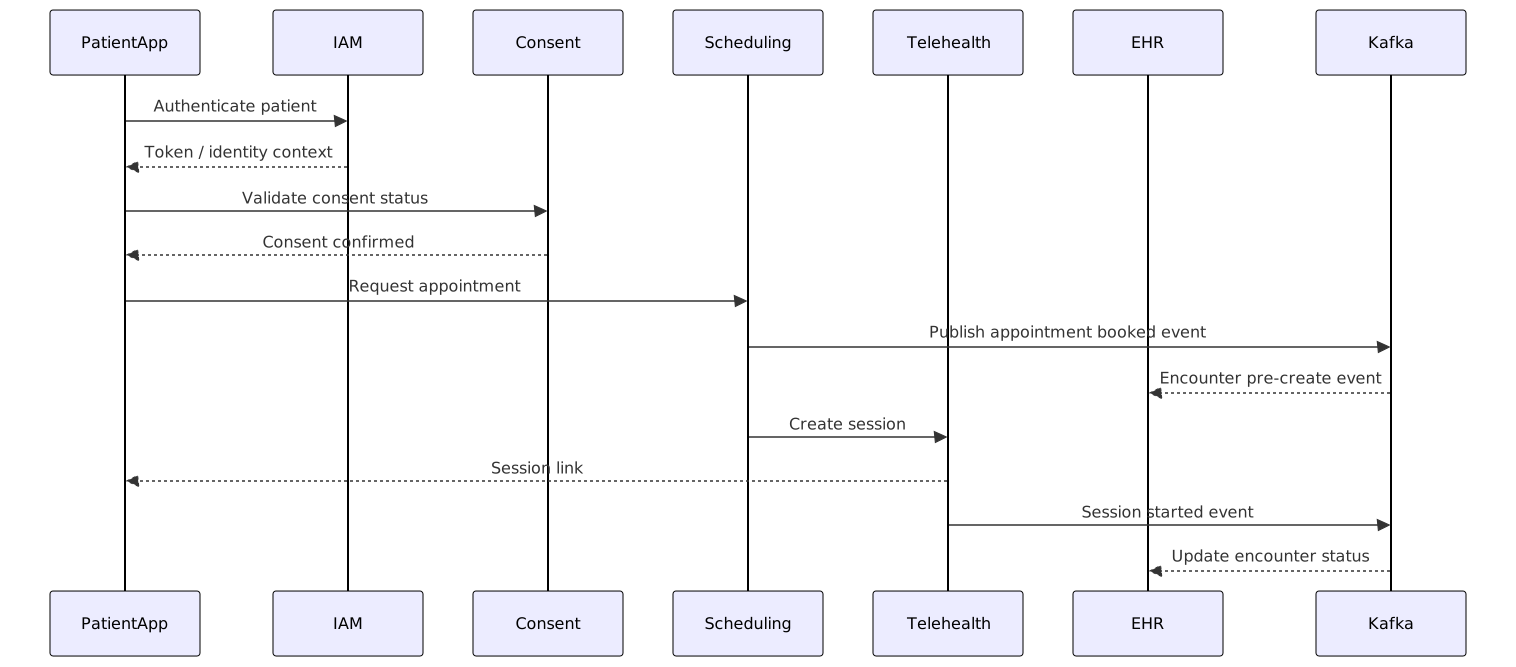
That is not a full SysML treatment, obviously. But as a study path, it is the right instinct: use a real problem, then formalize the right parts.
That approach produces a reusable artifact, not just exam memories.
How OCSMP compares with alternatives
This is where I get a bit opinionated.
OCSMP is rarely the first certification I would recommend to a broad enterprise architect.
If your gap is enterprise operating model, governance, or architecture practice structure, look elsewhere first. TOGAF, despite all its flaws, still has more direct relevance there. EA governance checklist
If your gap is process modeling, BPMN often offers more immediate return.
If your gap is implementation depth on a platform, cloud certifications may matter more. For many architects, an AWS, Azure, or GCP credential plus real delivery experience will create more obvious career value than OCSMP.
If your gap is healthcare interoperability, security, or domain-specific standards, then FHIR, privacy, security architecture, or identity-related learning may have stronger immediate impact.
But if your gap is system interaction rigor, OCSMP is stronger than those alternatives.
That is the key point. It solves a different problem.
I have watched architects drift over time from standard enterprise concerns into system-of-systems complexity without fully realizing it. A digital platform becomes a care coordination platform. Then device telemetry arrives. Then identity and consent rules become dynamic. Then operational state transitions start driving business risk. At that point, old habits stop being enough.
That is where OCSMP becomes surprisingly valuable.
Not as a badge. As a forcing function.
Does OCSMP change your hiring prospects?
Sometimes. Not universally.
Internally, it can increase trust if leadership already values formal modeling or if your organization is moving toward digital engineering, systems architecture, or stronger traceability practices. In that case, the credential can signal seriousness.
Externally, it helps most in niche or advanced roles:
- regulated industries
- engineering-led organizations
- MBSE teams
- digital engineering functions
- large transformation programs with serious systems complexity
- healthcare platform roles that sit close to devices, operations, or compliance-sensitive workflows
Where it helps less:
- generalist enterprise architecture roles
- IT strategy roles
- standard application modernization work
- broad cloud transformation roles without much behavior modeling
- architecture leadership jobs where stakeholder influence matters more than notation depth
On a résumé, OCSMP works best when paired with evidence.
Not “OCSMP certified.”
More like: “Used formal system models to reduce integration ambiguity across patient app, IAM, EHR, and remote monitoring workflows; improved traceability and cut interface defects during UAT.”
That tells a story. The credential alone does not.
My blunt recommendation
I would recommend OCSMP if:
- you work in healthcare or another domain with high interaction complexity
- you regularly face ambiguity around system boundaries and behavior
- you want to move toward systems architecture or MBSE roles
- you already feel the limits of informal diagrams
- your organization is at least somewhat serious about model-based practices
- your projects involve device integration, event-driven orchestration, IAM complexity, or operationally sensitive workflows
I would not recommend it if:
- you mainly do portfolio planning, standards governance, or roadmap facilitation
- you want a quick credential boost without practical application
- your teams will not use models in delivery
- your architecture pain is really about governance, process ownership, or data quality rather than system behavior
- you have no realistic way to practice what you learn
And there is a middle category that deserves honesty: senior architects who do not need the cert, but would still benefit from the discipline.
That group is larger than people think.
Some experienced architects do not need OCSMP for market credibility at all. They already have it. But they may still gain a lot from the habits that serious SysML study reinforces: precision, decomposition, traceability, interaction clarity, and stronger review questions.
That is not nothing.
A practical playbook for the next 30 days
If you are on the fence, do not overthink it. Run a short decision cycle.
Step 1: inventory your current architecture pain
Be honest. Is your pain mainly:
- governance confusion?
- process inconsistency?
- data quality?
- cloud sprawl?
- integration ambiguity?
- behavior and state complexity?
If the last two dominate, keep going.
Step 2: test one SysML-shaped problem
Pick a real cross-system workflow. In healthcare, good candidates include:
- virtual care appointment-to-encounter flow
- remote patient monitoring escalation
- device-to-EHR alert ingestion
- patient identity and consent propagation across channels
- smart hospital bed management and patient flow
Model the context. Model the interactions. Model key states.
Then ask a hard question: did this expose issues your normal architecture artifacts were hiding?
If yes, you have your answer.
Step 3: assess organizational fit
Will anyone use the artifacts?
Is there tooling or repository support?
Do engineering teams see value?
Can this connect to delivery, testing, operations, or compliance practices?
If the answer is no across the board, do not expect certification alone to fix that.
Step 4: choose your path
You have three reasonable options:
Pursue now
If the pain is real, the problem fit is clear, and you have a way to apply it.
Learn SysML first without certifying
If you see potential value but want to test it before committing.
Skip for now
If your actual architecture problems lie elsewhere.
A quick checklist helps:
Pursue now if:
- your projects are interaction-heavy and behavior-heavy
- formal modeling would clearly reduce ambiguity
- hiring value exists in your market
- you can apply it immediately
Learn first if:
- you are curious but unconvinced
- your organization is not yet model-driven
- you need to test whether SysML really fits your work
Skip for now if:
- your challenges are mostly governance or strategy
- nobody will use the models
- you are chasing the badge more than the capability
Final view
OCSMP is not broadly essential for every enterprise architect. That is the truth, and pretending otherwise helps nobody.
But in the right problem space, it is genuinely useful.
Healthcare is one of those spaces more often than people realize, because healthcare systems cross technical, operational, and clinical boundaries in ways that standard architecture artifacts often flatten or hide. Capability maps and application diagrams tell part of the story. They rarely tell the full behavioral story. That is where SysML earns attention.
If you need a badge, OCSMP may disappoint.
If you need sharper systems thinking, it can be worth a lot more than the badge.
So my recommendation is simple: pursue OCSMP when your architecture problems demand formal systems modeling—not when your LinkedIn profile does.
FAQ
Is OCSMP useful for enterprise architects?
Sometimes, but not usually as a core qualification. It is most useful when an enterprise architect works in system-of-systems, behavior-heavy, regulated, or engineering-adjacent environments.
How hard is OCSMP compared with TOGAF?
It is a different kind of hard. TOGAF is broader and more conceptual around architecture practice. OCSMP requires more precision in notation and formal reasoning. Many architects find OCSMP less forgiving. ArchiMate in TOGAF
Is SysML relevant in healthcare architecture?
Yes, especially in virtual care, device integration, smart hospitals, care escalation workflows, and identity/consent-heavy platforms.
Do I need to be an engineer to benefit from OCSMP?
No. But you do need comfort with formal modeling and structured thinking. It helps if you are close to systems architecture problems, not just enterprise planning.
Can I use SysML without becoming fully model-based?
Absolutely. In fact, that is often the practical sweet spot. You can use SysML selectively where behavior, interfaces, and traceability matter without turning your entire architecture practice into an MBSE program.
Frequently Asked Questions
What is enterprise architecture?
Enterprise architecture aligns strategy, business processes, applications, and technology. Using frameworks like TOGAF and languages like ArchiMate, it provides a structured view of how the enterprise operates and must change.
How does ArchiMate support enterprise architecture?
ArchiMate connects strategy, business operations, applications, and technology in one coherent model. It enables traceability from strategic goals through capabilities and application services to technology infrastructure.
What tools support enterprise architecture modeling?
The main tools are Sparx Enterprise Architect (ArchiMate, UML, BPMN, SysML), Archi (free, ArchiMate-only), and BiZZdesign. Sparx EA is the most feature-rich, supporting concurrent repositories, automation, and Jira integration.