⏱ 20 min read
Most UML is dead on arrival.
That sounds harsher than it should, but not by much. In a lot of enterprises, teams still produce beautiful UML diagrams that have almost no relationship to the systems that get built, deployed, secured, monitored, and painfully maintained for the next seven years. The model becomes a workshop artifact. The implementation architecture becomes a separate reality. And then everyone pretends those two things are somehow connected because the boxes have similar names.
They usually aren’t.
If you want the blunt version: UML is useful only when it helps people make implementation decisions. Not abstract decisions. Not “future-state capability alignment” in a vacuum. Real decisions. Service boundaries. Event ownership. IAM integration points. Network trust zones. Data consistency rules. Deployment topology. Kafka topic strategy. Cloud runtime constraints. If the model doesn’t survive contact with those questions, it’s not architecture. It’s a sketch with governance branding.
The simple version first
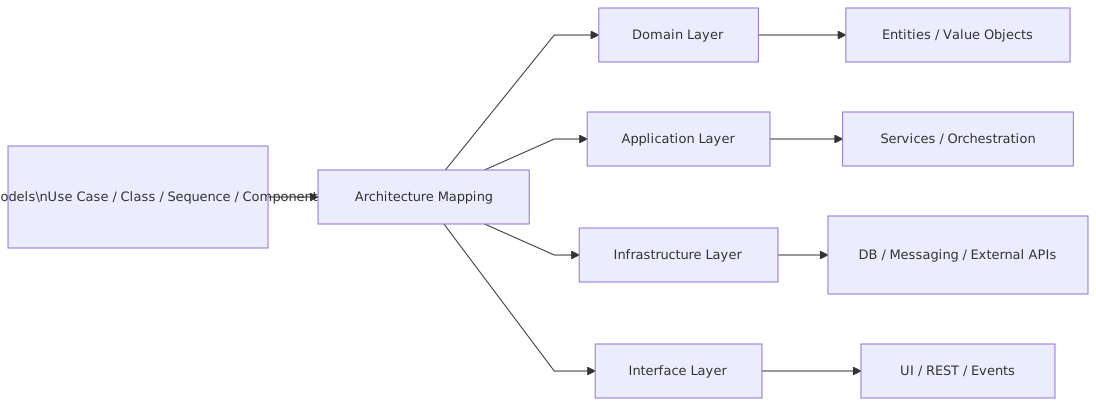
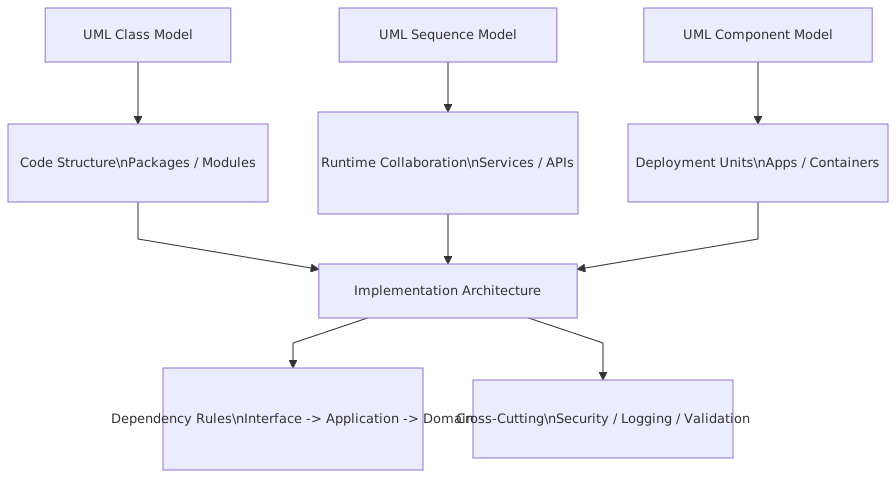
Translating UML models into implementation architecture means taking conceptual or design models—use case diagrams, class diagrams, sequence diagrams, component diagrams, state diagrams—and turning them into things engineering teams can actually build and operate.
In practical terms, that means answering questions like:
- What becomes a service?
- What becomes a database schema?
- What becomes an event on Kafka?
- What becomes an API contract?
- What needs IAM integration?
- What runs in Kubernetes, what runs as serverless, and what absolutely should not run in either?
- Where are the trust boundaries?
- Where do failures happen?
- What are the ownership lines between teams?
That’s the job.
UML is not the destination. It’s a thinking tool. Sometimes a useful one. Sometimes an expensive distraction.
The real work of architecture starts when you force every model element to justify itself in implementation terms.
Why enterprises struggle with this
The problem is not that UML is outdated. The problem is that enterprises often use it at the wrong altitude. UML modeling best practices
A business architect creates a capability map. A solution architect creates a component diagram. A domain architect builds a class model. A security architect overlays controls. Then engineering gets involved and says, “Fine, but what are we deploying, where does identity come from, how do events flow, and what happens when Kafka is down?” ArchiMate capability map
That’s when the room gets quiet.
Because many architectural models are optimized for reviewability, not buildability.
I’ve seen banks with hundreds of pages of architecture pack material and still no clear answer to these four implementation questions:
- Which system owns customer identity?
- Which service is allowed to publish account status changes?
- How are entitlements enforced across channels?
- Which failures are synchronous and which are event-driven?
If your UML doesn’t help answer those, you’re not translating architecture into implementation. You’re decorating uncertainty.
UML is not code, but it should constrain code
Here’s the contrarian take: I don’t think UML has to be “kept fully in sync” with code to be valuable. That’s a fantasy in most enterprise environments. Models drift. Teams change. roadmaps move. Fine. EA governance checklist
But UML does need to constrain implementation in meaningful ways.
A good model should create decisions that are hard to violate accidentally.
For example:
- A sequence diagram should make clear whether fraud screening happens synchronously before payment initiation, or asynchronously after an event.
- A component diagram should make clear whether IAM is centralized through a shared identity provider or fragmented across applications.
- A state model should define legal lifecycle transitions for an account or loan application.
- A domain model should distinguish between customer, party, account holder, and authenticated user—because in banking those are not interchangeable, and teams make expensive mistakes when they pretend they are.
So no, UML doesn’t need to become executable religion. But yes, it must shape implementation architecture.
That means every UML artifact should eventually map to one or more implementation concerns. UML for microservices
The practical translation: from UML artifact to implementation decision
This is where architects either earn their keep or become diagram librarians.
Below is the translation that actually matters.
That table is the core of the topic, honestly. If you remember one thing, remember this: the value of UML is in what implementation decisions it forces early.
Start from business meaning, but don’t stay there too long
Architects often get trapped between two bad extremes.
One group stays conceptual forever. They produce elegant models of “Customer Onboarding Capability” and “Payment Servicing Domain” but never get to the ugly details of IAM token propagation, Kafka partitioning, or cloud network egress rules.
The other group jumps straight into implementation and says diagrams are a waste of time. That usually leads to accidental architecture: APIs designed around team structures, events with no domain semantics, duplicated identity logic, and impossible-to-govern security patterns.
The right move is neither.
Start with business meaning. Then translate aggressively.
For example, if your use case says:
> “Retail customer updates contact details across channels”
That sounds simple. It isn’t. In implementation architecture, that use case becomes questions like:
- Which channel initiates it: mobile app, branch system, contact center?
- Is the customer authenticated directly through enterprise IAM?
- Is strong authentication required for profile changes?
- Which system is the master for customer profile data?
- Is the update synchronous or does it emit a Kafka event for downstream systems?
- Do legacy core banking systems subscribe to profile-change events?
- How is consent and audit captured?
- Which cloud service hosts the customer profile API?
- What happens if CRM and core banking disagree?
That is translation. That is architecture work.
Real architecture work: what this looks like on an actual programme
Let’s take a realistic enterprise example: a bank modernizing its retail servicing platform.
The bank has:
- legacy core banking systems on-prem
- a digital channel stack in the cloud
- Kafka as the enterprise event backbone
- centralized IAM using OAuth2/OpenID Connect
- multiple product domains: current accounts, cards, loans, savings
- a mandate to move customer-facing services to cloud-native platforms
The architecture team starts with UML models across business and solution design.
Step 1: Use case model
They document use cases like:
- View account balance
- Freeze debit card
- Update customer contact details
- Apply for personal loan
- Receive transaction alert
Useful. But not enough.
A weak architecture team stops there and says the digital banking platform will support these use cases through “modular services.” That phrase should set off alarms every time. Modular services is usually code for “we haven’t done the hard partitioning yet.”
A stronger team asks:
- Which use cases are channel-facing only?
- Which require orchestration across multiple product systems?
- Which need customer authentication and step-up authentication?
- Which create events that downstream systems consume?
- Which require strict consistency versus eventual consistency?
Now the use cases begin to shape implementation.
Step 2: Domain/class model
The team models concepts like:
- Customer
- Party
- Account
- Card
- Loan Application
- Contact Preference
- Alert Subscription
- Authenticated Session
This is where many architects get sloppy. They see entities and immediately infer services. So they create Customer Service, Account Service, Card Service, Contact Preference Service, Alert Service, Session Service. Suddenly they have a distributed object model wearing a microservices costume.
That is not architecture. That is decomposition by noun.
A better interpretation is:
- Which entities are in the same consistency boundary?
- Which are mastered by existing systems?
- Which are reference data vs transactional data?
- Which are suitable for event publication?
- Which need independent lifecycle management?
In our banking example:
- Account may still be mastered in the core banking platform.
- Card may be mastered in a card processor platform.
- Customer profile may be exposed through a cloud-native servicing domain, but not necessarily mastered there.
- Alert Subscription might be a genuinely new cloud-native domain owned by the digital platform.
- Authenticated Session belongs to IAM and should not become a bespoke application concept unless you enjoy security incidents.
That distinction matters a lot.
Step 3: Sequence diagrams
Now things get serious.
Take the use case: Freeze debit card.
A naive sequence diagram shows:
Customer App → Card Service → Core Processor → Success Response
That’s clean. Too clean. Unrealistically clean.
A more implementation-ready sequence diagram asks:
- Customer authenticates with IAM
- Mobile app gets access token
- API gateway validates token
- Card Management API checks entitlements
- Card Management API invokes orchestration service
- Orchestration service sends synchronous command to card processor
- On success, event
card.status.changedis published to Kafka - Notification service consumes event and sends push notification
- Audit service captures immutable record
- Fraud monitoring consumes same event asynchronously
Now we have architecture. We can discuss latency, retries, event schemas, token scopes, and operational ownership.
The sequence diagram has moved from “message passing illustration” to “implementation contract.”
Kafka changes how UML should be interpreted
A lot of architects still model interactions as if every meaningful business step is a synchronous request-response. That’s one of the biggest translation failures in modern enterprise architecture.
If Kafka is part of your estate, your UML models need to reflect event-driven reality, not pretend everything is a method call with better branding.
This means:
- sequence diagrams should show event publication and consumption explicitly
- component diagrams should identify event producers, consumers, and event owners
- state diagrams should reflect transitions caused by events, not just API commands
- domain diagrams should distinguish command models from event models
And here’s the hard truth: not every class relationship belongs in an event schema.
Architects often create bloated event payloads because they try to serialize the entire domain model. Bad idea. Events should represent business facts, not portable object graphs.
For example, in banking:
Bad event:
CustomerUpdatedwith nested addresses, preferences, linked accounts, KYC documents, channel settings, and advisor relationships
Better event:
CustomerContactDetailsChangedCustomerMarketingPreferenceChangedCustomerAddressVerified
Smaller, versionable, clearer ownership.
Kafka rewards clarity. UML should help create that clarity, not muddy it.
IAM is where abstract models go to die
If you want to test whether a UML model is serious, ask how identity and access are represented.
Most aren’t.
Architects often treat IAM as a box on a component diagram: “Enterprise Identity Service.” Fine. But implementation architecture needs much more than that.
You need to know:
- Who is the subject: customer, employee, partner, service account?
- Who authenticates them?
- What token or assertion format is used?
- Where are authorization decisions made?
- How are entitlements mapped to business actions?
- How do downstream services trust identity context?
- What data is identity data versus customer profile data?
In banking, this distinction is absolutely critical.
A customer may have:
- a digital identity in IAM
- one or more party records in customer master
- one or more product relationships in core banking
- delegated access arrangements
- channel-specific permissions
If your UML domain model collapses all that into “User,” your implementation architecture will be wrong before sprint one.
This is one of the most common mistakes I see. Teams model identity too generically, then bolt IAM on later. Then they discover:
- customer and employee identities need different trust paths
- branch-assisted journeys require delegated actions
- token claims don’t match business authorization needs
- legacy systems can’t consume modern identity tokens directly
- audit requirements need identity lineage across asynchronous flows
By then, fixing it is expensive.
So yes, your UML needs to represent identity concepts properly. Not in every diagram, but certainly in the architecture-critical ones.
Cloud architecture is not just deployment after the fact
Another bad habit: treating implementation architecture as “the same design, but now we draw AWS or Azure icons.”
No.
Cloud changes design choices. It is not just hosting.
When translating UML into implementation architecture, cloud concerns should influence:
- service granularity
- statelessness assumptions
- failure handling
- data locality
- secrets management
- network segmentation
- observability design
- autoscaling behavior
- managed service dependencies
A component diagram that says “Notification Component” is almost useless until you know whether it becomes:
- a stateless containerized service in Kubernetes
- a serverless event consumer
- a managed messaging workflow
- a SaaS integration
- a batch process that should frankly stay off the cloud-native path
Likewise, a deployment diagram should not be an afterthought. It should answer real questions:
- Which services are public-facing?
- Which live in private subnets?
- Where does Kafka live—managed cloud, self-hosted, hybrid bridge?
- How does IAM integrate with cloud workloads?
- Which services require low-latency connectivity to on-prem core banking?
- What are the resilience zones?
A lot of UML stays too logical for too long. In enterprise work, that’s dangerous. Especially in hybrid estates.
Common mistakes architects make
Let’s be honest about the recurring failures.
1. Treating UML as a deliverable instead of a decision tool
If the goal is to “complete the model set,” you’re already off course. The goal is to reduce ambiguity in implementation.
2. Mapping classes directly to microservices
This is probably the most common design sin of the last decade. Domain entities are not service boundaries. Services should align to business capabilities, ownership, change patterns, and consistency boundaries.
3. Ignoring non-functional realities in sequence diagrams
A sequence without retries, timeouts, async behavior, and failure paths is a fiction. It may be useful for discussion, but it is not enough for architecture.
4. Leaving IAM out until security review
Identity is not a bolt-on concern. It changes API design, channel flows, audit, and service trust boundaries.
5. Designing event-driven architecture as if events are just async APIs
They’re not. Events need ownership, schema discipline, versioning strategy, and clear semantic meaning.
6. Keeping component models too abstract
If a component can’t be tied to a deployable unit, an integration style, or an operational owner, it’s probably too vague.
7. Failing to model system-of-record boundaries
In enterprises, especially banks, many domains are federated. If the UML doesn’t show mastering and source-of-truth realities, implementation teams will duplicate data and invent reconciliation pain.
8. Producing one “perfect” architecture model
Different audiences need different views. Business stakeholders, platform engineers, security teams, and delivery squads do not need the same UML artifacts at the same level of detail.
9. Pretending legacy systems will behave like modern services
They won’t. Mainframes, core banking platforms, and old card processors have quirks, batch windows, throughput constraints, and weird failure modes. Model accordingly.
10. Not revisiting the model once implementation starts
You don’t need full synchronization, but you do need feedback. Otherwise the architecture becomes ceremonial.
A better translation method
Here’s the approach I’ve found works in real enterprise programmes.
1. Identify the architecturally significant scenarios
Not every use case deserves deep modeling. Focus on scenarios that stress the architecture:
- high-value transactions
- identity-sensitive journeys
- cross-domain orchestration
- event-heavy flows
- low-latency customer interactions
- regulatory or audit-heavy processes
In banking, “view balance” and “freeze card” deserve different levels of scrutiny. “Apply for loan” deserves more than both.
2. Model the domain carefully, especially ownership
Ask for each concept:
- who owns it?
- who writes it?
- who reads it?
- who publishes changes?
- where is the system of record?
- what level of consistency is required?
This prevents fake microservices and fake data ownership.
3. Use sequence diagrams to force sync/async decisions
Don’t just show interactions. Show:
- auth/token validation
- API gateway behavior
- command vs event flow
- timeout points
- compensating paths
- audit capture
- Kafka publication/consumption
This is where theoretical architecture becomes implementable.
4. Convert components into deployable and operable units
For every component, identify:
- runtime platform
- owning team
- integration style
- scaling model
- trust boundary
- observability requirements
- resilience pattern
If you can’t answer these, the component is still too abstract.
5. Overlay IAM and security explicitly
I’ll repeat this because teams avoid it: make identity visible in the architecture. Show token flows, policy decision points, privileged operations, service-to-service trust, and audit lineage.
6. Validate against platform and legacy constraints
A model that ignores the actual cloud platform, enterprise Kafka standards, IAM product limitations, or core banking integration patterns is not architecture. It’s fan fiction.
A real enterprise example: retail loan origination in a bank
Let’s go deeper with one concrete scenario.
A bank wants to modernize personal loan origination.
Initial UML view
The team starts with:
- use case diagrams for customer application journey
- class diagrams for Applicant, Loan Application, Offer, Credit Assessment, Document, Approval
- sequence diagrams for application submission and decisioning
- component diagrams for front end, loan service, credit service, document service, notification service
Looks reasonable.
What weak translation looks like
The team turns each component into a microservice and each class into a persistence model. They make synchronous API calls between all services. IAM is handled only at the front end. Kafka is added later for notifications.
Result:
- too many chatty service calls
- duplicated customer data
- no clear source of truth for application state
- difficult audit trail
- poor resilience when credit bureau calls fail
- authorization logic spread inconsistently
- event integration bolted on as an afterthought
Classic enterprise modernization mess.
What stronger translation looks like
The architecture team reframes the model around implementation realities.
Domain decisions
- Loan Application is the central aggregate with owned lifecycle state.
- Applicant identity is authenticated via enterprise IAM but customer profile data is sourced from customer master.
- Credit Assessment is not a separate customer-facing service boundary; it is an external capability invoked and recorded within the application workflow.
- Document metadata is part of the application domain; document binaries are stored in managed object storage.
- Offer is a stateful business artifact generated from decisioning, not an independently owned microservice.
Interaction decisions
- Application submission is synchronous up to “application accepted.”
- Credit bureau and affordability checks may be asynchronous if latency exceeds threshold.
- Kafka events are published for
loan.application.submitted,loan.application.assessed,loan.offer.generated, andloan.application.approved. - Notification and analytics consume these events independently.
IAM decisions
- Customer authentication is delegated to enterprise IAM using OIDC.
- Token claims carry customer identity, but business entitlements are resolved in the application domain.
- Staff-assisted processing uses a separate workforce identity realm and stricter audit tagging.
- Service-to-service calls use workload identity, not reused user tokens.
Cloud decisions
- Customer-facing APIs run in Kubernetes.
- Document upload uses cloud object storage with signed URLs.
- Event-driven post-processing runs on serverless consumers.
- Sensitive decisioning logs are centralized in immutable audit storage.
- Connectivity to on-prem core systems uses private integration links.
Now the UML has been translated into implementation architecture that delivery teams can actually execute.
That’s the difference.
The uncomfortable truth: some UML should be thrown away
Not every model deserves to survive.
This is another contrarian point architects don’t say enough. Sometimes the right move is not to refine the UML. It’s to discard the parts that don’t help implementation.
Examples:
- class diagrams with too much inheritance and no business value
- use case diagrams that merely restate obvious UI actions
- component diagrams with generic labels like “Integration Layer”
- deployment diagrams created only for governance slides
- sequence diagrams that ignore auth, error handling, and asynchronous behavior
Architecture is not a museum for every artifact produced during discovery.
Keep the models that clarify implementation. Drop the rest.
Teams often feel guilty about this because enterprises worship traceability. Fine. Maintain traceability where it matters. But don’t preserve low-value UML just because someone attached it to a template.
What good looks like
When UML has been translated well into implementation architecture, you can see it in the questions teams stop asking.
Engineers no longer ask:
- who owns this data?
- is this synchronous or event-driven?
- where does authorization happen?
- which service publishes this business event?
- what is the source of truth?
- what happens when the downstream system is unavailable?
Those decisions have already been made visible.
Good translation also creates alignment across disciplines:
- developers know the service and event boundaries
- platform teams know the deployment and trust assumptions
- security teams understand IAM integration and audit lineage
- operations teams can see failure domains and observability needs
- product teams understand where customer journeys depend on legacy constraints
That is what architecture is supposed to do.
Not just describe a system. Make it buildable.
Final thought
UML is neither the problem nor the answer.
The problem is architects who stop at abstraction and call it completeness. The answer is disciplined translation: taking models and forcing them through the realities of enterprise implementation—Kafka, IAM, cloud platforms, legacy systems, regulatory controls, team ownership, operational failure.
If you work in a bank, this matters even more. You do not get the luxury of vague architecture. Identity is messy. data ownership is contested. event flows are business-critical. cloud is hybrid. legacy is immortal. Regulators don’t care how elegant your component diagram looked in the design review.
So use UML, absolutely. But use it like an architect, not a curator.
Model early. Translate relentlessly. Throw away what doesn’t help. And never confuse a neat diagram with an implementation architecture.
FAQ
1. Which UML diagrams are actually most useful for implementation architecture?
Usually a small set: use case diagrams for key scenarios, domain/class diagrams for core concepts, sequence diagrams for behavior, component diagrams for decomposition, and deployment diagrams for runtime topology. If I had to choose only two for real enterprise work, I’d pick sequence diagrams and component diagrams, because they force implementation choices fastest.
2. Should UML models stay fully synchronized with code?
In theory maybe, in practice rarely. What matters is that the architecture-critical decisions stay current: service boundaries, event ownership, IAM patterns, deployment topology, and key state transitions. Full synchronization is often expensive and not worth the effort.
3. How do you avoid turning domain models into too many microservices?
Don’t map services from nouns. Define boundaries using business capability, ownership, consistency needs, change frequency, and operational independence. A rich domain model does not imply a large number of services. In fact, it often argues for fewer, better-defined ones. capability map template
4. Where should Kafka appear in UML models?
Explicitly in sequence and component diagrams. Show who publishes events, who consumes them, what business fact the event represents, and whether the flow is synchronous, asynchronous, or hybrid. If Kafka is central to the architecture but invisible in the models, the models are incomplete.
5. How early should IAM be included in architecture models?
From the start. Not as a deep security design on day one, but as a first-class architectural concern. Authentication, authorization, token propagation, service trust, and audit identity lineage all affect implementation architecture. Leaving IAM until later almost always creates rework.
Frequently Asked Questions
What is enterprise architecture?
Enterprise architecture is a discipline that aligns an organisation's strategy, business processes, information systems, and technology. Using frameworks like TOGAF and modeling languages like ArchiMate, it provides a structured view of how the enterprise operates and how it needs to change.
How does ArchiMate support enterprise architecture practice?
ArchiMate provides a standard modeling language that connects strategy, business operations, applications, data, and technology in one coherent model. It enables traceability from strategic goals through business capabilities and application services to the technology platforms that support them.
What tools are used for enterprise architecture modeling?
The main tools are Sparx Enterprise Architect (ArchiMate, UML, BPMN, SysML), Archi (free, ArchiMate-only), and BiZZdesign Enterprise Studio. Sparx EA is the most feature-rich option, supporting concurrent repositories, automation, scripting, and integration with delivery tools like Jira and Azure DevOps.