⏱ 23 min read
Enterprise Architecture Capability Map Template: Guide, Examples & Best Practices Sparx EA best practices
Discover how to use an enterprise architecture capability map template to define business capabilities, align strategy, prioritize investments, and improve operating model design. how architecture review boards use Sparx EA
enterprise architecture capability map template, capability map template, enterprise architecture capability map, business capability map, business capability mapping, enterprise architecture template, capability-based planning, business architecture framework, operating model design, strategy to execution alignment, capability assessment, capability heatmap, architecture governance, transformation planning, target state architecture
Introduction
An enterprise architecture capability map template gives organizations a disciplined way to describe what the business must be able to do, regardless of current processes, systems, or reporting lines. That distinction is not academic. In most transformation efforts, discussions quickly drift into the current operating model: existing applications, team structures, local workflows, and inherited constraints. A capability map resets the conversation around the business abilities required to execute strategy.
That shift is valuable because it creates a common language across business and technology stakeholders. Executives usually frame priorities in terms of growth, customer experience, resilience, compliance, efficiency, or innovation. Technology teams work with platforms, applications, data, integration, and delivery constraints. A capability map connects those perspectives by translating strategic intent into a set of business abilities that can be assessed, prioritized, and supported through architecture decisions.
The template matters because consistency is what turns capability mapping into an enterprise tool rather than a one-off workshop output. Without a common structure, teams model at different levels of detail, use inconsistent naming, and interpret scope differently. Comparison becomes unreliable, and reuse is limited. A sound template provides standard hierarchy, definitions, metadata, and visual conventions so the map can support executive communication, portfolio analysis, investment governance, and transformation planning.
Capability maps are also practical decision tools. Once capabilities are defined, architects can overlay strategic importance, maturity, pain points, cost, risk exposure, and application support. That makes it easier to identify where the organization is overinvesting, underinvesting, or carrying avoidable complexity. A strategically important capability with fragmented system support may justify modernization sooner than a low-differentiation capability that is already stable and efficient. In one insurance firm, for example, a capability review showed that Manage Claims Intake was supported by five separate intake paths across web, call center, broker, email, and scanned forms. The issue was not simply channel inconsistency; it was that a core business capability had become structurally fragmented.
Capability maps also improve traceability. They can be linked to value streams, processes, information domains, applications, technologies, and ownership models. That makes them useful for more than target-state design. When a merger, regulatory change, platform replacement, or market expansion is proposed, architects can quickly identify which capabilities are affected and where dependencies sit. A bank entering a new country, for instance, may discover that Manage Customer Due Diligence and Monitor Financial Crime Risk require more attention than the product launch capability that initially drew executive focus.
Used well, an enterprise architecture capability map template becomes more than a diagramming aid. It provides a durable planning structure that helps align strategy, transformation priorities, and technology change around a shared view of what the business must be able to do. The sections that follow explain what a capability map is, why it matters, how to structure the template, and how to use it as a working instrument for strategy, transformation, and governance.
What an Enterprise Architecture Capability Map Is
An enterprise architecture capability map is a structured representation of the business abilities an organization needs to operate, compete, and change. It describes what the enterprise must be able to do, not how work is currently performed, which systems support it, or which teams own execution. Because capabilities are defined at a conceptual business level, they usually remain more stable than processes, products, projects, and organizational structures.
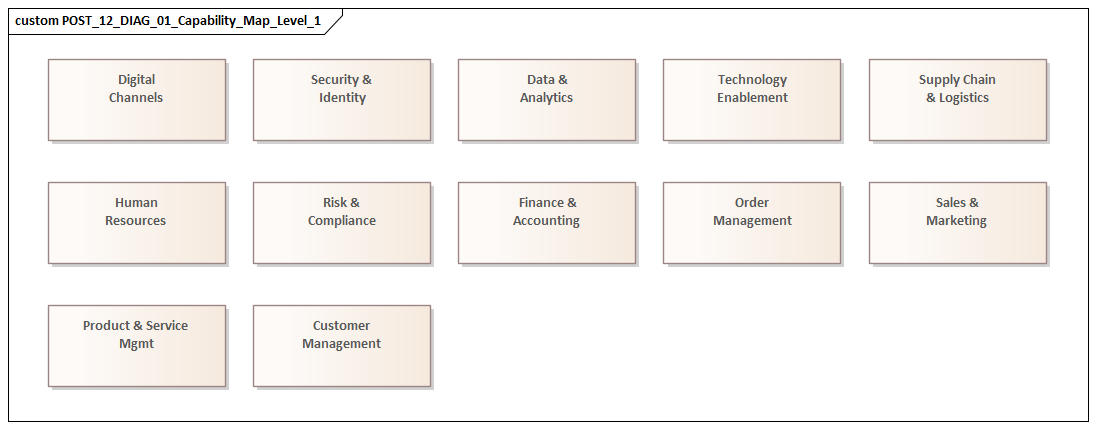
In practice, a capability map is organized as a hierarchy. The top level typically contains broad enterprise domains such as customer management, product and service management, operations, finance, risk, human resources, or technology enablement. Those domains are then broken down into more specific capabilities and, where necessary, lower-level sub-capabilities. The objective is to provide enough structure for planning and analysis without turning the map into a process inventory.
That balance matters. If the model is too broad, it becomes generic and difficult to use. If it goes too deep, it starts describing workflows, tasks, or organizational activities rather than durable business abilities. A useful capability map stays at the level where decisions about investment, maturity, ownership, and change can be made with consistency. free Sparx EA maturity assessment
A defining characteristic of a capability is its independence from implementation. Manage Customer Relationships is a capability. The CRM platform, account management teams, service scripts, and supporting processes are not; they are implementation mechanisms. Keeping that boundary clear prevents architecture discussions from being dominated by current-state constraints. It allows teams to ask whether the enterprise has the right business ability, how well that ability performs, and what level of investment or redesign it requires.
The capability map also serves as a classification model for change. Initiatives, applications, data domains, risks, and technology investments can all be mapped back to capabilities. That creates a common anchor across the portfolio. If several initiatives claim to improve customer onboarding, the map helps determine whether they are strengthening the same capability, addressing adjacent capabilities, or simply duplicating effort. In a retail group, two separate programs were both presented as “digital onboarding improvements.” When mapped to capabilities, one targeted Verify Customer Identity, while the other focused on Activate Customer Account. The distinction changed the funding discussion because the real dependency sat upstream in identity verification.
It is equally important to distinguish a capability map from related artifacts:
- It is not a process model, because it does not show sequence, flow, or decision logic.
- It is not an operating model, because it does not define governance, organization, sourcing, or reporting lines.
- It is not an application landscape, because it does not catalog systems or platforms.
- It is not a value stream, because it does not describe how value is delivered end to end.
Even so, one of the map’s strengths is the way it connects to those other views. In mature architecture practices, the capability map becomes a reference structure that links them.
Capability maps also support multiple planning horizons. Some capabilities are foundational and need to be reliable and cost-effective. Others are differentiating and tied directly to strategy. Some are mature and stable; others need to evolve quickly because of market pressure, regulation, or digital ambition. By presenting the full business capability landscape in one structure, the map helps architects distinguish commodity from differentiating areas and guide decisions about standardization, outsourcing, modernization, or innovation. A logistics company moving toward real-time shipment visibility, for example, may discover that Manage Event Distribution has become strategically important because downstream customer notifications, control tower analytics, and partner updates all depend on it.
For that reason, a capability map is more than a taxonomy. It is a planning structure that gives enterprise architecture a stable way to frame change, compare investment choices, and coordinate decisions across business and technology domains.
Why Capability Maps Matter in Enterprise Architecture
The value of a capability map lies in the stable, business-centered frame it gives architecture decision-making. That stability matters because strategies shift, products evolve, organizations restructure, and technology estates change continuously. Enterprise architecture needs a reference model that remains useful through those changes. Capability maps provide that continuity.
One of their clearest benefits is strategic translation. Strategy is often expressed in broad ambitions such as entering new markets, improving retention, increasing resilience, reducing cost, or expanding digital channels. Those ambitions are meaningful, but they are too high level to guide architecture action directly. Capability maps translate them into assessable business abilities. Architects can then ask more useful questions: Which capabilities must improve to support the strategy? Which are already sufficient? Which require redesign, new data, modernized applications, or different sourcing models?
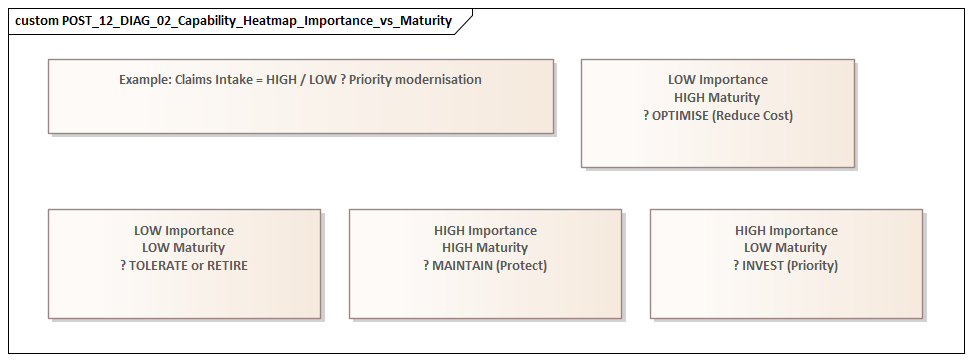
Capability maps also improve prioritization. Most organizations face more demand than they can fund or deliver. Without a structured view, priorities tend to follow urgency, sponsorship strength, or the quality of the business case rather than enterprise need. A capability-based approach introduces a more defensible basis for comparison. Capabilities can be evaluated by strategic importance, maturity, risk exposure, regulatory pressure, performance gaps, and technical debt. That helps leadership distinguish between change that is merely requested and change that is structurally necessary. fixing Sparx EA performance problems
They are equally valuable in cross-domain architecture. Business, data, application, and technology architecture are often managed separately, but enterprise decisions rarely succeed when those perspectives stay disconnected. A capability-centric view gives all architecture domains a common anchor. If a capability is strategically important but underperforming, business architecture can clarify outcomes, data architecture can identify information constraints, application architecture can assess fragmentation, and technology architecture can examine platform limitations. The map does not replace deeper analysis, but it keeps each domain aligned to the same business frame.
Capability maps are also effective at exposing imbalance across the enterprise. In many organizations, investment patterns reflect history more than strategy. Some capabilities accumulate overlapping applications, vendors, and local process variation because they have grown organically over time. Others remain weak because they cut across organizational boundaries and lack clear sponsorship. Mapping systems, initiatives, and costs to capabilities makes those patterns visible. That supports rationalization, simplification, and targeted investment.
Because capability maps remain independent of implementation, they also work well in governance conversations with executives, who generally do not want decisions framed around platform detail. A capability-based view allows architecture teams to discuss business impact instead: which business abilities are being improved, protected, standardized, or transformed. That tends to increase the relevance of architecture in investment review, target-state planning, and portfolio governance. An architecture board can reject a proposed point solution not because it violates a tooling preference, but because it adds more fragmentation to a capability already earmarked for enterprise consolidation.
Just as importantly, capability maps help architecture operate at the enterprise level rather than the project level. Projects optimize for local outcomes. Enterprise architecture has to look across initiatives and ask whether change is coherent as a whole. By using capabilities as a common planning structure, architects can connect individual programs to broader enterprise intent, identify overlap before it becomes waste, and guide incremental decisions toward a more deliberate future state. Sparx EA guide
In that role, the capability map becomes one of the most practical tools for turning enterprise architecture from a documentation function into a mechanism for coordinated change.
Core Components of an Enterprise Architecture Capability Map Template
If a capability map is expected to support those uses, the template needs more than a set of labeled boxes. It requires a small number of well-defined components that make the model consistent, reusable, and analytically useful.
1. Capability hierarchy
The hierarchy is the structural backbone of the template. Most organizations model capabilities across two or three levels:
- Level 1: broad enterprise domains
- Level 2: meaningful business abilities within those domains
- Level 3: optional deeper decomposition for areas requiring more analysis
The hierarchy should be designed deliberately and applied consistently. If one domain is modeled at a strategic level and another at an operational level, comparison becomes unreliable. Consistent decomposition is essential if the map will be used for prioritization, heatmapping, and governance.
2. Capability name and definition
A label alone is rarely enough. Each capability should include a short, business-oriented definition that explains its purpose and boundaries without referring to specific systems, teams, or local processes. Good definitions reduce overlap between adjacent capabilities and make later mapping of applications, initiatives, and ownership more consistent.
This is especially important because capabilities are meant to remain independent of implementation. Once definitions slide into process or system language, the map loses much of its architectural value.
3. Scope and boundary notes
Many capability maps become confusing because neighboring capabilities overlap. A template should include optional inclusion or exclusion notes that clarify what belongs inside a capability and what belongs elsewhere. This is particularly useful in areas such as customer lifecycle management, product development, compliance, or shared services, where business language is often interpreted differently by different teams. Sparx EA training
Boundary notes do not need to be extensive. A concise statement is usually enough to prevent repeated debate in workshops and governance reviews.
4. Metadata for analysis
Metadata is what turns the map from a descriptive model into a planning instrument. Common fields include:
- Strategic importance
- Business criticality
- Current maturity
- Pain points
- Risk level
- Regulatory sensitivity
- Degree of differentiation
- Geographic or business-unit relevance
Not every template needs every field, but it should include enough information to support comparison and heatmapping. Overlays such as maturity, risk, or application support are what make the map useful for decision-making rather than simple documentation. For example, a heatmap may show Manage Access as high-risk and low-maturity, which helps justify a phased IAM modernization program.
5. Linkages to related architecture artifacts
A strong capability map template is designed with traceability in mind. Typical links include:
- Value streams
- Key processes
- Information or data domains
- Applications
- Platforms
- Products or services
- Stakeholders or stewards
These links allow the capability map to act as a reference structure across the architecture repository. They also support impact analysis when strategy, regulation, or technology changes.
6. Visual encoding rules
Because capability maps are often used in executive and portfolio discussions, the template should define how the visual model works. This includes:
- How hierarchy is shown
- How colors are used
- What information appears directly on the map
- What belongs in supporting documentation
Color should be used consistently and for one purpose at a time. One heatmap may use color for maturity and another for risk. Trying to show both on the same map usually creates confusion.
7. Governance and maintenance fields
Capability maps are enterprise assets and should be managed accordingly. The template should include:
- Unique identifiers
- Version information
- Steward or owner
- Review date
- Change status where needed
These fields may seem administrative, but they are essential for reuse across programs and planning cycles. Without them, maps drift, duplicate, and lose credibility.
Taken together, these components make the template usable as a practical enterprise architecture tool. They provide the structure needed to define capabilities clearly, compare them consistently, connect them to the wider architecture landscape, and maintain them over time.
How to Design and Structure the Template
The components above define what the template should contain. Design is the next concern: how those components are organized so the model remains clear, durable, and easy to use.
Start with the right leveling model
In most enterprises, two or three levels are enough. Level 1 should be broad enough to make sense to senior stakeholders, while Level 2 should be specific enough to support investment and transformation discussions. Level 3 should be used selectively, mainly where deeper analysis is justified because the area is strategically differentiating, highly regulated, or operationally complex.
Not every branch of the map needs the same depth. The criteria for deeper decomposition should therefore be explicit. Otherwise, the model becomes uneven and difficult to govern.
Define naming conventions early
Capability names should be concise, action-oriented, and expressed in business language. Verb-noun phrasing is common because it is easy to scan and generally stable over time, for example:
- Manage Supplier Performance
- Develop Products and Services
- Fulfill Customer Orders
- Govern Enterprise Risk
The exclusions matter as much as the pattern. Names should avoid department titles, product names, platform references, and local shorthand understood by only part of the enterprise.
Clarify scope boundaries
A template should make it easy to define boundaries between related capabilities. Customer acquisition, onboarding, servicing, and retention may all sit in one domain, but they should be separated if they are assessed, funded, or changed differently. Scope notes help prevent overlap and reduce inconsistency when teams map projects or applications.
This is one of the simplest ways to avoid repeated explanation later.
Design for one structure and many views
One of the strongest design principles is to maintain a single structural capability model while allowing multiple analytical overlays. The hierarchy should remain stable. Different views can then show:
- Strategic priority
- Maturity
- Risk exposure
- Application concentration
- Cost allocation
- Transformation activity
This is generally better than creating separate capability maps for each purpose. Multiple maps almost always drift apart over time, which weakens trust and traceability.
Make the template referenceable
Each capability should have a unique identifier that can be reused across repositories, spreadsheets, planning documents, and governance artifacts. In larger organizations, identifiers are essential. Without them, linking initiatives, applications, and assessments back to the same capability becomes manual and error-prone.
Referenceability is what allows the capability map to become a cross-architecture anchor rather than a static visual.
Separate visual presentation from detailed catalog content
A capability map needs to support both overview and drill-down. The visual view should help leaders understand the landscape quickly. The detailed catalog should hold definitions, metadata, and links to related artifacts. The two layers should be synchronized through identifiers and hierarchy, but they should not be forced into a single overloaded diagram.
This separation improves usability. Executives get clarity; architects and analysts get detail.
Design for maintenance from the start
A durable template includes rules for change. Architects should define:
- How often the map is reviewed
- What kinds of changes require approval
- Who may add, merge, split, or retire capabilities
- How local variations are managed
Maintenance design is not secondary. A capability map becomes valuable only when it is treated as a managed enterprise asset rather than a one-time workshop output. In practice, this also helps when technology decisions have business implications. If an integration platform is approaching end of life, for example, the capability map should help show which business capabilities depend on it and how upgrade timing affects transformation plans.
A well-structured template combines conceptual clarity with operational discipline. It is simple enough to remain stable, yet structured enough to support analysis, traceability, and reuse.
Using the Capability Map to Drive Strategy, Transformation, and Governance
Once the capability structure is in place, the map becomes more than a reference model. It can be used as a working decision tool across strategy, transformation, and governance.
Strategy translation
Strategy is often expressed in ambitions that are too abstract for direct architecture action. Capability maps translate those ambitions into targeted areas of business change.
A goal such as expand digital channels may affect capabilities related to customer engagement, digital sales, onboarding, fulfillment, analytics, identity management, and service operations. A goal such as increase resilience may point to capabilities in risk management, continuity planning, supplier management, infrastructure operations, and security response.
This creates a more disciplined way to interpret strategy. Instead of launching loosely related projects under a broad theme, the organization can define a capability uplift agenda with clearer scope and better alignment.
Transformation planning
Transformation programs are often framed around projects, platforms, or organizational redesign. Those views are useful, but they do not always show whether the enterprise is improving the right business abilities. A capability map provides that test.
Architects can use it to examine whether initiatives are concentrated on the capabilities most relevant to strategic outcomes, whether key dependencies are missing, and whether multiple programs are changing the same area inconsistently. This is where traceability and metadata become especially valuable.
A common pattern appears in many organizations: front-office initiatives attract attention and funding, while enabling capabilities such as data management, integration, decision support, and compliance operations remain underdeveloped. The capability map helps make those gaps visible. A healthcare provider, for example, may invest heavily in digital appointment booking while Manage Patient Identity remains fragmented across hospitals and clinics. The visible symptom is channel friction; the structural issue is a weak shared capability.
Roadmapping
Capability-based roadmapping improves the sequencing of change. Rather than planning only by project readiness or annual budget cycles, architects can stage transformation according to dependency and target-state logic.
Some capabilities provide shared foundations and need to be strengthened first. Others can be modernized incrementally. Still others may require temporary stabilization before broader redesign is feasible. The result is a roadmap that reflects enterprise realities rather than a simple collection of project timelines.
It also makes trade-offs easier to communicate. Leadership can see which capabilities are being accelerated, delayed, or constrained by current investment choices. In an event-driven modernization effort, for instance, architects may sequence canonical event design, platform hardening, and producer onboarding before broader process automation is allowed to depend on the new event backbone.
Governance and initiative evaluation
Capability maps also strengthen governance. When new initiatives are proposed, architecture teams can ask a more disciplined set of questions:
- Which capabilities are affected?
- How strategic are those capabilities?
- What is their current maturity?
- Do existing initiatives already address the same area?
- Is the proposal strengthening a core business ability or adding local optimization?
- What dependencies on other capabilities, applications, or data domains must be considered?
These questions shift governance away from isolated business cases and toward enterprise impact. They also improve consistency across investment decisions. In practice, this is often where architecture boards make better calls: approving a shared capability uplift while rejecting a business-unit-specific workaround.
Investment rationalization
By aggregating spend, applications, risks, and projects against capabilities, architects can identify where the organization is investing heavily without corresponding strategic value and where critical capabilities remain thinly supported.
This is often more insightful than application-centric or department-centric reporting because it shows the business purpose behind the spending. It becomes easier to justify:
- Consolidation in commodity areas
- Targeted investment in differentiating capabilities
- Retirement of redundant systems
- Rebalancing of transformation budgets
Portfolio visibility and enterprise coherence
Capability maps help architecture operate at enterprise scale by showing how individual efforts fit together. Programs that appear separate when viewed by department or project can often be seen as overlapping when mapped to the same capability. Conversely, initiatives that seem unrelated may support a common strategic objective through adjacent capabilities.
This portfolio-level visibility is one of the strongest reasons to invest in a standard template. It allows the organization to coordinate change deliberately rather than discovering overlap and dependency too late.
Ongoing use, not annual presentation
The most effective capability maps are used repeatedly, not just presented once during an annual planning cycle. They should be revisited in:
- Portfolio reviews
- Target-state design
- Merger and acquisition analysis
- Regulatory impact assessment
- Modernization planning
- Investment approval forums
Over time, the map becomes the durable decision layer: strategy is interpreted through capabilities, transformation is coordinated through capabilities, and governance is exercised through capabilities.
Common Challenges and Best Practices
Even a well-designed template can lose value if it is applied poorly. Several issues recur in enterprise environments.
Common challenges
1. False precision
Teams sometimes assign too many scores, attributes, and heatmap colors before the capability structure is stable. That creates the appearance of rigor without real agreement on what the capabilities actually mean.
2. Ownership fragmentation
Business stakeholders may see the map as an architecture artifact, while architects expect the business to validate and maintain it. Without shared ownership, the map quickly becomes outdated or ignored.
3. Over-customization
Business units often want local versions of the map. Some adaptation may be necessary, but too much customization weakens comparability across the enterprise.
4. Inconsistent granularity
Some domains are modeled at a high level while others are decomposed in excessive detail. This makes cross-enterprise analysis difficult and undermines prioritization.
5. Confusion with process or application models
If capabilities are defined in workflow or system terms, the map loses the implementation independence that gives it architectural value.
6. Static use
Some organizations create a capability map during a strategy exercise and never integrate it into governance, portfolio reviews, or roadmapping. In that case, the artifact may be interesting, but it is not especially useful.
Best practices
Start lightweight and prove value early
Begin with a manageable baseline and test it through real use cases such as initiative intake, portfolio rationalization, or target-state analysis. If the map cannot support decisions, improve the model before adding more detail.
Resolve ambiguity early
Use facilitated reviews to settle naming disputes, overlaps, and scope boundaries before applications and initiatives are mapped. Ambiguity becomes much harder to correct later.
Keep structure stable, update analysis more frequently
The capability hierarchy should change slowly. Heatmaps, maturity assessments, and investment overlays can change more often as business conditions evolve. Separating structural change from analytical change improves stability.
Maintain a common enterprise core
Where local variation is necessary, keep it controlled. A shared core capability model should remain consistent across the enterprise, with extensions used only where genuinely required.
Treat the map as a governed reference asset
Assign stewardship, version control, review cycles, and change rules. Governance is what turns the map into a durable enterprise asset.
Use the map in real forums
The capability map should appear in planning, governance, transformation, and investment discussions. Reuse is what builds trust and keeps the model relevant. A good sign is when architecture boards, modernization teams, and lifecycle governance forums all reference the same capability structure.
Conclusion
An enterprise architecture capability map template is most useful when it creates a stable, business-centered structure for decision-making. It helps the organization describe what the business must be able to do, independent of current systems, processes, and organizational arrangements. That stability allows strategy to be translated into capability priorities, transformation to be coordinated across programs, and governance to focus on enterprise impact rather than local optimization.
The strongest templates combine a clear hierarchy, concise definitions, boundary guidance, practical metadata, traceability to related architecture artifacts, and disciplined governance. Together, those elements allow one structural map to support many analytical views without fragmenting into multiple inconsistent versions.
Used consistently, the capability map becomes more than a diagram. It becomes a practical enterprise architecture control point: a shared model for interpreting strategy, assessing investment, exposing imbalance, and guiding change toward a coherent future state.
Frequently Asked Questions
What is an enterprise architecture capability map?
A capability map is a structured view of what a business must be able to do, organised by domain. Capabilities represent stable business outcomes independent of the current organisation or systems. They are used to frame investment decisions, identify gaps, and link strategy to architecture.
How do you build a capability map for a digital transformation?
Start by identifying L1 domains (Customer, Product, Operations, Finance, etc.) then decompose to L2 capabilities within each. Validate with business stakeholders. Rate each capability on strategic importance and current maturity. Link capabilities to supporting applications to reveal gaps and redundancies.
How does a capability map link to applications in Sparx EA?
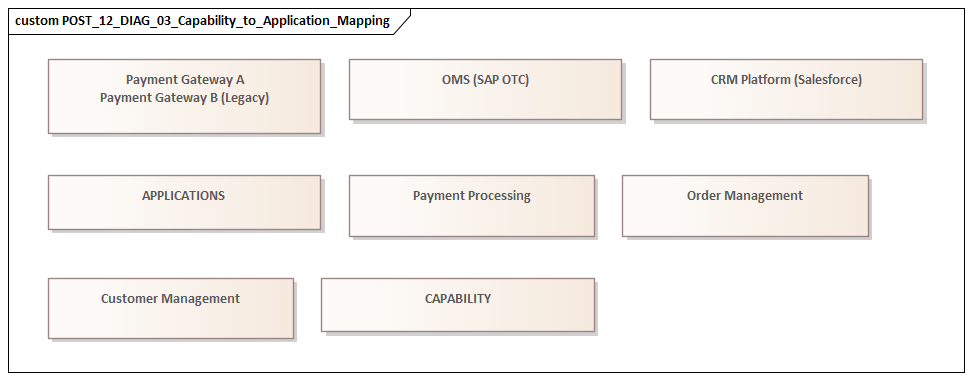
In Sparx EA, capabilities are modeled as elements in the Business or Strategy layer. Application Components in the Application layer are linked to capabilities via Realisation or Association relationships. This creates a queryable capability-to-application map that enables portfolio analysis and investment prioritisation.