⏱ 18 min read
Most enterprise architecture diagrams are expensive wallpaper.
That sounds harsher than it is. But not much harsher.
A lot of UML in the enterprise exists to satisfy governance, calm auditors, or decorate a Confluence page nobody opens after the project kickoff. Boxes, arrows, stereotypes, swimlanes. Beautiful. Useless by sprint three. The problem is not UML itself. The problem is that most teams use it as a static drawing language in a world where systems are dynamic, distributed, event-driven, policy-heavy, and cloud-hosted. UML modeling best practices
That is where Executable UML gets interesting.
Not because it magically turns architects into developers. Not because every model should generate all code. And definitely not because “model-driven everything” was some unfulfilled prophecy waiting for better tooling. Frankly, a lot of that old model-driven hype deserved to fail.
Executable UML matters for a more practical reason: it forces architecture to become precise enough to run.
And once a model can run, simulate, validate, or generate behavior with discipline, architecture stops being mostly opinion and starts becoming a testable asset.
Executable UML, simply explained
At a simple level, Executable UML is UML used in a way that defines system behavior precisely enough that tools can execute it, simulate it, or transform it into running software artifacts.
That’s the SEO-friendly version. Plain English: instead of drawing a sequence diagram to “communicate intent,” you create a behavioral model with enough semantics that a machine can do something real with it.
Usually that means:
- modeling state
- modeling events
- modeling actions
- modeling object interactions
- defining enough rules so the behavior is unambiguous
In traditional UML, a state machine might be explanatory. In Executable UML, it is behavioral truth, or at least close to it. A class model is not just documentation; it can drive runtime structures, validations, contracts, or generated code. An activity model is not just a process sketch; it can become an executable workflow or orchestration. UML for microservices
That distinction is everything.
If your diagrams can’t be interpreted consistently by both humans and tools, they are not executable. They are just illustrations.
Why enterprise architects should care
Because modern enterprise systems are too complex to manage with static diagrams alone.
Think about a bank launching a new digital lending platform. The architecture spans:
- customer identity and IAM
- fraud scoring
- Kafka event streams
- core banking integration
- cloud-native APIs
- decisioning workflows
- compliance and audit trails
- regional deployment constraints
- resilience policies
Now ask an uncomfortable question: how much of that architecture is defined precisely enough that engineering teams will implement it consistently?
Usually, not enough.
Architects write principles. Solution teams improvise. Integration teams fill gaps. Security adds controls late. Operations discovers the actual runtime model in production. Then everyone pretends the architecture was followed.
Executable UML offers a way to close part of that gap. Not all of it. I’m not selling religion here. But it can close the gap between conceptual architecture and runtime behavior, especially in domains where process, state, policy, and interaction rules matter.
The idea underneath: metamodel first, diagrams second
Here’s the part many people skip, and they shouldn’t.
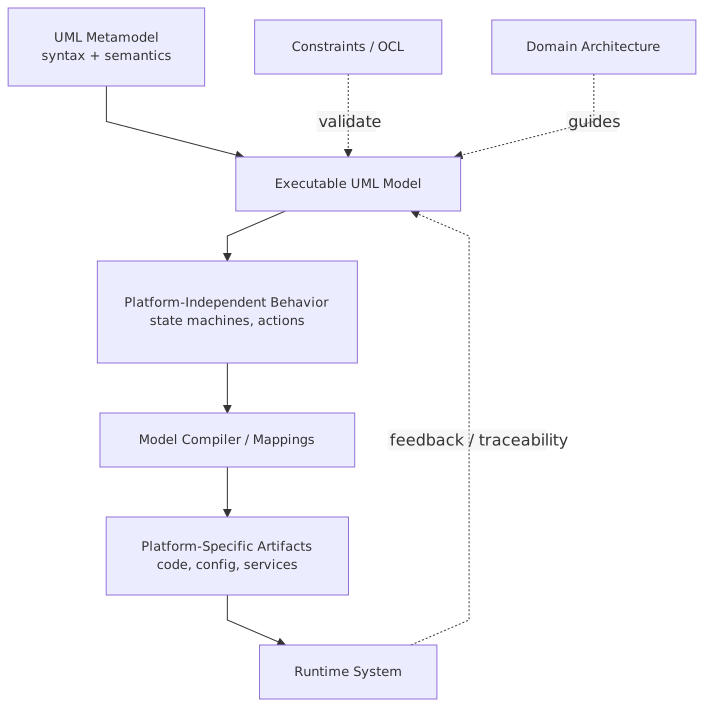
To understand Executable UML, you need to understand the metamodel. Not in a PhD way. In a practical architecture way.
A model describes a system.
A metamodel describes the language used to create that model.
UML itself is defined by a metamodel. It says what a class is, what an association is, what a state machine is, what a transition means, what constraints are allowed, and so on.
This matters because execution requires semantics. And semantics come from the metamodel.
If your architecture team says:
- “This box is a service”
- “This arrow is an event”
- “This state means pending”
- “This action provisions an entitlement”
…those things need formal meaning if you expect tooling to validate or execute them.
Otherwise, every team interprets the picture differently. Which, to be fair, is the default enterprise operating model.
Why metamodels matter in real life
In real architecture work, a metamodel gives you controlled vocabulary and behavioral consistency.
For example, in a banking architecture repository, you may define a metamodel where:
- Capability maps to business responsibility
- Application Service exposes business or technical functionality
- Domain Event is emitted asynchronously via Kafka
- Policy Decision Point evaluates IAM or risk rules
- Stateful Business Object follows a state machine
- Deployment Unit maps to cloud runtime artifacts
Now you’re not just drawing. You’re constraining what can be said and what it means.
Strong opinion: most architecture repositories fail not because the tooling is bad, but because the metamodel is lazy. Teams allow ambiguous object types, inconsistent relationships, and made-up semantics. Then they wonder why nobody trusts the repository.
Executable UML, or any executable modeling approach, punishes that laziness. Which is good.
So what actually makes UML “executable”?
Not every UML diagram is executable, and not every executable model uses all of UML.
In practice, Executable UML tends to focus on a subset of UML with clear runtime meaning:
- Class models for structure and domain concepts
- State machines for lifecycle behavior
- Activity diagrams for workflows and control logic
- Action semantics for executable behavior
- sometimes sequence/communication semantics, though these are often less central in execution
The key is that the model must specify:
- What objects exist
- What state they hold
- What events they receive
- How they transition
- What actions happen as a result
- What constraints must hold
That’s where precision enters. You move from “the payment service updates account status” to something like:
- LoanApplication enters
Approved - transition triggered by
CreditApproved - guard condition requires
KYCStatus = Verified - action emits
LoanApprovedEventto Kafka - IAM policy grants temporary access scope to underwriting role
- persistence update commits before event publication or via transactional outbox
That is architecture with teeth.
Not all execution means code generation
This is one of the biggest misconceptions.
People hear Executable UML and immediately think: “Oh, that old dream where diagrams generate the entire application.” Then they roll their eyes. Honestly, fair enough. Full code generation has been oversold for years.
But execution can mean several things.
This is where I get a bit contrarian: for enterprise architecture, full code generation is often less important than executable validation.
Why? Because enterprise architecture usually fails at the seams:
- missing states
- undefined ownership
- impossible transitions
- contradictory IAM policies
- event contracts that don’t line up
- cloud deployment assumptions that break resilience
If executable modeling catches those earlier, it has already paid for itself.
A practical mental model: architecture as layered semantics
If you want to apply Executable UML in a real enterprise, stop thinking of it as “draw and generate.” Think of it as layered semantics.
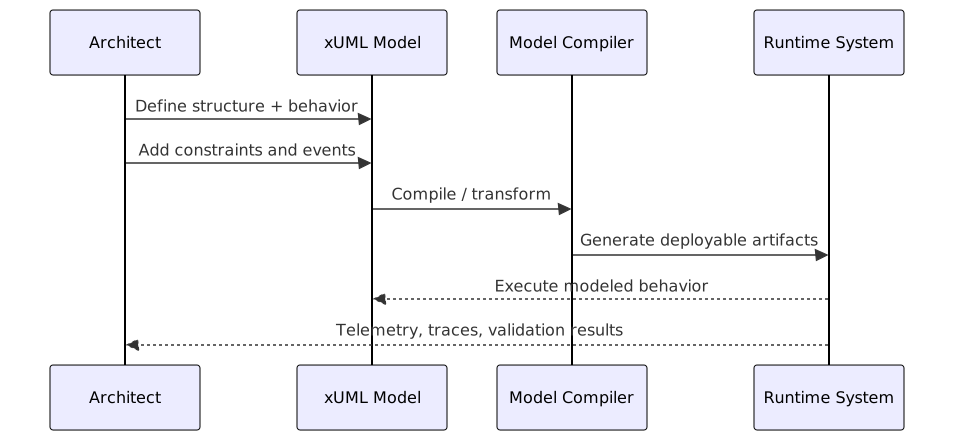
Layer 1: Conceptual architecture
This is the business-facing view.
- capabilities
- actors
- high-level services
- business objects
- major events
At this layer, UML can still be lightweight. You’re framing the problem.
Layer 2: Logical behavior
This is where executable discipline begins.
- state machines for important domain objects
- activities for workflows
- object interactions
- constraints and rules
- event definitions
This layer is where ambiguity gets expensive, so precision matters.
Layer 3: Platform mapping
Now you map the behavioral model to actual technologies.
- state transitions to microservice logic
- events to Kafka topics
- identity actions to IAM services
- workflows to BPM/workflow engines
- deployment units to Kubernetes or serverless components in cloud
Layer 4: Runtime realization
This is the system in production.
- running services
- event brokers
- policy engines
- cloud infrastructure
- logs, traces, metrics, audit records
Executable UML is most useful when layers 2 and 3 are explicitly connected. That’s where most architecture artifacts currently go to die.
A real enterprise example: digital account opening in a bank
Let’s make this concrete.
Imagine a retail bank modernizing account opening across mobile and web channels. The target architecture includes:
- a customer onboarding domain
- IAM integration for identity proofing and access control
- Kafka for event-driven integration
- cloud-hosted microservices on Kubernetes
- legacy core banking system behind APIs
- fraud and sanctions screening services
- audit and compliance monitoring
The business says: “We want account opening in under five minutes.” Fine. The architecture challenge is not the happy path. It’s the stateful mess underneath.
Core business object: AccountApplication
This object might have states like:
- Draft
- Submitted
- IdentityVerified
- RiskScreened
- Approved
- Rejected
- AccountProvisioned
- Failed
- Closed
In a normal architecture document, someone would draw that as a state machine and move on.
In an executable approach, that state machine becomes enforceable logic.
Example semantics
Submitted -> IdentityVerifiedonly if identity provider confirms KYCIdentityVerified -> RiskScreenedtriggered by sanctions/fraud workflow completionRiskScreened -> Approvedonly if risk score below threshold and product eligibility validApproved -> AccountProvisionedrequires successful core banking API response- any transition failure may route to
Failedwith compensation actions
Already this improves architecture quality, because now everyone is forced to ask:
- What events trigger transitions?
- Which system owns each state change?
- What happens if Kafka delivery is delayed?
- What if IAM identity proofing succeeds but core banking provisioning fails?
- What is the source of truth for application status?
These are architecture questions, not coding details.
Where Kafka fits
In the bank example, Kafka is not just plumbing. It is part of the behavioral contract.
You might define events such as:
ApplicationSubmittedIdentityVerifiedRiskAssessmentCompletedApplicationApprovedAccountProvisioningRequestedAccountProvisionedApplicationFailed
Executable modeling helps by linking event emission to state transitions. That sounds obvious, but many enterprises still model events separately from lifecycle behavior, which is a mistake.
Contrarian thought: event-driven architecture without explicit state models is often just distributed confusion.
Teams publish events, subscribe to topics, and celebrate decoupling. Meanwhile nobody can reliably answer what state a business object is in, who owns transitions, or what consistency guarantees exist. Executable UML can force those answers.
Where IAM fits
IAM is another area where architecture diagrams are usually too shallow.
In account opening, IAM is not just “user authenticates with SSO.” It includes:
- customer identity proofing
- consent capture
- role-based access for bank staff
- fine-grained access to application data
- service-to-service authorization
- audit of privileged actions
An executable model can represent IAM-related state and policy interactions, for example:
- application cannot transition to
Submittedwithout consent artifact - underwriting staff can trigger manual review only with
Underwriterrole - support users may view status but not PII unless elevated access is approved
- service actions emitting account creation commands require workload identity with scoped permissions
That’s useful architecture. Not “there is an IAM layer” nonsense.
Where cloud fits
Now map this to cloud runtime:
- onboarding service runs on Kubernetes
- Kafka is managed cloud streaming
- IAM uses cloud-native identity plus bank federation
- workflow engine orchestrates manual review steps
- object store holds evidence documents
- observability stack traces state transitions and policy decisions
The executable model does not need to replace all infrastructure-as-code. That would be silly. But it can define the behavioral logic that those runtime platforms implement.
This is the sweet spot.
How architects actually use this in real work
Let’s leave theory for a minute.
In actual enterprise architecture work, Executable UML is useful in five places.
1. Clarifying domain behavior before implementation
This is the obvious one. Before teams build services, you model the lifecycle of key business objects.
In banking, those are things like:
- account applications
- payments
- loans
- disputes
- customer entitlements
If the state model is weak, the implementation will drift immediately.
2. Aligning event-driven integration
Kafka-based systems often suffer from event sprawl. Too many topics, weak naming, duplicate semantics, no lifecycle ownership.
Executable models help define:
- event sources
- triggering conditions
- state preconditions
- consumer expectations
- error and retry behavior
This is much better than a giant event catalog with no behavioral context.
3. Making IAM architecture concrete
Architects often leave IAM too abstract until security design. Big mistake.
When identity, authorization, and consent are modeled as executable constraints or policy-linked actions, teams discover issues earlier:
- missing approval paths
- over-broad roles
- impossible segregation-of-duty rules
- broken customer/staff access boundaries
4. Testing architecture decisions before coding everything
Simulation matters more than many architects admit. ArchiMate in TOGAF ADM
If you simulate a workflow and discover there are six failure modes with no compensation path, you just saved the program months of pain.
5. Governing change in regulated environments
In regulated sectors like banking, architecture changes need traceability.
Executable models can provide traceability from:
- business rule
- to state transition
- to event
- to service behavior
- to control evidence
Auditors like evidence. Engineers like clarity. Architects should like both.
Common mistakes architects make
This is where I’ll be blunt.
Mistake 1: Treating UML as presentation, not semantics
If your model is only for presentation, don’t call it architecture rigor. Call it communication support.
There’s nothing wrong with lightweight diagrams. But don’t confuse a sketch with a precise model.
Mistake 2: Modeling everything
This kills executable modeling fast.
Not every part of the enterprise needs executable precision. Focus on domains where behavior, state, and policy matter most.
Good candidates:
- onboarding
- payments
- access control
- fulfillment
- exception handling
- compliance workflows
Bad candidates:
- every trivial CRUD admin function
- generic reporting views
- low-value technical utilities
Mistake 3: Ignoring the metamodel
If teams invent meanings ad hoc, execution becomes impossible or misleading.
You need a defined modeling vocabulary. Not massive, just disciplined.
Mistake 4: Separating business process from technical events
In many enterprises, BPM people model process, integration people model events, and application teams model services. Three disconnected truths. It never ends well.
State transitions, process actions, and events must be connected.
Mistake 5: Believing code generation solves architecture
It doesn’t.
Generated code can still implement a bad design. Worse, it can industrialize a bad design.
Mistake 6: Forgetting runtime concerns
A model that ignores retries, idempotency, eventual consistency, authorization, and observability is not executable architecture. It’s a fantasy.
Mistake 7: No ownership model
Who owns the state machine? Who approves changes? Who validates topic contracts? Who governs IAM policies?
If the answer is “everyone,” the answer is no one.
What good looks like
A good executable architecture practice is narrower than people think and more disciplined than people want.
Here’s a practical view.
That’s the shift. Less decorative architecture, more operational architecture.
The uncomfortable truth about tooling
Tooling matters, but less than people think.
Bad tools can slow you down, yes. But many architecture teams blame tools when the real problem is that they want precision without discipline. That’s not how this works.
To make Executable UML useful, you need tools that support some combination of:
- UML behavioral modeling
- model validation
- state machine execution or simulation
- transformation to code/config/workflow artifacts
- traceability to implementation and runtime components
But the harder problem is organizational:
- getting architects and engineers to agree on semantics
- limiting the scope
- treating the model as a living asset
- integrating it into delivery, not just governance
If your executable model lives in a specialist tool that nobody in engineering touches, it will become another architecture graveyard.
A sane adoption path
Do not try to “roll out Executable UML across the enterprise.” That sentence alone should trigger suspicion.
Instead:
Step 1: Pick one high-value domain
A banking onboarding flow. A payment exception process. An IAM access approval lifecycle.
Something with:
- clear business value
- stateful behavior
- cross-team dependencies
- compliance sensitivity
Step 2: Define a minimal metamodel
Don’t boil the ocean.
Maybe just:
- business object
- state
- event
- action
- policy constraint
- service owner
- deployment unit
That’s enough to start.
Step 3: Model one lifecycle deeply
Go beyond happy paths.
Model:
- transitions
- failures
- retries
- manual intervention
- audit events
- authorization checks
Step 4: Connect it to runtime platforms
Map:
- events to Kafka topics
- actions to services
- approvals to workflow engine
- identities to IAM components
- deployment to cloud services
Step 5: Validate with engineering and operations
If SREs, developers, and security architects can’t use the model, it’s too abstract.
Step 6: Use it in change governance
No major change to the flow should happen without updating the model. Otherwise execution and architecture diverge immediately.
Where Executable UML fits relative to other architecture methods
It is not a replacement for all architecture methods. It complements them.
- ArchiMate is often better for enterprise-wide viewpoint mapping
- C4 is often better for software communication and decomposition
- BPMN can be better for business workflow readability
- Infrastructure as Code is better for provisioning cloud runtime
- Policy-as-Code is better for technical enforcement in some IAM/security scenarios
Executable UML sits in an interesting middle zone: precise enough to represent behavior, abstract enough to stay architectural.
That middle zone is valuable.
My opinion: too many enterprises jump from high-level diagrams straight into platform-specific implementation. They skip the behavioral architecture layer entirely. Then they wonder why distributed systems become inconsistent and governance becomes performative. ARB governance with Sparx EA
Executable UML can fill that gap if used carefully.
What it does not solve
Let’s not romanticize it.
Executable UML does not solve:
- bad domain boundaries
- weak product ownership
- politics between teams
- poor data quality
- broken legacy APIs
- immature DevOps
- every cloud design problem
- every IAM policy challenge
And it definitely does not eliminate the need for code-level design.
It also won’t help if the organization lacks the patience to model behavior honestly. Some enterprises say they want rigor, but what they really want is a diagram that approves funding. Different thing.
Final thought
Executable UML is not interesting because it makes diagrams run.
It is interesting because it forces architects to be explicit about behavior, ownership, state, and constraints before reality does it for them in production.
That’s the real value.
In banking, in Kafka-heavy integration landscapes, in IAM-sensitive platforms, in cloud-native systems with too many moving parts, the architecture that survives is not the architecture with the prettiest pictures. It’s the architecture that can be reasoned about, validated, and traced into runtime behavior.
So yes, use UML if it helps. But stop using it like digital whiteboard art.
If a model cannot clarify how the system behaves, who owns transitions, what events mean, how access is controlled, and how runtime components realize the design, then it is not architecture in any serious sense.
It’s just drawing.
FAQ
1. Is Executable UML the same as model-driven development?
Not exactly. Executable UML is often part of a model-driven approach, but the key idea is that the model has precise behavioral semantics. That may lead to simulation, interpretation, validation, workflow execution, or code generation. Full model-driven development is broader and often more ambitious.
2. Should enterprise architects try to generate complete applications from UML models?
Usually no. That’s the wrong goal for most enterprises. A better goal is to make critical behavioral models precise enough to validate, simulate, and partially transform into implementation artifacts. Full generation can work in narrow domains, but it is not the main value.
3. Where is Executable UML most useful in enterprise systems?
It works best in domains with complex state and policy: banking onboarding, payment processing, IAM approval flows, claims handling, order fulfillment, and compliance-heavy workflows. It is less useful for simple CRUD-heavy applications with minimal behavior. EA governance checklist
4. How does Executable UML help with Kafka-based event-driven architecture?
It ties events to explicit business object lifecycles and transitions. That reduces event sprawl, clarifies ownership, and makes it easier to reason about retries, failures, and eventual consistency. Without that, Kafka often becomes a transport layer for loosely understood business semantics.
5. Can Executable UML work in cloud-native architecture?
Yes, if you use it at the right level. It should define behavior and constraints, then map them to cloud runtime components like Kubernetes services, managed Kafka, IAM platforms, workflow engines, and observability tooling. It should not try to replace infrastructure-as-code or platform engineering practices.
Frequently Asked Questions
What is a UML metamodel?
A UML metamodel is a model that defines UML itself — it specifies what element types exist (Class, Interface, Association, etc.), what relationships are valid between them, and what constraints apply. It uses the Meta Object Facility (MOF) standard, meaning UML is defined using the same modeling concepts it uses to define other systems.
Why does the UML metamodel matter for enterprise architects?
The UML metamodel determines what is and isn't expressible in UML models. Understanding it helps architects choose the right diagram types, apply constraints correctly, use UML profiles to extend the language for specific domains, and validate that models are internally consistent.
How does the UML metamodel relate to Sparx EA?
Sparx EA implements the UML metamodel — every element type, relationship type, and constraint in Sparx EA corresponds to a metamodel definition. Architects can extend it through UML profiles and MDG Technologies, adding domain-specific stereotypes and tagged values while staying within the formal metamodel structure.