⏱ 19 min read
Most enterprise architecture teams don’t fail because they lack diagrams. They fail because everyone looks at the same diagram and quietly assumes a different meaning.
That is the uncomfortable truth behind semantic variation points in UML. UML gives us a standardized notation, yes. But it also leaves parts of meaning intentionally open. That flexibility sounds elegant in theory. In practice, it’s where architecture reviews go sideways, delivery teams build incompatible interpretations, and governance boards approve designs that were never actually aligned.
My opinion: semantic variation points are one of the most under-discussed risks in enterprise architecture. Not because UML is bad. UML is still useful. But because architects often pretend the notation is precise when the semantics are not. That gap matters a lot once you move from whiteboard modeling into regulated, distributed, cloud-heavy enterprise systems.
And if you work in banking, insurance, public sector, or any environment with Kafka, IAM, multiple clouds, and too many integration teams, this topic is not academic. It’s operational.
Let’s make it simple first.
The simple version
A semantic variation point in UML is a place where UML allows more than one valid interpretation of meaning.
In plain English: the diagram symbol is standard, but what it means can vary unless the modeler or organization defines it more precisely.
That means two architects can both be “using UML correctly” and still mean different things. UML modeling best practices
Examples:
- Does a component dependency imply runtime invocation, deployment dependency, or just design-time usage?
- Does an interface realization represent a strict service contract or a looser capability?
- Does an activity flow imply synchronous processing, eventual completion, or merely ordering?
- Does a state transition happen atomically, transactionally, or via asynchronous events?
UML intentionally leaves room for interpretation because it needs to work across many domains. Embedded systems. Business processes. Enterprise applications. Telecom. Banking. That flexibility is not a bug. But in enterprise architecture, unmanaged flexibility becomes ambiguity, and ambiguity becomes delivery risk.
So the core issue is this:
> If your architecture uses UML but you do not define the semantics that matter for your organization, your models are only half-specified. UML for microservices
That’s the simple explanation. Now the deeper one.
Why UML has semantic variation points in the first place
A lot of people treat UML as if it were a programming language with strict execution meaning. It isn’t. UML is a modeling language, not an executable truth machine.
The UML spec separates things into:
- syntax: the notation and structure
- semantics: the meaning
- variation points: places where the semantics may differ or be specialized
This was a deliberate design choice. It allowed UML to be broadly adopted without forcing one rigid interpretation onto every domain.
Fair enough. A telecom switching model and a retail banking onboarding model should not be forced into exactly the same semantic frame.
But here’s my contrarian view: what was good for standardization became dangerous for enterprise architecture governance.
Why? Because enterprises don’t just need expressive notation. They need:
- repeatable interpretation
- review consistency
- traceability
- automation potential
- architecture decisions that survive handoffs
If one team models “service dependency” as synchronous REST and another uses the same notation to mean asynchronous Kafka consumption, your portfolio-level diagrams become political artwork. Nice shapes. No operational truth.
That’s why semantic variation points matter more in enterprise architecture than they do in a classroom.
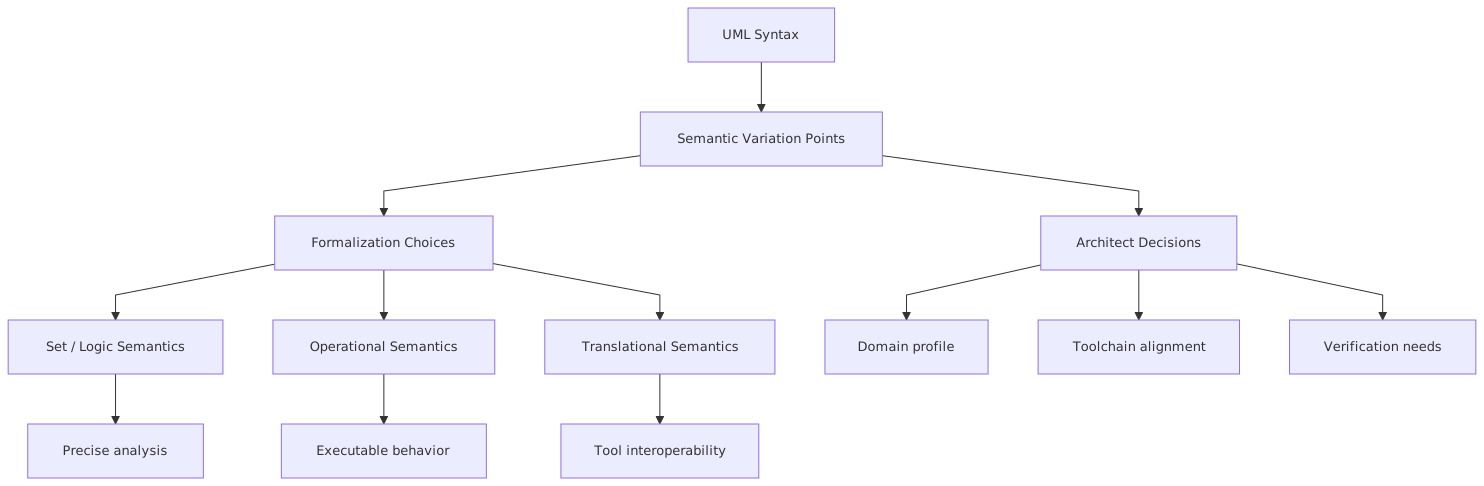
Formalization: what it actually means
When people hear “formalization,” they often think of heavy methodology, too much governance, or some architecture office trying to suck all the life out of modeling. ArchiMate for governance
That’s not what I mean.
In this context, formalization means making the intended meaning of UML constructs explicit enough that teams interpret them consistently.
You can formalize semantic variation points through several mechanisms:
- Modeling conventions
- A published architecture modeling standard
- Example: “A dependency arrow between application components means runtime invocation only, not data ownership or deployment coupling”
- Profiles and stereotypes
- Extend UML with organization-specific semantics
- Example: <, <, <
- Tagged values
- Attach metadata to model elements
- Example: message delivery guarantee = at-least-once
- Constraints
- Formal or semi-formal rules
- Example: customer master systems cannot be modeled as depending on downstream reporting platforms for operational processing
- Reference semantics
- Mapping UML constructs to enterprise architecture concepts
- Example: “component” means deployable service boundary in cloud-native systems, not merely a code module
- Tooling rules
- Validation in modeling repositories
- Example: every interface exposed externally must include authentication and data classification tags
This is where architecture becomes real work. Not drawing. Defining meaning.
And yes, some architects resist this. They say formalization makes diagrams harder to create. True. It also makes them harder to misuse. Which is exactly the point.
The trade-off nobody likes to admit
There is no free lunch here.
The whole conversation about semantic variation points is really a conversation about one trade-off:
My strong view: selective formalization is the only sane enterprise approach.
Trying to formalize every UML semantic choice is a mistake. It creates a modeling religion. Teams stop thinking and start filling in templates. The result looks rigorous and is often dead on arrival.
But doing nothing is worse. Then your architecture repository becomes a museum of conflicting assumptions.
The right move is to formalize where ambiguity creates material risk:
- security boundaries
- integration semantics
- data ownership
- identity and access
- resiliency expectations
- deployment responsibility
- event delivery guarantees
- consistency and transactional assumptions
In other words, formalize the semantics that can break production systems, compliance posture, or operating models.
Not every association line in every diagram.
Where semantic variation points hurt in real architecture work
This is where the topic stops being theoretical.
1. Integration architecture
In many enterprises, architects draw application interaction diagrams with arrows between systems and call it done. That’s lazy architecture.
The arrow itself is often semantically underdefined:
- Is it sync or async?
- Request-response or fire-and-forget?
- Contract versioned or informal?
- Is the source dependent on availability of the target?
- Is there temporal coupling?
- Who owns retry behavior?
- Is ordering guaranteed?
- Is this API, file transfer, event stream, or CDC?
If you use the same UML dependency or connector notation for all of that, your model hides the most important decisions.
In Kafka-heavy environments, this gets worse. Teams often draw a producer connected to a topic and a consumer connected to the same topic and assume the design is obvious. It isn’t.
Key semantic questions:
- Is the topic an integration contract or an internal implementation detail?
- Is the consumer allowed to replay indefinitely?
- Is the event immutable?
- Is schema evolution backward-compatible?
- Is ordering per key meaningful to business logic?
- Is the event authoritative or merely informative?
A UML component or sequence diagram won’t answer those by itself. You have to formalize the semantics around it.
2. IAM and security architecture
This is one of the biggest blind spots.
Architects model users, applications, identity providers, and access relationships. Fine. But the semantics of those relationships are often murky.
Example:
- Does an association between an application and IAM platform mean authentication only?
- Or authentication plus authorization?
- Does “role” refer to business role, application role, cloud IAM role, or privileged operational role?
- Is trust federated or centralized?
- Are tokens propagated or exchanged?
- Is service-to-service identity distinct from end-user identity?
If you don’t define these semantics, the diagram can pass review while the implemented design creates privilege escalation paths or audit gaps.
And in banking, that’s not a small problem. That’s a regulator problem.
3. Cloud deployment architecture
UML deployment diagrams are useful, but they have semantic variation points too. A node can represent many things depending on how your organization uses the notation:
- physical host
- VM
- Kubernetes cluster
- namespace
- managed service boundary
- cloud account
- region-level construct
If one architect models a “node” as a Kubernetes namespace and another uses it as an entire AWS account, your deployment models become incomparable.
This matters for:
- isolation design
- blast radius
- cost responsibility
- controls inheritance
- network trust boundaries
Cloud architecture absolutely requires semantic discipline. Otherwise “deployed on separate nodes” means whatever the presenter needs it to mean in that meeting.
4. Data architecture and ownership
Another classic enterprise mess.
A UML class or component model might show that multiple systems use “Customer,” “Account,” or “Transaction” entities. But what is the semantic meaning of use?
- authoritative ownership?
- cached copy?
- reporting replica?
- transient enrichment?
- golden source?
- operational source of truth for one subdomain only?
Without formalization, architects accidentally approve duplicated ownership models while believing they’ve designed shared understanding.
That’s how enterprises create seven customer masters and then spend five years talking about MDM.
Common mistakes architects make
Let me be blunt. Most problems here are self-inflicted.

Mistake 1: Assuming notation equals meaning
It doesn’t.
A clean UML diagram is not a precise architecture just because it looks professional. Architects often overestimate how much meaning is carried by standard notation.
The notation is a starting point. Semantics still need to be declared.
Mistake 2: Mixing abstraction levels in one diagram
This is epidemic.
You’ll see a component diagram mixing:
- business capabilities
- application services
- Kafka topics
- IAM roles
- cloud resources
- teams
Then people wonder why reviews become vague.
Semantic variation points get worse when abstraction levels are mixed, because the reader can’t tell what kind of dependency or responsibility is being modeled.
Mistake 3: Using one arrow for every kind of relationship
Dependency. Invocation. Ownership. Trust. Replication. Event subscription. Control. All shown the same way.
This is not simplification. It is semantic collapse.
Mistake 4: Formalizing too late
Teams often wait until implementation friction appears, then try to retrofit semantics into diagrams. By then:
- interfaces already exist
- IAM patterns are embedded in code
- Kafka topics are already consumed by six teams
- cloud accounts and permissions are provisioned
Formalization should happen at the architecture pattern level, not as cleanup after delivery.
Mistake 5: Over-formalizing low-value areas
This is the opposite error. Some architecture offices become obsessed with complete semantic purity. They define twenty stereotypes for concepts nobody uses, and then wonder why product teams stop modeling.
Not every line needs a constitutional amendment.
Mistake 6: Confusing tool constraints with semantic clarity
A repository tool may force mandatory fields. Good. That does not mean the model semantics are sound.
You can have a fully populated modeling tool full of unclear architecture.
Mistake 7: Ignoring operational semantics
This is the big one in event-driven and cloud systems.
Architects model structure but not behavior:
- retries
- failure modes
- eventual consistency
- replay
- token expiration
- failover
- dead-letter handling
- idempotency
Yet these are often the actual semantics that determine whether the architecture works.
A real enterprise example: retail banking onboarding on Kafka and cloud IAM
Let’s make this concrete.
A mid-sized retail bank was redesigning customer onboarding across channels:
- mobile app
- branch platform
- web onboarding
- fraud screening
- KYC/AML services
- customer master platform
- notification services
The target architecture used:
- Kafka for event distribution
- cloud-hosted microservices
- centralized IAM with federation
- a mix of managed database services and existing on-prem core banking systems
The architecture team produced UML component and sequence diagrams. On paper, it looked good. Modern, event-driven, secure.
But there were hidden semantic variation problems.
What the diagrams showed
Onboarding ServicepublishesCustomerCreatedFraud Serviceconsumes onboarding eventsCustomer Masterreceives customer dataIAM Platformauthenticates users and services- cloud deployment nodes host each service in separate environments
Looks reasonable. Review passed.
What different teams assumed
Channel team assumption
CustomerCreatedmeans onboarding successfully completed and customer is active
Fraud team assumption
CustomerCreatedis an early lifecycle event meaning “candidate customer record exists”
Customer master team assumption
- customer master becomes authoritative owner as soon as it receives the event
IAM team assumption
- service identity propagation includes end-user context in all downstream service calls
Platform team assumption
- each service on a separate deployment node means separate Kubernetes namespaces, not separate cloud accounts or trust zones
All of these assumptions were consistent with the diagrams as drawn.
And all of them were incompatible.
What went wrong
- Event meaning was ambiguous
- Fraud processing delayed activation, but downstream systems treated CustomerCreated as final
- Notifications were sent before KYC completion
- Ownership semantics were unclear
- The onboarding service and customer master both behaved as temporary systems of record
- Reconciliation logic exploded
- IAM semantics were muddled
- Some service calls used client credentials only
- Others attempted token propagation
- Audit trails for user-initiated actions became inconsistent
- Deployment isolation was overstated
- “Separate nodes” in the UML deployment diagram implied stronger isolation than actually implemented
- Security reviewers thought privileged admin paths were segmented across trust boundaries when they were only namespace-separated TOGAF roadmap template
- Kafka topic semantics were not formalized
- Teams treated topics as either durable business contracts or internal integration channels depending on convenience
- Schema changes caused avoidable downstream breaks
How the architecture was fixed
The bank did not replace UML. It formalized the semantic variation points that mattered.
They introduced:
- a UML profile for event-driven architecture
- stereotypes for
<,> <,> <,> <,> <,> <> - required tagged values for:
- delivery guarantee
- ordering scope
- PII classification
- source-of-truth status
- authentication mode
- authorization decision point
- deployment isolation level
And they published a short but practical semantic guide:
CustomerCreatedrenamed toCustomerOnboardingInitiatedCustomerActivatedintroduced as the business event for downstream activation logic- application-to-application IAM relationships had to declare whether they used propagated user identity, token exchange, or service-only credentials
- deployment nodes were mapped to defined cloud isolation levels:
- namespace
- cluster
- account/subscription
- region
That one move reduced architecture review confusion dramatically. More importantly, implementation teams stopped inventing semantics during delivery.
This is what real architecture work looks like. Less art. More disciplined meaning.
A practical formalization approach for enterprise architects
If you’re running architecture in a serious enterprise, here’s the approach I recommend.
1. Identify high-risk semantic areas
Don’t start with all UML constructs. Start with the places where ambiguity creates expensive mistakes.
Usually:
- integration semantics
- event semantics
- IAM trust and authorization
- data ownership
- deployment isolation
- resiliency expectations
2. Define enterprise meanings, not theoretical ones
Avoid academic language where possible. Your semantic guide should answer practical questions like:
- Does this arrow mean synchronous dependency?
- What exactly qualifies as an authoritative source?
- When can a Kafka topic be modeled as a business contract?
- What does “separate deployment node” mean in our cloud model?
If a delivery lead can’t use the definition in a design review, it’s too abstract.
3. Create a lightweight UML profile
Not fifty stereotypes. Maybe ten to fifteen that matter.
For example:
That’s enough to improve clarity without turning your model into a taxonomy project.
4. Attach mandatory metadata where semantics matter
Examples:
- consistency model
- retry ownership
- idempotency requirement
- data classification
- RTO/RPO relevance
- token type
- trust boundary crossing
- schema compatibility rule
This is where modeling starts becoming useful for governance and automation. EA governance checklist
5. Teach reviewers to challenge semantics, not just notation
Architecture review boards often spend too much time on visual neatness and too little on meaning.
Better review questions:
- What does this dependency imply operationally?
- Is this event authoritative or informative?
- What identity context is present on this call?
- What isolation level does this deployment node represent?
- Who owns replay and duplicate handling?
That is architecture. The rest is drawing hygiene.
Contrarian thought: sometimes ambiguity is useful
I don’t want to oversell formalization.
There are cases where semantic looseness is healthy.
Early-stage exploration benefits from softer modeling. If a team is still comparing architectural options, forcing precise semantics too early can create fake certainty. You end up polishing assumptions before the business case is stable.
Also, in strategic enterprise views, some abstraction is necessary. A portfolio map should not carry the same semantic precision as a solution interaction model for payments processing.
So yes, ambiguity has a place.
But here’s the catch: intentional ambiguity is fine; accidental ambiguity is not.
If a model is exploratory, say so.
If a relationship is conceptual, say so.
If semantics are deferred, record that decision.
The problem is not incomplete models. The problem is pretending incomplete models are precise enough for governance or delivery commitment.
That distinction matters.
How this applies in day-to-day architecture work
This topic shows up constantly, even if teams don’t call it by name.
In solution architecture
You’re reviewing a design for a new customer notification service. The sequence diagram shows an API call from account servicing and an event emitted to Kafka. You need to know:
- is the API call part of a transaction boundary?
- does notification depend on immediate success?
- can the event be replayed?
- what customer identity context is allowed downstream?
Without explicit semantics, the design is fragile.
In enterprise integration governance
You’re trying to reduce point-to-point interfaces. UML component diagrams show “service interactions” across domains. Unless you formalize whether those are business contracts, internal calls, or event subscriptions, your target-state architecture is fantasy.
In IAM architecture
You’re standardizing access patterns for cloud-native applications. Diagrams show applications trusting the enterprise IdP and using cloud IAM roles. You need to distinguish:
- workforce identity
- customer identity
- workload identity
- privileged admin identity
If UML relationships don’t carry that semantic distinction, your control model will be weak.
In cloud platform architecture
You’re defining landing zones and workload isolation. Deployment diagrams need semantic rules for what constitutes:
- environment boundary
- trust boundary
- network boundary
- operational ownership boundary
Otherwise every team claims compliance while implementing something different.
In data governance
You’re documenting system-of-record patterns. Models must distinguish:
- creates data
- owns data
- replicates data
- enriches data
- consumes data
- archives data
A generic association line is nowhere near enough.
What good looks like
A good enterprise architect does not just produce diagrams. They produce shared meaning.
That means:
- the notation is understandable
- the semantics are explicit where risk is high
- the abstraction level is controlled
- the model supports decisions, not decoration
- teams can implement from it without inventing key assumptions
If your UML models require the original architect to stand beside them and explain every connector, they are not architecture assets. They are presentation aids.
That sounds harsh, but it’s true.
The best architecture teams I’ve seen do three things well:
- they standardize only what matters
- they tie semantics to operational reality
- they accept that modeling is communication with governance consequences, not just a documentation exercise
That’s the mature position.
Final take
Semantic variation points in UML are not a niche modeling curiosity. They are one of the reasons enterprise architecture often looks aligned while delivery outcomes diverge.
UML gives you a common language, but not always a common meaning. If you ignore that, your architecture practice becomes vulnerable to interpretation drift. In modern enterprises—especially those built on Kafka, federated IAM, cloud platforms, and distributed ownership models—that drift is expensive.
So my advice is straightforward:
- Do not abandon UML
- Do not worship UML
- Formalize semantics where ambiguity creates real risk
- Keep it lightweight enough that teams will actually use it
- Treat semantics as part of architecture governance, not optional commentary
Because in enterprise architecture, the dangerous thing is rarely the diagram you forgot to draw.
It’s the one everyone approved for different reasons.
FAQ
1. Are semantic variation points a flaw in UML?
No. They are a design feature. UML had to support many domains, so some semantics were intentionally left open. The flaw is usually in how enterprises use UML without defining local meaning where it matters.
2. Should we create a full enterprise UML meta-model?
Usually no. That becomes too heavy for most organizations. A selective approach is better: define profiles, stereotypes, and constraints only for high-risk areas like integration, IAM, data ownership, and deployment isolation.
3. How is this relevant to Kafka-based architectures?
Very relevant. UML alone does not define whether an event is a business contract, whether replay is allowed, what delivery guarantees exist, or who owns schema compatibility. Those semantics must be made explicit or Kafka designs become dangerously ambiguous.
4. What is the biggest mistake architects make with semantic variation points?
Assuming everyone shares the same interpretation of a diagram. They don’t. Especially across security, platform, integration, and application teams. Architects need to define meaning, not just notation.
5. Can ArchiMate or C4 avoid this problem?
They can reduce some ambiguity in certain contexts, but they do not eliminate the underlying issue. Every modeling language has interpretation boundaries. The real discipline is not picking a “perfect” notation. It’s establishing shared semantics for the decisions your enterprise actually cares about.
Frequently Asked Questions
What is enterprise architecture?
Enterprise architecture is a discipline that aligns an organisation's strategy, business processes, information systems, and technology. Using frameworks like TOGAF and modeling languages like ArchiMate, it provides a structured view of how the enterprise operates and how it needs to change.
How does ArchiMate support enterprise architecture practice?
ArchiMate provides a standard modeling language that connects strategy, business operations, applications, data, and technology in one coherent model. It enables traceability from strategic goals through business capabilities and application services to the technology platforms that support them.
What tools are used for enterprise architecture modeling?
The main tools are Sparx Enterprise Architect (ArchiMate, UML, BPMN, SysML), Archi (free, ArchiMate-only), and BiZZdesign Enterprise Studio. Sparx EA is the most feature-rich option, supporting concurrent repositories, automation, scripting, and integration with delivery tools like Jira and Azure DevOps.