⏱ 19 min read
Most enterprise architecture arguments about modeling languages are a waste of time.
There, I said it.
Teams spend weeks debating whether ArchiMate or UML is “better,” while the actual architecture is rotting in Confluence, integration dependencies are tribal knowledge, IAM is stitched together with screenshots, and the Kafka estate has become a distributed rumor. The language is not the architecture. But—and this is the important part—the language absolutely shapes what architects can see, discuss, govern, and change.
So yes, the comparison matters. A lot.
My strong opinion: ArchiMate is generally better for enterprise architecture communication and cross-domain reasoning; UML is generally better for design precision and software-centric semantics. If you try to use UML as your primary enterprise architecture language, you usually end up with diagrams that are technically rich and organizationally useless. If you try to use ArchiMate for detailed system design, you end up with elegant abstractions that hide exactly the implementation risks that will later hurt you.
That is the real comparison. Not “which one wins.” But what kind of expressiveness each metamodel enables, and what architectural decisions become easier—or harder—because of that.
The simple explanation
Let’s get the SEO-friendly version out early.
- ArchiMate is a modeling language designed for enterprise architecture.
It is good at expressing relationships between business capabilities, processes, applications, data, technology, and motivation.
- UML is a modeling language designed primarily for software and system design.
It is good at expressing structure, behavior, interactions, classes, components, deployment, and implementation detail.
If you are mapping:
- business capability to application service to cloud platform to IAM dependency, ArchiMate is usually the cleaner fit.
- service internals, object relationships, API sequence behavior, or component-level design, UML is usually more expressive.
That’s the short answer.
But the real issue is metamodel expressiveness. In other words: what kinds of things the language can represent natively, and what kinds of meaning you have to force into it.
And this is where a lot of architects get sloppy.
The comparison most people make is too shallow
People often compare ArchiMate and UML by saying things like:
- “ArchiMate is more abstract.”
- “UML is more detailed.”
- “ArchiMate is for business, UML is for IT.”
All true. Also not enough.
The better question is this:
What kinds of architectural truth can each metamodel express without distortion?
Because every model distorts reality. The issue is whether it distorts the right parts.
UML’s expressiveness
UML is powerful because it has rich semantics for:
- structural decomposition
- interface realization
- object and class relationships
- dynamic interactions
- state transitions
- deployment structures
- behavioral specifications
It is a language born from software engineering. Even when used at higher levels, it carries that DNA. It likes systems that can be decomposed into well-defined parts with crisp interactions.
That’s excellent when you are designing:
- a customer onboarding service
- a token validation component
- a fraud rules engine
- a Kafka consumer group behavior
- cloud deployment nodes and runtime environments
ArchiMate’s expressiveness
ArchiMate is powerful because it has rich semantics for:
- layering across business, application, and technology
- service-oriented abstractions
- motivation and strategy linkage
- capability mapping
- implementation and migration viewpoints
- dependency tracing across domains
- enterprise-wide impact analysis
ArchiMate is not trying to explain your code. It is trying to explain your enterprise. That distinction matters more than many modelers admit. EA governance checklist
It is excellent when you are reasoning about:
- which business capabilities depend on IAM
- which applications publish to Kafka and why
- which cloud platform services underpin a customer journey
- which regulatory requirement drives a control
- which transition architecture creates operational risk
That is a very different expressive target.
Metamodels matter because they bias thinking
A metamodel is not just a schema behind a tool. It is an opinion about reality.
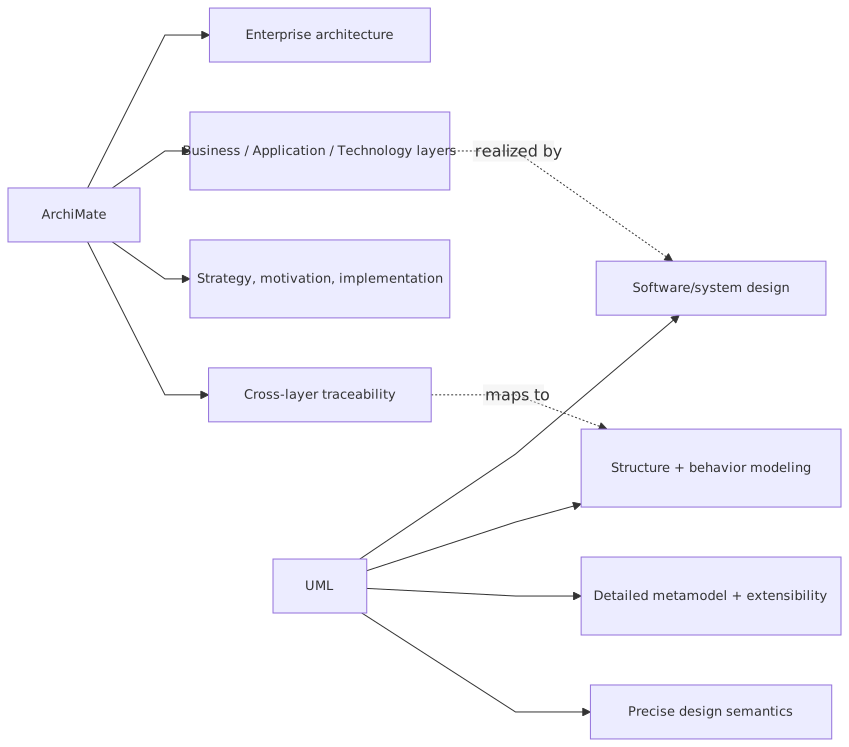
That sounds philosophical, but in architecture work it’s painfully practical.
If your metamodel makes it easy to model components, interfaces, ports, and messages—but awkward to model capabilities, value streams, and policy drivers—your architecture practice will drift toward technical decomposition and away from enterprise reasoning.
If your metamodel makes it easy to connect strategic goals to technology platforms—but vague to represent runtime interactions and object responsibilities—your architecture practice will drift toward executive coherence and away from engineering precision.
Neither is wrong. But pretending they are interchangeable is wrong.
This is one of the biggest mistakes architects make: they confuse diagramming convenience with semantic fitness.
A rectangle is easy to draw in both. That doesn’t mean it means the same thing.
ArchiMate is more expressive for enterprise relationships
Here’s my contrarian take: many architects underestimate ArchiMate because they confuse simplicity with weakness. ArchiMate modeling guide
ArchiMate has fewer detailed constructs than UML in many areas. True. But for enterprise architecture, that is often a feature, not a bug.
Why? Because enterprise architecture is usually less about detailed internal mechanics and more about cross-layer dependency truth.
In a bank, when an architect asks:
- Which customer channels rely on the central IAM platform?
- Which regulatory controls depend on event integrity in Kafka?
- Which cloud landing zone services support payment processing?
- Which business process breaks if token introspection latency spikes?
- Which applications are consumers of customer-profile events?
Those are not class-model questions. They are not sequence-diagram-first questions. They are enterprise dependency questions.
ArchiMate handles that elegantly because its metamodel was built to connect:
- business actors
- business processes
- application services
- application components
- data objects
- technology services
- infrastructure nodes
- goals, requirements, principles, constraints
- work packages, plateaus, gaps
That breadth matters.
A useful way to say it
UML expresses systems deeply. ArchiMate expresses enterprises broadly.
And in real architecture work, breadth often beats depth first.
UML is more expressive for design semantics
Now let’s not turn this into ArchiMate fan fiction. UML is more expressive in areas where enterprise architects often become hand-wavy. ArchiMate tutorial
For example:
- event ordering
- service interaction detail
- interface contracts
- state transitions
- object lifecycles
- component composition
- deployment specifics
- software design accountability
If your team is designing a Kafka-based transaction monitoring service in a bank, UML can show things ArchiMate simply cannot show well without becoming vague.
A sequence diagram can reveal:
- producer publishes event
- schema validation occurs
- consumer retries on failure
- IAM token expires mid-call
- dead-letter topic receives poison message
- compensation workflow triggers
ArchiMate can show that these components and services exist, that they interact, and that a process depends on them. But it cannot express the behavioral nuance with the same precision.
That’s not a flaw. That’s scope discipline.
The problem starts when architects ask ArchiMate to do software design, or UML to do enterprise architecture. Then both languages start looking bad, and the blame goes to the notation instead of the modeler.
The real comparison: expressiveness by architectural concern
Here’s the table I wish more architecture teams used before standardizing on a modeling approach.
This is the point. Comparative expressiveness is not abstract theory. It changes what questions your architecture can answer quickly and credibly.
Real architecture work: where this shows up
Let’s move from theory to the messy reality of enterprise work.
1. Banking architecture
In a bank, architecture is rarely just software design. It is usually a tangle of:
- channels
- product systems
- core banking
- identity and access management
- event streaming
- cloud controls
- data retention obligations
- third-party integration
- operational resilience requirements
Suppose the bank is modernizing customer onboarding.
The target state includes:
- mobile and web onboarding channels
- centralized IAM with OAuth and MFA
- Kafka for onboarding events
- cloud-native document verification services
- risk screening services
- customer master data updates
- audit and compliance reporting
Now ask two different questions.
Question A:
How does customer onboarding capability depend on IAM, Kafka, and cloud services across business and application layers?
That is an ArchiMate question.
You want to show:
- onboarding as a business capability/process
- onboarding application services
- IAM application services
- event streaming platform services
- cloud technology services
- data objects like customer profile and onboarding event
- requirements and controls
- implementation roadmap
ArchiMate is almost purpose-built for this.
Question B:
What exactly happens when the onboarding service emits an event, the risk engine consumes it, token validation fails on one call, and retries route to a dead-letter topic?
That is a UML question.
You want:
- sequence diagrams
- component diagrams
- maybe state or activity diagrams
- deployment specifics
- exception handling behavior
UML is stronger here.
The mature architect uses both, but not interchangeably.
A real enterprise example
Let me make this concrete.
A large retail bank I worked with—details generalized, obviously—was moving from a batch-heavy integration landscape to an event-driven architecture using Kafka. At the same time, it was centralizing IAM and pushing more workloads into cloud-managed platforms.
The architecture team had a problem. Actually several.
- Business leaders did not understand why IAM modernization was delaying product launches.
- Integration teams understood Kafka topics but not business ownership.
- Security architects understood identity flows but not application service dependencies.
- Cloud teams saw landing zones, clusters, and policies, but not which customer journeys they affected.
- Every group had diagrams. None of them joined up.
Classic enterprise mess. Very common.
What went wrong initially
The team tried to standardize on UML for everything.
On paper, that sounded disciplined. UML is formal, rich, and widely known. But in practice:
- business stakeholders disengaged immediately
- architects overproduced component diagrams
- capability and process linkage became implicit instead of explicit
- motivation, constraints, and transition states were barely modeled
- portfolio-level impact analysis was weak
- the models answered engineering questions better than enterprise ones
So they had a lot of “good” diagrams and poor architectural visibility.
What changed
We introduced an ArchiMate-based enterprise metamodel for:
- business capabilities
- customer journeys
- application services
- application components
- data objects
- Kafka platform services
- IAM services
- cloud technology services
- controls, principles, and requirements
- transition architectures
Then we kept UML for:
- API behavior
- event processing sequences
- component-level service design
- deployment and runtime mechanics where needed
That split was not academic. It changed decision quality.
Example insight
Using ArchiMate, the bank could finally show that:
- the Digital Onboarding business capability depended on
- the Customer Identity Verification application service, which depended on
- the Central IAM Token Service, Kafka Event Backbone, and Cloud Secrets Management technology/application services.
Then we overlaid a resilience requirement and a migration plateau.
Suddenly executives understood why a seemingly “technical” IAM delay was blocking onboarding revenue targets. Security teams saw where token service resilience was business critical. Platform teams saw which cloud controls were on the critical path. Product owners saw event backbone dependency in plain language.
That is what expressiveness means in real life. It means your model can expose truths people can act on.
Then, when engineering teams needed to design token exchange and event retry behavior, UML sequence and component diagrams took over.
That combination worked.
Trying to force one language to do both would have been ideology, not architecture.
Common mistakes architects make
There are a few recurring modeling sins here. I’ve made some of them myself. Most architecture teams make all of them eventually.
1. Using UML to impress instead of clarify
This is widespread.
Architects create detailed UML diagrams because they look rigorous. But rigor is not the same as relevance. A 70-box component diagram that nobody outside engineering can interpret is not enterprise architecture. It is visualized local knowledge.
If your CIO cannot trace a major capability to the key enabling services and risks, the model is failing.
2. Using ArchiMate as a vague poster language
The opposite mistake is also common.
Teams adopt ArchiMate and produce beautiful, sterile diagrams full of abstract nouns:
- capability
- service
- process
- data object
- node
Everything is neat. Nothing is actionable.
They avoid specifics because ArchiMate feels “strategic.” That is lazy architecture. The point is not to be abstract. The point is to be abstract enough to reason across domains while still naming real things.
“Identity Service” is too vague in a bank with six identity services.
3. Confusing metamodel compliance with architectural usefulness
A model can be perfectly compliant with a notation and still be useless.
This is one of those uncomfortable truths modelers hate hearing.
I’ve seen ArchiMate models that were semantically tidy and practically empty. I’ve seen UML models that were textbook-correct and decision-irrelevant.
The test is simple:
- Can the model support impact analysis?
- Can it reveal ownership?
- Can it expose risk concentration?
- Can it support roadmap decisions?
- Can it guide design handoff?
If not, who cares that it obeys the notation?
4. Modeling only one layer
Enterprise architects often get trapped in their comfort zone:
- business architects stay too high
- application architects stay in service maps
- infrastructure architects stay in cloud diagrams
- security architects stay in IAM flows
Real architecture work happens in the joins.
A Kafka platform diagram without business context is incomplete.
A business capability map without platform dependencies is incomplete.
An IAM model without application consumers is incomplete.
A cloud reference architecture without actual service consumers is incomplete.
ArchiMate is stronger precisely because it encourages those joins.
5. Treating Kafka as just middleware
This one is especially relevant now.
In many enterprises, Kafka is not just integration plumbing. It becomes a strategic event backbone, a control surface, and sometimes a hidden dependency monster.
Architects often model it too shallowly:
- one box called “Kafka”
- arrows everywhere
- no distinction between platform service, topic domain, producer ownership, consumer criticality, or resilience dependency
That is not enough.
ArchiMate can help represent Kafka as part of the application and technology service landscape. UML can then describe the producer-consumer mechanics where needed. Use both. Stop flattening event architecture into a generic middleware icon.
Contrarian thought: ArchiMate’s weakness is sometimes its strength
Here’s the part some UML purists dislike.
ArchiMate’s relative lack of low-level precision is often exactly why it works better in enterprise settings.
Because enterprise architecture is not software design at scale. It is decision support under ambiguity.
You often do not need perfect behavioral semantics to decide:
- whether IAM centralization creates too much concentration risk
- whether a cloud service becomes a hidden single point of failure
- whether Kafka is overused for synchronous business needs
- whether a capability is too dependent on one platform team
- whether a transition state is more dangerous than the target state
You need relationship clarity, not behavioral exhaustiveness.
UML enthusiasts sometimes oversell precision as inherently superior. It isn’t. Precision is only valuable if it matches the decision being made.
An executive steering committee does not need a sequence diagram to understand that three revenue-generating journeys all rely on one fragile token service deployed in one cloud region.
That is an enterprise architecture statement. ArchiMate expresses it cleanly.
But ArchiMate can also enable bad architecture habits
Let’s be fair.
ArchiMate can make weak architects look sophisticated.
Because the language supports high-level enterprise views, people can hide behind abstraction and never commit to difficult design realities. They produce capability maps, service landscapes, and transition views while avoiding questions like:
- What is the actual trust boundary?
- Where is the retry logic?
- How does failover work?
- What is the consistency model?
- Which component owns schema evolution?
- What exactly happens when IAM is unavailable?
That is where UML—or some equally precise design language—must enter.
If your ArchiMate model says the onboarding process “uses” the IAM service, that’s fine. But if nobody has modeled token refresh behavior, fallback rules, and failure impact, then your architecture is incomplete.
Enterprise architecture should not stop at enterprise views. It should know when to hand off to design rigor.
How to apply this in practice
Here is the practical approach I recommend.
Use ArchiMate as the primary enterprise architecture metamodel when you need to:
- map business capabilities to application and technology services
- model portfolio dependencies
- express strategy, requirements, and constraints
- understand cloud platform usage across domains
- trace IAM dependencies across applications
- represent Kafka as part of the enterprise integration backbone
- show transition architectures and roadmaps
- support governance and investment decisions
Use UML when you need to:
- design service interactions
- specify component structures
- model runtime behavior
- describe API orchestration
- represent event sequences and failure handling
- clarify deployment and execution detail
- hand architecture into engineering
In other words:
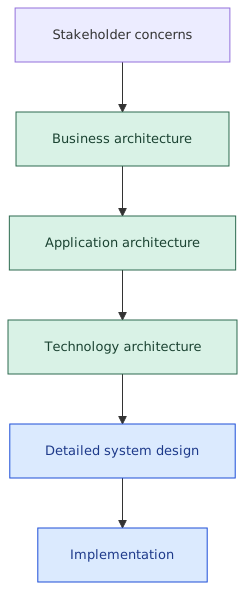
ArchiMate for architectural context. UML for design precision.
Not revolutionary. Just correct.
A practical split for a bank using Kafka, IAM, and cloud
If I were setting up a modeling practice for a modern bank, I’d do something like this:
ArchiMate repository would cover:
- business capabilities: onboarding, payments, fraud management, customer servicing
- value streams / business processes
- application services: customer profile, payment initiation, token service, consent service
- application components: channel apps, risk engines, event gateways
- data objects: customer identity, payment event, consent record
- technology services: Kafka platform, Kubernetes platform, cloud IAM integration, secrets management, observability
- requirements: PSD2, auditability, resilience, least privilege
- implementation roadmap and transition plateaus
UML repository would cover:
- onboarding API sequence with IAM token exchange
- Kafka event publication and consumption behavior
- fraud detection service interactions
- component decomposition of the consent service
- state behavior for customer verification workflow
- deployment specifics for critical services
That gives you both enterprise coherence and engineering accountability.
Anything else tends to drift into either executive wallpaper or engineering tunnel vision.
What architects should ask before choosing the notation
Before someone says “we should model this in UML” or “let’s standardize on ArchiMate,” ask:
- What decision are we trying to support?
- Who is the audience?
- Do we need cross-layer traceability or runtime precision?
- Is this about portfolio dependency or component behavior?
- Will this model need to connect strategy to implementation?
- Will engineers need to build from it directly?
Those questions usually settle the matter faster than any notation debate.
Final view
So, which metamodel is more expressive?
The honest answer is: each is more expressive in the domain it was built to represent.
But if we are talking specifically about enterprise architecture, then I’ll be blunt:
ArchiMate is usually the more appropriate and more useful metamodel.
Not because it is “better” in some universal sense.
Not because UML is obsolete. It isn’t.
But because enterprise architecture lives in the relationships between business, application, technology, and change. That is ArchiMate’s home ground.
UML remains essential when architecture must become design. It is stronger where precision matters, especially in software behavior, component semantics, and interaction detail.
The mistake is not choosing one over the other.
The mistake is pretending they solve the same problem.
In real architecture work—especially in banks, in cloud-heavy estates, in Kafka-based integration landscapes, in IAM-centric security architectures—you need both kinds of expressiveness. But you need them at the right altitude.
That’s the architect’s job. Not to worship notation. To use the right semantic tool for the decision in front of us.
And frankly, more architecture teams should spend less time arguing about boxes and more time exposing the dependencies that actually put the enterprise at risk.
FAQ
1. Should enterprise architects learn UML if they already use ArchiMate?
Yes. Absolutely. Even if ArchiMate is your primary EA language, UML helps when you need to go deeper into service design, behavior, and implementation detail. You don’t need to become a UML purist, but you do need enough fluency to avoid hand-wavy architecture.
2. Can ArchiMate model Kafka architectures well enough on its own?
For enterprise-level views, often yes. It can show producers, consumers, services, dependencies, and platform relationships. But for detailed event flow behavior—ordering, retries, dead-letter handling, schema interactions—UML is stronger. ArchiMate gives context; UML gives mechanics.
3. Why do some teams fail with ArchiMate?
Usually not because of the notation. They fail because they model abstractions without operational reality. They create generic service maps, avoid naming real systems, and never connect models to decisions, ownership, or roadmaps. ArchiMate works when it is grounded in actual enterprise concerns. ArchiMate in TOGAF ADM
4. Is UML too technical for business stakeholders?
Often, yes. At least most UML diagrams are. Some simplified component or deployment views can work, but in general UML is not ideal for executive or cross-functional enterprise communication. It carries too much software design baggage for that audience.
5. If I have to choose one language for an enterprise repository, which should it be?
For most enterprises, especially large regulated ones like banks, choose ArchiMate for the repository backbone. Then allow UML where deeper design detail is required. If you choose UML as the primary enterprise repository language, you will probably end up over-modeling technical structure and under-modeling enterprise dependency.
Comparative Expressiveness: ArchiMate vs UML Metamodels
- ArchiMate is stronger for cross-layer enterprise views and dependency tracing.
- UML is stronger for precise system/design expressiveness and implementation-oriented detail.
- Together, they support architecture-to-design continuity.
Frequently Asked Questions
What is a UML metamodel?
A UML metamodel is a model that defines UML itself — it specifies what element types exist (Class, Interface, Association, etc.), what relationships are valid between them, and what constraints apply. It uses the Meta Object Facility (MOF) standard, meaning UML is defined using the same modeling concepts it uses to define other systems.
Why does the UML metamodel matter for enterprise architects?
The UML metamodel determines what is and isn't expressible in UML models. Understanding it helps architects choose the right diagram types, apply constraints correctly, use UML profiles to extend the language for specific domains, and validate that models are internally consistent.
How does the UML metamodel relate to Sparx EA?
Sparx EA implements the UML metamodel — every element type, relationship type, and constraint in Sparx EA corresponds to a metamodel definition. Architects can extend it through UML profiles and MDG Technologies, adding domain-specific stereotypes and tagged values while staying within the formal metamodel structure.