⏱ 20 min read
Most UML models fail for a boring reason: they look precise, but they allow nonsense.
That’s the uncomfortable truth. Teams spend weeks drawing clean class diagrams, domain models, application landscapes, interface contracts, and capability maps. Everyone nods in workshops. The diagrams get pasted into PowerPoint, architecture repositories, and governance decks. Then implementation starts, and suddenly the model turns out to be soft where it mattered. Invalid states were possible. Required relationships were ambiguous. “Business rules” lived in someone’s head, or worse, in a Jira comment. architecture decision records
This is exactly where OCL helps. And yes, I know: the minute you say “Object Constraint Language,” half the room mentally checks out. It sounds academic. It sounds like something only UML purists care about. It sounds, frankly, like the kind of thing architects mention to impress each other and then never use. UML modeling best practices
That’s a mistake.
Used properly, OCL is one of the few practical tools that can make UML models actually enforce business logic instead of merely suggesting it. Not all enterprise teams need it everywhere. But when you need model-level validation that survives workshops, handovers, and implementation drift, OCL is surprisingly useful. UML for microservices
My strong opinion: if you model important enterprise domains without explicit constraints, you are not doing architecture rigorously. You are doing diagram theatre.
What OCL in UML actually is — in plain English
Let’s get the simple explanation out early.
OCL (Object Constraint Language) is a formal language used with UML to define rules and validations that diagrams alone cannot express clearly.
UML can show:
- classes
- attributes
- relationships
- multiplicities
- inheritance
But UML alone often cannot express rules like:
- an account must have at least one active owner
- a Kafka topic used for payment events must have encryption enabled
- a privileged IAM role cannot be assigned without an approved business owner
- a cloud workload marked “regulated” must run only in approved regions
That’s what OCL is for.
You attach OCL expressions to UML model elements and define:
- invariants: rules that must always be true
- preconditions: what must be true before an operation
- postconditions: what must be true after an operation
- derived values: values calculated from other data
- queries: logic to inspect the model
So instead of a model saying “here is an Account class,” it can say:
- every Account must belong to a Customer
- a closed Account cannot have a positive balance
- a premium Customer must have at least one verified identity record
That’s the practical value. OCL turns UML from a picture into a model with teeth.
Why architects should care
Here’s the enterprise architecture angle.
In real architecture work, we are constantly trying to do one thing: reduce ambiguity before it becomes cost.
That cost shows up as:
- rework in delivery teams
- inconsistent APIs
- broken data contracts
- weak controls in IAM
- non-compliant cloud deployments
- contradictory interpretations between business and engineering
A lot of those problems are not technology problems. They are model quality problems. The architecture says one thing visually, but the actual allowed states are wider than intended.
Architects often assume implementation teams will “handle the details.” Sometimes they do. Often they each handle them differently. Then you get fragmented behavior across channels, services, and platforms.
OCL gives you a way to state critical rules once, near the model, where they belong.
Not every architecture artifact needs formal constraints. Let’s not become zealots. But high-value domains absolutely benefit:
- core banking entities
- identity and access models
- event ownership and integration contracts
- regulated cloud control models
- entitlement and approval workflows
This is especially true in enterprises where many teams build against the same conceptual model.
The core idea architects miss
A UML diagram answers: what exists and how things relate.
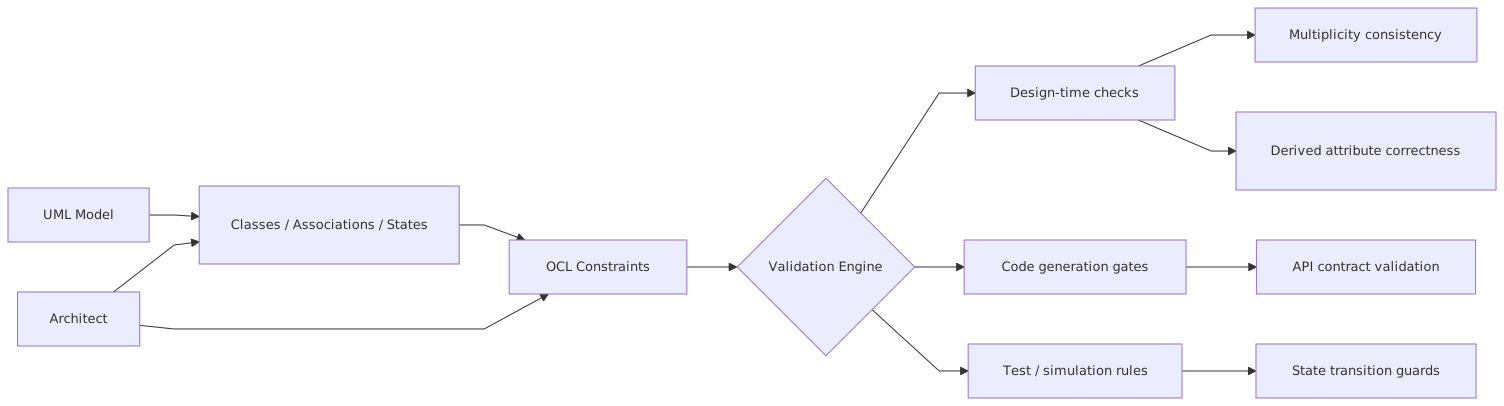
OCL answers: what is allowed.
That distinction matters more than people admit. TOGAF roadmap template
For example, a UML association between Customer and Account may show 1..*, but that still leaves important questions open:
- Can an account have multiple primary holders?
- Can a minor own an investment account?
- Can a frozen account accept incoming transfers?
- Can an account exist without a KYC status?
The diagram is not wrong. It’s just incomplete.
And in enterprise architecture, incomplete is dangerous because people mistake it for complete.
A practical mental model for using OCL
I’ve found OCL becomes much less intimidating when architects use it in four buckets:
If you stay in those four areas, OCL remains practical. Once people start trying to encode an entire enterprise rules engine inside UML, things go off the rails quickly.
That’s one of my contrarian views here: OCL is powerful, but it is not a substitute for executable policy engines, workflow engines, or runtime validation frameworks. Use it where architectural precision matters. Don’t turn it into a religion.
Basic OCL examples, without the usual academic fog
Let’s make this concrete.
Imagine a banking domain model with these classes:
CustomerAccountOwnerTransaction
Invariant example
A current account must always have at least one active owner.
`ocl
context Account
inv ActiveOwnerRequired:
self.type = AccountType::Current implies
self.owners->exists(o | o.status = OwnerStatus::Active)
`
That means: for current accounts, there must be at least one owner whose status is Active.
Another invariant
A closed account must have zero balance.
`ocl
context Account
inv ClosedAccountHasZeroBalance:
self.status = AccountStatus::Closed implies
self.balance = 0
`
This is exactly the kind of rule that often gets “assumed” and never made explicit.
Precondition example
Before processing a transfer, the source account must be active.
`ocl
context Account::transfer(amount: Decimal, target: Account)
pre SourceAccountMustBeActive:
self.status = AccountStatus::Active
`
Postcondition example
After a successful transfer, the source balance must decrease by the transfer amount.
`ocl
context Account::transfer(amount: Decimal, target: Account)
post SourceBalanceReduced:
self.balance = self.balance@pre - amount
`
Now, let’s be honest: many enterprise architects will never write these exact expressions themselves in daily work. But they should absolutely understand what they do, when they matter, and how they strengthen model quality.
Where OCL becomes genuinely useful in enterprise architecture
This is the point where people usually say, “Fine, but where does this actually matter outside a modeling classroom?”
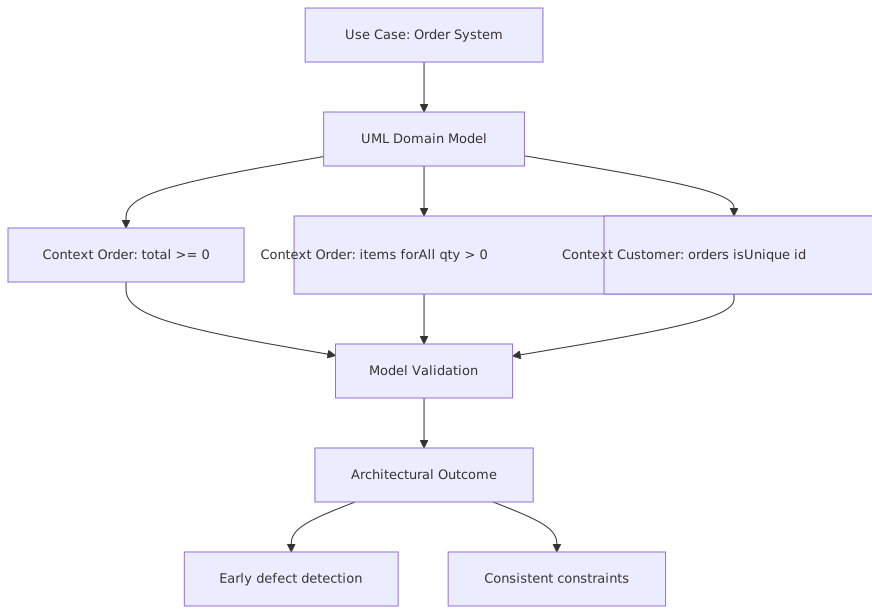
Fair question.
Here are the places where I’ve seen practical value.
1. Banking domain validation
Banking is full of rules that sound obvious until systems disagree about them.
A retail bank may have:
- customers
- party hierarchies
- products
- accounts
- mandates
- transaction limits
- KYC states
- regulatory classifications
The problem is that different systems interpret these differently:
- core banking thinks one way
- CRM thinks another
- digital channels infer something else
- compliance tools bolt on extra logic later
A shared UML domain model without constraints only gets you halfway. OCL can define the invariants that prevent interpretation drift.
Example: joint account rules
Suppose the bank offers joint accounts, but exactly one owner must be designated as the “primary contact.”
`ocl
context Account
inv OnePrimaryContactForJointAccount:
self.type = AccountType::Joint implies
self.owners->select(o | o.isPrimaryContact = true)->size() = 1
`
That’s not trivial fluff. That affects statements, notifications, complaints handling, and legal communications.
Example: KYC dependency
An account in active status must be linked to a customer with completed KYC.
`ocl
context Account
inv ActiveAccountRequiresCompletedKYC:
self.status = AccountStatus::Active implies
self.customer.kycStatus = KYCStatus::Completed
`
Again, obvious? Yes. Explicit in most architecture models? No.
And that gap matters. Because if one onboarding platform interprets “pending review” as good enough and another does not, you now have operational inconsistency and compliance exposure.
Real enterprise effect
In real architecture work, these constraints help with:
- canonical domain model reviews
- system-of-record alignment
- API contract governance
- validation of event payload semantics
- onboarding logic standardization across channels
This is where architects should stop pretending diagrams alone are enough.
2. Kafka event architecture and message integrity
Now let’s talk integration, because this is where many modern enterprise platforms get messy fast.
Teams love Kafka. And mostly for good reason. It’s powerful, scalable, and very effective for event-driven architecture. But Kafka also makes it easy to publish sloppy events at scale.
What you often see:
- topics with vague ownership
- event types overloaded with multiple meanings
- missing keys
- inconsistent tenant context
- no enforcement of retention or classification metadata
- fields that are “required” by convention only
An architecture repository may show topic relationships and producers/consumers in UML. Nice. But that still doesn’t validate the important rules.
Example: payment event requirements
Imagine a PaymentEvent model in your enterprise integration architecture. You want every payment event to include:
- event ID
- correlation ID
- event timestamp
- source system
- customer context for traceability
- classification level for data handling
You can express that as model constraints.
`ocl
context PaymentEvent
inv MandatoryMetadataPresent:
not self.eventId.oclIsUndefined() and
not self.correlationId.oclIsUndefined() and
not self.eventTimestamp.oclIsUndefined() and
not self.sourceSystem.oclIsUndefined() and
not self.dataClassification.oclIsUndefined()
`
Example: topic policy alignment
Suppose any topic carrying regulated banking data must have encryption enabled and retention below a defined threshold.
`ocl
context KafkaTopic
inv RegulatedTopicPolicy:
self.containsRegulatedData = true implies
self.encryptionEnabled = true and
self.retentionHours <= 168
`
That’s architecture-level validation. Not runtime enforcement by itself, but still valuable. It prevents bad design from being approved as if it were complete.
Why this matters architecturally
When event models are unconstrained:
- downstream consumers code defensively in different ways
- lineage becomes hard to trust
- governance becomes documentation-heavy and enforcement-light
- platform teams fight avoidable design exceptions
A lot of “Kafka complexity” is actually just weak modeling discipline.
That’s another opinion I’ll stand by.
3. IAM architecture: where OCL is more useful than people expect
Identity and access management is one of the best use cases for OCL because IAM models are full of structural and policy constraints.
You may model:
UserRolePermissionApplicationApprovalBusinessOwnerEntitlementPolicyAccessReview
A standard UML diagram can show these entities and associations. Fine. But IAM is not about structure alone. It’s about rules:
- privileged roles need stronger controls
- orphaned entitlements are not acceptable
- approvals must come from the right authority
- toxic role combinations must be blocked
Example: privileged role ownership
Every privileged role must have a business owner and a technical owner.
`ocl
context Role
inv PrivilegedRoleRequiresNamedOwners:
self.isPrivileged = true implies
not self.businessOwner.oclIsUndefined() and
not self.technicalOwner.oclIsUndefined()
`
Example: approval requirement
A privileged entitlement cannot be assigned unless an approval exists and is valid.
`ocl
context EntitlementAssignment
inv PrivilegedAssignmentRequiresApproval:
self.role.isPrivileged = true implies
self.approval->exists(a | a.status = ApprovalStatus::Approved)
`
Example: toxic combinations
A user must not hold both “payment creator” and “payment approver” roles.
`ocl
context User
inv SegregationOfDuties:
not (
self.roles->exists(r | r.name = 'PaymentCreator') and
self.roles->exists(r | r.name = 'PaymentApprover')
)
`
That kind of constraint is gold in enterprise architecture because it links business control logic directly to the access model.
Real-world IAM architecture application
In practice, OCL-like constraints help when:
- defining target-state IAM operating models
- reviewing role engineering approaches
- documenting segregation-of-duties rules
- aligning identity governance with application onboarding
- validating model consistency before implementation
No, OCL won’t replace your IAM product’s policy engine. It shouldn’t. But it can make the architecture explicit before products and workflows start encoding local interpretations.
4. Cloud architecture and control models
Cloud architecture is another place where UML models often become suspiciously decorative.
Enterprises model:
- workloads
- environments
- landing zones
- data stores
- identity boundaries
- network segments
- resilience tiers
- compliance classifications
But the critical architectural rules are usually buried in standards documents nobody reads.
Example: regulated workload placement
A workload classified as regulated must be deployed only in approved regions.
`ocl
context Workload
inv RegulatedWorkloadApprovedRegionOnly:
self.classification = DataClassification::Regulated implies
self.deployedRegion->forAll(r | r.isApprovedForRegulated = true)
`
Example: production resilience requirement
Tier-1 workloads must use multi-zone deployment.
`ocl
context Workload
inv Tier1RequiresMultiZone:
self.resilienceTier = ResilienceTier::Tier1 implies
self.multiZoneDeployment = true
`
Example: internet exposure control
Internal-only applications must not expose public endpoints.
`ocl
context ApplicationService
inv InternalServiceNoPublicEndpoint:
self.exposureType = ExposureType::InternalOnly implies
self.publicEndpoint = false
`
These aren’t just nice-to-have validations. They’re architecture controls.
And yes, in mature cloud environments, these rules should also exist in policy-as-code tools, infrastructure guardrails, and CI/CD checks. Absolutely. But the architecture model should still express them if they define the intended design state.
This is a point many architects miss: runtime enforcement does not remove the need for design-time precision.
A real enterprise example: retail bank modernization
Let me describe a realistic composite example.
A retail bank is modernizing customer servicing across channels:
- legacy core banking remains in place
- new digital channels expose account and payment capabilities
- Kafka becomes the event backbone
- IAM is centralized with role-based and policy-based controls
- workloads are deployed on a regulated cloud landing zone
The enterprise architecture team creates UML models for:
- customer and account domain
- event taxonomy
- IAM role and entitlement model
- cloud deployment patterns
Initially, the models are visually strong but logically weak. Review workshops reveal recurring ambiguity:
Domain issues
- Can dormant accounts receive inbound payments?
- Can a customer with partial KYC access lending products?
- Can an account have more than one primary servicing branch?
Kafka issues
- Which events are authoritative versus derived?
- Are all payment events traceable end-to-end?
- Which topics can carry regulated personal data?
IAM issues
- Who owns privileged operational roles?
- Can contractors receive emergency access?
- Which approval path is mandatory for treasury systems?
Cloud issues
- Which workloads may use cross-region replication?
- What classification determines region eligibility?
- Which applications may expose APIs publicly?
Without explicit constraints, every platform team fills in the gaps differently.
So the architecture team defines a focused OCL-backed validation layer in the model.
Banking constraints
- active accounts require completed KYC
- joint accounts must have exactly one primary contact
- closed accounts must have zero available balance
Kafka constraints
- regulated topics require encryption and approved retention
- payment events require correlation ID and classification tag
- authoritative events must declare owning system
IAM constraints
- privileged roles require business and technical owners
- emergency access assignments must be time-bound
- payment creation and approval roles are mutually exclusive
Cloud constraints
- regulated workloads deploy only to approved regions
- tier-1 services require multi-zone deployment
- internal-only services cannot expose public endpoints
What changes after this?
Not magic. But a lot improves:
- architecture reviews become faster because basic validity is testable
- API and event design discussions stop relitigating obvious rules
- governance shifts from vague interpretation to explicit criteria
- implementation teams know where policy begins and ends
- audit conversations improve because control intent is traceable to the model
That’s the practical value. Not elegance. Not UML purity. Reduced ambiguity.
Common mistakes architects make with OCL
This is where I’ll be blunt.
1. They ignore constraints completely
The most common mistake is not misuse. It’s omission.
Architects produce domain models with just enough precision to look serious, but not enough to constrain anything important. Then they act surprised when every implementation team invents its own logic.
If the rule matters, model it.
2. They over-formalize everything
The opposite error is also common in architecture circles with modeling enthusiasm.
Not every rule belongs in OCL. If you try to encode every pricing rule, workflow detail, UI validation, and exception path, the model becomes unreadable and politically dead. Nobody maintains it.
Use OCL for architecturally significant constraints, not every possible rule.
3. They confuse model validation with runtime enforcement
This one causes endless confusion.
OCL in UML helps validate design intent and model consistency. It does not automatically enforce behavior in Kafka brokers, IAM platforms, cloud control planes, or banking applications.
You still need:
- schema validation
- policy-as-code
- application logic
- workflow controls
- runtime monitoring
OCL complements those. It does not replace them.
4. They write constraints nobody outside the modeling team understands
If your OCL expressions are technically correct but your delivery architects, analysts, and platform leads cannot understand the business meaning, you’ve failed.
Always pair constraints with plain-language explanations.
5. They model the wrong level of detail
Another frequent problem: architects attach OCL to conceptual models that are too abstract to validate anything useful, or too implementation-specific to stay stable.
The sweet spot is usually:
- stable business entities
- integration contracts
- governance-relevant platform abstractions
- access control models
- compliance-relevant deployment models
6. They don’t align OCL with enterprise control intent
This is subtle but important.
A constraint should map to a real business, risk, or operational concern:
- regulatory obligation
- service resilience requirement
- data protection rule
- segregation-of-duties control
- event traceability requirement
If it doesn’t matter in real decisions, it probably doesn’t belong.
When not to use OCL
Let’s be honest for a minute. Some architects push formalism because they like formalism. That is not the same as adding value.
Don’t use OCL when:
- your model is too immature and changing daily
- the domain is low criticality and simple
- teams will never maintain the constraints
- the rule is better expressed directly in code or schema
- governance maturity is too low to sustain formal model validation
I’m not interested in selling OCL as universally necessary. It isn’t.
But in large enterprises, especially regulated ones, there is a middle ground between “nothing formal” and “overengineered metamodel obsession.” That middle ground is where OCL can be very practical.
How to introduce OCL without scaring everyone
If you’re an enterprise architect trying to make this real, do not start with a lecture on formal specification. You’ll lose the room instantly.
Start with pain.
Ask:
- Which business rules keep being interpreted differently?
- Which architecture reviews repeatedly debate the same “obvious” rules?
- Which controls are important enough that ambiguity is expensive?
- Which shared models are used by many teams?
Then take 5–10 critical rules and encode only those.
A sensible adoption pattern looks like this:
For example:
- in banking, start with account and customer constraints
- in Kafka, start with event metadata and topic policy constraints
- in IAM, start with privileged role ownership and SoD rules
- in cloud, start with region, resilience, and exposure constraints
That is enough to make the architecture materially better.
What good looks like
A good OCL-enabled UML model in enterprise architecture has a few characteristics:
- constraints are few but meaningful
- each one maps to a real business or control concern
- expressions are reviewed by both architects and domain experts
- plain-language interpretation is documented
- constraints influence governance, not just repository decoration
- they are stable enough to survive delivery cycles
A bad one:
- has dozens of brittle technical rules
- is maintained by one modeling enthusiast
- is disconnected from implementation and review processes
- is impossible for anyone else to interpret
- is treated as intellectual property rather than working architecture
I’ve seen both. The second type usually dies quietly.
Final thought
OCL is not glamorous. It won’t make your architecture decks prettier. It won’t win applause in steering committees. Most executives will never know it exists.
Good.
That’s not the point.
The point is that enterprise architecture should reduce ambiguity in important systems. If your UML models cannot express the rules that matter, then they are not strong enough for serious architecture work.
And no, I don’t buy the argument that “the engineers will figure it out.” They will figure something out. The question is whether all teams will figure out the same thing, in the same way, under the same constraints. In enterprises, that consistency is where architecture earns its keep.
So use OCL selectively. Use it where the model needs teeth. Don’t overdo it. Don’t ignore it either.
Because once your domain, Kafka events, IAM controls, and cloud policies become shared enterprise assets, diagrams alone are too polite. Sometimes architecture needs to say: this is not just how things look. This is what is allowed.
FAQ
1. Is OCL still relevant in modern enterprise architecture, especially with APIs, Kafka, and cloud-native platforms?
Yes. Maybe more than before. Modern platforms create more distributed interpretation risk, not less. OCL is useful at design time to define constraints consistently across APIs, event models, IAM structures, and cloud deployment abstractions.
2. Does OCL replace schema validation, policy-as-code, or runtime controls?
No. It complements them. OCL expresses model intent and validates design consistency. Runtime enforcement still belongs in application code, schema registries, IAM platforms, CI/CD controls, and cloud policy frameworks.
3. Where should architects start using OCL first?
Start where ambiguity is expensive:
- banking customer/account models
- Kafka event metadata and ownership rules
- IAM privileged access and segregation-of-duties constraints
- cloud workload classification and deployment restrictions
Pick one model and a handful of rules. Don’t start with everything.
4. What are the biggest mistakes teams make with OCL?
Two extremes: not using it at all, or using it for everything. The best use is targeted. Model the constraints that matter architecturally, explain them in plain language, and connect them to actual review and governance processes. EA governance checklist
5. Can non-specialist architects and analysts realistically work with OCL?
Yes, if it’s introduced properly. They do not need to become formal methods experts. They need to understand the business meaning of constraints and review whether the rule is correct. Usually a small number of architecture or modeling specialists can help write the expressions while the wider team validates intent.
Frequently Asked Questions
What is UML?
UML (Unified Modeling Language) is a standardised visual modeling language for describing software systems. It defines diagram types for structure (class, component, deployment) and behaviour (sequence, activity, state machine, use case). UML is maintained by the Object Management Group (OMG) and is the most widely used modeling standard in software engineering.
What are the most useful UML diagram types?
For enterprise architects: Component diagrams (application structure and interfaces), Deployment diagrams (infrastructure topology), and Sequence diagrams (runtime interactions). For software architects and developers: Class diagrams (domain models), State Machine diagrams (lifecycle), and Activity diagrams (process flows).
How does UML relate to ArchiMate in enterprise architecture?
UML and ArchiMate are complementary. ArchiMate is used for enterprise-wide architecture views across business, application, and technology layers. UML is used for detailed software design within specific application components. Both are natively supported in Sparx EA, allowing architects to maintain full traceability from EA views down to UML design models.