⏱ 20 min read
Most API governance programs fail for a boring reason: they confuse linting with architecture.
They buy a gateway, publish a style guide, add a few OpenAPI checks in CI, and call it governance. Then six months later the bank has four customer APIs, three notions of identity, event contracts that contradict REST contracts, and a Kafka estate full of “temporary” topics that somehow became critical infrastructure. Nobody can explain which APIs are canonical, which are product-facing, which are internal domain interfaces, or why IAM policies look different in every cloud account.
That is the actual problem.
API design governance is not mainly about naming conventions or whether you use kebab-case. It is about controlling meaning, responsibility, and change across a large enterprise. And if you want to do that consistently, you need a model behind the rules. Not just guidelines. A model.
That is where a UML metamodel becomes surprisingly useful. UML modeling best practices
A lot of architects hear “UML” and immediately think of stale class diagrams from 2008, generated by tools nobody liked. Fair reaction. Traditional UML documentation often deserved its bad reputation. But the metamodel idea is different, and frankly much more valuable than the old diagramming culture around it. UML for microservices
The simple explanation first
A UML metamodel is just a structured way to define the kinds of things that exist in your architecture and how they relate.
For API design governance, that means defining concepts like: ArchiMate for governance
- API
- Resource
- Operation
- Event
- Consumer
- Domain
- Identity Provider
- Policy
- Schema
- Version
- Deployment
- Data Classification
And then defining the rules between them:
- An API belongs to one domain
- An operation exposes one or more business capabilities
- An event is published to a topic and owned by a producer
- A public API must map to an IAM policy model
- A PII-bearing schema must have retention and masking rules
- A Kafka topic contract must trace back to a business event or domain object
- A cloud deployment must inherit baseline controls
That is governance in a useful form. Not “please follow standards,” but “these object types exist, these relationships matter, and these constraints are non-negotiable.”
So the metamodel becomes the architecture backbone for API governance. EA governance checklist
That sounds more academic than it really is. In practice, it gives architects a way to stop arguing from taste and start governing from structure.
Why API governance gets messy in enterprises
In real enterprises, APIs are not one thing.
You have:
- customer-facing APIs exposed through an API gateway
- internal service APIs in Kubernetes
- partner APIs with ugly historical constraints
- event APIs on Kafka
- identity and access APIs from IAM platforms
- cloud provider APIs embedded in provisioning and platform automation
- data product APIs in analytics domains
Treating all of that as one flat “API portfolio” is one of the most common mistakes architects make. It creates fake consistency and hides the important distinctions.
A payments API in a bank is not governed the same way as a Kafka event stream for fraud scoring. Some controls overlap. Many do not. The semantics are different, the lifecycle is different, the consumers are different, and the operational risks are definitely different.
This is why a metamodel matters. It forces you to define the categories explicitly.
Without it, governance usually degrades into one of two bad patterns:
- Governance theater
Lots of templates, review boards, scorecards. Very little effect on design quality.
- Tool-driven pseudo-governance
If it passes OpenAPI linting, people assume it is architecturally sound. It isn’t.
Neither solves the real enterprise problem, which is consistency of architectural intent across teams, channels, domains, and platforms.
What a UML metamodel actually gives you
Let’s make this practical.
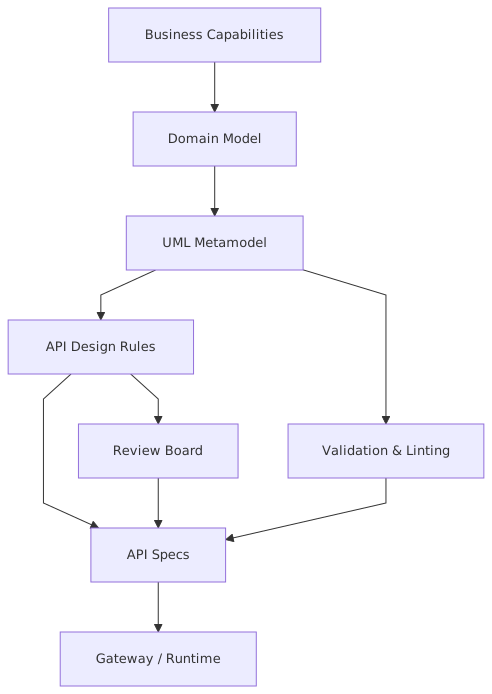
A UML metamodel is not the same as drawing UML diagrams for every API. Please don’t do that. Nobody wants a 70-page model repository full of diagrams that no engineering team reads.
The useful part is defining the meta-level concepts and constraints. Think of it as the enterprise grammar for APIs.
At minimum, a metamodel for API design governance should define: architecture decision record template
That table looks simple. Good. It should be simple at first.
The point is not to create a giant ontology because architects enjoy taxonomy. The point is to define just enough shared structure so that governance can become repeatable and automatable.
The contrarian view: diagrams are not the value
Here’s the part many architects don’t like hearing: the visual UML diagram is often the least important part.
The value is the metamodel as an explicit semantic system. Once you have that, diagrams, catalogs, rules, review checklists, and automated validations all become coherent.
Without that semantic core, governance rules are usually fragmented:
- API style guide in Confluence
- IAM standards in a security PDF
- Kafka naming rules in a platform wiki
- cloud tagging policy in Terraform modules
- lifecycle standards in some architecture review board deck
Each document is “correct” in isolation. Together they are chaos.
A UML metamodel lets you unify them around common concepts. That is much more important than whether someone drew a nice package diagram.
How this applies in real architecture work
This is where the topic either becomes useful or turns into modeling hobbyism.
In real architecture work, a UML metamodel helps in five concrete ways.
1. It clarifies ownership
Enterprises are terrible at API ownership. Really terrible.
An API team says they own the interface. A domain team says they own the business capability. A platform team owns the gateway. Security owns IAM controls. Data governance owns classifications. Then an incident happens and suddenly nobody owns the customer impact.
If your metamodel says:
- every API belongs to one domain
- every API has one accountable owner
- every schema has a steward
- every event topic has a producer owner and platform host
- every externally exposed interface has an IAM trust model
then governance stops being vague.
Ownership becomes a modeled property, not a meeting outcome.
2. It exposes broken boundaries
A metamodel helps you detect anti-patterns such as:
- one API spanning multiple business domains
- Kafka events carrying data from unrelated bounded contexts
- IAM scopes designed around technical services instead of business permissions
- cloud-native APIs leaking infrastructure concerns into business contracts
- “customer” resources duplicated across retail banking, lending, and CRM domains with no canonical relationship
Architects often miss these because they review APIs one by one. The metamodel gives you a portfolio view. You can see structural duplication and boundary violations.
3. It supports automation
This matters. Governance that cannot be operationalized will be ignored.
Once your metamodel is explicit, you can map it to automation:
- OpenAPI lint rules based on API type and consumer type
- AsyncAPI checks for Kafka topic naming, ownership, retention, and schema evolution
- IAM policy generation from operation sensitivity and consumer context
- cloud deployment controls based on API classification and region
- architecture repository validation for missing ownership or lifecycle state
You are no longer checking syntax alone. You are checking architectural integrity.
4. It improves review quality
A lot of architecture reviews are too subjective. They revolve around senior people saying “I wouldn’t have designed it that way.”
That is not governance. That is taste with authority.
A metamodel improves reviews because it anchors questions like:
- What domain owns this API?
- Is this operation command, query, or event publication?
- What identity context applies?
- Is this payload canonical, contextual, or derived?
- Does this event correspond to a business event or just a technical state change?
- What lifecycle state is being introduced?
- Does this cloud deployment violate data residency constraints?
Reviews become sharper and less political.
5. It connects design-time and runtime
This is one of the biggest gaps in enterprise architecture.
Design teams define APIs. Platform teams operate gateways and Kafka clusters. Security teams enforce IAM. Cloud teams manage deployment baselines. But the traceability between those layers is weak.
A metamodel can link them:
- API contract → consumer type → IAM scopes
- event contract → Kafka topic → retention policy
- schema classification → encryption requirement → cloud deployment control
- external API → gateway policy → WAF and rate limiting
- regulated data object → region constraint → cloud account placement
That is actual governance. Design connected to operation.
A banking example: where this becomes real
Let’s take a realistic retail banking scenario.
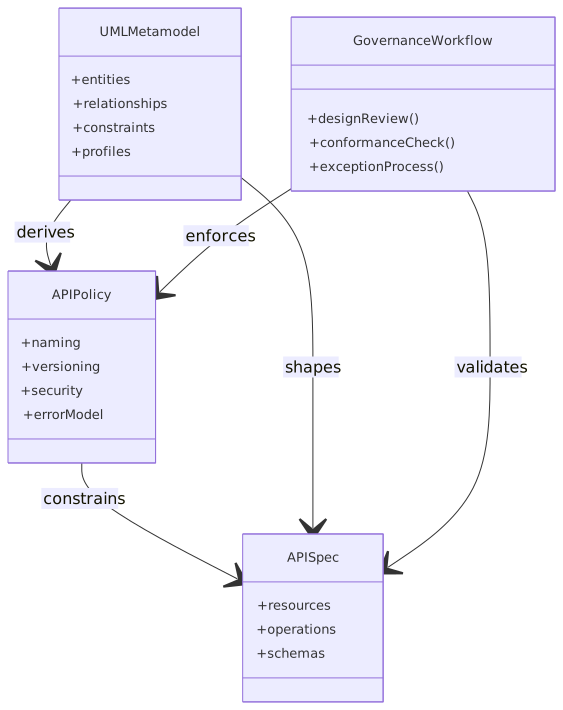
A bank is modernizing its customer servicing landscape. It has:
- mobile and web channels consuming customer and account APIs
- a Kafka backbone for near-real-time events
- IAM based on OAuth2/OIDC with a central identity platform
- workloads distributed across AWS and Azure
- legacy core banking systems still exposing SOAP and batch interfaces underneath
The bank wants consistent API governance across channel APIs, internal service APIs, and event streams.
At first, the architecture team tries the usual approach:
- API style guide
- standard OpenAPI template
- review board
- Kafka topic naming convention
- IAM standards document
It doesn’t work well.
Why? Because teams are solving different problems under one generic “API” label.
For example:
- The mobile customer profile API is a customer-facing experience API
- The account servicing API is a domain API
- The customer-updated Kafka event is an event contract
- The IAM token introspection endpoint is a platform security API
- The cloud provisioning API is an infrastructure API
Those are not the same thing, and governance should not pretend they are.
So the bank defines a UML metamodel with API subtypes and relationships.
Core metamodel concepts in the bank
The bank models:
- BusinessDomain: Customer, Accounts, Payments, Lending, IAM, Fraud
- APIInterface with subtypes:
- Operation
- Event
- Schema
- DataClassification
- Consumer
- IdentityPolicy
- DeploymentEnvironment
- Topic
- LifecycleState
- ExperienceAPI
- DomainAPI
- ProcessAPI
- EventAPI
- PlatformAPI
Then they define constraints such as:
- Every ExperienceAPI must consume one or more DomainAPIs but may not define canonical business objects independently.
- Every EventAPI must map to exactly one producer domain.
- Every schema carrying customer PII must have DataClassification = Confidential or Restricted.
- Every externally consumed API must reference an IdentityPolicy.
- Every Kafka topic must have an owner domain, retention class, and schema compatibility mode.
- Every cloud deployment of a Restricted API must declare region and encryption controls.
Now things get more disciplined.
The customer domain owns the canonical CustomerProfile schema.
The mobile channel can expose a customer summary representation, but it cannot invent a competing canonical customer object.
The fraud domain can subscribe to customer change events, but it cannot republish modified customer truth as if it were source-of-record.
The IAM team must align token claims and scopes to business operations, not to random microservice names.
The cloud platform team can enforce deployment controls because classification is modeled upstream.
That is not theoretical. That is exactly the kind of architecture hygiene large banks struggle to maintain.
Kafka is where weak governance gets exposed fast
If you want to test whether your API governance is serious, look at Kafka.
REST APIs can hide bad architecture for a while because gateways, documentation portals, and consumer onboarding processes give the illusion of order. Kafka is less forgiving. If your event semantics are weak, your topic landscape becomes a junk drawer very quickly.
Common enterprise failures include:
- topics named after systems instead of business events
- no clear producer ownership
- event payloads carrying denormalized junk for “convenience”
- multiple versions with no compatibility strategy
- technical CDC events presented as business events
- IAM/ACL controls inconsistent across clusters and environments
A metamodel helps because it distinguishes:
- BusinessEvent
- TechnicalEvent
- Topic
- Producer
- Consumer
- Schema
- RetentionPolicy
- CompatibilityRule
That distinction matters.
A customer-address-changed event in banking is a business event.
A row-updated event from a legacy customer table is a technical event.
Those should not be governed the same way. Yet many enterprises treat them as equivalent because both happen to move through Kafka.
Bad idea.
Your metamodel should make that impossible or at least visible.
IAM is not an afterthought in API governance
Another common mistake: architects treat IAM as a downstream control, not a design concern.
That is backwards.
Identity and access shape the API contract itself. They affect resource granularity, operation design, audience boundaries, token claims, scope semantics, and auditability. In a regulated enterprise, especially banking, that is not optional.
A UML metamodel for API governance should explicitly model:
- identity provider
- trust boundary
- consumer identity type
- authorization model
- scopes/claims/roles
- policy decision point
- audit obligation
Why? Because otherwise teams invent authorization semantics locally.
You end up with:
- one API using
accounts.read - another using
read:account - another using application roles only
- Kafka consumers authorized by technical service IDs with no business traceability
- cloud-native services relying on IAM roles that are disconnected from API-level entitlement models
This creates a governance mess and a compliance headache.
A metamodel forces consistency. Not necessarily one global pattern for everything, which is unrealistic, but at least a governed set of identity patterns tied to API types and consumer types.
Common mistakes architects make
Let’s be blunt. Architects often make this harder than it needs to be.
Mistake 1: Modeling too much too early
They create an enormous enterprise metamodel with 120 element types, then nobody uses it.
Start smaller. Define the minimum concepts needed to govern APIs meaningfully. Expand only when there is a real decision or automation need.
Mistake 2: Treating all APIs as the same
As mentioned earlier, this is a foundational error. REST, event, IAM, and platform APIs are related but not identical. If your metamodel does not distinguish them, your governance will be shallow.
Mistake 3: Confusing canonical with reusable
Not every shared schema should be canonical. Enterprises over-centralize data objects and then wonder why domains are blocked.
Canonical should mean enterprise source-of-truth significance, not “lots of teams use it.”
Mistake 4: Ignoring runtime implications
An API model that does not connect to gateways, Kafka clusters, IAM policies, or cloud controls becomes decorative. Real governance must bridge logical and physical architecture.
Mistake 5: Letting review boards substitute for modeling
A review board can enforce a metamodel. It cannot replace one. If the core concepts and constraints are not explicit, reviews become personality-driven.
Mistake 6: Failing to model lifecycle
This one hurts enterprises badly. Architects approve APIs as if approval is the end of the story. It isn’t. APIs change, deprecate, split, merge, and linger. A metamodel needs lifecycle state and migration relationships.
Mistake 7: Assuming the tooling will solve semantics
OpenAPI, AsyncAPI, API gateways, schema registries, and cloud policy engines are useful. They are not semantic governance on their own. Tools enforce what you define. If you define very little, they will enforce very little.
What a practical metamodel implementation looks like
You do not need a giant UML tool rollout to make this work.
A practical implementation usually looks like this:
1. Define the metamodel in plain language first
Use a compact architecture standard. Maybe 10–20 element types and a set of constraints. Keep it understandable.
2. Represent it in a repository
This could be an enterprise architecture tool, a graph model, or even a well-structured internal metadata service. The point is consistency, not fancy notation.
3. Map design artifacts to the metamodel
For example:
- OpenAPI specs map to APIInterface, Operation, Schema
- AsyncAPI specs map to EventAPI, Event, Topic, Schema
- IAM configs map to IdentityPolicy, Consumer, TrustBoundary
- Terraform or cloud metadata map to DeploymentEnvironment and controls
4. Add validation rules
Examples:
- no external API without owner and identity policy
- no Kafka topic without business or technical event classification
- no restricted-data schema without encryption and residency tags
- no duplicate canonical entity in two domains without explicit relationship
5. Use it in architecture review and portfolio management
The metamodel should influence both individual project decisions and enterprise-wide portfolio rationalization.
That is the sweet spot.
Cloud changes the urgency
Cloud makes API governance both easier and more dangerous.
Easier, because cloud-native platforms provide policy engines, metadata, automation hooks, and scalable deployment patterns.
More dangerous, because teams can publish APIs, topics, functions, and service endpoints very quickly. Speed without semantic governance just creates distributed confusion faster.
In multi-cloud enterprises, this gets worse.
An API exposed through AWS API Gateway, a Kafka event on Confluent Cloud, an IAM trust setup in Azure AD, and a workload deployed in Kubernetes across regions can all be part of one business capability. If your governance model does not connect those concerns, each platform team will optimize locally and the end-to-end architecture will drift.
A UML metamodel helps maintain a stable enterprise language above cloud-specific implementation choices.
That matters a lot. Otherwise “governance” becomes whatever each cloud platform happened to support first.
Strong opinion: governance should be opinionated, not neutral
Architects sometimes try to make governance frameworks “non-prescriptive” to avoid friction.
I think that is usually a mistake.
Good governance should be opinionated where the enterprise risks are real:
- domain ownership should be explicit
- external APIs should not invent local identity semantics
- event contracts should not masquerade as business truth when they are technical extracts
- PII-bearing schemas should not move freely without classification and control
- public and partner APIs should have stricter compatibility discipline than internal experimental interfaces
Neutral governance sounds mature. Often it is just weak.
The metamodel is where those opinions become durable and teachable.
Another contrarian thought: don’t chase universal standardization
Not every API should look the same. That fantasy causes damage.
A customer mobile API may optimize for consumer simplicity.
A domain API may optimize for domain integrity.
A Kafka event may optimize for temporal business fact.
An IAM API may optimize for token and policy semantics.
A cloud provisioning API may optimize for platform control.
Trying to flatten all of these into one “enterprise standard API pattern” usually produces mediocre designs everywhere.
The better move is governed diversity: multiple approved interface types with explicit semantics and constraints. Again, this is exactly what a metamodel is good at.
The organizational impact
This approach also changes how architecture teams work.
Instead of being the people who manually inspect every API spec, architects become designers of the governance system itself. They define the semantic model, the allowed patterns, the constraints, and the traceability to runtime platforms.
That is a better use of architecture effort.
It also helps distribute governance. Domain architects, platform teams, security teams, and API product owners can all work from the same model while applying their own controls.
Done well, the metamodel becomes shared enterprise infrastructure. Not just an architecture artifact.
If you do only three things
If your organization is not ready for a full metamodel-driven governance approach, do these three things first:
- Define API types explicitly
Separate experience, domain, process, event, and platform APIs.
- Model ownership and identity as first-class properties
Not optional metadata. Mandatory design elements.
- Connect contracts to runtime controls
Gateway policy, Kafka topic governance, IAM, cloud deployment controls. No disconnect.
That alone will put you ahead of most enterprise API governance programs.
Final thought
The phrase “UML metamodel” may sound too formal for modern API work. Fine. Call it an enterprise semantic model if that makes people less nervous.
But the principle remains: API governance only becomes real when the enterprise defines the things it governs, the relationships that matter, and the constraints it will actually enforce.
Without that, governance is style guidance plus meetings.
With it, architecture becomes much more disciplined. You can govern REST and Kafka together without pretending they are identical. You can connect IAM to interface design instead of bolting it on later. You can align cloud controls with data and exposure semantics. And in a bank or any large regulated enterprise, that difference is not academic. It is the difference between architecture and entropy.
FAQ
1. Is UML really necessary for API governance, or can we just use OpenAPI and AsyncAPI?
OpenAPI and AsyncAPI describe contracts well, but they do not define the enterprise semantics around ownership, domain boundaries, IAM context, lifecycle, or policy relationships. UML as a metamodel approach helps define those higher-level concepts. You may not need classic UML diagrams, but you do need a metamodel.
2. How detailed should the metamodel be at the start?
Keep it small. Start with API type, domain, owner, schema, consumer, identity policy, deployment context, and lifecycle. If the model becomes a taxonomy project, you’ve already gone too far.
3. How does this help with Kafka governance specifically?
It lets you distinguish business events from technical events, require topic ownership, define schema and compatibility rules, and connect event contracts to retention, IAM/ACL, and platform controls. That is much stronger than just naming conventions.
4. How do you get engineering teams to accept this without slowing delivery?
By making the model practical and automatable. If the metamodel drives reusable templates, validation, policy generation, and faster reviews, teams usually accept it. If it only produces documents and diagrams, they won’t.
5. Does this work only in regulated industries like banking?
No, but banking makes the value obvious because identity, audit, data classification, and change control matter so much. The same approach works in healthcare, telecom, retail, and any large cloud-heavy enterprise with multiple API styles and many teams.
Frequently Asked Questions
What is a UML metamodel?
A UML metamodel is a model that defines UML itself — it specifies what element types exist (Class, Interface, Association, etc.), what relationships are valid between them, and what constraints apply. It uses the Meta Object Facility (MOF) standard, meaning UML is defined using the same modeling concepts it uses to define other systems.
Why does the UML metamodel matter for enterprise architects?
The UML metamodel determines what is and isn't expressible in UML models. Understanding it helps architects choose the right diagram types, apply constraints correctly, use UML profiles to extend the language for specific domains, and validate that models are internally consistent.
How does the UML metamodel relate to Sparx EA?
Sparx EA implements the UML metamodel — every element type, relationship type, and constraint in Sparx EA corresponds to a metamodel definition. Architects can extend it through UML profiles and MDG Technologies, adding domain-specific stereotypes and tagged values while staying within the formal metamodel structure.