⏱ 23 min read
Title: Deconstructing the UML Metamodel: Formal Analysis of MOF Abstraction Layers UML modeling best practices
Meta description: A rigorous analysis of the UML metamodel and MOF abstraction layers, explaining semantics, consistency, and governance implications. UML for microservices
Keywords: UML metamodel, MOF abstraction layers, UML formal analysis, Meta Object Facility, UML semantics, metamodeling in UML, enterprise architecture modeling, model governance, UML consistency, OMG UML MOF ARB governance with Sparx EA
Slug: deconstructing-the-uml-metamodel-formal-analysis-of-mof-abstraction-layers
Introduction
The UML metamodel is the formal definition of UML itself. It is not a collection of diagrams, but the specification that determines what a Class, Association, Activity, StateMachine, Property, or Package actually is, how those elements relate, and which constraints preserve model integrity. To deconstruct UML through MOF-based abstraction layers is to examine the architecture of the language across the M0–M3 stack: runtime instances, user models, the UML metamodel, and the meta-metamodel that makes the metamodel definable in a disciplined way.
This matters because UML is still often treated as notation first and semantics second, while semantic precision resides in the metamodel. It establishes typing, ownership, specialization, redefinition, containment, and well-formedness rules on which tools, transformations, profiles, and governance processes depend. A formal analysis of these layers clarifies what is genuinely abstract, what is representational, and where ambiguity enters through tooling shortcuts, inconsistent extensions, or weak model governance. Understanding the UML metamodel is how architects move from drawing diagrams to engineering a modeling language with controlled semantics. EA governance checklist
In enterprise architecture, the stakes are practical rather than academic. Large organizations rely on models to align business capabilities, application landscapes, integration contracts, process designs, information structures, and increasingly automated delivery pipelines. If the metamodel is poorly understood, teams confuse notation with ontology, stereotype everything without semantic discipline, and produce repositories that appear rich yet cannot support traceability, impact analysis, conformance checking, or model-driven transformation. The problem is acute in regulated environments such as banking, where architecture artifacts must withstand audit, support lineage, and remain coherent across years of change.
MOF-based abstraction layers provide the mechanism for separating domain facts from model constructs, and model constructs from the language that defines them. That separation is what allows extension without collapse, reuse without contradiction, and tool interoperability without semantic drift. This article therefore goes beneath UML notation to examine the metamodel as a formal system: its abstraction layers, semantic commitments, integrity constraints, and the consequences for architecture governance, repository quality, and enterprise-scale modeling discipline.
Why the UML Metamodel Matters: Semantics, Governance, and Enterprise Modeling Integrity
The UML metamodel matters because it is where modeling ceases to be illustrative and becomes governable. A diagram can persuade; only a metamodel can determine whether two elements are comparable, whether a dependency is meaningful, whether a specialization is valid, or whether a repository can support automated reasoning. The metamodel is therefore not a hidden technicality beneath UML. It is the semantic contract that makes UML usable as an engineering language rather than a presentation medium.
This becomes obvious in architecture governance. A bank may require application models, interface contracts, data lineage, and process controls to remain consistent across portfolio planning, solution design, and regulatory evidence. If “Application Service,” “API,” “System,” and “Component” are used loosely as drawing labels, governance degenerates into visual inspection and subjective interpretation. If those concepts are grounded in a disciplined metamodel, they can be typed, constrained, related, and validated. The practical consequence is substantial: impact analysis becomes computable, traceability becomes defensible, and model quality can be assessed against explicit rules rather than reviewer preference.
The metamodel also defines the boundary between extension and corruption. UML is intentionally extensible through profiles, stereotypes, tagged values, and constraints. That flexibility is useful, but dangerous when treated casually. A stereotype should refine semantics, not replace them. If a team stereotypes every Class as “Microservice,” “Domain,” or “CriticalAsset” without preserving the underlying UML meaning, the result is semantic camouflage: the model appears tailored to the enterprise, yet its core constructs no longer support reliable interpretation. This is a common failure mode in Sparx EA repositories, where unrestricted profile use creates a landscape of locally meaningful symbols that cannot be consistently queried, transformed, or governed.
There is a deeper issue: abstraction integrity across layers. M0 facts about customers, payments, services, and events must not be conflated with M1 model elements, and M1 model elements must not be confused with M2 definitions such as Class, Property, or Association. Once that layering collapses, teams begin treating domain objects as language constructs and language constructs as domain truth. The result is not merely conceptual untidiness. It produces invalid transformations, misleading reports, and false confidence in repository completeness.
For enterprise modeling integrity, the UML metamodel is therefore a control mechanism. It governs what can be said, how it can be related, and which assertions are structurally valid. In regulated and transformation-heavy environments, that is the difference between a model estate that supports decision-making and one that merely accumulates diagrams.
MOF as the Formal Foundation: Meta-Levels, Self-Description, and the Architecture of Abstraction
MOF provides the formal architecture that makes the UML metamodel possible. Its significance is not simply that it sits above UML in a hierarchy, but that it defines a disciplined way to describe modeling languages using explicit constructs for classes, properties, associations, packages, constraints, and inheritance. In the familiar four-layer stack, M0 contains concrete phenomena or runtime instances, M1 contains user models of those phenomena, M2 contains the UML metamodel that defines the vocabulary of those models, and M3 contains MOF as the language in which that metamodel is itself expressed.
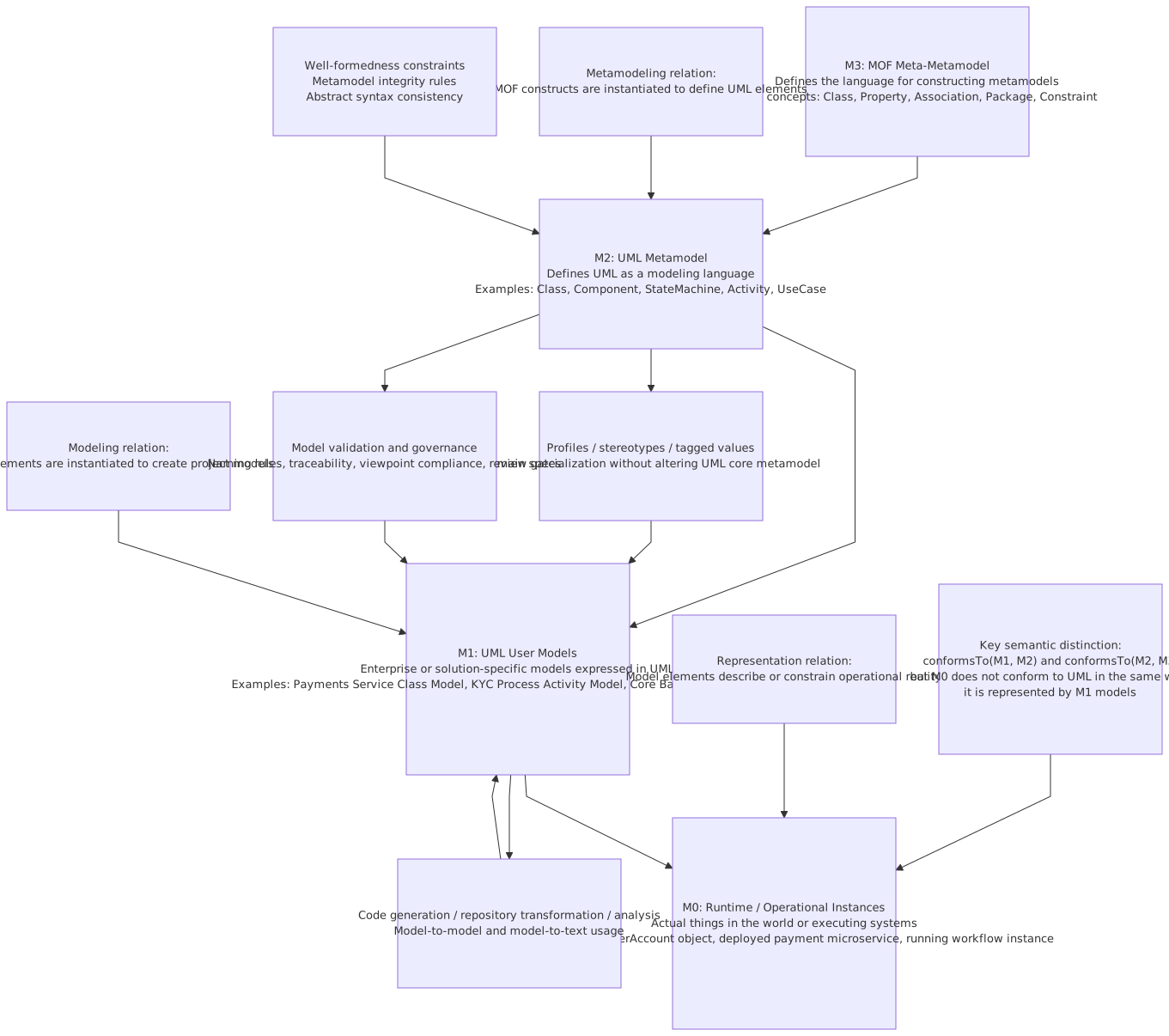
The value of this arrangement is semantic separation. Each layer is typed by the layer above, and that typing relation prevents the language from collapsing into an unstructured collection of symbols.
This is where self-description becomes important. MOF is often described as self-describing because the M3 language can define itself using its own constructs. That does not imply undisciplined circularity. It means the meta-metamodel is sufficiently minimal and regular that its own abstract syntax can be represented within the same formal system. In practice, this gives the ecosystem a stable reflective core. Tool vendors, standards bodies, and transformation engines can treat metamodels as first-class models because the language used to define them is itself modelable.
The abstraction layers are therefore not merely pedagogical. They control what kind of statement is being made. Consider a banking example. A specific payment instruction executed at 14:03 is an M0 fact. A payments model containing a class PaymentInstruction and an association to Account is M1. The UML definition of Class, Property, Association, and Package is M2. MOF’s definition of what it means to have a class with properties and associations is M3. Confusing these levels is a common source of repository corruption. Teams claim that “the metamodel shows all payment interfaces,” when they actually mean an M1 model, or they create governance rules for “classes” that accidentally target domain entities rather than UML metaclasses.
The practical implication is governance precision. If a Sparx EA repository mixes M1 architecture content with M2 extension logic in an uncontrolled way, profiles become semantically unstable. Stereotypes start behaving like substitute metaclasses, traceability rules become inconsistent, and transformations lose fidelity. MOF’s layered architecture is designed to avoid exactly that outcome. It allows extension, but only by preserving the distinction between defining a language, using a language, and instantiating what the language describes.
Deconstructing the UML Metamodel: Core Constructs, Package Structure, and Semantic Variation Points
To understand the UML metamodel operationally, one must move from abstraction layers to the internal architecture of UML itself: the core constructs from which the language is assembled, the package structure that modularizes those constructs, and the semantic variation points that deliberately leave room for interpretation or platform-specific realization. Here UML stops looking like a monolithic notation standard and reveals itself as a layered metamodel with both formal discipline and controlled incompleteness.
At the center are a small number of foundational metaclasses that carry disproportionate semantic weight. Element is the universal root for most UML concepts, providing identity and the ability to own comments, constraints, and relationships. NamedElement adds naming and namespace participation. PackageableElement makes an element eligible for inclusion in a package namespace. Type, Classifier, and Class introduce progressively richer typing semantics, culminating in the ability to classify instances, participate in generalization hierarchies, and own features. Relationship and its specializations, such as Association and Dependency, represent semantic linkage rather than mere line drawing. Property is especially important because it appears across structural and behavioral contexts: as an attribute, an association end, a part, or a parameter-like feature in certain interpretations.
Much of UML’s expressive power comes from the reuse of these metaclasses across packages rather than from isolated diagram-specific constructs.
That reuse is organized through package structure. UML is not defined as one flat schema; it is partitioned into packages such as Kernel, Dependencies, Classification, StructuredClasses, Activities, Actions, StateMachines, and UseCases. The Kernel provides the semantic backbone: ownership, typing, namespaces, redefinition, and generalization. Other packages extend this backbone rather than bypass it. This matters because tool behavior often obscures package boundaries, leading modelers to think in diagram types rather than metamodel dependencies. In Sparx EA, for example, a team may treat an Activity diagram, a Class diagram, and a StateMachine diagram as separate modeling worlds. At metamodel level they are not separate worlds; they are different projections over a shared semantic infrastructure. That shared infrastructure is what enables traceability from a business process step to an application service operation, and then to a state transition governing exception handling.
Semantic variation points are the necessary complication. UML intentionally leaves certain semantics open, especially in execution models, concurrency, event dispatch, token flow, and scheduling. This is not a defect. It is a trade-off between standardization and applicability across domains. A telecom execution engine, a banking workflow platform, and a safety-critical embedded runtime do not resolve all behavioral semantics identically.
The risk is silent divergence. If an enterprise assumes that all tools interpret activity token consumption or state machine run-to-completion semantics in the same way, model portability becomes illusory. Governance must therefore identify which variation points matter, define enterprise conventions, and constrain tooling accordingly. In regulated environments, ambiguity tolerated in notation becomes unacceptable when models support controls, automation, or audit evidence.
Formal Analysis of MOF-Based Abstraction Layers: Conformance, Instantiation, Classification, and Recursive Typing
The formal difficulty in MOF-based abstraction is not remembering that M3 sits above M2, which sits above M1. The real difficulty is distinguishing four relations that are routinely blurred in practice: conformance, instantiation, classification, and recursive typing. They are related, but not interchangeable, and many repository errors begin when teams treat them as though they were.
Conformance is the relation between a model and its metamodel. An M1 UML model conforms to the UML metamodel at M2 if its elements are valid instances of UML metaclasses and satisfy the applicable structural and semantic constraints. A Class in a solution model conforms because it is an instance of the UML metaclass Class, with legal ownedAttributes, associations, generalizations, and namespace placement. This is a language-validity relation. It answers the question: is this model well-formed in the language?
Instantiation is different. It is the relation between an instance and its classifier within a model. A runtime payment object is an instance of the class PaymentInstruction. Instantiation belongs primarily between M0 and M1, not between M1 and M2. Confusing these leads architects to say that a model “instantiates UML” when they actually mean it conforms to UML.
Classification is broader still. A classifier defines the set of instances that may be typed by it, along with the features and constraints those instances inherit. In UML, Class, DataType, Component, Actor, and Signal are all classifiers, but they classify different kinds of instances under different semantic assumptions. In enterprise terms, this matters when a bank models Customer, Account, FraudCase, and PaymentEvent. Those are M1 classifiers of domain phenomena. They are not metaclasses, and governance rules for them should not be written as though they were language definitions.
Recursive typing is the most subtle of the four. MOF is reflective: the meta-metamodel can describe itself. But this is not license for uncontrolled circularity. The recursion is disciplined because each statement is made at a distinct level, even if similar constructs recur. A MOF Class can type the UML metaclass Class at M2; the UML metaclass Class can classify a domain class such as PaymentInstruction at M1; that domain class can classify a concrete payment instance at M0. The word “Class” appears repeatedly, but its referent changes by level. Formal integrity depends on preserving that shift.
This has direct tooling implications. In Sparx EA and similar repositories, profile designers often create stereotypes that mimic new metaclasses while remaining only extensions of existing UML elements. That is acceptable if the stereotype refines semantics and preserves conformance. It becomes dangerous when teams treat «Microservice» on a Class as though they had created a new modeling language construct with independent instantiation rules. They have not. They have created a constrained extension of an existing metaclass. If governance ignores that distinction, validation rules, transformations, and reports will overclaim semantic precision that the repository does not possess.
Consistency, Expressiveness, and Limits: What the UML Metamodel Enables and Where It Becomes Ambiguous
The practical test of any metamodel is not whether it is elegant, but whether it preserves meaning under use, extension, exchange, and automation. On that measure, the UML metamodel is both powerful and uneven. It enables a high degree of expressiveness because its core abstractions are intentionally general. Classifiers can represent business concepts, technical components, interaction roles, signals, and deployment artifacts. Properties can denote attributes, association ends, parts, ports, or parameters depending on context. Dependencies can capture usage, abstraction, realization, or trace-like relationships.
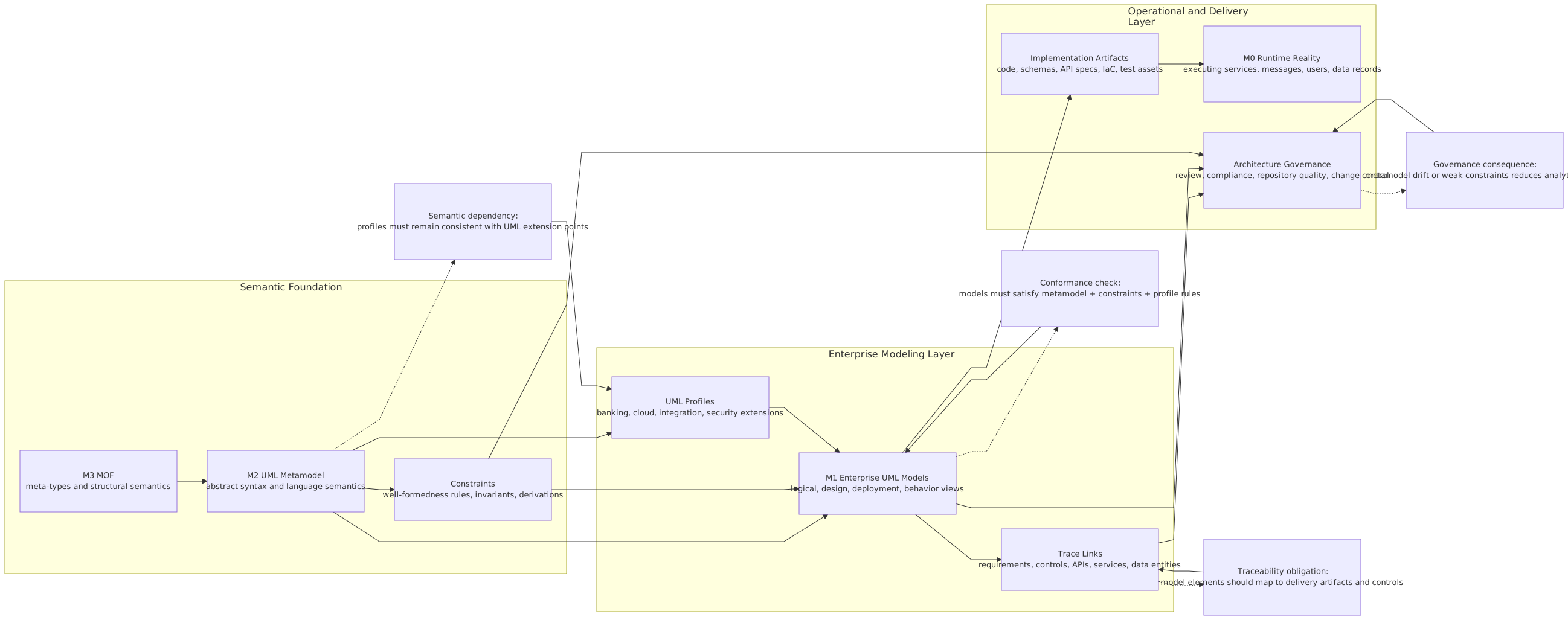
This reuse gives UML a compact semantic foundation and allows different model views to remain connected through shared metaclasses rather than isolated notational islands.
That expressiveness matters in enterprise architecture because real systems cut across structural, behavioral, and operational concerns. A bank modernizing payment processing may need to connect a domain class such as PaymentInstruction, an event such as PaymentSubmitted, a component providing sanction screening, a sequence of API interactions, and a state machine governing exception handling. UML can represent all of these within one metamodel family. The benefit is not diagrammatic variety. It is semantic continuity across design, traceability, and impact analysis.
Yet the same generality introduces ambiguity. UML often permits multiple semantically plausible encodings of the same architectural fact. Is an external fraud engine best modeled as a Component, a Class with «service», an Interface provider, or a Node-hosted deployable artifact? Each choice may be defensible, but they do not carry the same implications for instantiation, behavior, deployment, or interface accountability. Similarly, a customer address may appear as an attribute, an associated value object, or a composition part. The metamodel allows all three because it is expressive; governance must decide which distinctions are meaningful in the enterprise.
The limits become sharper when one asks UML to serve as an executable, governable, enterprise-wide semantic system. Some semantics are underspecified by design. Others depend on OCL constraints that many repositories only partially enforce. Still others are left to profiles, conventions, or tool behavior. In Sparx EA, for example, two teams may both model “application services” using UML Components, but one treats provided interfaces as contractual APIs while the other uses them merely as visual labels. Formally, both may conform. Semantically, they are not equivalent. free Sparx EA maturity assessment
That is the central trade-off. UML metamodeling gives enough structure to support disciplined modeling, transformation, and analysis, but not enough determinacy to eliminate interpretation. Enterprises therefore need a semantic governance layer above bare conformance: modeling conventions, profile discipline, validation rules, and explicit decisions about what distinctions the repository will treat as architecturally significant. Without that, the metamodel enables expression but cannot guarantee consistency of meaning.
Enterprise Implications: Tooling, Model Governance, Interchange, and Controlled Metamodel Evolution
If the previous sections establish what UML is at metamodel level, this section addresses whether that formal structure survives enterprise use. In practice, the decisive questions are concrete. Can tools preserve semantics rather than just notation? Can governance distinguish a valid model from a merely drawable one? Can models move across repositories without semantic erosion? And can an enterprise extend UML in a controlled way without quietly inventing a private language that no longer interoperates?
Tooling is the first pressure point. Most repositories expose UML through diagram palettes, convenience properties, and vendor-specific abstractions. That improves usability, but often hides the metamodel relations that matter for integrity. In Sparx EA, for example, a team may create an “Application Service” by selecting a stereotyped component from a toolbox, while another creates a class with a service stereotype and identical visual appearance. To a reviewer scanning diagrams, the two may look equivalent. At metamodel level they are not. One is a Component-based classifier with deployment implications; the other remains a Class unless constrained otherwise. Tooling therefore does not merely store models; it mediates semantic discipline.
Model governance must operate above syntax checking. Conformance to UML is necessary, but enterprise usefulness depends on additional rules: which metaclasses are permitted for which concerns, which stereotypes are authoritative, which tagged values are mandatory, which relationships carry lifecycle accountability, and which semantic variation points must be fixed by convention. A bank, for instance, may decide that externally consumable APIs are always modeled as provided Interfaces realized by Components, never as free-form dependencies or class operations. That decision is not stylistic. It enables impact analysis, control mapping, and traceability from business capability to application service to deployed interface to operational owner.
Interchange is where weak governance becomes visible. XMI can exchange model structure, but not all tools serialize, interpret, or rehydrate semantics identically. Profiles, diagram layout, OCL constraints, and vendor extensions are especially fragile. A payments modernization program moving models between a central architecture repository and a delivery team’s design tool may find that stereotypes survive while constraint logic, namespace discipline, or relationship semantics do not. The result is formal portability without practical equivalence. In regulated environments, that is serious: an imported model may appear complete yet no longer support the assertions originally attached to it.
Controlled metamodel evolution is therefore essential. Enterprises do need extension mechanisms: profiles for cloud services, event contracts, regulatory controls, or platform patterns. But extension should refine UML, not bypass it. A stereotype such as «EventTopic» on InformationItem or Component can be useful if its semantics, constraints, and allowed relationships are explicit. It becomes harmful when teams treat it as though they had introduced a new metaclass with independent rules never enforced by the underlying repository. The discipline is straightforward, but demanding: extend conservatively, constrain explicitly, validate automatically, and version the profile as a governed asset. That is how an enterprise preserves both local relevance and metamodel integrity.
Conclusion
The real value of the UML metamodel is not that it makes modeling look orderly; it is that it makes the language governable. Once UML is understood through its MOF-based abstraction layers, it stops being a loose collection of diagram types and becomes what it actually is: a formally structured modeling system with explicit semantic commitments. That distinction matters because most enterprise modeling failure does not come from notation choice. It comes from semantic drift, uncontrolled extension, weak traceability, and the inability to determine whether two models are merely similar in appearance or genuinely consistent in meaning.
A formal reading of the metamodel clarifies where those failures originate. The M3, M2, M1, and M0 layers are not pedagogical conveniences; they separate concerns that must remain distinct if a modeling environment is to preserve integrity. MOF provides the meta-structural discipline, UML supplies the language semantics, and user models instantiate those semantics under real delivery constraints. When those layers are blurred, profiles become ad hoc dialects, tools invent incompatible interpretations, and governance collapses into diagram review.
For architects, repository owners, and method engineers, the implication is direct: treat the metamodel as operational infrastructure. Extension mechanisms must be constrained, model validation must be tied to metamodel semantics, and traceability must be anchored in formally defined elements rather than visual conventions. This is especially important in regulated and transformation-heavy environments, where models are expected to support impact analysis, compliance evidence, and cross-tool interoperability.
Deconstructing the UML metamodel therefore leads to a practical conclusion: abstraction is not an academic luxury but the condition for reliable modeling at scale. If UML is to remain useful in complex enterprises, it must be used not just as notation, but as a disciplined semantic architecture.
FAQ
What is the UML metamodel in simple but accurate terms?
The UML metamodel is the formal definition of UML itself. It specifies concepts such as Class, Property, Association, and Activity, and the rules governing how they relate. In MOF terms, UML is typically treated as an M2 model that defines the language used to create M1 user models, while M3 provides the meta-metamodeling foundation.
How do the MOF abstraction layers relate to UML models?
The MOF stack is usually described as M3, M2, M1, and M0. M3 defines the meta-metamodeling constructs, M2 contains the UML metamodel, M1 contains actual UML models created by architects or developers, and M0 represents runtime or real-world instances. The value of the stack is semantic separation: each layer defines the structure and meaning of the layer below.
Why does the UML metamodel matter in enterprise architecture practice?
It matters because tool behavior, model validation, interchange, and governance all depend on metamodel semantics. If architects misunderstand the metamodel, they often create inconsistent profiles, misuse stereotypes, or assume notation implies semantics. In regulated enterprises, that can undermine traceability, impact analysis, and repository integrity across teams and lifecycle stages.
What is the difference between a UML metamodel and a UML profile?
A metamodel defines the core abstract syntax and semantics of the language. A profile is an extension mechanism that customizes UML for a domain using stereotypes, tagged values, and constraints without changing the underlying metamodel. This distinction is critical: profiles adapt UML safely, while metamodel changes create compatibility, tooling, and governance risks.
Is UML really defined by diagrams, or by the metamodel?
Formally, UML is defined primarily by its abstract syntax, semantics, and well-formedness rules, not by diagram appearance alone. Diagrams are views of underlying model elements. Two diagrams may look similar yet mean different things depending on the metamodel relationships beneath them. Serious modeling therefore depends on semantic precision, not just notation.
What are the main risks when teams ignore UML metamodel semantics?
The common risks are semantic drift, invalid model extensions, inconsistent repository content, and false confidence in tool-generated diagrams. Teams may mix domain meaning with notation, create stereotypes that duplicate native constructs, or break interchange between tools. Over time, this reduces model reliability and weakens architecture governance, especially where traceability and compliance evidence are required.
Visual Explanations
MOF-Based Abstraction Stack: From Meta-Metamodel to Runtime Instances
Semantic Dependency and Governance Flow Across UML Metamodel Layers
Frequently Asked Questions
What is a UML metamodel?
A UML metamodel is a model that defines UML itself — it specifies what element types exist (Class, Interface, Association, etc.), what relationships are valid between them, and what constraints apply. It uses the Meta Object Facility (MOF) standard, meaning UML is defined using the same modeling concepts it uses to define other systems.
Why does the UML metamodel matter for enterprise architects?
The UML metamodel determines what is and isn't expressible in UML models. Understanding it helps architects choose the right diagram types, apply constraints correctly, use UML profiles to extend the language for specific domains, and validate that models are internally consistent.
How does the UML metamodel relate to Sparx EA?
Sparx EA implements the UML metamodel — every element type, relationship type, and constraint in Sparx EA corresponds to a metamodel definition. Architects can extend it through UML profiles and MDG Technologies, adding domain-specific stereotypes and tagged values while staying within the formal metamodel structure.