⏱ 21 min read
Most UML in banking is either too pretty to be useful or too vague to be trusted.
That’s the blunt version. I’ve seen teams spend weeks polishing sequence diagrams that nobody uses after the design review. I’ve also seen the opposite: architecture decisions made from half-baked boxes and arrows in PowerPoint, with no shared notation, no clear meaning, and no way to reason about risk. In banking, both extremes are expensive. One creates false confidence. The other creates operational chaos.
So let’s say the quiet part out loud: UML is not dead in banking. But the way many enterprises use it absolutely should be. UML modeling best practices
If you work in banking architecture, UML still matters because banking systems are large, regulated, integrated, and politically complicated. You need a way to describe behavior, structure, dependencies, ownership, and trust boundaries. You need a common language between architects, engineering leads, security teams, IAM specialists, cloud platform teams, auditors, and sometimes vendors who all think they understand the system until production proves they don’t.
A simple explanation upfront, because this matters for search and because too many architecture articles get clever too early: UML, or Unified Modeling Language, is a standard way to describe software systems using diagrams such as sequence diagrams, class diagrams, component diagrams, deployment diagrams, and use case diagrams. In banking systems, UML helps architects communicate how applications, services, users, events, data, and infrastructure interact.
That’s the clean definition. Reality is messier.
In practice, UML in banking is useful when it helps answer questions like:
- Who calls what, and in what order?
- Where does customer identity get verified?
- Which service owns the source of truth?
- What happens when Kafka is unavailable?
- Which cloud boundary contains regulated data?
- Where is authorization actually enforced?
- What breaks when we modernize one part of the payment flow?
That is real architecture work. Not diagramming for the sake of governance theatre. ArchiMate for governance
This article is about the practical lessons. The stuff that survives contact with core banking, IAM integration, Kafka event streams, cloud landing zones, and audit pressure. Some of it will sound opinionated, because it is. Architecture without opinions is usually just administration with nicer fonts. TOGAF roadmap template
Why UML still has a place in banking
Banking systems are not simple software products. They are layered operational machines with history. A retail bank might have digital channels on cloud, fraud detection in a hybrid setup, IAM spread across modern identity providers and legacy directories, payments running through event-driven services over Kafka, and core account systems still deeply tied to older transaction platforms. Add compliance, resilience, segregation of duties, data residency, and vendor dependencies. Now try explaining a critical customer journey without a model.
That’s where UML earns its place.
Not because UML is elegant. It often isn’t. Not because every engineer loves it. They don’t. UML matters because banking architecture needs shared precision. A sequence diagram can reveal a broken authentication step in thirty seconds. A deployment diagram can expose that your “cloud-native” service still depends on a single on-prem token service. A component diagram can show that your anti-fraud capability is actually a thin wrapper around three teams that don’t coordinate release windows.
And here’s the contrarian bit: UML is often more valuable in banks than in startups, even though banks use it worse. Startups can survive with tribal knowledge and fast iteration. Banks cannot. A missed dependency in a lending system becomes a regulatory issue. A misunderstood authorization flow becomes a security finding. A hidden batch integration becomes a failed migration.
So yes, UML has a place. But only if we stop pretending all diagrams are architecture.
The biggest misunderstanding: UML is not the architecture
A diagram is evidence of thought, not proof of thought.
Architects get this wrong all the time. They produce diagrams as deliverables instead of using them as tools for decision-making. In banking enterprises, this gets amplified by governance structures that ask for “the architecture pack” as if architecture is a document set rather than a set of trade-offs. EA governance checklist
A useful UML artifact in banking should do at least one of these things:
That table is more practical than most UML training. UML for microservices
The real issue is not whether to use UML. The issue is selecting the right UML view for the decision you’re making. If you’re discussing Kafka event replay strategy, a use case diagram is almost useless. If you’re discussing customer onboarding actors and responsibilities, a deployment diagram won’t save you.
A lot of architects fail here because they want one master diagram that explains everything. That diagram does not exist. And in banking, trying to force it usually creates diagrams that are unreadable, politically convenient, and technically weak.
Start simple: what UML actually helps with in banking systems
Before going deeper, let’s make this practical.
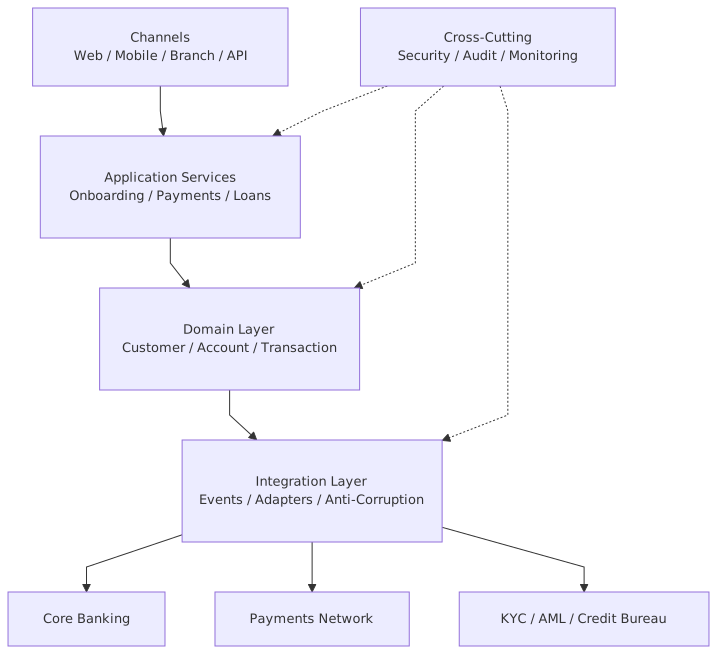
In banking architecture work, UML helps with four things:
- Explaining business flows in technical terms
- Making integration patterns visible
- Showing control points for security and IAM
- Revealing operational dependencies before they become incidents
That’s it. That’s the value.
Take a basic retail banking scenario: a customer logs into mobile banking, views accounts, initiates a transfer, and receives a notification.
That journey sounds simple. It usually isn’t.
Under the hood, you may have:
- mobile app and web app channels
- API gateway
- IAM platform using OAuth2/OpenID Connect
- customer profile service
- account aggregation service
- payment orchestration service
- fraud/risk engine
- Kafka for event publication
- notification service
- core banking ledger
- audit service
- cloud observability stack
- token vault or HSM-backed signing service
- on-prem dependency for a legacy entitlement check
If you cannot model that clearly, you cannot reason about it clearly.
A good sequence diagram for this flow should show:
- the authentication handoff to IAM
- token issuance and validation points
- synchronous APIs versus asynchronous Kafka events
- where fraud decisioning occurs
- where authorization is enforced
- where the customer gets a definitive response
- what happens if downstream systems are delayed
That’s architecture. Not because the diagram is formal, but because the model forces precision.
The sequence diagram is the most underrated banking architecture tool
If I had to keep only one UML diagram in enterprise banking work, I’d keep the sequence diagram. No question.
Why? Because banking problems are rarely just about structure. They’re about interactions over time. Money moves. Tokens expire. Events arrive late. Fraud checks branch. Manual review interrupts automation. Legacy services timeout. Sequence matters.
And sequence diagrams expose lies very quickly.
For example, a team says: “Our payment API is non-blocking and event-driven.” Fine. Draw it. Usually what appears is this:
- Channel sends payment request
- API validates session token with IAM
- API writes request to orchestration service
- Orchestration service synchronously calls fraud
- Fraud synchronously calls customer risk profile
- Risk profile synchronously calls on-prem master data
- Payment service writes to core ledger
- Core ledger returns confirmation
- Kafka event is published
- Notification service sends SMS
That is not event-driven in any meaningful architectural sense. That is a synchronous transaction with an event attached at the end for decoration.
This is why sequence diagrams matter. They expose where your architecture story diverges from runtime truth.
In banking, I use sequence diagrams heavily for:
- login and step-up authentication
- payment initiation and settlement
- customer onboarding and KYC
- card transaction authorization
- fraud alert processing
- account closure workflows
- entitlement propagation
- event publication and consumption patterns
- operational failover scenarios
And yes, I include alternate and failure paths. If your banking sequence diagrams only show the happy path, they are basically marketing material.
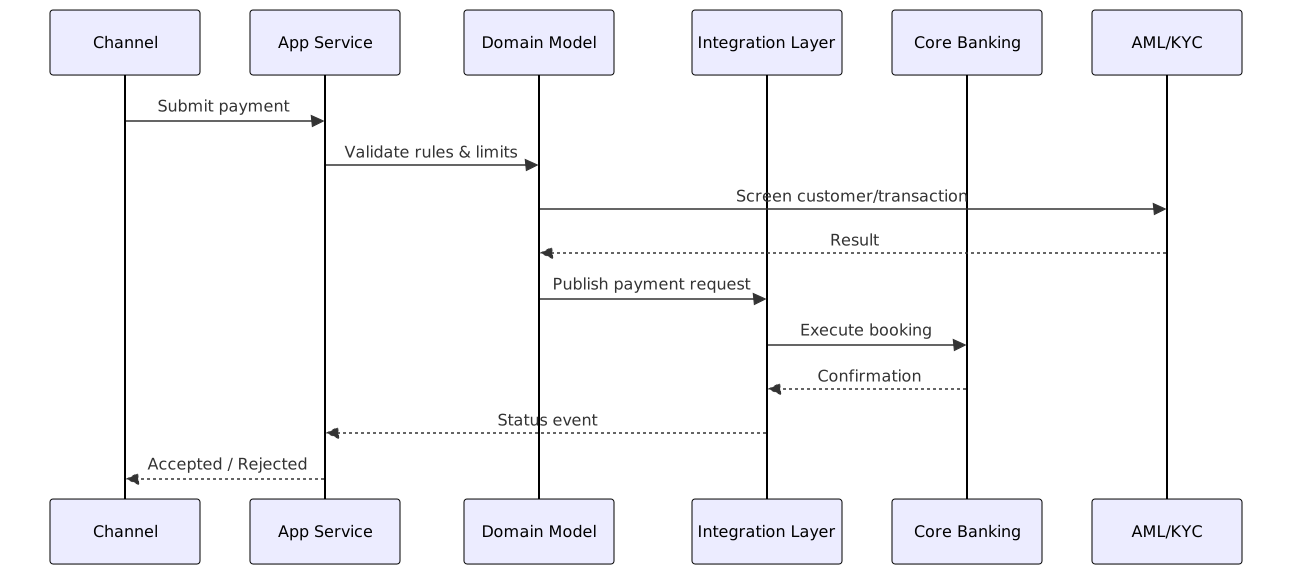
A real sequence diagram for payment initiation should include things like:
- invalid token
- insufficient entitlement
- fraud timeout
- duplicate request handling
- Kafka publish failure
- idempotency behavior
- compensation or retry
- customer-visible response versus backend completion
That level of detail is where architecture becomes useful to engineering and operations.
UML and Kafka: where many bank architects get lazy
Banks love saying they are event-driven. Some are. Many are event-themed.
Kafka is now common across banking estates for transaction events, customer domain events, fraud signals, operational telemetry, and integration decoupling. That’s good. But UML usage around Kafka is often shallow. Architects draw a box labeled “Kafka” in the middle of a component diagram and act like they’ve described the architecture. They haven’t.
If Kafka is central to your banking integration model, your UML should make at least these things visible:
- which service publishes which event
- event ownership
- key topics and contracts
- sync versus async boundaries
- consumer groups and critical consumers
- retry, dead-letter, and replay patterns
- ordering assumptions
- idempotency responsibilities
- failure handling and eventual consistency implications
A component diagram can show producer and consumer relationships. Useful. But the sequence diagram is where the truth lives. It should show whether the business process depends on Kafka acknowledgment, whether publishing is inside the transaction boundary, and what the customer sees if publication fails.
Here’s the contrarian opinion: many architects overstate the decoupling benefit of Kafka in banking. Kafka reduces some forms of coupling, yes. It often increases operational and semantic coupling if governance is weak. Two teams may be technically decoupled but completely dependent on each other’s event meanings, schemas, replay assumptions, and timing expectations.
That’s why UML should not just show “Service A publishes Event X.” It should show where Event X matters in the business flow.
For example, in a mortgage servicing context, if “PaymentPosted” is emitted after ledger update, downstream systems may assume finality. But what if there is later reversal logic? What if notification service sends customer confirmation before anti-money-laundering checks complete? What if analytics consumes before enrichment? If your UML doesn’t show these temporal and business implications, you’re not modeling architecture. You’re drawing plumbing.
IAM is where UML becomes non-negotiable
Identity and access management in banking is where vague diagrams go to die.
Banks have layered IAM realities:
- workforce IAM
- customer IAM
- privileged access management
- machine-to-machine identities
- federation with external parties
- legacy entitlements
- API authorization
- token exchange across domains
- strong customer authentication requirements
- audit and consent obligations
This is not a place for hand-wavy boxes.
A proper UML treatment of IAM in banking should include both structural and behavioral views. The component diagram should show identity provider, access management services, token validation points, policy decision points, directories, customer profile stores, and application integration patterns. The sequence diagram should show login, MFA, token issuance, token introspection or validation, authorization decisions, consent checks, and downstream service trust.
One of the most common mistakes I see: architects model authentication and forget authorization. In banking, those are different universes. A customer can be authenticated and still not be allowed to perform a transfer above a threshold, view a joint account, approve a treasury payment, or access a delegated business account role.
Another mistake: assuming IAM is just an edge concern. It isn’t. In real banking systems, authorization often leaks deep into service design because entitlements depend on product type, account relationship, geography, customer segment, transaction value, and risk posture. If your UML says “gateway authenticates user” and nothing else, you’ve probably missed the hard part.
A useful banking sequence for IAM should answer:
- who authenticates the user
- where MFA is triggered
- how tokens are issued and scoped
- how service-to-service trust works
- where authorization is evaluated
- whether policy is centralized or embedded
- how delegated authority is represented
- how audit records are generated
And if you have both cloud-native APIs and legacy applications, model the bridging pattern honestly. Don’t pretend the old entitlement engine magically disappeared because the front door now uses OpenID Connect.
Cloud architecture: deployment diagrams matter more than people admit
A lot of enterprise architects quietly avoid deployment diagrams because they force uncomfortable precision. But in banking cloud work, they are essential.
When a bank says an application is “on cloud,” that phrase can mean almost anything:
- containerized in a managed Kubernetes platform
- running in virtual machines
- managed services for database and messaging
- cloud-hosted but dependent on on-prem data sources
- multi-region active-passive
- isolated by landing zone
- partially serverless
- outbound-only from regulated subnet
- fronted by private connectivity from branch systems
Without a deployment view, all of these collapse into one misleading blob.
In real architecture work, deployment diagrams help answer:
- where workloads run
- where data resides
- which network zones are crossed
- where encryption boundaries apply
- what HA and DR assumptions exist
- which IAM control plane is used
- where Kafka clusters are hosted
- what depends on on-prem connectivity
- how regulated workloads are isolated
This matters especially in banking because cloud diagrams are often over-simplified for executive consumption, and then reused in technical contexts where they become dangerous.
For instance, a payments platform may appear fully cloud-native in a high-level component diagram. But a proper deployment diagram reveals:
- API services in cloud region A
- Kafka managed cluster in region A with mirror to region B
- IAM federation to on-prem directory
- HSM-backed signing service retained on-prem
- settlement adapter running in private data center
- MPLS/private link dependency for core banking access
- audit archive in separate compliance account
- observability stack split across cloud-native and SIEM tooling
That deployment reality changes your resilience story, your latency profile, your failure modes, and your migration sequencing. It also changes your risk register. Which is why deployment diagrams are not infrastructure trivia. They are architecture.
A real enterprise example: payment modernization in a retail bank
Let me give a realistic enterprise scenario. Not a toy example.
A mid-sized retail bank wanted to modernize domestic payments. The existing process was spread across internet banking, mobile banking, a legacy payments hub, an entitlement engine, and a core ledger. Customer experience was poor, release cycles were slow, and fraud controls were bolted on inconsistently. The target architecture introduced:
- cloud-hosted API gateway
- customer IAM with MFA
- payment orchestration microservices
- Kafka for payment lifecycle events
- fraud scoring service
- notification service
- centralized audit service
- continued use of existing core ledger and settlement adapter
On paper, this looked straightforward. In reality, it wasn’t.
What the architects initially modeled
They had:
- a component diagram showing channels, gateway, payment services, Kafka, fraud, ledger
- a generic cloud diagram
- a use case view for customer payment initiation
What they did not have was a serious sequence diagram or an honest deployment diagram.
What went wrong
During testing, several issues appeared:
- Authorization logic was inconsistent
IAM authenticated users, but account-level entitlements still lived in a legacy engine. Some payment APIs checked it, some relied on cached profile data, some didn’t enforce approval thresholds correctly.
- Kafka publication timing was misunderstood
Teams assumed PaymentInitiated was published only after successful ledger persistence. In practice, one service published before ledger confirmation to support near-real-time notifications. That caused false customer messages when ledger write failed.
- Fraud timeout behavior was undefined
In one path, fraud timeout meant “fail closed.” In another, it meant “queue for review.” Customer channels received inconsistent responses.
- Cloud dependency story was misleading
The orchestration service was in cloud, but final payment authorization still depended on an on-prem entitlement check over a constrained network path. Peak-hour latency was awful.
- Replay and idempotency were weak
During a Kafka consumer restart, duplicate processing generated duplicate notification attempts and confused the operations team.
What fixed it
The architecture team stopped making prettier diagrams and made more honest ones.
They created:
- a detailed sequence diagram for payment initiation, including failure paths
- a separate sequence diagram for event publication and downstream consumption
- a deployment diagram showing cloud and on-prem runtime dependencies
- a state model for payment lifecycle: initiated, validated, fraud-pending, authorized, posted, failed, reversed
That work exposed key architecture decisions:
- authorization would be centralized through a policy service facade over the legacy entitlement engine, reducing scattered checks
- customer confirmation would only occur after ledger confirmation event, not API acceptance
- fraud timeout rules would be standardized by payment type and amount
- idempotency keys would be mandatory for payment initiation and notification processing
- Kafka event contracts would distinguish business acceptance from final posting
- network and resilience design would account for on-prem dependency rather than pretending it was temporary noise
This is exactly how UML applies in real architecture work. Not as compliance wallpaper. As a way to make hidden assumptions visible before they become incidents.
Common mistakes architects make with UML in banks
Let’s be direct about the failure patterns.
1. Using one diagram for every audience
A board summary, a security review, a delivery team handoff, and an operations readiness discussion do not need the same diagram. Forcing one artifact to serve all audiences makes it useless for all of them.
2. Modeling the future fantasy, not the current reality
Architects love target-state diagrams that quietly erase the ugly dependencies. In banking, those ugly dependencies are usually the project. Model them.
3. Ignoring failure paths
If your sequence diagrams don’t include retries, timeouts, fallback, and manual intervention, then they are incomplete for banking use.
4. Mixing abstraction levels
A component diagram with “Customer Domain” next to “Oracle Package XYZ” is a mess. Choose a level and stay there.
5. Treating Kafka as a magic decoupling box
Event-driven does not remove responsibility for ownership, ordering, semantics, or resilience.
6. Reducing IAM to login screens
Authentication is only the front door. Banking risk sits deeper in authorization, delegation, consent, and audit.
7. Forgetting deployment truth
A cloud architecture that hides on-prem trust anchors, network dependencies, or data gravity is not architecture. It’s optimism.
8. Over-modeling static structure, under-modeling behavior
Banking failures often come from interactions over time. Sequence and state matter more than people think.
9. Producing diagrams no engineering team can update
If only enterprise architecture can edit the UML, the models will rot. Fast.
10. Confusing notation purity with usefulness
I do not care if every arrow is textbook-perfect if the model fails to explain the risk. Purity is not the goal. Clarity is.
That last point irritates some UML purists. Fine. In enterprise banking, usefulness wins.
What good UML looks like in real architecture work
A good UML practice in banking is boring in the best possible way. It is repeatable, selective, and tied to decisions.
Here’s a practical pattern I recommend:
For a major banking capability or initiative, keep a small model set
1. Context/component view
Shows major services, ownership, external systems, and key interfaces.
2. One or two critical sequence diagrams
Shows end-to-end flow, including IAM, sync/async boundaries, and alternate paths.
3. Deployment diagram
Shows runtime topology, cloud/on-prem boundaries, resilience zones, and trust boundaries.
4. Optional state model where lifecycle matters
Payments, cards, onboarding cases, fraud investigations, loan applications.
That’s usually enough.
And keep them alive. If the architecture decision changes, update the model. If nobody updates the model, archive it instead of pretending it is current.
Another contrarian thought: in many bank programs, four accurate diagrams beat twenty polished ones. Documentation volume is often inversely related to architectural honesty.
How to use UML without becoming process-heavy
Banks have a habit of turning every useful thing into a bureaucratic burden. UML is no exception.
So here’s the practical approach.
- Use UML where ambiguity is expensive.
- Don’t model trivial systems deeply.
- Focus on risk-heavy flows: payments, identity, entitlements, customer data, fraud, regulatory reporting.
- Standardize a lightweight set of views.
- Tie diagrams to architecture decisions and controls.
- Review them with engineers, security, and operations together.
- Update them when the design materially changes.
Also, be comfortable mixing UML with other architecture artifacts. I’m not ideological about notation. In real enterprise work, a C4-style view, a data flow diagram, and a UML sequence diagram can coexist perfectly well. The point is not to worship UML. The point is to communicate architecture precisely enough to make better decisions.
But if you’re in banking and you’re not using sequence and deployment views for critical journeys, you are probably leaving risk unmodeled.
Final thought
UML in banking systems is neither obsolete nor sacred. It is a tool. A very useful one, when used with discipline and a bit of skepticism.
The practical lesson is simple: use UML to expose truth, not to decorate strategy decks. Model interactions, trust boundaries, runtime dependencies, and failure behavior. Be especially rigorous where Kafka, IAM, and cloud architecture intersect, because that’s where modern banking complexity tends to hide behind confident vocabulary.
And don’t confuse having diagrams with having architecture. Banks do that a lot.
The best architects I know use UML sparingly, sharply, and without sentimentality. They don’t model everything. They model the parts where misunderstanding would cost money, resilience, or credibility. That’s the right standard.
If your UML helps a banking team catch a broken authorization path, a false event assumption, or a hidden on-prem dependency before go-live, then it has done more than most architecture documentation ever will.
That’s enough reason to keep it.
FAQ
1. Is UML still relevant for modern banking systems using microservices and cloud?
Yes. Maybe more than ever. Microservices, Kafka, IAM, and cloud increase distributed complexity. UML helps make interactions, dependencies, and boundaries explicit. The trick is using the right diagrams, not producing lots of them.
2. Which UML diagrams are most useful in banking architecture?
Sequence diagrams, component diagrams, and deployment diagrams are the most consistently valuable. State diagrams are also very useful for payment or account lifecycles. Use case diagrams help early on, but they are not enough for technical design.
3. How does UML help with Kafka-based banking architectures?
It helps show who publishes and consumes events, where async boundaries exist, and what happens during failure or replay. The biggest benefit is exposing assumptions about timing, ordering, and business finality that are often hidden in event-driven systems.
4. How should architects model IAM in banking with UML?
Use component diagrams for identity providers, policy services, token validation points, and application trust relationships. Use sequence diagrams for login, MFA, token issuance, authorization checks, delegation, and audit generation. Don’t stop at authentication; authorization is usually the harder part.
5. What is the most common UML mistake in enterprise banking?
Modeling only the happy path. Banking architecture lives in exceptions, delays, retries, manual reviews, and partial failures. If the diagrams don’t show that, they are incomplete and sometimes actively misleading.
UML in Banking Systems: Practical Lessons
Practical lessons
- Keep UML centered on bounded contexts, not vendor systems alone.
- Separate domain logic from integration concerns with clear adapters.
- Model cross-cutting controls explicitly: audit, security, compliance.
- Use sequence diagrams for critical flows; use layered diagrams for ownership and dependencies.
Frequently Asked Questions
How is ArchiMate used in banking architecture?
ArchiMate is used in banking to model regulatory compliance (Basel III/IV, DORA, AML), integration landscapes (core banking, payment rails, channels), application portfolio rationalisation, and target architecture for transformation programs. Its traceability capabilities make it particularly valuable for regulatory impact analysis.
What enterprise architecture challenges are specific to banking?
Banking faces unusually complex EA challenges: decades of legacy core systems, strict regulatory change requirements (DORA, Basel IV, PSD2), fragmented post-M&A application landscapes, high-stakes integration dependencies, and the need for real-time operational resilience views. Architecture must be both accurate and audit-ready.
How does Sparx EA support banking enterprise architecture?
Sparx EA enables banking architects to model the full DORA ICT asset inventory, maintain integration dependency maps, track application lifecycle and vendor EOL, and generate compliance evidence directly from the model. Integration with CMDB and Jira keeps the model current without manual maintenance.