⏱ 19 min read
Most enterprise architecture arguments about UML and ArchiMate are a waste of time.
There, I said it.
Not because the question is unimportant. It is important. It shapes how teams model systems, communicate decisions, and govern change. But too often the debate gets reduced to lazy slogans: “UML is too technical”, “ArchiMate is too abstract”, “Just use both”. That kind of advice sounds mature and balanced, but in practice it often produces model sprawl, diagram fatigue, and architecture repositories nobody trusts.
Here’s the blunt version: UML and ArchiMate are not competing notations in the simple sense. They are different metamodels with different ideas about what reality matters. If you do not understand that, you will misuse both.
And yes, this matters in real architecture work. Especially in large enterprises where you are trying to connect strategy to systems, systems to interfaces, interfaces to data, data to controls, and all of that to delivery. Banks, cloud migrations, Kafka event platforms, IAM programs — this is where the choice becomes painfully concrete.
Simple explanation first: what is the difference?
If you want the quick SEO-friendly answer:
- UML is mainly for modeling the design and behavior of software-intensive systems.
- ArchiMate is mainly for modeling enterprise architecture across business, application, technology, and strategy layers.
- UML is more expressive for software structure and behavior.
- ArchiMate is more expressive for enterprise relationships, dependencies, and operating context.
That’s the simple version. Mostly true. Also incomplete.
The real difference is not just “software vs enterprise.” The real difference is what each metamodel considers a first-class concept.
UML says: classes, components, interactions, states, deployments, activities — these are meaningful things to model directly.
ArchiMate says: business capabilities, application services, processes, actors, technology services, value streams, capabilities, outcomes, and relationships across layers — these are meaningful things to model directly.
So when people ask, “Which one is more expressive?” the only honest answer is: more expressive for what?
That qualifier matters because architects routinely confuse diagram richness with metamodel expressiveness. A notation can let you draw many things and still be weak at expressing the thing you actually need to govern.
The metamodel question architects tend to skip
A lot of architects say they care about metamodels, but what they really care about is diagram appearance. Boxes, arrows, colors, maybe a repository if procurement forced one. Fair enough. We all live in the real world.
But if you are serious about enterprise architecture, the metamodel is the real game.
A metamodel defines:
- what kinds of elements exist
- what relationships are legal or meaningful
- what abstractions are encouraged
- what traceability can be maintained
- what questions you can ask later without rebuilding the model from scratch
That last point is where projects live or die.
If your model cannot answer:
- which business capability depends on this IAM platform?
- which Kafka topics support a regulated payment flow?
- which cloud services host customer authentication?
- which application services expose account balance data?
- what breaks if we decommission this on-prem integration hub?
…then your architecture model is decorative, not operational.
This is exactly where UML and ArchiMate diverge in practice. ArchiMate modeling guide
UML’s expressiveness: excellent, but narrower than people admit
Let me be contrarian for a second. UML is often dismissed in enterprise architecture circles as too detailed, too developer-centric, or too old-school. That criticism is lazy. UML modeling best practices

UML is still one of the richest modeling languages we have for representing software structure and behavior. If you need precision around service interactions, lifecycle behavior, object responsibilities, deployment topology, or integration contracts, UML can say things that ArchiMate simply cannot say well. ArchiMate tutorial
That is not a small advantage. It is a serious one.
Where UML is genuinely strong
UML gives you strong expressive power in areas like:
- Static structure
- Behavior
- Runtime and deployment
- Detailed interaction semantics
- classes
- interfaces
- components
- packages
- dependencies
- sequence diagrams
- activity diagrams
- state machines
- use cases
- nodes
- artifacts
- execution environments
- deployments
- lifelines
- messages
- control flow
- object creation
- asynchronous interactions
For software architecture, this matters a lot. If your team is designing an event-driven platform using Kafka, UML sequence and component diagrams can express producer-consumer behavior, orchestration, asynchronous messaging, and service boundaries with more operational clarity than ArchiMate. ArchiMate layers explained
For example, if a bank is building a fraud detection flow:
- card authorization service emits an event
- Kafka topic distributes it
- fraud scoring service consumes and enriches it
- IAM policy checks whether downstream services can access sensitive customer attributes
- alert service triggers case management workflow
In UML, you can model temporal interactions, interface dependencies, and deployment concerns in a way engineers can act on immediately.
ArchiMate can indicate that these application components collaborate and that an application service supports a business process. Useful, yes. But if you need to reason about the actual interaction behavior, ArchiMate starts feeling thin. ArchiMate relationship types
The uncomfortable truth about UML in EA
Now the criticism.
UML is expressive, but often in the wrong direction for enterprise architecture. It gives you a lot of precision around system design, but much weaker native support for things enterprise architects care about daily:
- business capability mapping
- strategic motivation
- value realization
- portfolio rationalization
- cross-layer dependency analysis
- business/application/technology traceability in one coherent abstraction stack
You can force UML to do some of this. Architects love forcing tools to do things they were not designed to do. It usually ends badly.
Yes, you can create stereotypes, profiles, custom tagged values, and governance conventions. You can turn UML into a kind of pseudo-EA language. But once you need that much tailoring, you are basically confessing the native metamodel is not aligned to the problem. UML for microservices
And that is the issue: UML is highly expressive, but not naturally enterprise-expressive.
ArchiMate’s expressiveness: less precise, more architecturally useful
ArchiMate gets mocked for being abstract. Sometimes rightly. Plenty of ArchiMate models are just polite wallpaper: capabilities floating over applications, applications floating over technology, arrows everywhere, no real decisions enabled. ArchiMate modeling best practices
But when used properly, ArchiMate is one of the best enterprise architecture metamodels because it encodes something most organizations desperately need: cross-layer coherence.
That sounds academic. It is not.
Cross-layer coherence means you can model:
- a business capability like customer onboarding
- the business processes that realize it
- the application services that support those processes
- the application components that provide those services
- the technology services and infrastructure hosting them
- the strategic drivers, risks, and outcomes behind the investment
That chain is gold in real architecture work.
Where ArchiMate is genuinely strong
ArchiMate shines in:
- Layered architecture views
- Cross-domain relationships
- Motivation and strategy
- Portfolio and operating model reasoning
- Roadmapping and transition architecture
- business, application, technology
- serving, realization, assignment, access, triggering, flow
- drivers, goals, outcomes, principles, requirements, capabilities, value streams
- what supports what
- what is duplicated
- what should be standardized
- plateaus, gaps, work packages, deliverables
For enterprise architecture, this is often exactly the right level of expressiveness. Not because it is more detailed, but because it captures the architecture questions that matter to leadership and transformation teams.
Take an IAM modernization in a bank. The program is rarely just “replace the authentication service.” It usually affects:
- customer onboarding
- employee access management
- privileged access controls
- fraud operations
- cloud landing zones
- API gateways
- regulatory obligations
- third-party identity federation
ArchiMate lets you represent these concerns in one connected model without collapsing into implementation detail too early.
That is the point. Enterprise architecture is not software design at enterprise scale. It is a different problem.
The weakness of ArchiMate nobody should ignore
Now the other side.
ArchiMate is often praised for being “simple,” but that simplicity comes with tradeoffs. Its behavioral expressiveness is weaker than UML. Its ability to represent interaction mechanics is limited. It often struggles when architects need to model real runtime semantics, integration choreography, event processing nuances, or detailed service contract responsibilities. UML domain modeling
And that matters more now than it did ten years ago.
Modern enterprises are not just stacks of applications. They are ecosystems of APIs, event streams, cloud services, policy engines, identity providers, data products, and automation flows. The architecture is dynamic. If your notation cannot express enough of that dynamic behavior, you get nice strategy maps and poor execution guidance.
This is why some architects quietly abandon ArchiMate the moment the conversation gets technical. They say they are “moving into solution architecture,” but really they are hitting the edge of the metamodel.
That edge is real.
Comparative view: expressiveness by concern
Here is the practical comparison that matters more than ideology.
This is why saying “UML is more expressive” is both true and misleading.
It is more expressive in terms of software semantics.
It is not more expressive in terms of enterprise dependency structure.
And frankly, for most enterprise architects, that second category is the one that pays the bills.
Real enterprise example: a bank modernizing payments and identity
Let’s make this concrete.
Imagine a retail bank modernizing its payments landscape. It wants to:
- move from batch-heavy integration to event streaming with Kafka
- modernize customer and workforce IAM
- shift payment APIs and fraud services to cloud platforms
- reduce duplication across online banking, mobile banking, and branch systems
- improve regulatory traceability for access control and transaction handling
This is not a hypothetical architecture toy. This is normal enterprise work now.
What the CIO wants to know
The CIO and transformation office ask:
- Which business capabilities are affected?
- Which systems are critical to payment initiation and settlement?
- Where are identity dependencies concentrated?
- What cloud migration sequencing reduces operational risk?
- What platforms are duplicated?
- What programs are competing for the same services and teams?
That is ArchiMate territory.
You model:
- business capabilities: payments processing, customer identity management, fraud management
- business processes: payment initiation, transaction authorization, dispute handling
- application services: payment orchestration, customer authentication, token validation, fraud scoring
- application components: payment hub, mobile app backend, IAM platform, fraud engine, Kafka platform
- technology services: container platform, managed Kafka, IAM runtime, observability stack
- strategic elements: goals, drivers, outcomes, work packages
Now you can see that the same IAM platform supports:
- customer login
- employee SSO
- privileged access workflows
- API token validation for payment services
That is useful because it reveals concentration risk and sequencing constraints.
What the platform architect wants to know
Then the platform architect asks:
- How does the payment orchestration service interact with Kafka topics?
- Which events are published synchronously vs asynchronously?
- Where does token introspection happen?
- What are the consumer responsibilities for fraud scoring?
- How are retry and dead-letter patterns handled?
- What is deployed where in cloud and what trust boundaries exist?
That is UML territory.
You use:
- component diagrams for service boundaries and interfaces
- sequence diagrams for payment initiation and fraud workflows
- deployment diagrams for cloud runtime topology
- maybe state diagrams for transaction lifecycle states
A sequence diagram can show:
- Mobile banking app sends payment request
- API gateway validates token with IAM
- Payment orchestration service persists request
- Event published to Kafka topic
- Fraud scoring service consumes event
- Risk result emitted
- Payment orchestration updates state
- Core banking connector executes booking
- Notification service informs customer
That level of behavior is where UML earns its keep.
What goes wrong in real organizations
Here is the pattern I see all the time.
The enterprise architecture team models the transformation in ArchiMate. Good start.
Then they try to use the same notation for every technical discussion. Bad move.
Soon the diagrams become overloaded with interface labels, messaging details, cloud constructs, topic names, trust zones, and pseudo-runtime semantics. The ArchiMate model gets ugly and ambiguous. Engineers ignore it.
Or the reverse happens.
A technically strong architecture team models everything in UML. Components, deployments, interactions, maybe some package views. But there is no coherent capability map, no strategic traceability, no operating model perspective, no portfolio view. Leadership sees a wall of technical diagrams and learns nothing.
Then people conclude “modeling doesn’t work here.”
No. The problem is not modeling. The problem is metamodel mismatch.
Common mistakes architects make
This is where strong opinion is needed, because some of these mistakes are self-inflicted.
1. Treating notation choice as a religious decision
It is not a religion. It is a fit-for-purpose decision.
If you insist one language should model everything, you are usually optimizing for tool convenience or personal comfort, not architecture quality.
2. Confusing abstraction with vagueness
ArchiMate is abstract by design. That is not the same as being vague.
A good ArchiMate model is selective. It shows the dependency structure that matters. A bad one uses abstraction as an excuse to avoid hard decisions.
3. Using UML to fake enterprise traceability
You can extend UML profiles until the sun burns out. It still does not naturally become a strong enterprise metamodel.
If you need traceability from regulatory driver to business capability to application service to cloud platform, UML is fighting uphill.
4. Using ArchiMate to fake runtime design
This is maybe the most common sin in modern architecture teams.
ArchiMate is not great for detailed runtime interaction design. Stop pretending it is. If your Kafka event choreography needs exact sequencing, timing assumptions, and service responsibilities, use UML or another technical modeling approach.
5. Modeling too much, too early
Architects love completeness. Enterprises punish it.
You do not need a perfect repository of every element before making useful architecture decisions. Start with the decision points:
- impacted capabilities
- critical applications
- integration dependencies
- identity trust boundaries
- cloud hosting patterns
- migration sequencing
Then deepen the model where risk or ambiguity justifies it.
6. Letting tools dictate the metamodel
This one is painful.
Many organizations choose a repository tool, then quietly let the tool’s convenience features define the architecture language. If a relationship is hard to create, teams stop modeling it. If a view is easy to auto-generate, they overuse it.
That is backwards. The metamodel should serve the architecture questions, not the other way around.
So which metamodel is more expressive?
If you force me to answer directly:
- UML is more expressively powerful for software design and dynamic behavior.
- ArchiMate is more expressively useful for enterprise architecture as practiced in large organizations.
Useful is the key word.
Because expressiveness in architecture is not just about what can be represented. It is about what can be represented coherently, consistently, and usefully for decisions.
A notation that can describe every message in a distributed workflow but cannot cleanly connect that workflow to business capability, risk, ownership, and transformation planning is incomplete for enterprise work.
A notation that can map the whole enterprise but cannot express enough runtime behavior to guide implementation is also incomplete.
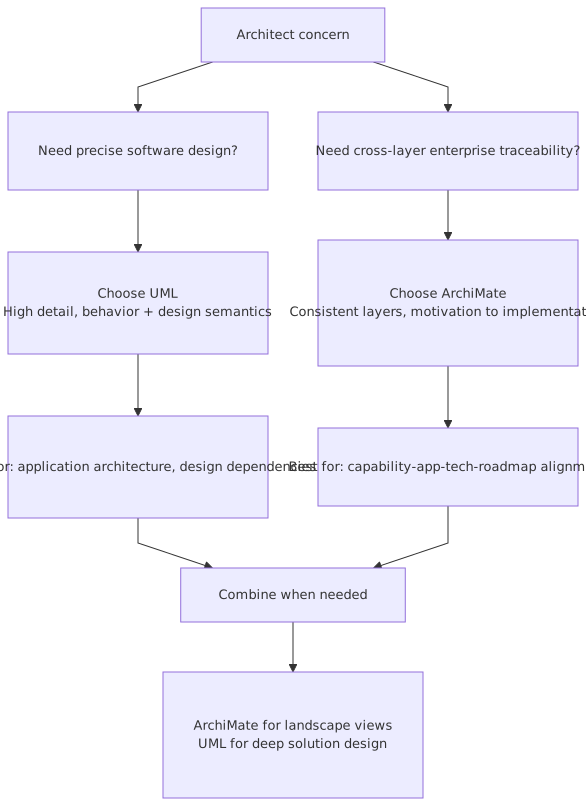
This is why mature architecture practices usually need both perspectives. But I want to be careful here, because “use both” is often lazy advice.
The non-lazy way to use both
Using both does not mean creating duplicate diagrams of the same thing in two notations because governance said so.
It means assigning each metamodel a job.
Use ArchiMate for:
- capability maps
- business to application alignment
- application portfolio views
- technology dependency maps
- IAM operating model context
- cloud transition architectures
- strategic roadmaps
- impact analysis across domains
Use UML for:
- service decomposition
- API interaction modeling
- Kafka event flow behavior
- IAM authentication and authorization flows
- deployment topology
- state transitions
- failure and retry scenarios
And most importantly: define the handoff between them.
For example:
- An ArchiMate application component maps to one or more UML components.
- An ArchiMate application service is elaborated by UML interface and sequence models.
- An ArchiMate technology node or technology service is refined by UML deployment views.
- ArchiMate work packages and plateaus frame the transformation roadmap; UML models clarify implementation design for critical increments.
That is a sane division of labor.
A practical rule for real architecture teams
Here is the rule I give teams:
If the question starts with “why, what supports what, what changes, who depends on it, or how do we sequence it?” start with ArchiMate.
If the question starts with “how exactly does it behave, interact, fail, deploy, or enforce policy?” move to UML.
That rule is not perfect. But it is better than endless notation debates.
What this means for banking, Kafka, IAM, and cloud architectures
Let’s tie this back to the examples because this is where the comparison gets practical.
Banking
Banks need traceability, control, and impact analysis. Product lines, channels, operations, compliance, and technology all intersect. ArchiMate is usually the better backbone for the repository because it can relate business capability, process, application, and infrastructure. UML becomes essential when modeling payment flows, case workflows, or service interactions that need engineering precision.
Kafka
Kafka is where ArchiMate often gets stretched too far. It can show that event streaming supports application collaboration. Fine. But topic semantics, producer-consumer timing, replay behavior, retry logic, and event choreography are better expressed in UML. Architects who try to force all Kafka design into ArchiMate usually end up with hand-wavy boxes and arrows.
IAM
IAM is a perfect crossover domain. Enterprise architects need ArchiMate to show which capabilities, actors, services, and technology domains depend on identity. Solution and platform architects need UML to model authentication flows, token exchange, policy enforcement points, federation sequences, and trust boundaries in more operational detail.
Cloud
Cloud transformation needs both. ArchiMate helps answer: what moves, what stays, what depends on what, and what business outcomes are expected. UML helps answer: what runs where, what interfaces with what, and how the runtime topology is structured.
Final opinion
If you are doing enterprise architecture and you use UML as your primary metamodel, you will probably become too technical too early.
If you are doing enterprise architecture and you use ArchiMate as your only metamodel, you will probably become too abstract too long.
That is the uncomfortable truth.
My stronger opinion is this: for enterprise architecture repositories and transformation planning, ArchiMate is usually the better default. Not because it is more sophisticated, but because it is aligned to enterprise questions.
But if you stop there, you will fail your engineering stakeholders.
And if you dismiss UML because it feels old or “too solution-architect,” you are throwing away one of the best tools for expressing the dynamic reality of modern digital platforms.
The right answer is not compromise for its own sake. It is disciplined separation of concerns.
That is what mature architecture looks like. Not one notation to rule them all. Not fifty disconnected diagrams. A coherent metamodel strategy, with each language used where it is actually strong.
That’s less glamorous than methodology debates. But it works.
FAQ
1. Is ArchiMate replacing UML in enterprise architecture?
No. ArchiMate is better suited as an enterprise-level metamodel, but it does not replace UML for detailed software and interaction modeling. In practice, ArchiMate often frames the architecture context, while UML refines critical technical areas.
2. Which is better for modeling Kafka-based event architectures?
For enterprise context and dependency mapping, ArchiMate is useful. For actual event flow behavior, producer-consumer interactions, sequencing, retries, and topic-level design, UML is usually better. Kafka architecture almost always needs more behavioral precision than ArchiMate comfortably provides.
3. Can UML be extended to cover enterprise architecture needs?
Yes, technically. With profiles, stereotypes, and conventions, you can stretch UML quite far. But that often creates a custom modeling language that is hard to govern and hard for others to interpret consistently. It is usually possible, but often not wise.
4. Which metamodel works better for IAM architecture?
Both, but for different purposes. Use ArchiMate to show how IAM supports business capabilities, applications, users, and technology services across the enterprise. Use UML to model actual authentication flows, federation sequences, token handling, and authorization interactions.
5. If I have to choose only one, which should I choose?
If your job is enterprise architecture in a large organization, choose ArchiMate. If your job is software or solution architecture, choose UML. If you are in a bank running cloud, IAM, and Kafka modernization, the honest answer is that you will eventually need both — but with clear boundaries, not duplication.
UML vs ArchiMate Metamodels: Expressiveness at a Glance
Frequently Asked Questions
What is a UML metamodel?
A UML metamodel is a model that defines UML itself — it specifies what element types exist (Class, Interface, Association, etc.), what relationships are valid between them, and what constraints apply. It uses the Meta Object Facility (MOF) standard, meaning UML is defined using the same modeling concepts it uses to define other systems.
Why does the UML metamodel matter for enterprise architects?
The UML metamodel determines what is and isn't expressible in UML models. Understanding it helps architects choose the right diagram types, apply constraints correctly, use UML profiles to extend the language for specific domains, and validate that models are internally consistent.
How does the UML metamodel relate to Sparx EA?
Sparx EA implements the UML metamodel — every element type, relationship type, and constraint in Sparx EA corresponds to a metamodel definition. Architects can extend it through UML profiles and MDG Technologies, adding domain-specific stereotypes and tagged values while staying within the formal metamodel structure.