⏱ 20 min read
Most enterprise architecture teams do not have a UML problem. They have a discipline problem. UML modeling best practices
That sounds harsh, but it’s true. UML gets blamed for being too academic, too heavy, too old, too “Ivory Tower.” In reality, what usually fails is not the notation. It’s the way architects use it: giant unreadable diagrams, no governance intent, no connection to delivery, no ownership, no lifecycle. Then six months later people say, “See? UML doesn’t work here.” UML for microservices
I don’t buy that.
Used properly, UML is still one of the most effective tools for architecture governance in large organizations. Not because it is elegant. Not because developers love it. Honestly, many don’t. It works because it gives you a shared language for structure, behavior, boundaries, and responsibility. And governance, at its core, is about making those things visible enough to challenge them. ArchiMate for governance
If you are trying to govern architecture across banking platforms, cloud migrations, IAM integration, Kafka-based eventing, vendor systems, and teams with wildly different maturity levels, hand-wavy whiteboard sketches are not enough. You need lightweight rigor. That is where UML earns its place.
What UML means in architecture governance, simply
Let’s make this plain early.
UML for architecture governance means using a small, practical subset of UML diagrams to review, communicate, and enforce architectural decisions across projects and platforms.
Not all UML. Just the parts that help answer governance questions like: EA governance checklist
- What systems exist and how do they connect?
- Where are trust boundaries?
- Which services own which data?
- How does an event flow through Kafka?
- What identity provider authenticates which user or workload?
- What happens when a core system fails?
- Which interfaces are synchronous vs asynchronous?
- What is allowed, and what is architectural drift?
That’s it.
In real enterprise work, UML is not there to impress anyone. It is there to make architecture review less subjective and less dependent on who shouts loudest in the room.
The first uncomfortable truth: governance without models becomes politics
A lot of architecture governance in enterprises is still personality-driven. One chief architect says “this looks wrong,” another says “we’ve always done it this way,” and a delivery lead says “we don’t have time.” Everyone argues from intuition. Sometimes from ego. Often from partial information. architecture decision record template
A model changes that.
Even a simple UML component diagram can force useful questions:
- Why is this channel service calling the customer master directly?
- Why does this API bypass IAM and trust an internal header?
- Why is a payments service publishing customer PII into a broad Kafka topic?
- Why does this cloud-native app still depend on a database schema owned by a mainframe adapter team?
Once those are visible, governance becomes evidence-based. Not perfect. Not mechanical. But better.
This is why I push back when people dismiss UML as “just documentation.” Good models are not documentation. They are inspection tools.
The second uncomfortable truth: most architects use too much UML
Here’s the contrarian view.
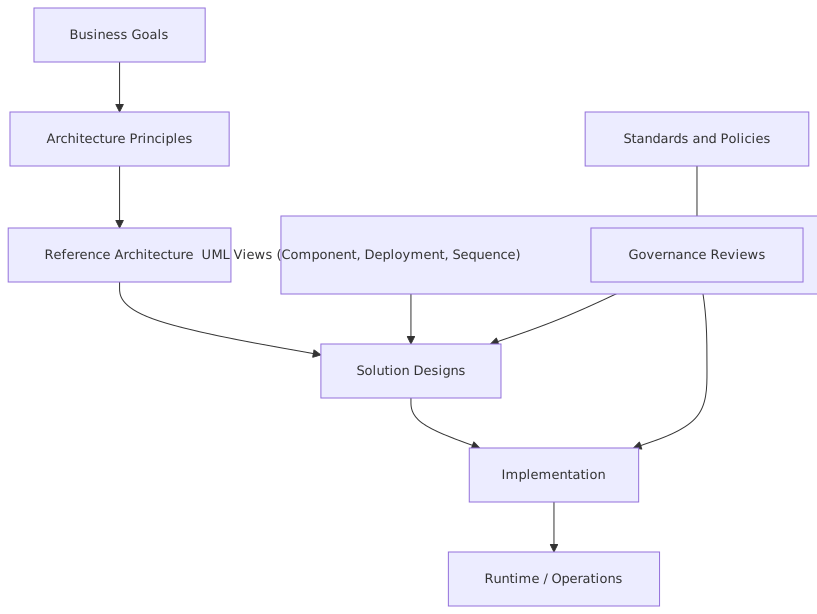
The problem is not that architects use UML. The problem is that they use far too much of it, and usually the wrong parts.
In architecture governance, you do not need a full UML encyclopedia. You need maybe five diagram types, used consistently:
- Use case diagrams — sparingly, to frame actors and system intent
- Component diagrams — to show systems, services, interfaces, dependencies
- Sequence diagrams — to show runtime behavior, especially integrations
- Deployment diagrams — to show runtime topology, cloud placement, trust zones
- State diagrams — occasionally, where lifecycle matters, such as payment status or identity token state
That’s enough for most enterprise governance boards.
What you do not need is a 70-page model pack full of diagram noise that nobody can maintain. If your UML repository becomes a museum, governance is already dead.
Why UML still matters in modern enterprise architecture
There’s a recurring argument that “we have C4 now,” or “we just use ADRs,” or “we model in code,” or “our cloud diagrams in draw.io are enough.”
Fine. Use all of those. I do.
But UML still matters because it handles behavior and structure together in a way most informal approaches do not. Governance requires both.
For example:
- A cloud diagram may show that workloads run in AWS across multiple VPCs.
- A sequence diagram shows that the onboarding service requests an OAuth token from IAM, then publishes a customer-created event to Kafka, then waits for an anti-fraud decision from a separate service.
You need both views to govern the architecture responsibly.
In regulated industries like banking, this becomes even more important. Auditors, security teams, risk teams, resilience teams, and delivery teams all care about different aspects of the same architecture. UML gives enough precision to bridge those conversations without forcing everyone into source code or vendor-specific tooling.
What “good” UML governance looks like in practice
Good governance modeling is not about detail. It is about decision support.
A useful UML model should help reviewers answer questions such as:
- Does this solution align to target architecture?
- Are boundaries between domains respected?
- Are IAM flows secure and centralized?
- Are Kafka topics and consumer responsibilities explicit?
- Is cloud deployment consistent with resilience and data residency requirements?
- Are critical dependencies visible?
- Can we see where technical debt is being accepted?
That means every model should be linked to a governance decision.
If there is no decision attached, don’t model it.
That’s probably the strongest advice in this article.
A practical governance rule
For every UML artifact, define:
That table alone would improve a lot of architecture review packs.
Best practice 1: Use UML to govern decisions, not to describe everything
This is the big one.
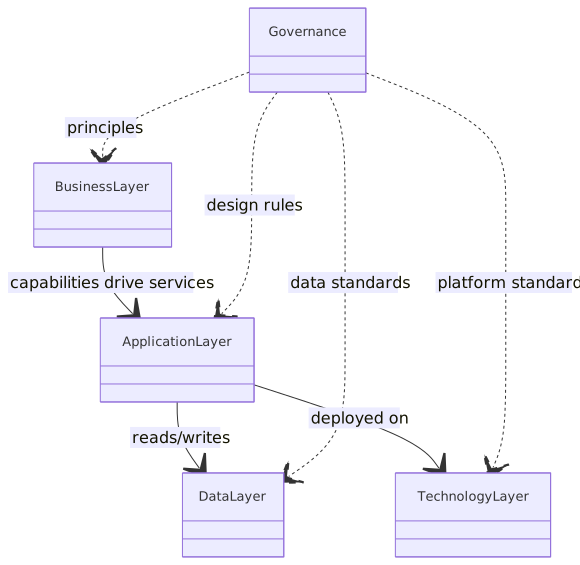
Architecture governance is not enterprise archaeology. You are not trying to preserve every detail of a system forever. You are trying to support decisions about compliance, risk, alignment, and quality.
So ask: what decision needs to be made?
Examples:
- Should a new mobile banking capability integrate directly with the customer platform?
- Can a fraud service consume payment events from Kafka without exposing cardholder data?
- Is it acceptable for a cloud-native onboarding service to call an on-prem IAM adapter synchronously?
- Should a new domain own its own database, or continue reading from a shared schema?
Then choose the UML view that clarifies that decision.
A lot of architects reverse this. They start drawing because drawing feels productive. It isn’t. Not unless the model sharpens a governance call.
Best practice 2: Standardize a small UML subset across the enterprise
If every architecture team uses UML differently, governance turns into translation work.
One bank I worked with had three architecture communities:
- central enterprise architects
- domain architects in retail and payments
- platform architects in cloud and security
All were “using UML.” In practice, every team had different conventions. One team used component diagrams as context diagrams. Another put runtime behavior into deployment views. Another labeled everything with vendor products and nobody could tell what was logical vs physical.
The result? Endless review friction.
The fix was boring but effective: define a modeling standard. Not a giant methodology. Just a few pages:
- which diagram types are approved for governance
- what level of abstraction each should use
- how to represent trust boundaries
- how to show external systems
- how to mark synchronous vs asynchronous interfaces
- how to identify Kafka topics, events, and consumers
- how to show IAM actors, token exchanges, and policy enforcement points
- how to distinguish logical architecture from deployment reality
This matters more than people think. A consistent notation reduces noise. Governance conversations become faster because reviewers are not constantly decoding style choices.
Best practice 3: Make component diagrams your primary governance artifact
If I had to choose one UML artifact for architecture governance, it would be the component diagram. Not because it is glamorous. It isn’t. But because it is where most enterprise architectural risk actually sits: dependencies, interfaces, ownership, coupling.
A good component diagram should show:
- business-facing capabilities or services
- external systems
- interfaces and protocols
- domain boundaries
- ownership
- critical dependencies
- security-relevant crossing points
In banking, this is especially useful because so many “new” digital capabilities are sitting on top of old platform realities.
For example, a retail bank launching a real-time account alert feature might have:
- Mobile App
- API Gateway
- Notification Service
- Customer Preference Service
- Event Processing Service
- Kafka cluster
- Core Banking Adapter
- IAM platform
- Audit logging service
That is governance gold. Immediately you can ask:
- Why does Notification Service need direct access to customer preferences?
- Is API Gateway enforcing authentication, or does each service do it?
- Are account events published from the core adapter or synthesized downstream?
- Is the audit service mandatory for every notification decision?
- Which component owns consent data?
Those are architecture questions. UML helps expose them.
Best practice 4: Use sequence diagrams for the parts everyone gets wrong
There is one area where architecture reviews often collapse into nonsense: runtime interaction.
People say things like “the service publishes an event” or “IAM is integrated” or “Kafka decouples everything.” Then you look closer and realize nobody agrees on the actual flow.
Sequence diagrams are brutally useful here.
Use them for:
- login and token exchange flows
- customer onboarding journeys
- payment authorization and fraud checks
- event publication and consumption chains
- fallback and retry behavior
- exception handling in distributed workflows
Example: IAM plus Kafka in a banking flow
Imagine a new business account onboarding service in a bank.
At a high level, it sounds simple:
- user logs in
- submits onboarding request
- service validates identity and risk
- account gets created
- downstream systems are notified
In reality, governance needs much more precision.
A sequence diagram can show:
- Customer authenticates via enterprise IAM using OIDC
- Front-end receives ID token and access token
- API Gateway validates token and forwards request
- Onboarding Service calls KYC Service
- Onboarding Service stores application data
- Onboarding Service emits
BusinessCustomerOnboardedevent to Kafka - CRM, Notifications, and Risk Monitoring consume the event
- Audit Service records the transaction
- If KYC fails, no event is emitted and case management is triggered
That model immediately raises important governance issues:
- Are tokens propagated safely between layers?
- Is the event emitted only after durable state commit?
- Is PII included in the Kafka payload?
- Are consumer services idempotent?
- Does Audit Service capture both success and failure paths?
- Is the onboarding flow too tightly coupled to synchronous downstream checks?
This is where UML earns its keep. Not at the “boxes and arrows” level. At the “what actually happens” level.
Best practice 5: Model trust boundaries explicitly
This is one of the most common architecture failures I see.
Architects produce neat component diagrams, but they hide the boundaries that matter most: internet to DMZ, cloud to on-prem, production to non-production, human user to workload identity, regulated data zone to general analytics zone.
If your UML models do not show trust boundaries, they are governance-light at best.
Especially in cloud and IAM-heavy architectures, this is not optional.
A deployment or component diagram should clearly show:
- external user zone
- edge/API gateway layer
- trusted internal services
- IAM/identity provider location
- Kafka cluster location and network segregation
- cloud account/subscription boundaries
- regulated data stores
- cross-region or cross-cloud movement
This is where architects often get a bit lazy because the “pretty” diagram gets uglier once boundaries are added. Tough. Governance is not a beauty contest.
Best practice 6: Separate logical architecture from physical deployment
Another classic mistake.
A team shows a component diagram with Kubernetes, Kafka brokers, Azure services, IAM products, VPCs, and business domains all mashed together. Nobody can tell what the system is versus where it runs.
That confusion kills governance.
Keep separate views:
- Logical view: business services, interfaces, domain ownership
- Runtime/behavioral view: interactions, sequencing, events
- Physical/deployment view: cloud services, clusters, regions, networks, failover
This sounds obvious, but in real architecture boards it is constantly violated. Usually because teams are rushing. Or because tooling encourages diagram dumping. Or because architects want one picture to do everything.
One picture should not do everything. That’s not efficiency. That’s ambiguity.
Common mistakes architects make with UML in governance
Let’s be direct.
1. Treating UML as a compliance artifact
They create diagrams because the governance process demands them, not because the diagrams help. The result is dead content. Reviewers skim it. Delivery teams ignore it.
2. Modeling too late
By the time UML appears, key decisions are already baked into code or vendor contracts. Then the model becomes a retrospective justification exercise.
3. Going too low-level
Class diagrams for enterprise governance? Usually a waste of time. Governance needs architecture-level visibility, not implementation trivia.
4. Ignoring async reality
Teams draw clean request-response interactions while the real architecture depends on Kafka events, retries, delayed consumers, dead-letter handling, and eventual consistency. Governance then reviews a fantasy architecture.
5. Hiding security assumptions
IAM is shown as a single box called “SSO,” with no token flow, no trust model, no policy enforcement detail. That is not architecture. That is wishful thinking.
6. Letting diagrams drift from reality
A six-month-old model that no longer matches the platform is worse than no model. It creates false confidence.
7. Using UML without ownership
If nobody owns model updates, the repository decays. Fast.
8. Confusing notation quality with architecture quality
A perfectly drawn diagram can still represent a terrible architecture. Some architects forget that.
A real enterprise example: banking modernization with Kafka, IAM, and cloud
Let me ground this in something realistic.
A mid-sized bank was modernizing its customer servicing platform. Legacy channels were tightly integrated with a core banking platform on-prem. The target state aimed for:
- digital channels in the cloud
- API-led access to core capabilities
- Kafka for enterprise event streaming
- centralized IAM for workforce and customer identity
- gradual decomposition of monolithic servicing functions
On paper, the strategy was sensible. In execution, it was messy.
What went wrong initially
Each project produced its own diagrams. Some used informal cloud architecture sketches. Some had PowerPoint boxes. Some had sequence diagrams, but only for happy paths. Security teams produced separate IAM flow diagrams. Event architecture was documented in Kafka topic spreadsheets.
Governance reviews became painful because nobody had an integrated view.
Typical problems surfaced late:
- channel teams bypassed canonical APIs and called legacy adapters directly
- Kafka topics carried inconsistent customer identifiers across domains
- IAM token validation happened in multiple layers with different policies
- cloud services depended synchronously on on-prem systems that were not resilient enough
- data ownership was unclear between CRM, servicing, and onboarding domains
All of this could have been found earlier with better UML discipline.
What changed
The bank introduced a pragmatic architecture governance model using a fixed UML subset.
For each solution passing architecture review, the team had to provide:
- Component diagram
- domain services
- external systems
- APIs
- Kafka topics
- ownership labels
- trust boundaries
- Sequence diagrams for critical flows
- customer login
- profile update
- account alert subscription
- event publication and consumer handling
- failure path for core banking unavailability
- Deployment diagram
- cloud landing zone placement
- Kubernetes clusters
- managed Kafka environment
- IAM tenancy
- on-prem connectivity
- region and availability assumptions
- Decision notes
- why direct sync integration was accepted or rejected
- where eventual consistency was used
- what security controls were mandatory
The practical outcome
This did not magically fix the architecture. Nothing ever does. But it improved governance quality immediately.
The component diagrams exposed where teams were violating domain boundaries.
The sequence diagrams revealed that “event-driven” flows still depended on synchronous customer preference lookups at runtime, creating hidden coupling.
The deployment diagrams showed that some supposedly resilient services still had single-region dependencies on IAM adapters.
Most importantly, architecture review conversations got more concrete. Instead of generic statements like “this needs to be more decoupled,” reviewers could say:
- this service should publish to Kafka after state commit, not before
- this token exchange belongs at the gateway, not in every microservice
- this customer identifier must be canonicalized before crossing domains
- this cloud component cannot depend on a single on-prem fraud endpoint without buffering or fallback
- this event payload must exclude regulated data fields
That is real governance. Specific. Actionable. Tied to models.
How to apply this in day-to-day architecture work
This is where many articles go vague, so let’s not.
If you are a working architect, here is how UML should fit into your actual week.
During discovery
Create a rough component diagram first. Not polished. Just enough to identify systems, domains, interfaces, and unknowns.
Purpose: surface architectural risk early.
During solution shaping
Add one or two sequence diagrams for flows likely to trigger governance concerns:
- IAM login and authorization
- Kafka publication and consumption
- external vendor integration
- transaction-critical flows
Purpose: expose runtime assumptions before design hardens.
Before architecture review
Refine the component and deployment views. Make sure they answer:
- where does it run?
- who owns what?
- what crosses trust boundaries?
- what is sync vs async?
- what happens on failure?
Purpose: support a governance decision, not just submission.
During delivery
Keep models lightweight but alive. Update when meaningful architectural changes occur:
- new Kafka topics
- IAM integration redesign
- cloud deployment changes
- domain ownership changes
- resilience pattern changes
Purpose: keep architecture review connected to reality.
During operational incidents or postmortems
Use sequence and deployment diagrams to explain failure propagation and control gaps.
Purpose: architecture learning, not blame.
That last point matters. UML is underrated in incident analysis. A good sequence diagram can reveal architectural fragility much faster than a hundred Slack messages and someone’s memory of what the system “usually” does.
A few strong opinions architects may not like
Let me be slightly provocative.
Not every architecture needs a diagram set
Some changes are too small. Don’t force UML where a short ADR and one context sketch will do.
But every significant architecture decision needs a model somewhere
If a change affects security, resilience, integration topology, eventing, or domain boundaries, and you have no model, you are governing blind.
“Agile” is not a reason to avoid modeling
That excuse should have died years ago. Fast-moving teams need clearer architecture, not less.
UML is not old-fashioned; bad modeling is
A sloppy Miro board can be more outdated than a clean UML sequence diagram.
If engineers hate your diagrams, the problem may be you
A lot of architects produce diagrams for other architects. That is vanity, not governance.
A practical minimum standard for enterprise architecture teams
If I were setting a UML governance baseline for an enterprise today, especially one dealing with cloud, IAM, and event streaming, I would require this:
That’s enough structure to be useful, without becoming process theater.
The governance payoff
So what do you actually get from using UML well?
You get faster reviews, because the important questions become visible sooner.
You get better cross-team alignment, because people stop talking past each other.
You get stronger security outcomes, because IAM and trust boundaries are modeled, not implied.
You get more realistic event-driven designs, because Kafka interactions are shown as they really behave.
You get better cloud decisions, because deployment assumptions are explicit.
And maybe most importantly, you get less architectural drift. Not zero. Drift always happens. But less invisible drift.
That matters in large enterprises where the architecture is not ruined by one bad decision. It is ruined by hundreds of small unchallenged ones.
Final thought
UML is not the point. Governance is the point.
But architecture governance needs something more disciplined than vibes and more usable than a 200-page standard. A practical subset of UML hits that middle ground surprisingly well.
Use it to clarify boundaries. Use it to challenge assumptions. Use it to expose coupling, security gaps, and operational fragility. Do not use it to decorate governance packs or satisfy methodology nostalgia.
And please, keep it human. A good architecture model should help a delivery lead, a security architect, a platform engineer, and an enterprise architect have the same conversation without pretending the system is simpler than it is.
That’s the real value.
FAQ
1. Is UML still relevant for modern cloud-native architecture?
Yes. Absolutely. Cloud-native does not remove the need to model structure, behavior, and deployment. If anything, distributed systems make sequence and deployment views more important. The trick is using a small practical subset, not the entire UML catalog.
2. Which UML diagrams are most useful for architecture governance?
For most enterprises: component, sequence, and deployment diagrams. Use case diagrams can help with scope, and state diagrams are useful in specific domains like payments or identity lifecycles. Start there.
3. How should UML represent Kafka-based event-driven architecture?
Use component diagrams to show producers, consumers, topic ownership, and domain boundaries. Use sequence diagrams to show publication timing, consumer behavior, retries, and failure scenarios. Do not pretend asynchronous flows are simple request-response interactions.
4. How does UML help with IAM and security governance?
It helps by making trust boundaries, token flows, authentication points, authorization enforcement, and sensitive data movement visible. A lot of security architecture fails because these are assumed rather than modeled.
5. What is the biggest mistake architects make when using UML for governance?
Using UML as a documentation obligation instead of a decision-support tool. Once diagrams stop helping people make architecture decisions, they become stale artifacts almost immediately.
Frequently Asked Questions
What is architecture governance?
Architecture governance is the set of practices, processes, and standards that ensure architectural decisions are consistent, traceable, and aligned to organisational strategy. It includes architecture review boards (ARBs), modeling standards, lifecycle management, compliance checking, and exception handling.
How do you set up architecture governance in a large organisation?
Start with clear principles and a lightweight metamodel. Establish an Architecture Review Board with defined remit and cadence. Implement decision records (ADRs). Use a tool like Sparx EA to make governance evidence model-based rather than slide-based. Federate ownership — enterprise architects set standards, domain architects maintain their areas.
What is the role of ArchiMate in architecture governance?
ArchiMate supports governance by providing a standard language that makes architecture proposals comparable and reviewable. Governance decisions, principles, and compliance requirements can be modeled as Motivation layer elements and traced to the architectural choices they constrain — enabling reviews based on evidence, not opinion.