⏱ 18 min read
Most enterprise architecture teams do not fail because they lack models. They fail because their models lie.
That sounds harsh, but it is usually true. The UML repository says one thing, the integration platform says another, the IAM landscape has drifted, the Kafka event catalog grew sideways, and cloud teams made three architecture decisions nobody bothered to reflect back into the metamodel. Then someone asks for impact analysis before a core banking change, and suddenly the “single source of truth” turns into a confidence-destroying archaeology exercise.
This is the uncomfortable truth about UML metamodel evolution: the hard part is not drawing diagrams. The hard part is keeping the meaning of those diagrams stable while the enterprise keeps changing underneath them. UML modeling best practices
And here is the contrarian view up front: most organizations should spend less time arguing about UML notation purity and more time treating the UML metamodel like a versioned enterprise asset, closer to an API contract than a drawing standard. If you do not version the metamodel seriously, consistency breaks. If consistency breaks, architecture governance becomes theater.
What UML metamodel evolution actually means
Let’s keep this simple early.
A UML metamodel is the definition of the modeling language you use internally. It defines what kinds of elements exist, what properties they have, and how they can relate. In enterprise architecture work, that often means your organization takes standard UML and extends it with stereotypes, tagged values, constraints, naming rules, lifecycle states, and repository conventions.
For example:
- a
Servicestereotype might represent an API or business service - an
EventStreamstereotype might represent a Kafka topic abstraction - an
IdentityProviderstereotype might represent IAM components - a
CloudWorkloadstereotype might capture deployment ownership, region, and compliance tags
That custom layer is your real metamodel in practice. Not the textbook UML spec. The thing your teams actually use. UML for microservices
Metamodel evolution means changing that definition over time:
- adding new element types
- renaming or deprecating old ones
- changing relationship rules
- tightening constraints
- splitting overloaded concepts into separate ones
- aligning model semantics with new architecture realities like event-driven systems, zero-trust IAM, or cloud platform abstractions
And versioning strategies are how you manage those changes so existing models do not become inconsistent or meaningless.
That is the SEO-friendly version. Now the real story.
Why this becomes painful in enterprises
In enterprise architecture, the metamodel is never static because the enterprise is never static.
A bank that was mostly core systems plus ESB suddenly becomes:
- channel apps on cloud
- Kafka-based event streaming
- centralized IAM with delegated authorization
- SaaS platforms with externalized identity
- domain APIs managed through gateways
- data products and lineage requirements
- regulatory controls mapped to technical architecture elements
If your UML metamodel still thinks in terms of “Application”, “Interface”, and “Database” as broad generic buckets, it will collapse under the weight of real decisions. Architects then compensate with free-text notes, custom naming hacks, or one-off stereotypes. That is when entropy wins.
I have seen repositories where:
- Kafka topics were modeled as interfaces in one domain
- as components in another
- as data stores in a third
- and not modeled at all in cloud-native teams because “the platform team has that elsewhere”
That is not just messy. It destroys traceability. You cannot do impact analysis, ownership mapping, or control validation when the same thing means four different things.
So yes, UML metamodel evolution sounds academic. In real architecture work, it is brutally operational.
The core challenge: evolution without semantic drift
The biggest risk is not change itself. It is semantic drift.
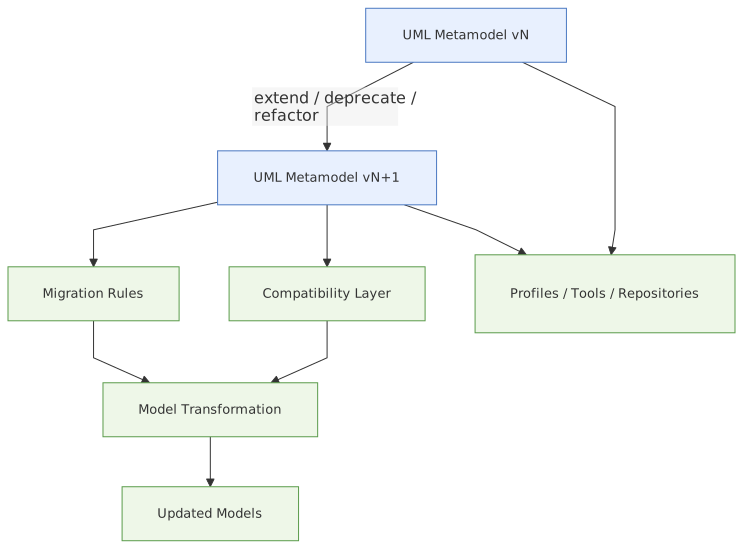
Semantic drift happens when the same model element type gradually means different things to different teams, or when a change in the metamodel is rolled out unevenly and nobody is sure what old models mean anymore.
Classic examples:
Serviceoriginally meant a deployable application service, later expanded to include business capabilities exposed by API, and eventually used for Kafka consumers tooUserrelationship in IAM models starts as human identity, then service accounts and workload identities get pushed into the same bucketInterfacebecomes a dumping ground for REST APIs, async events, batch files, and webhook contractsEnvironmentmeans deployment environment for cloud teams, but lifecycle stage for governance teams
This is where architects often fool themselves. They think consistency comes from publishing a metamodel PDF and maybe doing a training session. It does not. Consistency comes from governed versioning, migration paths, validation, and relentless operational discipline.
In other words, metamodel evolution is not a notation problem. It is a product management problem.
A practical way to think about metamodel versions
Not every metamodel change is equal. Some changes are harmless. Some are destructive. Some require repository migration. Some require reinterpretation of old diagrams.
Here is a useful way to classify them.
My strong opinion: never casually change the meaning of an existing core concept. If a concept’s semantics need to change, create a new concept and deprecate the old one. Semantic mutation is one of the fastest ways to destroy trust in an architecture repository.
This is exactly like API design. Breaking changes are not evil, but pretending they are non-breaking absolutely is.
Versioning strategies that actually work
There is no single perfect versioning strategy, but there are patterns that work much better than the hand-wavy approach many architecture teams use.
1. Semantic versioning for the metamodel
Yes, use semver-like thinking.
- Major: breaking semantic or structural changes
- Minor: additive or constrained-but-manageable changes
- Patch: typo fixes, documentation clarifications, non-semantic corrections
This sounds obvious, but many teams do not do it. They have “metamodel vNext”, “v2024 revised”, or “new repository standard”. That is vague and politically convenient, which is exactly why it fails.
If your banking architecture repository uses metamodel 3.2 and the cloud foundation team is already on 4.0 semantics, that difference must be explicit.
2. Dual-run periods
For major changes, support old and new concepts in parallel for a defined period.
Example:
- old stereotype:
Interface - new stereotypes:
RESTAPI,AsyncEventContract,BatchExchange
For 6 months:
- allow both
- provide auto-classification suggestions
- flag old usage as deprecated
- report progress by domain
This is less elegant than a clean cutover, but enterprises are not elegant. They are full of programs, exceptions, frozen releases, audit windows, and underfunded teams. Dual-run is often the only sane option.
3. Explicit migration mappings
Every major metamodel change should have a migration map:
- old concept
- new concept
- conversion rule
- manual review needed?
- semantic risk
- examples
Without this, you are not versioning. You are announcing.
4. Backward-compatible aliases where possible
If tool support allows it, keep aliases or transformation rules for renamed elements and tags. This reduces disruption.
But do not overdo backward compatibility. Another contrarian thought: too much compatibility can preserve bad architecture thinking long after you should have killed it. Some concepts deserve a hard retirement.
5. Versioned validation rules
The metamodel is not just types. It is also constraints and quality rules.
For example:
- every
KafkaTopicmust have producer owner, consumer owner, retention class, schema reference - every
IdentityProvidermust declare trust boundaries and protocol support - every
CloudWorkloadhandling customer PII must map to a control profile
These validations should be version-aware. A model created under metamodel 2.x may need different enforcement than one created under 3.x, at least during transition.
Consistency challenges nobody likes talking about
This is where architecture work becomes political and messy.
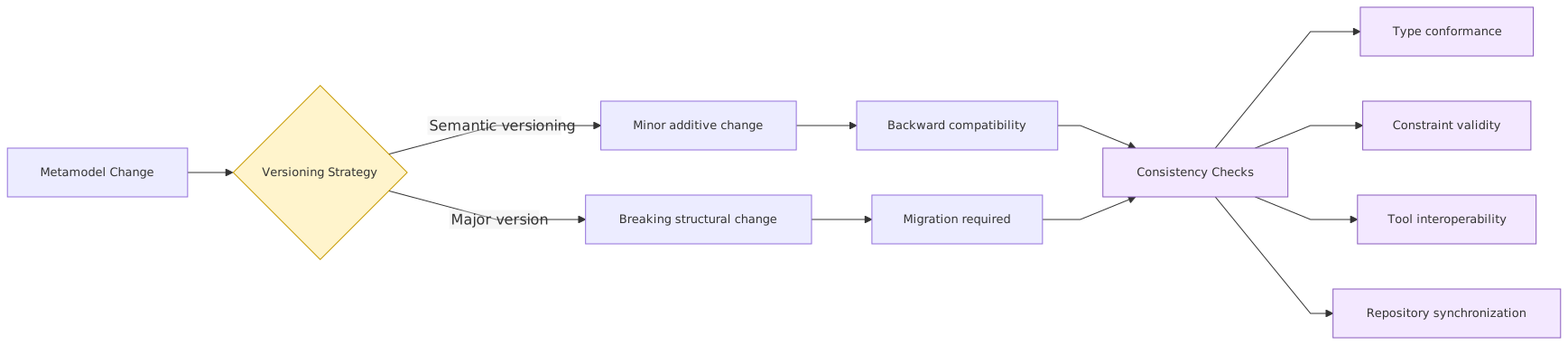
Tool consistency is usually weaker than people think
Most EA tools and UML modeling platforms can store custom stereotypes and tagged values. Great. That does not mean they handle metamodel evolution well.
Typical problems:
- old stereotypes remain in hidden libraries
- reports mix old and new taxonomy
- scripts break after property changes
- import/export pipelines flatten semantics
- integrations to CMDB, API catalogs, or cloud inventories do not understand versioned mappings
The result is fake consistency. The repository looks standardized until you query it.
Federated architecture teams interpret rules differently
Central EA says “model event contracts explicitly.”
One domain models Kafka topics.
Another models Avro schemas.
Another models consumer groups.
Another just links producer app to consumer app and writes “Kafka” in the connector label.
All of them think they complied.
This is not because architects are stupid. It is because metamodel definitions are often too abstract, and enterprise architecture leaders underestimate the need for usage patterns and anti-pattern examples.
Legacy models become toxic debt
Old models are rarely cleaned up. They sit in the repository and continue to influence decisions.
A ten-year-old banking payments model with obsolete IAM assumptions can still get reused in a transformation deck because it is “already approved architecture.” That is how bad semantics survive.
Governance boards often review diagrams, not metamodel integrity
This is a serious blind spot.
Architecture review boards love discussing whether a design should use Kafka or REST, or whether IAM federation belongs at the edge or in-domain. Fine. Important discussions.
But they often do not ask:
- Is the model using current metamodel semantics?
- Are deprecated stereotypes still present?
- Are mandatory properties complete?
- Does this diagram mean the same thing as another team’s diagram?
Without that, governance focuses on design choices while the modeling foundation rots.
How this applies in real architecture work
Let’s make this concrete. In real enterprise architecture, metamodel evolution matters in at least five daily activities.
Impact analysis
Suppose a retail bank wants to modernize customer onboarding. That touches:
- digital channels in cloud
- IAM flows for identity proofing and authentication
- Kafka events for customer creation and KYC status changes
- downstream core banking systems
- audit and compliance controls
If your metamodel clearly distinguishes:
- business capability
- application service
- API contract
- event contract
- identity provider
- authorization decision point
- cloud workload
- regulated data asset
Then impact analysis is possible.
If everything is modeled as generic Application, Interface, and DataStore, impact analysis becomes a workshop exercise with sticky notes and memory.
Target-state architecture
Target-state models often fail because they use future-looking concepts that the current metamodel cannot express.
Cloud-native teams need to model:
- workload identities
- managed services
- platform guardrails
- event schemas
- policy enforcement points
- shared observability services
If your metamodel is still optimized for on-prem deployment nodes and application components, target-state diagrams become half-truths.
Governance and standards
A standard like “all customer-domain integrations should be event-first where suitable” is impossible to govern if eventing is not a first-class metamodel concept.
Similarly, IAM standards like “all external SaaS must federate through enterprise IdP using approved trust patterns” require explicit identity relationships in the model.
Portfolio rationalization
When executives ask how many integration mechanisms exist in the bank, or how many systems still use local authentication, the answer should come from the repository.
If metamodel evolution has been unmanaged, the answer comes from a manual survey. And then people wonder why architecture functions struggle for credibility.
Regulatory traceability
In banking, traceability matters. You may need to show which workloads process regulated customer data, which IAM controls protect them, and which event flows replicate data across regions.
That only works if the metamodel evolved to capture these concerns cleanly, and if consistency was enforced over time.
A real enterprise example: bank-wide event and IAM modernization
Let me give a realistic composite example. I have seen variations of this more than once.
A large regional bank had a mature UML-based architecture repository. It was built in the era of:
- core banking platforms
- middleware hub integration
- internal user directories
- mostly on-prem infrastructure
Their metamodel centered on:
ApplicationInterfaceDatabaseServerUserRole
Then the bank launched a modernization program:
- mobile and onboarding services moved to cloud
- Kafka became the strategic event backbone
- IAM shifted to centralized federation with OAuth2/OIDC and strong separation between workforce, customer, and workload identities
- data governance introduced stricter classification and lineage requirements
The architecture team made a common mistake. They tried to stretch the old metamodel instead of versioning it properly.
So they did things like:
- use
Interfacefor REST APIs and Kafka topics - attach IAM semantics as free-text notes to application components
- model cloud managed services as servers
- represent service accounts as users
- capture data classification in document attachments, not typed properties
For about a year, this looked acceptable. Diagrams existed. Governance meetings happened. Everyone said the repository was evolving. ArchiMate for governance
Then reality hit.
The bank wanted to assess the impact of rotating customer identity flows and introducing fine-grained authorization for digital channels. They needed to know:
- which applications depended on the central IdP
- which event streams carried customer profile data
- which cloud workloads consumed those streams
- which systems still had local authentication stores
- where customer consent data propagated
The repository could not answer reliably. Same concepts, different meanings everywhere.
At that point, they finally treated the metamodel as an architecture product and introduced version 4.0 with explicit concepts such as:
RESTAPIEventTopicEventSchemaIdentityProviderRelyingPartyWorkloadIdentityAuthorizationServiceCloudWorkloadManagedDataStoreDataClassification
They also introduced:
- mandatory ownership tags
- lifecycle status
- control mappings
- migration rules from old stereotypes
- validation scripts
- monthly conformance dashboards by domain
The migration was painful. Of course it was. Good architecture changes usually are. But within nine months, the bank could answer questions that were previously impossible:
- all customer-data Kafka topics and their producers/consumers
- all workloads using deprecated local authentication
- all cloud workloads lacking approved workload identity patterns
- all APIs and events impacted by a customer profile schema change
That is the difference between “we have architecture models” and “our architecture models are operationally useful.”
Common mistakes architects make
Let’s be blunt. These mistakes are everywhere.
1. Treating the metamodel as a one-time setup
It is not. If your enterprise changes materially every year, your metamodel should evolve deliberately every year too.
2. Confusing notation governance with semantic governance
Having a diagram template is not the same as having a stable meaning model.
3. Overloading generic concepts
If Interface or Service can mean five things, it means nothing. Split concepts earlier than feels comfortable.
4. Letting teams invent local stereotypes without central review
Local flexibility sounds empowering. It often becomes semantic fragmentation.
5. Making major changes without migration support
Announcing “from next quarter use the new metamodel” is fantasy. You need mappings, scripts, examples, and cleanup reporting.
6. Ignoring repository validation
If the tool cannot enforce rules, you still need external validation. Otherwise mandatory attributes become aspirational.
7. Keeping deprecated concepts forever
This is another contrarian point. Architects often avoid retirement because they fear disruption. But dead concepts left in the repository continue to distort reporting and decision-making.
8. Modeling technology platforms but not identity and data semantics
Many teams are still stronger at boxes and lines than at identity trust, authorization boundaries, and data movement semantics. In modern enterprises, especially banks, that imbalance is dangerous.
What a good metamodel evolution practice looks like
A mature practice is not glamorous. It is repetitive, disciplined, and slightly annoying. That is usually how you know it works.
Here is a practical operating model.
Metamodel product ownership
Assign a real owner or small owner group:
- chief architect delegate
- repository architect
- domain architect representatives
- tooling lead
Not a committee of twenty.
Change intake and review
Changes should come from actual needs:
- cloud platform changes
- IAM modernization
- Kafka/event architecture patterns
- regulatory requirements
- reporting gaps
- recurring modeling confusion
Each change request should document:
- problem being solved
- semantic rationale
- affected elements and relationships
- compatibility impact
- migration approach
- examples
Versioned release notes
Publish release notes like a software product:
- what changed
- why
- impact
- actions required
- deprecation timeline
Reference patterns
For each major concept, provide examples:
- how to model Kafka producer/topic/schema/consumer
- how to model IAM federation with enterprise IdP and SaaS relying party
- how to model cloud workload with managed database and control tags
This matters more than abstract definitions.
Automated quality checks
Run checks for:
- deprecated stereotypes
- missing mandatory properties
- invalid relationships
- inconsistent ownership
- duplicate semantics
Quality dashboards by domain create accountability fast.
Sunset policy
Every deprecated concept needs:
- deprecation date
- support end date
- migration target
- exception process
Without a sunset policy, deprecation is just wishful thinking.
Banking, Kafka, IAM, and cloud: where consistency gets tested hardest
These four areas expose weak metamodels quickly.
Banking
Banking architectures have layered legacy, product complexity, and regulation. If your metamodel does not distinguish product systems, customer-domain services, control points, and regulated data assets, your diagrams become decorative.
Kafka
Kafka is where many repositories reveal semantic laziness. Teams model topics, events, schemas, streams, and consumers inconsistently because the metamodel was built for synchronous integration. Eventing needs first-class concepts. Not footnotes.
IAM
IAM is often modeled terribly. “Auth happens here” is not architecture. You need explicit concepts for identity providers, trust relationships, relying parties, token flows, authorization services, and workload identities. Otherwise security architecture stays detached from enterprise architecture, which is a mistake.
Cloud
Cloud breaks old infrastructure-centric modeling assumptions. Managed services, ephemeral workloads, policy-as-code, shared platforms, and regional controls need representation. Modeling everything as a server or node is intellectually lazy and operationally unhelpful.
Final thought
UML metamodel evolution is not a niche concern for modeling purists. It is one of the hidden foundations of architecture credibility.
If your metamodel evolves badly, your repository decays.
If your repository decays, impact analysis weakens.
If impact analysis weakens, governance becomes opinion-driven. EA governance checklist
And when governance becomes opinion-driven, architecture stops being a discipline and turns into a presentation layer.
So yes, version your UML metamodel seriously. Treat semantic changes as breaking changes. Invest in migration. Be ruthless about consistency. Kill bad concepts when they outlive their usefulness.
And maybe the strongest opinion in this whole article: an imperfect but actively governed metamodel is far better than an elegant theoretical one nobody maintains. Enterprise architecture is not judged by how clever its abstractions are. It is judged by whether the model still tells the truth when the organization is under pressure.
That is the bar.
FAQ
1. How often should an enterprise UML metamodel be updated?
Usually 1–3 planned releases per year is enough for most organizations. More than that can create change fatigue. But if major shifts are happening—cloud migration, Kafka adoption, IAM redesign—you may need a more active cadence for a while.
2. Should we use pure UML or extend it heavily for enterprise architecture?
Use UML as a base, but extend it pragmatically. Pure UML is rarely enough for modern enterprise concerns like event streaming, IAM trust, control mappings, and cloud managed services. Just do not let extensions become uncontrolled local inventions.
3. What is the biggest consistency challenge during metamodel evolution?
Semantic drift. Not tooling, not training slides. The real problem is that different teams start using the same concept differently, or old concepts keep living with unofficial meanings. That is what destroys repository trust.
4. How do we migrate old models without causing chaos?
Use a phased approach: classify changes, publish migration mappings, support dual-run where needed, automate what you can, and track conformance by domain. Do not expect a one-shot cleanup. It is a program, not an announcement.
5. Is this really worth the effort for architecture teams under pressure?
Yes, if you want the repository to be useful for impact analysis, governance, regulatory traceability, and modernization planning. No, if your goal is only to produce diagrams for steering committees. That is the honest answer. architecture decision record template
Frequently Asked Questions
What is a UML metamodel?
A UML metamodel is a model that defines UML itself — it specifies what element types exist (Class, Interface, Association, etc.), what relationships are valid between them, and what constraints apply. It uses the Meta Object Facility (MOF) standard, meaning UML is defined using the same modeling concepts it uses to define other systems.
Why does the UML metamodel matter for enterprise architects?
The UML metamodel determines what is and isn't expressible in UML models. Understanding it helps architects choose the right diagram types, apply constraints correctly, use UML profiles to extend the language for specific domains, and validate that models are internally consistent.
How does the UML metamodel relate to Sparx EA?
Sparx EA implements the UML metamodel — every element type, relationship type, and constraint in Sparx EA corresponds to a metamodel definition. Architects can extend it through UML profiles and MDG Technologies, adding domain-specific stereotypes and tagged values while staying within the formal metamodel structure.