⏱ 19 min read
Most enterprise architecture models fail for a boring reason: they pretend ambiguity is sophistication.
That sounds harsh, but it’s true. Teams create UML diagrams full of extension points, optional behaviors, configurable policies, pluggable services, and environment-dependent flows. Everyone nods because the model looks “flexible.” Then six months later, the IAM team interprets a variation one way, the Kafka platform team interprets it another way, security assumes a third thing, and the delivery team is left discovering the architecture through production incidents.
This is exactly where formal semantics of UML variation points becomes useful. Not because architects need to become language theorists. Not because every enterprise diagram needs mathematical rigor. But because if you don’t define what can vary, when it can vary, and what is not allowed to vary, your architecture is not flexible. It’s just underspecified.
And underspecified architecture is expensive.
Let’s make this simple early: UML variation points are places in a model where different valid options can exist. Think optional steps in a business process, replaceable services in an application design, configurable authentication methods, or deployment choices across cloud environments. The “formal semantics” part means being precise about what those options mean, what constraints apply, and how choices affect the rest of the system.
That’s the simple version. SEO box checked. Now the real point:
In enterprise work, variation points are not academic. They are everywhere:
- A bank supports OAuth2 for retail channels but mutual TLS for partner APIs.
- Kafka consumers may process events in strict order for payments, but not for marketing events.
- IAM may require step-up authentication only for high-risk transactions.
- Cloud deployments may use active-active in one region set and active-passive in another due to regulation.
Those are variation points. And if your UML models treat them as informal notes instead of semantically controlled choices, you’re building confusion into the architecture. UML modeling best practices
Why architects keep getting this wrong
Architects love flexibility. I do too. But we often smuggle indecision into the design and call it extensibility.
A classic pattern looks like this:
- We draw a use case with an extension point.
- We add a note saying “authentication may vary by channel.”
- We create a component model where “messaging provider is pluggable.”
- We sketch deployment options for cloud and on-prem.
- We assume delivery teams will “interpret according to context.”
That sounds mature. In reality, it often means nobody has defined:
- whether the choices are mutually exclusive,
- whether multiple variants can coexist,
- what conditions trigger each variant,
- which invariants must hold across all variants,
- who owns the decision at runtime or design time,
- and what traceability exists from model to implementation.
So the model becomes a conversation artifact, not an architecture control mechanism.
I’m not against conversational artifacts. A whiteboard sketch is fine. But if the model is supposed to guide enterprise implementation across 20 teams, regulated data flows, and multiple platforms, then “sort of flexible” is not enough.
What a UML variation point actually is
At the practical level, a variation point is a defined place in a model where one or more alternatives may be selected.
In UML, this can show up in several ways:
- Use case extension points: optional or conditional behavior attached to a base use case.
- Generalization/specialization: a general component or process with specialized variants.
- Template or parameterized structures: generic patterns with configurable elements.
- State machine transitions with guards: behavior changes based on conditions.
- Activity branches and optional paths: operational variants in workflows.
- Profiles and stereotypes: domain-specific semantics layered on standard UML elements.
But saying “there are alternatives” is not enough. The semantics matter.
For a variation point to be meaningful in enterprise architecture, at minimum you need to know:
- Scope — what part of the model may vary?
- Binding time — when is the choice made? Design time, deployment time, runtime?
- Cardinality — is it one-of-many, zero-or-one, or many-at-once?
- Constraints — what rules govern valid combinations?
- Invariants — what must remain true regardless of selected variant?
- Ownership — who controls the choice?
- Traceability — how does the model map to implementation and governance?
Without those, the variation point is just a drawing with vibes.
Precision vs flexibility: the real tension
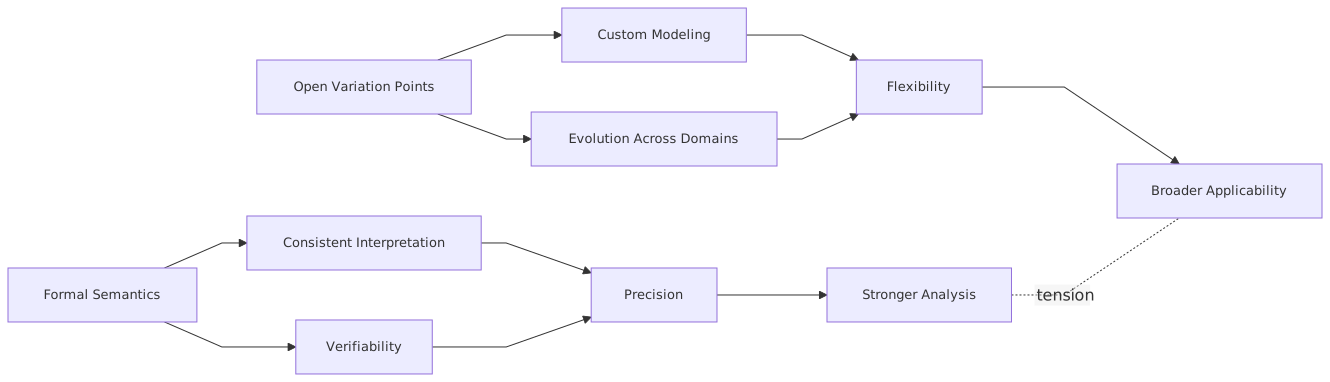
Here’s the tension in one sentence:
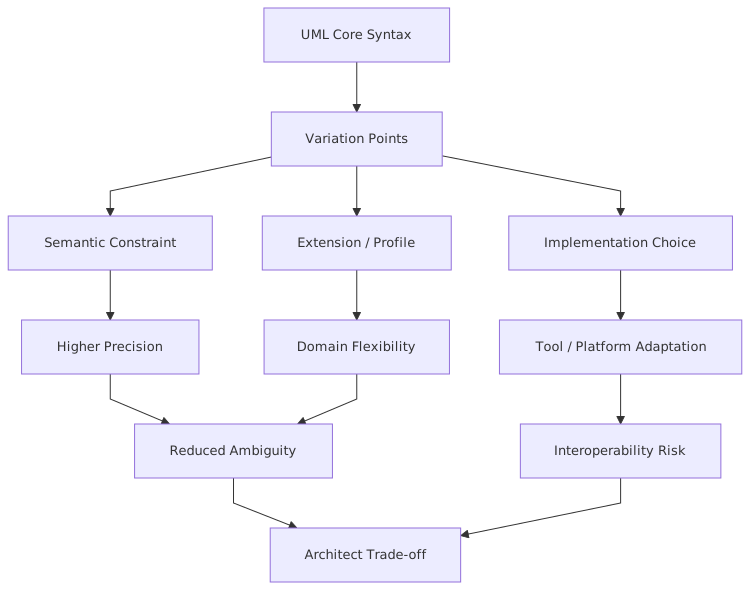
Too little precision and your architecture fragments; too much precision and your architecture calcifies.
That tension is real. It’s not solved by slogans.
Formal semantics is really about deciding where precision is necessary and where flexibility is legitimate. Good architects know the difference. Weak architects either over-model everything or leave everything open.
Let me be contrarian for a moment: most enterprise architecture frameworks are biased toward fake precision. They produce polished diagrams, taxonomies, and capability maps, but they often avoid the one thing that matters under delivery pressure: explicit semantics around variation and constraints.
A model can look rigorous and still be semantically loose.
For example, if your UML component diagram shows an “Event Broker” abstraction with implementations “Kafka” and “Managed Cloud Messaging,” that does not mean the architecture supports interchangeable messaging. It only means somebody drew two boxes under a parent box. If ordering guarantees, replay behavior, idempotency, schema evolution, security controls, and operational ownership differ, then those are not trivial variants. They are materially different architectural options. Treating them as a neat substitution hierarchy is how platform strategies go sideways.
So yes, precision matters. But not everywhere equally.
Where precision is non-negotiable
You need formal precision when variation affects:
- security controls,
- regulatory obligations,
- consistency and integrity,
- resilience patterns,
- identity and access decisions,
- data residency,
- interoperability contracts,
- operational recovery.
If a variation changes how customer identity is verified, how payment events are ordered, or where personal data is stored, that is not “implementation detail.” That is architecture.
Where flexibility should stay flexible
You can tolerate looser semantics when variation affects:
- UI behavior with low business risk,
- non-critical deployment optimizations,
- internal service decomposition,
- observability tooling choices with stable outputs,
- low-risk channel adaptations.
The mistake is treating all variation points the same. They’re not.
A practical semantic framework for UML variation points
If you want models that survive enterprise reality, define variation points with a small but disciplined semantic structure.
Here’s a useful approach.
This is not overkill. This is the minimum needed if the model is meant to drive delivery.
How this applies in real architecture work
This is where people usually drift into theory. Let’s not.
In real architecture work, formal semantics for variation points helps in five very concrete ways.
1. It reduces cross-team interpretation drift
Large enterprises don’t fail because one team is stupid. They fail because ten smart teams interpret the same “flexible” model differently.
If your UML model says “authentication varies by client type,” the mobile team may implement OAuth2 with PKCE, the partner API team may expect mutual TLS, and the legacy integration team may continue using shared secrets because “it wasn’t forbidden.” Formal semantics forces you to define the valid variants and selection conditions.
That reduces drift before implementation starts.
2. It improves architecture decision quality
A variation point is really a decision container. If defined properly, it exposes:
- what is fixed,
- what is variable,
- under what conditions,
- and with what trade-offs.
That’s exactly what architecture review boards should be evaluating. Not whether the diagram is pretty.
3. It makes governance lighter, not heavier
This is another contrarian point: precise semantics can reduce governance overhead.
Why? Because teams don’t need to escalate every case if the allowed variants and rules are already modeled. Governance becomes policy-driven instead of meeting-driven. EA governance checklist
For example:
- Retail APIs may use OAuth2.
- Interbank APIs must use mTLS plus signed JWT assertions.
- Administrative access requires federated IAM plus step-up MFA.
Once that variation point is semantically defined, teams can move faster inside the allowed envelope.
4. It improves cloud architecture consistency
Cloud architecture is full of variation points:
- region selection,
- failover mode,
- managed vs self-managed services,
- encryption key ownership,
- ingress patterns,
- identity federation models.
If these are modeled loosely, every platform squad creates its own interpretation of “approved cloud pattern.” Then your landing zone becomes a museum of exceptions.
A semantically clear variation model lets you define what can vary per workload class, data sensitivity level, or jurisdiction.
5. It supports better change management
When a regulation changes or a platform strategy shifts, clear variation points tell you what needs to move.
If your model explicitly says “customer identity proofing variant is selected by jurisdiction,” then a new regulatory requirement in Germany affects a known variation point. Without that semantic structure, you’re hunting through diagrams and tribal knowledge.
Common mistakes architects make
Let’s be honest. These are not edge-case mistakes. These are normal enterprise mistakes.
Mistake 1: Calling optionality a variation strategy
Putting [optional] on a diagram is not semantics.
Optionality only tells you something may or may not exist. It does not tell you:
- when it appears,
- who decides,
- whether it can coexist with alternatives,
- what rules apply.
A lot of UML models stop at optionality. That’s weak architecture.
Mistake 2: Mixing business variation with technical variation
Architects often collapse distinct kinds of variation into one model:
- customer segment rules,
- risk policy rules,
- deployment choices,
- integration protocol choices.
That creates a mess because the binding times and owners differ. A risk engine may decide one thing at runtime. A cloud topology is usually fixed at deployment time. An IAM policy may be centrally governed. These should not be thrown together as generic “extensions.”
Mistake 3: Assuming inheritance means substitutability
This is a big one in component models.
Just because two implementations inherit from an abstract service in UML does not mean they are operationally substitutable in an enterprise environment. UML for microservices
Kafka and a managed queue service are a perfect example. Both are “messaging,” yes. But they can differ in:
- ordering,
- retention,
- replay,
- partitioning,
- consumer scaling behavior,
- delivery semantics,
- schema control,
- security posture,
- ops model.
If those differences matter to business correctness, then they are not interchangeable variants without explicit constraints.
Mistake 4: Ignoring invariants
Architects are often good at documenting what changes and bad at documenting what must never change.
Invariants are where architecture earns its salary.
Examples:
- Every authentication variant must produce a non-repudiable audit trail.
- Every payment event variant must preserve transaction idempotency.
- Every cloud deployment variant must enforce centralized key rotation policy.
- Every IAM federation variant must support emergency revocation within defined SLA.
Without invariants, variation becomes permission for inconsistency.
Mistake 5: No traceability to implementation
This is the killer. The model says one thing, Terraform says another, Kafka topic policy says a third thing, and IAM configuration says whatever the last admin remembered. EA governance checklist
If variation points don’t trace to actual implementation artifacts, they are decorative.
A real enterprise example: retail banking payments modernization
Let’s make this concrete.
A regional bank is modernizing its payments and customer servicing platform. The target architecture includes:
- microservices in cloud,
- Kafka for event streaming,
- centralized IAM with federation,
- mobile and web retail channels,
- partner APIs for fintech integrations,
- legacy core banking systems still in play.
The architecture team creates UML models for:
- customer authentication,
- payment initiation workflow,
- event-driven payment status updates,
- deployment topology by jurisdiction,
- partner API onboarding.
At first, the diagrams look fine. But three major variation points are semantically weak.
Variation Point 1: Authentication method
The use case model says “Authenticate User” with extension points for:
- password login,
- MFA,
- biometric challenge,
- federated login.
Looks flexible. It isn’t.
What’s missing?
- Is MFA always additive or only conditionally required?
- Can federated login apply to retail users or only workforce and partners?
- Is biometric challenge a primary method or a step-up mechanism?
- Who decides at runtime: channel app, IAM platform, or risk engine?
- What audit requirements apply to all variants?
The bank discovers this problem when mobile banking assumes device biometrics can replace MFA for high-value transfers, while the IAM team insists biometrics are only a local device convenience and not a strong authentication event by policy.
That is not a technical bug. That is a semantic failure in the architecture model.
A better formal definition would specify:
- Allowed variants: password+MFA, federated SSO, partner certificate auth, risk-triggered step-up.
- Binding time: baseline method at channel design time; step-up at runtime by risk policy.
- Selection rules: transactions over threshold or abnormal behavioral score require step-up.
- Invariants: all successful auth flows generate audit event, device context, and policy decision record.
- Constraints: biometrics alone cannot satisfy high-risk transaction approval.
Now the model is useful.
Variation Point 2: Event transport for payment lifecycle
The component model defines an abstract “Payment Event Bus” with variants:
- Kafka,
- cloud-native messaging,
- direct synchronous callback.
This is where many architecture teams fool themselves.
For payment lifecycle, the semantics of the transport matter deeply:
- Kafka supports durable event replay and consumer decoupling.
- Synchronous callback is not event streaming; it’s a point-to-point integration pattern.
- Some cloud-native messaging services may not preserve partition-based ordering the same way.
- Retry and dead-letter handling differ materially.
The bank initially says all three are supported “depending on domain need.” That sounds pragmatic, but it creates downstream inconsistency:
- reconciliation teams expect replayable event streams,
- fraud analytics expects ordered status transitions,
- partner integrations rely on callbacks,
- operations cannot define one observability model.
A semantically stronger architecture model would split this into two distinct variation points:
- Internal domain event transport: Kafka only for payment domain events.
- External partner notification pattern: callback, webhook, or managed pub/sub based on partner capability.
That’s an important lesson: sometimes the right answer is not to formalize one variation point, but to decompose a fake one into two real ones.
Variation Point 3: Cloud deployment topology by jurisdiction
The deployment model allows:
- single-region deployment,
- multi-region active-passive,
- multi-region active-active.
Again, looks sensible. But if semantics are vague, teams misuse the options.
For example:
- customer profile services may tolerate eventual consistency in active-active mode,
- payment ledger services may not,
- IAM token validation may be globally distributed but key management may be region-bound,
- data residency rules may prohibit certain replication patterns.
The bank’s first version of the model treats topology as a generic deployment choice. Wrong move.
A more precise semantic model defines:
- Scope: workload deployment topology by data classification and business criticality.
- Selection rules: active-active allowed only for stateless or conflict-safe services.
- Constraints: ledger and settlement components cannot use cross-region active-active writes.
- Invariants: customer PII remains within jurisdictional boundary; centralized audit export is mandatory.
- Ownership: cloud platform architecture plus data governance.
- Traceability: deployment variant maps to Terraform blueprints and policy-as-code controls.
That is enterprise architecture doing actual work.
Why formal semantics matters especially in banking
Banking is a good domain for this topic because banks live inside constraints:
- regulation,
- auditability,
- risk controls,
- integration with old systems,
- strict operational resilience expectations.
In that environment, uncontrolled variation is not innovation. It’s a control failure.
A payment approval flow cannot “sort of vary.”
An IAM trust model cannot “depend on team preference.”
A Kafka retention strategy cannot be left vague if compliance needs event reconstruction.
A cloud failover pattern cannot be hand-waved if regulators ask how customer impact is contained.
This is where I get opinionated: enterprise architects should stop apologizing for precision in regulated systems. Precision is not bureaucracy. Precision is what prevents operational nonsense.
The trick is to be precise about the right things.
How to model variation points without becoming unbearable
There is a legitimate fear here. Some architects hear “formal semantics” and immediately start producing unreadable meta-models, profile definitions, or notation-heavy monstrosities. Don’t do that.
Your goal is not to impress a modeling purist. Your goal is to make enterprise decisions executable.
A good pattern is this:
1. Keep the UML readable
Use standard UML structures where possible:
- use case extensions,
- component specialization,
- activity guards,
- deployment alternatives,
- notes with constrained language.
2. Add a lightweight semantic contract
For each significant variation point, define:
- name,
- allowed variants,
- binding time,
- selection rules,
- invariants,
- constraints,
- owner,
- implementation trace.
This can live in a repository, architecture decision record set, or model metadata.
3. Separate business, runtime, and platform variation
This is critical.
A customer risk decision is not the same as a cloud deployment option.
A partner onboarding protocol is not the same as a workforce IAM trust chain.
Model them separately even if they intersect.
4. Tie model semantics to controls
If a variation matters, it should connect to:
- policy-as-code,
- platform templates,
- IAM configuration standards,
- Kafka topic standards,
- API gateway policies,
- runtime observability rules.
Otherwise it’s just architecture theater.
A practical decision test: when to formalize a variation point
Not every variation point deserves deep semantics. Use a simple test.
Formalize it if the variation:
- changes security posture,
- changes compliance obligations,
- changes business correctness,
- changes failure behavior,
- changes operational ownership,
- changes integration contract,
- or is likely to be interpreted differently by multiple teams.
If none of those apply, keep it lighter.
Here’s the contrarian part: many enterprise architects formalize the easy things and leave the dangerous things fuzzy. They produce meticulous taxonomy around application domains, but vague semantics around IAM trust boundaries or event consistency. That’s upside-down.
What precision actually buys you
Let’s strip away the modeling language for a second.
When variation points are semantically precise, you get:
- fewer architecture exceptions,
- less rework during delivery,
- cleaner handoff to engineering,
- more reliable platform standardization,
- better auditability,
- easier impact analysis,
- and fewer religious arguments between teams.
That last one matters more than people admit. TOGAF roadmap template
A lot of architecture conflict is not about technology. It’s about undefined choice boundaries. One team thinks a pattern is approved generally, another thinks it’s approved only under conditions. Formal semantics turns those assumptions into explicit rules.
That is a huge win.
The uncomfortable truth: flexibility is often overrated
Let me end the main argument with a slightly unfashionable opinion.
In enterprise systems, especially banks, too much architectural flexibility is usually a leadership failure, not a design virtue.
Not always. But often.
When every domain can choose its own auth flow, eventing style, cloud topology, and identity federation pattern, the enterprise is not empowering teams. It is outsourcing architecture to local convenience.
Variation should exist where business reality demands it. Not where governance is too timid to define standards.
That’s why formal semantics matters. It forces the question:
- What is truly variable?
- What is conditionally variable?
- What is fixed?
- And why?
If your UML models can answer those questions clearly, they become architecture. If not, they remain diagrams.
Final take
Formal semantics of UML variation points is not about academic purity. It is about making architectural flexibility safe, governable, and real.
The balance between precision and flexibility is the actual craft:
- too loose, and teams fragment;
- too rigid, and systems stagnate.
But if I had to choose which side enterprises usually get wrong, it’s not rigidity. It’s vagueness. By a mile.
So define variation points like they matter. Because in banking, Kafka-based eventing, IAM policy design, and cloud operating models, they absolutely do.
And if a model leaves room for three incompatible interpretations, don’t call it adaptable. Call it unfinished.
FAQ
1. What is a UML variation point in simple terms?
A UML variation point is a place in a model where different valid options are allowed. For example, an authentication flow may vary by customer type, or a deployment topology may vary by jurisdiction. The key is that the allowed differences should be defined clearly, not left vague.
2. Why do formal semantics matter for enterprise architecture?
Because enterprise architecture spans many teams, platforms, and controls. Without precise semantics, each team interprets variation differently. That leads to inconsistent IAM policies, broken Kafka assumptions, cloud exceptions, and expensive rework. Formal semantics reduces ambiguity.
3. Are UML variation points only useful in software design?
No. They are very useful in enterprise concerns like security models, integration patterns, operating models, cloud deployment choices, resilience strategies, and regulatory controls. In practice, that is where they often matter most.
4. How much precision is enough?
Enough to define the allowed variants, when choices are made, what rules govern selection, what must remain invariant, and who owns the decision. You do not need a mathematically heavy model for every case. But for security, compliance, and core business flows, you need more than informal notes.
5. What’s the biggest mistake architects make with variation points?
Treating ambiguity as flexibility. A diagram that says something “may vary” is not useful unless it also says how, when, by whom, and under what constraints. Otherwise the architecture shifts from intentional design to accidental interpretation.
Frequently Asked Questions
What is the difference between UML and ArchiMate?
UML is a general-purpose modeling language primarily used for software design — class structures, sequences, components, states, deployments. ArchiMate is an enterprise architecture language covering business, application, and technology layers. They are complementary: ArchiMate for cross-domain EA views, UML for detailed software design.
When should you use ArchiMate instead of UML?
Use ArchiMate when you need to model cross-domain architecture (business capabilities linked to applications linked to infrastructure), traceability from strategy to implementation, or portfolio views for stakeholders. Use UML when you need detailed software design — class models, sequence interactions, state machines, component interfaces.
Can ArchiMate and UML be used together?
Yes. In Sparx EA, both exist in the same repository. ArchiMate models the enterprise landscape; UML models the internal design of specific application components. An ArchiMate Application Component can link to the UML class diagram that defines its internal structure, maintaining traceability across abstraction levels.