⏱ 19 min read
Most enterprise data models fail long before the database is created.
Not because the team picked the wrong database. Not because the cloud platform was immature. Not even because Kafka or IAM integration was hard. They fail because people use diagrams like decoration. Boxes and lines everywhere, no shared meaning, no clear abstraction, no boundary between business truth and implementation detail. And then everyone wonders why delivery gets messy.
Here’s the blunt opinion: UML is still useful for data modeling, but only if you stop treating it like a generic drawing toolkit.
A lot of architects either ignore UML because “ERDs are enough,” or they overdo it and produce diagram museums nobody reads. Both are bad. In real enterprise architecture, UML gives you a disciplined way to describe data concepts, relationships, ownership, lifecycle, and context across systems. That matters when your architecture spans transactional banking systems, event streams on Kafka, IAM platforms, cloud-native services, and regulatory controls. UML modeling best practices
So let’s make this simple early.
What UML means for data modeling, in plain English
UML for data modeling means using UML class-style concepts to describe business entities, their attributes, and their relationships.
At the simplest level:
- A class represents a data concept, like Customer, Account, Payment, Role, Consent
- An attribute is a property, like accountNumber, status, createdAt
- An association is a relationship, like Customer owns Account
- Multiplicity tells you how many, like one customer can have many accounts
- Inheritance shows specialization, like Payment can be CardPayment or WireTransfer
- Composition shows strong ownership, like an Address inside a CustomerProfile
- Constraints describe rules, like an Account must have exactly one primary owner in a retail banking product
That’s the simple version. And yes, it sounds close to ER modeling. Because it is close. The difference is that UML often works better in enterprise architecture because it gives you a broader modeling language that connects data structure to application behavior, service boundaries, security context, and integration patterns. UML for microservices
That broader connection is exactly why architects should care.
Why architects still need UML for data modeling
A data model is never just a schema problem in enterprise work. It’s a coordination problem.
In real organizations, data lives in multiple places:
- core banking platforms
- CRM
- IAM directories
- cloud data lakes
- Kafka topics
- API payloads
- SaaS platforms
- operational stores
- analytics stores
If you only model tables, you miss the architecture. If you only model APIs, you miss the semantics. If you only model events, you miss the source of truth. UML can sit in the middle and force a more disciplined conversation.
I’m not saying UML is the only answer. It isn’t. Sometimes a conceptual ERD is cleaner. Sometimes a bounded context diagram in a DDD-style workshop is more useful. Sometimes a protobuf schema tells you what matters. But UML remains one of the few common notations that can bridge business concepts and technical implementation without collapsing into either side.
That bridging role is underrated.
A good architect uses UML data modeling to answer questions like:
- What is the canonical meaning of Customer?
- Is Account a business entity or just a representation inside one system?
- Does Consent belong to IAM, CRM, or a customer profile domain?
- Which data is authoritative, and which is derived?
- What relationships are stable enough to model explicitly?
- What constraints matter across systems, not just inside a database?
- Which concepts are shared and which should stay local to one service?
Those are architecture questions. Not diagramming questions.
The first thing architects get wrong: confusing conceptual, logical, and physical models
This is probably the most common mistake.
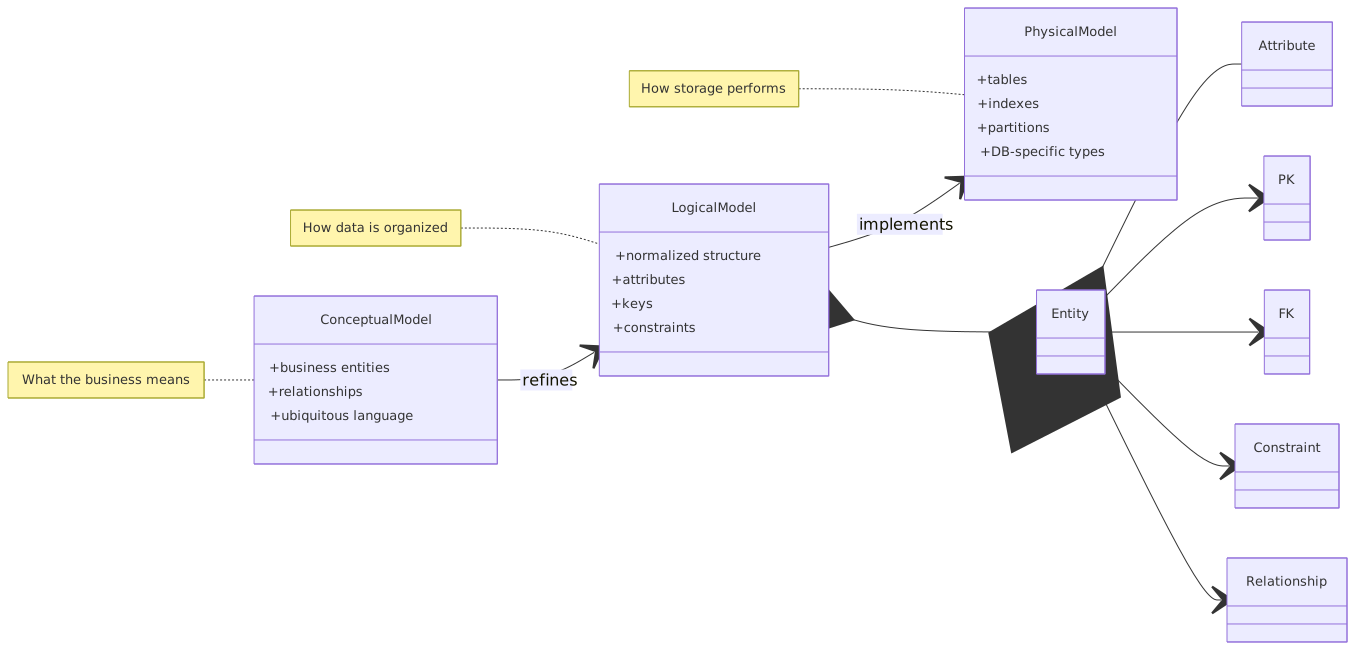
People throw everything into one diagram:
business entities, table names, Kafka topic payloads, microservice classes, cloud storage objects, and maybe even IAM group structures. One giant mess. Looks impressive. Useless in practice.
You need to separate at least three levels.
1. Conceptual model
This is about business meaning.
Examples:
- Customer
- Account
- Transaction
- Consent
- Entitlement
- Device
At this level, you care about:
- definitions
- relationships
- ownership
- business constraints
- lifecycle
You do not care about:
- PostgreSQL data types
- Kafka partition keys
- S3 object layout
- ORM annotations
2. Logical model
This is where structure gets more precise.
Examples:
- Customer has customerId, legalName, customerType
- Account has accountId, productType, currency, status
- Customer to Account is many-to-many in commercial banking, one-to-many in retail
- Consent has scope, channel, validityPeriod, revocationReason
Now you define:
- attributes
- cardinality
- identifiers
- normalization or denormalization intent
- optionality
- data quality rules
Still not physical yet.
3. Physical model
Now you map to implementation.
Examples:
- table structures in Oracle
- Avro schemas for Kafka topics
- IAM directory attributes
- DynamoDB partitioning
- cloud warehouse tables
- API JSON representations
This level includes:
- indexing
- storage format
- partitioning
- retention
- encryption
- performance choices
If you don’t separate these levels, every discussion turns into noise. The business wants to talk about customer identity. The platform team starts debating UUID formats. The IAM lead asks about SCIM mappings. The Kafka team asks if event payloads should be flattened. Nobody is wrong, but everyone is operating at the wrong layer.
Strong architects control the layer of the conversation.
UML concepts that actually matter for data modeling
You do not need the entire UML universe. Most enterprise teams barely need 20% of it. But the parts that matter, really matter.
1. Classes as business data entities
In UML data modeling, the class is your core building block. But here’s the contrarian point: do not think of a UML class as “a Java class.” That mental shortcut ruins models.
In enterprise architecture, a class is often just a structured business concept.
Examples:
- Customer
- Account
- PaymentInstruction
- RoleAssignment
- AuthenticationCredential
- EventSubscription
A class should represent something with stable meaning. If the meaning is unstable, don’t force it into the model yet.
Bad example:
- DigitalEngagementObject
That kind of name usually means the team doesn’t know what they’re modeling.
Good example:
- Session
- DeviceRegistration
- MFAChallenge
Specificity improves architecture.
2. Attributes and identifiers
Attributes look simple. They aren’t.
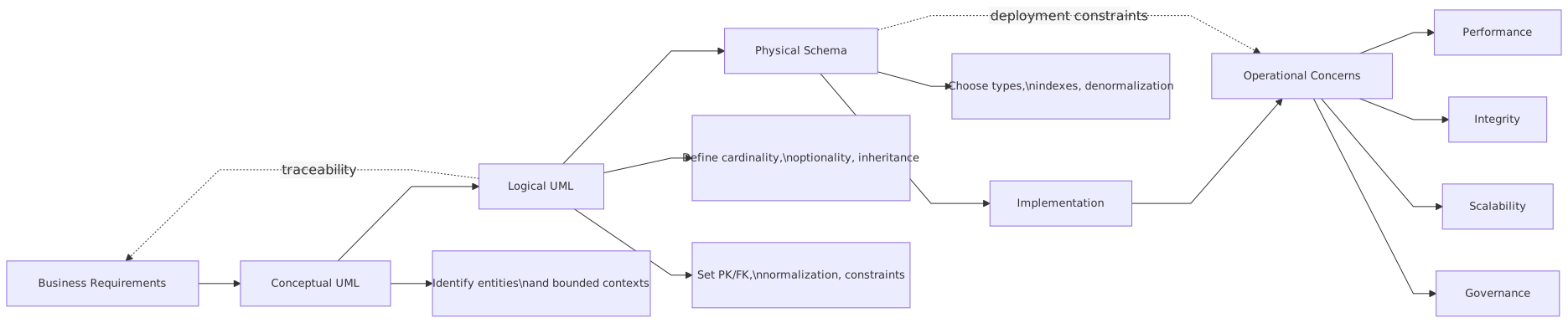
Architects often dump every known field into the model. That creates pseudo-completeness and hides what matters. A useful UML data model includes attributes that are architecturally relevant, not every field from every payload.
For example, in a banking domain:
Customer
- customerId
- customerType
- legalName
- residencyCountry
- riskRating
That’s enough for many architecture discussions. You don’t need 60 KYC fields in the conceptual model.
Also, be careful with identifiers:
- internal IDs
- external IDs
- regulatory IDs
- IAM subject IDs
- event correlation IDs
These are not interchangeable. I’ve seen entire enterprise integration programs become fragile because architects modeled “id” as if one ID ruled everything.
It never does.
3. Associations and multiplicity
This is where UML becomes genuinely valuable.
An association expresses a meaningful relationship:
- Customer owns Account
- Account generates Transaction
- User receives RoleAssignment
- Application publishes Event
- Consent applies to Channel
Multiplicity forces clarity:
- one-to-one
- one-to-many
- many-to-many
- optional vs mandatory
This sounds basic, but enterprise teams get it wrong constantly.
Example:
A retail banking team models Customer to Account as one-to-many. Fine for simple products. But then commercial banking arrives, where multiple legal entities and authorized signatories may relate to one account. Suddenly the model breaks. Not because UML failed. Because the architects modeled a product assumption as a universal truth.
Multiplicity is where hidden business assumptions get exposed.
4. Aggregation and composition
Honestly, these are often overused. But they can be helpful.
- Aggregation: a weak whole-part relationship
- Composition: a strong ownership relationship where the part’s lifecycle depends on the whole
Example:
- CustomerProfile composed of ContactPreferences and MarketingPreferences
- AccountStatement composed of StatementLineItems
But don’t get religious about this. In enterprise work, lifecycle and authority matter more than notation purity. If composition helps communicate that a child object cannot exist independently, use it. If it creates debate theater, simplify it.
5. Generalization and inheritance
Inheritance is useful when the specialization is real and stable.
Examples:
- PaymentInstruction
- CardPaymentInstruction
- WireTransferInstruction
- DirectDebitInstruction
Or in IAM:
- Credential
- PasswordCredential
- CertificateCredential
- FIDO2Credential
But many architects abuse inheritance because it looks elegant. Then the implementation teams suffer.
If the subtypes don’t have meaningful distinct rules, behavior, or constraints, inheritance is probably unnecessary. Sometimes a simple type attribute is enough.
That’s the contrarian take: just because UML allows inheritance doesn’t mean your enterprise data model should use it.
6. Constraints
This is one of the most neglected concepts, and one of the most useful.
Data relationships are not enough. Enterprise architecture runs on rules.
Examples:
- An Account must belong to exactly one booking entity
- A retail customer must have at least one verified identity document before digital onboarding completes
- A Kafka event for PaymentSettled must reference an existing paymentId
- An IAM RoleAssignment must have a valid scope and expiry date for privileged access
If your model doesn’t express important constraints, it’s decorative.
Constraints don’t need to be mathematically formal every time. Even a clear note is better than silence.
Where UML fits in modern architecture: not just databases
A lot of people hear “data modeling” and think relational schema. That’s too narrow for enterprise architecture now.
UML data modeling applies across:
That broader applicability is why architects should not dismiss UML as old-school. The challenge isn’t that UML is outdated. The challenge is that most teams use it lazily.
A real enterprise example: retail bank modernization with Kafka, IAM, and cloud
Let’s make this real.
Imagine a mid-size bank modernizing its customer platform.
The landscape
- Core banking system on a legacy platform remains the system of record for accounts
- A new cloud-native customer platform is built on Kubernetes in AWS
- Kafka is introduced for event-driven integration
- IAM is centralized using an enterprise identity platform with customer identity and workforce identity separated
- A cloud data lake ingests customer and transaction events for analytics and fraud detection
Sounds familiar, because it is.
The architectural problem
Every team uses the word “customer,” but they mean different things.
- Core banking means legal account holder
- CRM means commercial relationship
- IAM means authenticated digital identity
- Fraud platform means monitored person or entity
- Marketing platform means contactable profile
- Kafka topic owners mean whatever the current payload says
This is where weak architecture starts to collapse. Meetings become semantic warfare.
How UML helps
The architects create a conceptual UML data model with a few key entities:
- Party
- Customer
- AccountHolderRelationship
- Account
- DigitalIdentity
- Credential
- Consent
- Transaction
- RoleAssignment
Then they define relationships:
- Party may become Customer
- Customer may hold one or more Accounts through AccountHolderRelationship
- DigitalIdentity is associated with one Party
- DigitalIdentity may have multiple Credentials
- Consent is granted by Party and applies to specific channels or purposes
- RoleAssignment grants access over Account or Customer context
- Transaction belongs to Account
Notice what they did there:
they did not force one “Customer” object to mean everything.
That’s a mature move. In enterprise architecture, over-unification is just as dangerous as fragmentation.
Why this matters in implementation
Now the model can guide real decisions:
In Kafka
The architects define topic semantics based on conceptual entities:
customer-profile-updatedaccount-openedconsent-revokedcredential-registered
Each event references stable identifiers and clear entity meaning. The event schema is not invented in isolation by each delivery team.
In IAM
They separate:
- Party identity
- Digital identity
- Credential
- Role assignment
That avoids a common mistake where IAM becomes the accidental master for customer business data. IAM should manage authentication and authorization data, not become your customer golden record.
In cloud services
Microservices are allowed to keep local models, but they map back to the conceptual UML model. That means service autonomy without semantic anarchy.
In analytics
The data lake team understands that:
- Account is mastered in core banking
- DigitalIdentity is mastered in IAM
- Consent has a shared governance model
- Customer segmentation may derive from multiple upstream entities
This improves lineage and stewardship.
What went wrong before the UML model
Before the architecture team created the model:
- teams reused “customerId” for different identifiers
- Kafka events carried inconsistent payload structures
- IAM records were treated as customer truth
- account access rules were embedded differently in each application
- cloud services copied data without ownership rules
This is not hypothetical. It’s a pattern I’ve seen repeatedly.
The UML model did not solve every problem. It did something more important: it created a shared semantic contract.
That is what architects are supposed to do.
Common mistakes architects make with UML for data modeling
Let’s be honest here. Architects are often the problem.
1. Modeling too much, too early
Big enterprise models often become fantasy novels. Hundreds of classes, every possible edge case, no delivery relevance.
If your model cannot help a team make a decision this quarter, it’s probably too broad.
Model the stable core first:
- entities
- identifiers
- ownership
- cardinality
- key constraints
Then expand only where architecture decisions require it.
2. Confusing canonical with universal
A canonical model is useful. A universal model is usually a trap.
Not every system needs to use the same shape for Customer, Account, or Consent. The enterprise needs shared semantics, not forced structural sameness everywhere.
This is especially true in cloud-native environments. Service-local models are healthy. What matters is that mappings are intentional and semantics are clear. cloud architecture guide
3. Ignoring lifecycle and authority
A relationship on a diagram means very little if you don’t know:
- who creates the data
- who updates it
- who is authoritative
- how long it lives
- when it is deleted or archived
For example, in IAM:
- Credential lifecycle is different from Identity lifecycle
- RoleAssignment lifecycle is different from Employment lifecycle
- Consent lifecycle is different from Profile lifecycle
If your UML model ignores lifecycle, it will mislead implementation teams.
4. Treating Kafka events like database rows
This one is everywhere.
Architects model event payloads as if they are just distributed table records. That’s weak event thinking.
An event should represent something meaningful that happened:
- AccountOpened
- PaymentAuthorized
- ConsentRevoked
- CredentialReset
Your UML model should help distinguish:
- business entities
- event representations
- state snapshots
- references
Otherwise Kafka becomes a badly governed synchronization bus.
5. Letting IAM own business concepts it shouldn’t
IAM platforms are seductive because they already store identities, groups, roles, and attributes. So teams start stuffing business data into them:
customer tier, branch relationship, product flags, regulatory profile.
Bad idea.
IAM should hold what is necessary for identity, authentication, authorization, and some profile context. It should not become the master of all customer semantics. UML helps by making those conceptual boundaries visible.
6. Using notation to signal intelligence
Harsh but true.
Some architects create dense UML diagrams to look rigorous. But rigor is not complexity. A simple diagram with precise relationships and explicit constraints is much more valuable than a giant masterpiece nobody can explain.
If you need 20 minutes to decode your own notation, you’ve already lost the room.
Practical guidance: how to use UML in real architecture work
Here’s what actually works.
Start with business nouns, not system schemas
Run workshops around terms the business and domain teams already use:
- customer
- party
- account
- product
- consent
- role
- credential
- payment
Then challenge them. Ask:
- Are these really distinct concepts?
- Which ones are overloaded?
- Which are legal, operational, digital, or analytical views?
That conversation is more valuable than jumping into tooling.
Keep the first model conceptual
No data types. No column names. No API payloads.
Just:
- entities
- relationships
- multiplicity
- core constraints
- ownership notes
This is where alignment happens.
Add logical detail only where architecture decisions depend on it
Examples:
- unique identifiers
- mandatory fields
- subtype rules
- temporal validity
- reference integrity expectations
Don’t over-model every attribute.
Map conceptual entities to systems of record
For each important entity, identify:
- system of record
- systems of reference
- event producers
- downstream consumers
- retention and compliance concerns
This is where UML becomes architecture, not analysis.
Explicitly model identity boundaries
In modern enterprises, identity is often the hidden fault line.
Separate:
- person or organization as a business party
- digital identity as authentication subject
- entitlement as access grant
- credential as authentication mechanism
This matters in banking, healthcare, government, everywhere.
Use UML alongside other artifacts, not instead of them
A mature architecture repository might include:
- UML conceptual data model
- integration context diagrams
- event catalog
- API schemas
- data ownership matrix
- lineage view
- security classification map
UML is one instrument in the band. Important, not sufficient.
What good UML data modeling looks like in cloud architecture
Cloud makes bad data modeling easier to hide.
Why? Because teams can move fast, duplicate data freely, and spin up services with local persistence. That speed is useful. It also creates semantic drift.
A strong cloud architect uses UML data modeling to keep autonomy from becoming chaos.
For example:
- a customer profile service in AWS may use DynamoDB
- an onboarding service may use PostgreSQL
- an IAM platform may expose identities through SCIM
- Kafka may distribute customer lifecycle events
- Snowflake may store analytical customer dimensions
These can all have different physical models. Fine.
But conceptually, the architecture still needs clarity on:
- what a Party is
- what a Customer is
- what a DigitalIdentity is
- what a Consent is
- which IDs are stable across boundaries
- where authority sits
- what events mean
Without that, cloud-native architecture becomes distributed confusion with good CI/CD.
A simple decision framework for architects
If you’re wondering whether UML is worth using for a data modeling problem, ask these questions:
This is not theoretical. It saves time.
My strong opinion on UML in enterprise architecture
UML is neither dead nor sacred.
It is not dead because enterprises still need a disciplined way to describe shared business concepts across systems, especially in regulated environments like banking. And it is not sacred because a lot of UML work is bloated, ceremonial, and disconnected from delivery.
The right stance is pragmatic and opinionated:
- Use UML when semantics, relationships, and boundaries matter
- Don’t use UML to produce shelfware
- Keep conceptual and physical concerns separate
- Model identity and authority explicitly
- Don’t let event-driven architecture erase business meaning
- Don’t let IAM become the customer master by accident
- Don’t force universal models where bounded variation is healthier
That last point matters more than many architects admit. Enterprise consistency is good. Enterprise sameness is often harmful. ArchiMate in TOGAF ADM
A strong architect knows the difference.
Final thought
If your data model cannot explain why one banking team’s “customer” is not the same as IAM’s “user,” if it cannot show how Kafka events relate to source-of-truth entities, if it cannot tell cloud teams what they are free to change and what they must preserve, then it is not architecture.
It’s just drawing.
UML, used properly, helps architects do the real job: create shared meaning under technical and organizational complexity. That is still valuable. Probably more valuable now than ten years ago.
The trick is not to worship the notation.
The trick is to model what the enterprise actually needs to agree on.
FAQ
1. Is UML better than ERD for enterprise data modeling?
Not always. ERDs are often better for database-focused design. UML is stronger when you need to connect business concepts, application boundaries, integration semantics, and identity concerns. In enterprise architecture, that broader scope is often the reason UML wins.
2. Should Kafka event schemas be modeled directly in UML?
Yes, but carefully. Model the underlying business entities and then show how events represent them. Don’t confuse an event payload with the full entity model. Events describe things that happened, not just rows in motion.
3. How detailed should a conceptual UML data model be?
Less detailed than most architects think. Focus on core entities, relationships, multiplicity, identifiers, and critical constraints. If you include every field, the model stops being conceptual and becomes noise.
4. How does UML help with IAM architecture?
It helps separate business party, digital identity, credential, role, and entitlement. That separation is essential. Without it, teams often overload IAM with business data it should not own and create serious governance problems. ARB governance with Sparx EA
5. Can UML still work in cloud-native and microservices environments?
Absolutely. In fact, it’s useful there because local service models tend to drift over time. UML gives you a lightweight shared semantic model so teams can stay autonomous without inventing conflicting meanings for the same business concepts.
Frequently Asked Questions
What is enterprise architecture?
Enterprise architecture is a discipline that aligns an organisation's strategy, business processes, information systems, and technology. Using frameworks like TOGAF and modeling languages like ArchiMate, it provides a structured view of how the enterprise operates and how it needs to change.
How does ArchiMate support enterprise architecture practice?
ArchiMate provides a standard modeling language that connects strategy, business operations, applications, data, and technology in one coherent model. It enables traceability from strategic goals through business capabilities and application services to the technology platforms that support them.
What tools are used for enterprise architecture modeling?
The main tools are Sparx Enterprise Architect (ArchiMate, UML, BPMN, SysML), Archi (free, ArchiMate-only), and BiZZdesign Enterprise Studio. Sparx EA is the most feature-rich option, supporting concurrent repositories, automation, scripting, and integration with delivery tools like Jira and Azure DevOps.