⏱ 20 min read
Most enterprise architects don’t have a UML problem. They have a modeling discipline problem. UML modeling best practices
That sounds harsh, but it’s true. I’ve seen teams blame UML for diagrams that were vague, bloated, inconsistent, or basically decorative. The issue usually isn’t the notation. It’s that people draw boxes and arrows without understanding the structure underneath. They model appearances, not meaning. UML for microservices
And that’s exactly where the UML metamodel matters.
If that phrase makes you want to leave the room, stay with me. The UML metamodel is not some academic side quest. It’s simply the definition of what UML elements are, how they relate, and what is valid versus sloppy nonsense. If UML is the language, the metamodel is the grammar. You can ignore grammar and still make noise. But if you want precision, reuse, traceability, and models that survive contact with a real enterprise, you need it.
Enterprise architects should care because architecture work is full of ambiguity already. The last thing we need is ambiguous models. In a bank rolling out Kafka for event streaming, modernizing IAM, and moving customer services to cloud, the difference between a useful model and a pretty one is expensive. One helps teams align. The other gets pasted into PowerPoint and forgotten.
So this article is a practical guide. Not a standards lecture. I’ll explain the UML metamodel simply first, then go deeper. We’ll talk about how it applies in real architecture work, where architects get it wrong, and how to use it without becoming the person who weaponizes notation in workshops.
The simple explanation: what is the UML metamodel?
Here’s the plain-English version.
A model is a representation of something in your system or enterprise.
A metamodel is the model that defines the kinds of things you’re allowed to put in that model.
That’s it.
If you draw a UML class diagram and create a Customer class, an Account class, and an association between them, the UML metamodel defines:
- what a Class is
- what an Association is
- what properties a class can have
- what kinds of relationships are valid
- how inheritance works
- what constraints apply
So the metamodel is the structure behind UML. It defines the building blocks.
A useful way to think about it:
For most enterprise architects, you do not need to obsess over the meta-metamodel. You need to understand the metamodel enough to model consistently and intentionally.
The practical point is simple: the metamodel tells you what kind of statement you are making when you create a UML element.
That matters more than people admit. TOGAF roadmap template
Why enterprise architects should care
A lot of architects think UML metamodel knowledge is only for tool vendors, standards people, or model-driven engineering enthusiasts. I disagree.
In enterprise architecture, we constantly do three things:
- Abstract reality
- Create shared meaning
- Trace decisions across layers
The metamodel helps with all three.
If you don’t understand the underlying semantics of your notation, your diagrams become unstable. One architect uses a component to mean an application. Another uses it to mean a deployable service. Another uses it to mean a capability. Then six months later the architecture repository is a graveyard of conflicting intent.
This is especially painful in enterprises where diagrams are reused across governance, delivery, security, and operations. ARB governance with Sparx EA
A few examples:
- In a banking program, one team models “Customer Identity Service” as an application, another as a microservice, and another as a capability. Governance discussions collapse because everyone is talking about different things with the same label.
- In a Kafka estate, architects draw topics, producers, consumers, schemas, and event contracts inconsistently. Suddenly no one can tell whether a diagram describes runtime deployment, logical integration, or data ownership.
- In IAM, people mix actors, users, roles, systems, and permissions on one diagram with no semantic discipline. That’s not architecture. That’s anxiety rendered visually.
- In cloud migration work, architects often confuse node, execution environment, artifact, and component. Then they wonder why infrastructure, platform, and application teams interpret the same drawing differently.
This is where the UML metamodel earns its keep. It helps you decide what kind of thing you are modeling and what relationship you are actually asserting.
No, it won’t solve politics. Nothing solves politics. But it will reduce semantic drift, and that’s a big win.
UML metamodel in practical terms
Let’s make this less abstract.
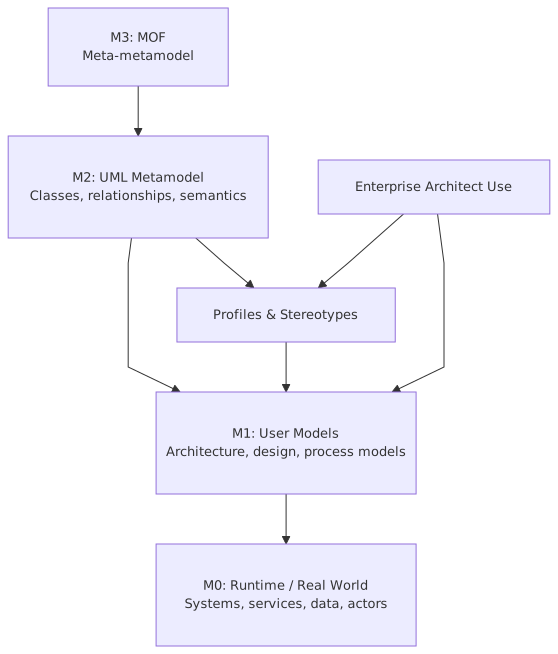
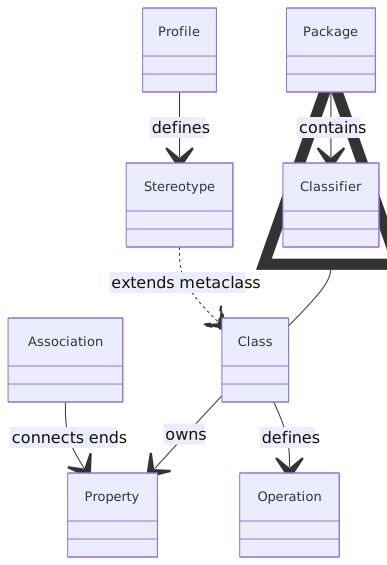
The UML metamodel defines metaclasses such as:
- Class
- Component
- Interface
- Actor
- UseCase
- Node
- Artifact
- Package
- Association
- Dependency
- Generalization
These are not your business objects. They are the types of modeling elements available to you.
When you create a UML diagram, you are instantiating those metaclasses.
For example:
Customeris an instance of the UML metaclass ClassFraud Detection Servicemight be an instance of ComponentRetail Bankermight be an instance of ActorCore Banking APImight expose an InterfaceKafka Broker Clustermight be a Node in a deployment viewCustomerCreatedEventmight be modeled as a Class or DataType, depending on intent
That last point is important. The metamodel doesn’t just give you boxes. It gives you semantics. The same real-world thing can be modeled differently depending on the viewpoint and purpose.
And this is where many architects get lazy.
They ask, “What icon should I use?”
The better question is, “What claim am I making about this thing in this view?”
That’s architecture.
The part people skip: UML is not one diagram type
Another common mistake: treating UML as if it were just class diagrams and maybe sequence diagrams if someone is feeling ambitious.
UML is a family of diagram types backed by a common metamodel. Different diagrams expose different aspects of that metamodel.
For enterprise architects, the ones that usually matter most are:
- Use case diagrams for actor-system interaction boundaries
- Class diagrams for structural concepts, information models, domain relationships
- Component diagrams for application/service decomposition and dependencies
- Sequence diagrams for interaction flow and responsibility timing
- Deployment diagrams for runtime placement across nodes/environments
- Package diagrams for logical grouping and dependency management
The metamodel connects these. A component shown in one view is not just a random box disconnected from another view. In principle, it is the same conceptual element represented across viewpoints.
In practice, many architecture teams never get this far. They create isolated diagrams with no consistency between them. So the sequence diagram refers to services that don’t exist in the component model, the deployment diagram introduces nodes nobody named before, and the information model uses different terms than the API design.
That’s not a UML flaw. That’s weak architecture governance.
Why the metamodel matters more in large enterprises than in small systems
In a startup, people can get away with whiteboard shorthand. The team is small. Shared context is high. You can point at a box and say, “You know what I mean.”
In an enterprise, that falls apart.
You have:
- multiple domains
- offshore teams
- architecture review boards
- security and risk functions
- platform teams
- vendors
- compliance requirements
- repositories and toolchains
- long-lived models reused across years
Under those conditions, sloppy semantics compound. A model is not just a conversation aid. It becomes an enterprise artifact.
And once a model becomes an artifact, it needs structure.
That’s what the UML metamodel gives you: a disciplined foundation so your models can be reviewed, reused, compared, and evolved without becoming contradictory.
Not glamorous, but very useful.
A real enterprise example: bank modernization with Kafka, IAM, and cloud
Let’s make this concrete.
Imagine a mid-sized retail bank modernizing customer onboarding. The bank has:
- a legacy core banking platform
- a new cloud-hosted onboarding portal
- a centralized IAM platform
- Kafka as the event backbone
- downstream fraud, CRM, and analytics consumers
The architecture team needs to communicate:
- who interacts with the onboarding system
- what applications/services exist
- how identity and access work
- what events are produced and consumed
- where workloads run
- what dependencies matter
Without metamodel discipline, teams usually produce four disconnected diagrams and call it architecture.
Here’s how a better approach works.
1. Use case view
You model actors like:
- Customer
- Branch Agent
- Compliance Officer
- IAM Platform
Yes, people often forget systems can participate in use-case-related interactions in broader architecture communication, though you should be deliberate about the semantics.
Use cases might include:
- Register Customer
- Verify Identity
- Approve Onboarding
- Provision Digital Access
This view clarifies boundary and responsibility.
2. Component view
You model components such as:
- Onboarding Portal
- Customer Profile Service
- Identity Verification Service
- Access Provisioning Service
- Kafka Event Publisher
- Core Banking Adapter
- IAM Integration Service
Now we have decomposition and dependencies. This is where architects often cheat by drawing “platform” as one giant box. Bad habit. Platforms have internal responsibilities too, at least at the level relevant to your decision.
3. Information/domain structure
You model concepts like:
- Customer
- Application
- IdentityAssertion
- Account
- RoleAssignment
- OnboardingEvent
This can be a class diagram or a simplified logical information model. Here the metamodel matters because a relationship between Customer and RoleAssignment is not the same thing as a deployment dependency between services. Sounds obvious. Yet I’ve seen enterprise repositories blur these until they become unusable.
4. Sequence view
A sequence diagram might show:
- Customer submits onboarding request
- Portal calls Identity Verification Service
- Service checks external KYC provider
- Customer Profile Service persists approved profile
- Access Provisioning Service calls IAM platform
- Kafka publisher emits
CustomerOnboarded - Fraud and CRM consume the event
Now interaction order is explicit. This is where hand-wavy architecture gets exposed. Sequence diagrams force responsibility clarity.
5. Deployment view
You model runtime placement:
- Portal deployed on cloud Kubernetes cluster
- IAM integration service running in private cloud
- Kafka cluster in managed cloud service
- Core banking adapter in on-prem integration zone
- Secure network links between zones
This is where node, execution environment, artifact, and component distinctions actually matter.
Why the metamodel matters in this example
Because each of those views is making different kinds of statements:
- about behavior
- about structure
- about responsibility
- about deployment
- about dependency
The UML metamodel gives you the categories and constraints to make those statements coherently.
Without it, you get a classic enterprise mess:
the Kafka topic is drawn as an application component, IAM roles are shown as actors, cloud regions are mixed with business capabilities, and nobody knows what level of abstraction they’re looking at.
That’s more common than people admit. ArchiMate in TOGAF ADM
Common mistakes architects make with the UML metamodel
Let’s be blunt. These are the mistakes I see all the time.
1. Treating UML shapes as generic icons
A box is not just a box.
If you use a component symbol, you’re saying something different than if you use a class, package, or node. If you don’t care about that distinction, you’re not really using UML. You’re using clip art with aspirations.
Sometimes that’s fine for a workshop sketch. But don’t pretend it’s a governed architecture model.
2. Mixing abstraction levels in one diagram
This is probably the biggest sin.
A single diagram shows:
- business capabilities
- applications
- APIs
- Kafka topics
- IAM roles
- cloud subnets
- users
- vendors
all at once.
People call this “end-to-end.” I call it visual panic.
The metamodel won’t stop you from making bad diagrams by itself, but understanding it should push you to separate concerns and choose the right element types.
3. Confusing logical and physical views
Architects often draw a component diagram and then sneak deployment facts into it. Or they create a deployment diagram that’s really an application landscape. The result is ambiguity.
For example:
- Is
Customer Servicea logical component? - A deployable container?
- A team-owned product?
- A cloud workload?
Pick one per view. Be explicit.
4. Ignoring relationship semantics
Not all arrows mean the same thing.
Association, dependency, realization, generalization, composition — these have different implications. Yet many teams use arrows as if they simply mean “somehow related.”
That destroys traceability.
In IAM models, for example, the difference between:
- a user assigned to a role
- a service depending on an identity provider
- a token containing claims
- a component realizing an authentication interface
is not trivial. Those are different relationships.
5. Modeling everything as classes
This usually happens when architects came from software design backgrounds and never adjusted their instinct.
Not every enterprise concern should be forced into a class model. Components, actors, nodes, interfaces, and packages exist for a reason. If your cloud operating model ends up looking like an object-oriented codebase, something has gone wrong.
6. Overengineering the metamodel discussion
Now the contrarian point.
Some architects discover the metamodel and become insufferable. Every workshop turns into a notation purity debate. Delivery teams stop listening. The model becomes technically correct and practically useless.
Don’t do that either.
The point of understanding the metamodel is to improve communication and rigor, not to cosplay as the UML police.
How this applies in real architecture work
This is where the topic gets practical.
Architecture governance
When reviewing solution designs, the metamodel helps you assess whether diagrams are semantically coherent. You can ask:
- Is this a logical decomposition or a physical deployment?
- Are these relationships dependencies, ownerships, or interactions?
- Are actors, systems, and data structures being mixed carelessly?
That leads to better review conversations.
Repository consistency
If your enterprise uses a modeling tool or repository, metamodel discipline is essential. Otherwise every domain creates its own private dialect.
A UML-informed approach helps standardize:
- what counts as an application component
- how interfaces are represented
- how information entities are modeled
- how deployment targets are described
No repository survives semantic chaos for long.
Traceability across domains
Suppose a bank introduces a new IAM policy requiring step-up authentication for high-risk onboarding. You need to trace impact across:
- business process
- application components
- interfaces
- sequence flows
- deployment zones
- security controls
If your models are grounded in a coherent metamodel, that traceability is possible. If not, you’re back to meetings and guesswork.
Cloud architecture
In cloud programs, the metamodel helps separate:
- application components
- infrastructure nodes
- execution environments
- deployment artifacts
- interfaces and dependencies
This sounds dry, but it stops a lot of confusion. A Kubernetes cluster is not an application component. A container image is not a business service. An API gateway is not the same thing as the interface contract it exposes.
People blur these constantly.
Event-driven architecture with Kafka
Kafka architecture is a great example because it forces multiple perspectives.
You may need to model:
- producer and consumer applications as components
- topics as communication channels or conceptual information carriers
- event schemas as information structures
- runtime brokers as deployment nodes
- interaction timing in sequence diagrams
If you collapse all that into one drawing, you lose meaning. The metamodel helps keep your views honest.
A practical mapping for enterprise architects
Here’s a simple way to think about common architecture concerns and likely UML element choices.
This is not the only way to model things. But it is a useful discipline.
And yes, there are edge cases. There always are. Architects love edge cases because they let them avoid making standards. Don’t let the edge cases drive the baseline.
The uncomfortable truth: most enterprise architecture diagrams are not models
Here’s the contrarian view.
A lot of what enterprises call “architecture models” are not really models. They are communication sketches. Again, that’s not always bad. Sketches are useful. But you should know the difference.
A model implies:
- defined semantics
- element types
- relationship meaning
- some consistency
- potential for reuse and traceability
A sketch implies:
- immediate communication
- local context
- low rigor
- low persistence value
The problem is not sketching. The problem is pretending a sketch is an enterprise model.
The UML metamodel matters because it forces that honesty. If you’re creating a reusable architecture asset, use real semantics. If you’re facilitating a workshop, sketch freely, then formalize later if it matters.
That’s a healthier approach than either extreme.
How to introduce UML metamodel discipline without annoying everyone
A practical adoption approach:
1. Standardize a small subset
Do not roll out full UML purity across the enterprise. Nobody wants that.
Pick a subset relevant to enterprise architecture:
- Actor
- Component
- Interface
- Class/DataType
- Package
- Node
- Dependency
- Sequence interactions
That gets you most of the value.
2. Define viewpoint-specific conventions
For example:
- Application landscape view: components and dependencies only
- Integration view: components, interfaces, and message flows
- Information view: classes/data types and associations
- Deployment view: nodes, execution environments, artifacts
- Operational flow view: sequence diagrams
This reduces ambiguity fast.
3. Publish examples, not just standards
Architects ignore abstract modeling standards. They copy examples.
Create examples for:
- banking onboarding
- Kafka event publication
- IAM federation
- cloud workload deployment
Good examples beat a fifty-page notation guide every time.
4. Review for clarity, not just compliance
In architecture review, ask:
- Is the viewpoint clear?
- Are element types used consistently?
- Does the model help decision-making?
If you only police notation, people will hate the practice. Fairly.
5. Accept “good enough”
Another strong opinion: enterprise architecture often overestimates the value of perfect formalism.
You need enough rigor to create shared understanding and traceability. Beyond that, returns drop quickly. Don’t spend three weeks debating whether an event contract is best represented as a class or information item if the integration design is collapsing for bigger reasons.
Banking, Kafka, IAM, and cloud: what good modeling looks like
Let’s tie the examples together.
Imagine the bank wants to introduce passwordless authentication for digital onboarding while streaming onboarding events to Kafka and deploying customer-facing services in cloud.
A coherent architecture model would likely include:
- Actor/use case view
Customer and Branch Agent interacting with onboarding and access provisioning capabilities.
- Component view
Onboarding Portal, Authentication Service, IAM Federation Service, Kafka Event Publisher, Customer Profile Service, Fraud Service, CRM Consumer.
- Information view
CustomerIdentity, CredentialBinding, AuthenticationChallenge, AccessPolicy, OnboardingEvent.
- Sequence view
Customer initiates onboarding, authentication challenge issued, IAM validates identity, profile created, event published, downstream services react.
- Deployment view
Portal and auth services in cloud Kubernetes, IAM connector in secure private subnet, Kafka in managed cloud, core banking adapter on-prem.
What matters is not that every symbol is textbook-perfect. What matters is that each view has internal semantic consistency and the views relate sensibly to each other.
That’s the practical value of the UML metamodel. It helps you maintain that consistency.
And honestly, once teams experience the difference, they usually don’t want to go back to random diagrams.
Final thought
The UML metamodel is not exciting. It’s not trendy. Nobody is going to give a keynote about how understanding Class, Component, and Dependency changed their life.
But for enterprise architects, it matters because architecture is partly the craft of making distinctions. If you cannot distinguish structure from behavior, logical from physical, actor from component, interface from implementation, then your models won’t carry architectural meaning. They will just carry labels.
That’s the real point.
Learn enough of the UML metamodel to model intentionally. Use it to improve consistency, governance, and traceability. Don’t turn it into religion. Don’t ignore it either.
In enterprise architecture, the middle path is usually the grown-up one.
And yes, that’s less glamorous than drawing another “target state” picture with gradients and hexagons. But it’s also more useful.
FAQ
1. Do enterprise architects really need to understand the UML metamodel, or is basic UML enough?
Basic UML is enough for sketching. It is not enough for consistent enterprise modeling at scale. You don’t need to memorize the full specification, but you should understand the core element types and relationship semantics. Otherwise your models drift and stop being reusable.
2. Is UML still relevant in cloud-native and event-driven architecture?
Yes, if used pragmatically. UML is not outdated because systems run in Kubernetes or communicate through Kafka. Structural views, interaction views, and deployment views are still needed. The trick is using UML selectively and not forcing every cloud concept into a rigid software-design mindset.
3. How does the UML metamodel help with Kafka-based architectures?
It helps separate concerns. Producers and consumers can be modeled as components, event schemas as information structures, interaction timing in sequence diagrams, and brokers/clusters in deployment views. That avoids the common mess where topics, services, and infrastructure are all mixed in one vague picture.
4. What are the most common mistakes when using UML in enterprise architecture?
The biggest ones are mixing abstraction levels, using symbols as generic icons, ignoring relationship meaning, and confusing logical and physical views. Another mistake is overcomplicating UML to the point where delivery teams stop engaging.
5. Should we use UML metamodel concepts in an EA tool or just in diagrams?
Both, if you have an EA repository. In diagrams, metamodel discipline improves communication. In tools, it improves consistency, traceability, and governance. If your repository has weak semantics, it becomes a dumping ground very quickly.
Frequently Asked Questions
What is a UML metamodel?
A UML metamodel is a model that defines UML itself — it specifies what element types exist (Class, Interface, Association, etc.), what relationships are valid between them, and what constraints apply. It uses the Meta Object Facility (MOF) standard, meaning UML is defined using the same modeling concepts it uses to define other systems.
Why does the UML metamodel matter for enterprise architects?
The UML metamodel determines what is and isn't expressible in UML models. Understanding it helps architects choose the right diagram types, apply constraints correctly, use UML profiles to extend the language for specific domains, and validate that models are internally consistent.
How does the UML metamodel relate to Sparx EA?
Sparx EA implements the UML metamodel — every element type, relationship type, and constraint in Sparx EA corresponds to a metamodel definition. Architects can extend it through UML profiles and MDG Technologies, adding domain-specific stereotypes and tagged values while staying within the formal metamodel structure.