⏱ 20 min read
Most architecture teams don’t have a tooling problem. They have a thinking problem.
They argue about whether to use UML or ArchiMate as if choosing the notation will somehow make the architecture coherent. It won’t. A bad architect with ArchiMate still produces expensive wallpaper. A delivery team drowning in UML still ships systems nobody can operate. The real question is not which notation is better in theory. It’s much more blunt than that:
When are you modeling software design, and when are you modeling the enterprise?
That’s the difference. And yes, it matters more than many teams want to admit. TOGAF roadmap template
If you want the short version early, here it is:
- UML is mainly for describing software systems and their design details.
- ArchiMate is mainly for describing enterprise architecture across business, application, data, and technology domains.
- UML helps you explain how a system is built.
- ArchiMate helps you explain how the enterprise fits together and why the system exists in the first place.
That’s the clean answer. But in real architecture work, it gets messy fast. Because enterprises are messy. Banking platforms are messy. IAM is messy. Kafka landscapes are messy. Cloud transformations are messy. And the wrong notation at the wrong level creates confusion, false precision, and very expensive meetings.
So let’s get practical.
The simple explanation first
If someone in a steering committee asks, “What’s the difference between UML and ArchiMate?”, you can say this without embarrassing yourself:
That’s it. If you stop reading there, you already know more than a surprising number of teams using both badly.
But the real value sits underneath that table.
Why this debate keeps happening
The reason architects keep comparing UML and ArchiMate is that both are modeling languages, both use boxes and lines, and both claim to “describe architecture.” So on the surface, they look interchangeable. ArchiMate modeling guide
They are not.
This is where many architecture practices go wrong. They treat notation as decoration instead of intent. A component diagram and an application collaboration view might both show systems connected by arrows, but they answer different questions.
- UML asks: how does this system behave or how is it designed?
- ArchiMate asks: what role does this thing play in the enterprise, what depends on it, and how does it support the business?
That difference sounds subtle. It isn’t.
A UML deployment diagram might show containers, nodes, and deployed artifacts in AWS. Useful.
An ArchiMate technology/application view might show how a cloud runtime supports customer onboarding, fraud checks, IAM integration, and event distribution via Kafka. Also useful.
Those are not the same model wearing different clothes.
One is about engineering realization.
The other is about enterprise meaning.
Good architects know the distinction. Weak architects blur it because they want one diagram to do everything. That usually ends in a diagram nobody trusts.
UML: still useful, still overused
Let’s be fair to UML first.
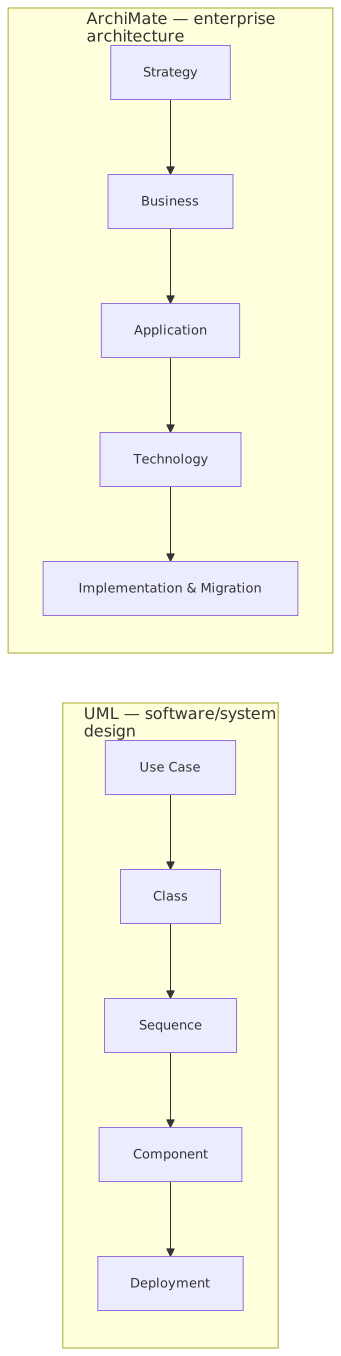
UML is not dead. It’s just often used in the wrong places, by the wrong people, for the wrong reasons.
At its best, UML is excellent for software-centric modeling. If you need to describe:
- service interactions
- component responsibilities
- lifecycle behavior
- domain object relationships
- deployment topology
- integration sequences
then UML can still do solid work.
A sequence diagram for an IAM login flow can be very effective. A component diagram for a payment orchestration service can still help. A state machine for card authorization status transitions can save teams from real production errors.
That’s the part many anti-UML voices ignore. The problem is not UML itself. The problem is that enterprise architects often drag UML up to a level it was never particularly good at.
Once you start trying to explain business capabilities, ownership boundaries, transformation roadmaps, regulatory constraints, and platform dependencies using UML alone, things get awkward. Fast. ArchiMate in TOGAF ADM
You can force it. Architects love forcing tools to do jobs they weren’t meant to do. But you end up with diagrams that are too technical for business stakeholders and too vague for engineers. That’s a bad combination. It means nobody can challenge the model properly.
So yes, UML is useful. But no, it is not your enterprise architecture language.
ArchiMate: more useful for enterprise architecture, but often abused
Now the uncomfortable truth on the other side.
ArchiMate is more appropriate than UML for enterprise architecture. I don’t think that’s controversial anymore. It was maybe ten years ago. Not now.
If you are mapping:
- business capabilities
- value streams
- application portfolios
- data objects
- technology services
- migration states
- strategic drivers
- compliance impacts
then ArchiMate is simply a better fit.
It was designed to connect those layers with explicit semantics. That matters in a real enterprise because architecture is rarely just about systems. It’s about the relationships between strategy, process, application, integration, information, and infrastructure.
That’s where ArchiMate earns its keep.
But here’s the contrarian part: many ArchiMate models are terrible.
Not because the language is weak, but because enterprise architects use it as a status symbol. They produce giant metamodel murals that technically conform to the notation and practically communicate nothing. Every box is correct. Every stakeholder is asleep.
ArchiMate can become architecture theater very quickly.
A model that shows 160 applications, 40 capabilities, 25 business actors, and three layers of technology services may be “complete,” but if it doesn’t help answer a decision, it’s waste. I’ve seen repositories full of immaculate ArchiMate content that had zero impact on investment decisions, cloud migration sequencing, or operational risk reduction. ArchiMate tutorial
That’s not architecture. That’s taxidermy.
The real difference: level of abstraction and purpose
If I had to reduce the whole comparison to one core idea, it would be this:
UML models the design of a thing. ArchiMate models the role of a thing in a wider enterprise system.
That’s why they are often complementary rather than competitive.
Here’s how that plays out in practice:
- A UML sequence diagram can show how a customer authentication request flows through API gateway, IAM service, MFA provider, and token issuer.
- An ArchiMate view can show that customer authentication is part of the “Secure Customer Access” capability, realized by IAM platforms, dependent on cloud identity services, governed by regulatory controls, and used by mobile banking, internet banking, and partner APIs.
Both are valid. But they solve different problems.
One tells engineers how the interaction works.
The other tells decision-makers why it matters and what else it affects.
When architects miss this, they either:
- produce enterprise views that are too technical to be strategic, or
- produce strategic views so abstract that engineering teams ignore them.
Neither outcome is acceptable.
How this applies in real architecture work
This is where the comparison becomes useful instead of academic.
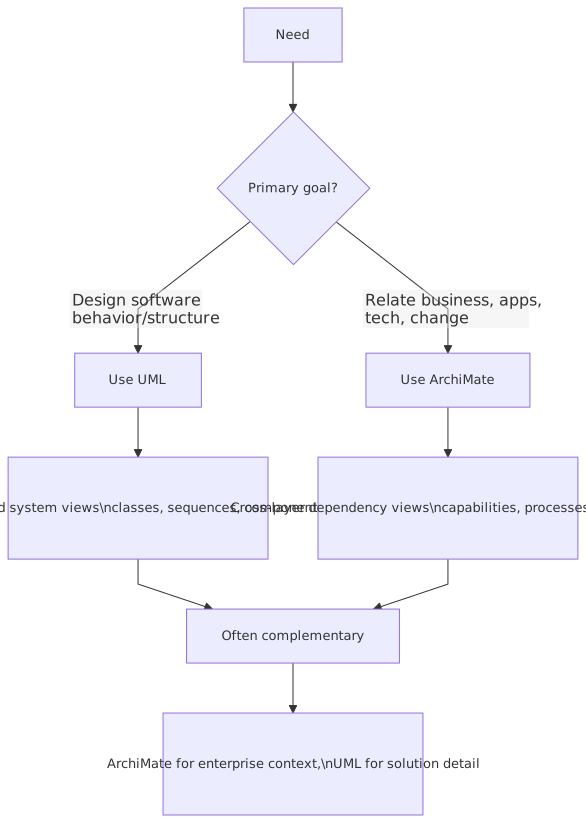
In real architecture work, you are usually doing some combination of these things:
- explaining a current-state landscape
- defining a target-state architecture
- assessing change impact
- aligning technology decisions to business priorities
- governing solution design
- communicating with mixed audiences
- reducing risk before money gets committed
UML and ArchiMate support those activities differently.
When UML is the better tool
Use UML when you need precision in solution behavior or design. For example:
- modeling how a Kafka consumer service handles duplicate payment events
- showing the lifecycle of a card dispute case
- documenting the internal components of an IAM platform integration
- describing interactions between microservices in a cloud-native onboarding flow
A banking team implementing event-driven fraud detection may need:
- component diagrams for the fraud service internals
- sequence diagrams for event publication and consumption
- deployment diagrams for Kubernetes clusters across regions
That is UML territory, or at least software-design territory.
When ArchiMate is the better tool
Use ArchiMate when you need to show enterprise relationships and consequences. For example:
- how Kafka supports multiple business capabilities beyond one project
- which IAM services are shared across channels
- what applications are impacted by a cloud network redesign
- how a regulatory requirement affects process, application, data, and technology layers
A bank moving from siloed authentication systems to a unified IAM platform needs to understand:
- which customer journeys depend on identity
- which channels consume authentication services
- which legacy directories and policy engines exist
- what migration waves are feasible
- where cloud identity services fit and where they don’t
That is ArchiMate territory.
In other words
If the question is “How does this service work?”, UML is often useful.
If the question is “Why does this service matter, who depends on it, and what breaks if we change it?”, ArchiMate is usually better.
That distinction saves time. It also prevents architecture teams from creating diagrams that answer the wrong question very elegantly.
A real enterprise example: banking, Kafka, IAM, and cloud
Let’s make this concrete.
Imagine a mid-sized retail bank. It has:
- mobile banking and web banking channels
- a legacy core banking platform
- a CRM platform
- a fraud engine
- several integration services
- an on-prem IAM stack for workforce and customer identity
- a growing Kafka platform used for event streaming
- a cloud migration program moving digital services to AWS or Azure
The bank wants to improve customer onboarding, strengthen authentication, and reduce integration complexity. Pretty normal.
What happens if the team uses only UML
The solution architects produce:
- sequence diagrams for onboarding requests
- component diagrams for IAM and API services
- deployment diagrams for cloud runtime
- class diagrams for customer identity objects
All useful. No issue there.
But then the steering committee asks:
- Which customer journeys depend on IAM?
- What is the blast radius of changing authentication policies?
- Which applications publish onboarding events to Kafka?
- Which capabilities move to cloud first, and what remains on-prem?
- Where are shared services versus duplicated local solutions?
- Which changes reduce operational risk versus just move it around?
UML starts struggling here. You can answer some of it, but not cleanly. You end up with a pile of diagrams and no coherent enterprise view.
What happens if the team uses only ArchiMate
The enterprise architecture team produces:
- business capability maps
- application cooperation views
- technology layer views
- migration roadmaps
- motivation views linking drivers to outcomes
Great. Now the board can see that “Customer Onboarding” depends on identity verification, fraud screening, consent capture, and event distribution. They can see that Kafka is becoming a shared integration backbone. They can see IAM as a strategic platform, not just a technical utility.
Then engineering asks:
- In what order are tokens exchanged?
- How is MFA triggered?
- How are retries handled on Kafka consumers?
- What component owns consent persistence?
- How does failover work between cloud regions?
ArchiMate is not the right level for that. If you try to force it, you get fake precision.
What good architecture looks like
A competent architecture practice uses both, selectively.
For this bank:
- ArchiMate shows that customer onboarding is a business process supported by digital channels, IAM services, fraud services, CRM, and Kafka-based event distribution; it shows where cloud services host the new onboarding platform; it shows dependencies and migration waves.
- UML shows the onboarding service decomposition, the authentication sequence, the event interactions, and deployment patterns.
That’s a healthy division of labor.
Not because “best practice says so,” but because different stakeholders need different truths at different levels.
Common mistakes architects make
This is where opinions need to be stronger, because a lot of architecture waste is self-inflicted.
1. Treating UML and ArchiMate as competing religions
They are not rival belief systems. They are tools. If your architecture guild spends more time defending notation purity than improving decision quality, something has gone badly wrong.
Use the language that fits the question.
2. Using UML for enterprise portfolio communication
This happens constantly. Someone puts 25 systems in a UML component diagram and calls it enterprise architecture. It usually becomes a technical spaghetti map with no business meaning, no lifecycle context, and no ownership clarity.
A system landscape is not automatically enterprise architecture just because it contains many systems.
3. Using ArchiMate to fake engineering detail
Also common. Architects create detailed ArchiMate models of service interactions and pretend they have specified the solution. They haven’t. They’ve created ambiguity with nicer semantics.
ArchiMate can show relationships. It does not replace interaction design where engineering detail matters.
4. Modeling everything
This is the classic architecture trap. If the repository can hold it, someone thinks it should be modeled.
No. Model what supports decisions.
You do not need a full ArchiMate representation of every internal utility service in your cloud landing zone just because the metamodel allows it. You do not need UML diagrams for every microservice if the code and tests already communicate the design.
Modeling should reduce uncertainty, not create maintenance debt.
5. Ignoring audience
This one is fatal.
A CIO does not need a sequence diagram of token introspection.
A platform engineer does not need a capability map with abstract strategy drivers during an incident review.
If the audience cannot act on the model, the model is wrong for that moment.
6. Confusing notation with architecture quality
A bad target-state architecture in ArchiMate is still bad.
A weak service decomposition in UML is still weak.
Notation does not rescue poor thinking. It only gives poor thinking cleaner lines.
7. Failing to connect enterprise architecture to delivery
This is probably the biggest issue in large organizations.
Enterprise teams create ArchiMate views. Delivery teams create UML or C4 or informal design sketches. Nobody links them. So strategy and implementation drift apart.
You need traceability, but sensible traceability. Not bureaucratic traceability. Enough to show that the target-state application service actually maps to a real backlog, a real service boundary, and a real operating model.
Where Kafka changes the modeling conversation
Kafka is a good example because it exposes the difference between UML and ArchiMate very clearly.
In many enterprises, Kafka is first introduced as “just middleware.” That’s usually a mistake. Once it starts carrying customer events, payment events, fraud signals, and IAM-related notifications, it becomes architectural infrastructure with business consequences.
In UML
You might model:
- producers and consumers
- topic interactions
- retry and dead-letter behavior
- event schema relationships
- runtime deployment
That’s useful for implementation and reliability design.
In ArchiMate
You might model:
- Kafka as part of the technology/application integration landscape
- which application services depend on event streaming
- which business processes are enabled by asynchronous integration
- what migration from point-to-point integration to event-driven architecture looks like
- the impact of Kafka platform failure on business capabilities
That’s useful for investment decisions, platform governance, and risk management.
A lot of architects miss the second part. They treat Kafka as a technical platform only. In banking, that’s naive. If your fraud engine, customer onboarding flow, and notification services all depend on event streaming, Kafka is part of the operating backbone of the enterprise. That needs enterprise-level visibility, not just engineering diagrams.
Where IAM exposes bad modeling habits
IAM is another excellent stress test.
Identity and access management cuts across:
- customer journeys
- workforce operations
- compliance
- security architecture
- application integration
- cloud platform design
That means it is almost impossible to model well with one notation alone.
UML is useful for:
- authentication and authorization flows
- token exchange sequences
- federation interactions
- user lifecycle states
- integration patterns between apps and identity providers
ArchiMate is useful for:
- showing IAM as a shared enterprise service
- identifying which channels and applications consume identity services
- linking IAM to security capabilities and regulatory drivers
- mapping target-state consolidation from fragmented identity stacks
- showing cloud IAM dependencies across business services
If a bank is modernizing customer IAM, the enterprise architecture concern is not just “how OAuth flows work.” That’s important, but secondary.
The bigger questions are:
- Which channels are in scope?
- Which customer segments are affected?
- Where do legacy identity stores create risk?
- Which business capabilities are blocked by fragmented IAM?
- What changes when cloud-native identity services are introduced?
- Which functions remain centralized and which become domain-owned?
That is not UML land.
Cloud migration: the place where both are needed and both get misused
Cloud programs are where architecture notations often become political.
One group wants detailed solution designs. Another wants transformation roadmaps. Both are right. Both often overreach.
UML in cloud work
Useful for:
- deployment topology
- service decomposition
- interaction design
- failover behavior
- runtime communication
ArchiMate in cloud work
Useful for:
- current-state to target-state transition
- mapping applications to hosting platforms
- identifying shared platform services
- showing business impact of migration waves
- linking technology choices to strategic outcomes
In a bank, suppose customer onboarding moves to cloud first, while core banking remains on-prem. Kafka bridges events across both. IAM is partially modernized, with customer identity in cloud but workforce identity still hybrid.
That scenario cannot be explained properly with UML alone. It needs an enterprise view showing transition states, dependencies, and risk concentration points. But it also cannot be delivered with ArchiMate alone. Engineering still needs concrete design views for traffic routing, token validation, encryption boundaries, and resilience.
This is why mature architecture teams stop asking “which one should we standardize on?” and start asking “what minimum set of views do we need across strategy, architecture, and delivery?”
That’s a much healthier conversation.
A practical way to decide which one to use
Here’s a blunt decision guide.
This table is not law. But it’s more useful than abstract arguments about notation philosophy.
My strong opinion: most enterprise architects should learn less UML and better abstraction
That will annoy some people, but I stand by it.
A lot of enterprise architects are too eager to drop into software-detail diagrams because it feels safer. It creates the illusion of precision. But enterprise architecture is not software design with bigger boxes. It is about structure, intent, dependency, constraint, and change across the organization.
If you are an enterprise architect and your default response to every problem is a detailed interaction diagram, you may be doing solution architecture while calling it enterprise architecture.
On the other hand, some enterprise architects hide behind ArchiMate abstraction because they’re uncomfortable with technical reality. That’s just as bad. If you can’t connect your enterprise views to how IAM, Kafka, cloud networking, API gateways, and data platforms actually work, then your models will drift into fiction.
So the real skill is not mastering notation syntax. It is knowing where to stop at each level.
That’s architecture maturity. Not whether your arrows are semantically pure.
What good teams actually do
The best teams I’ve seen do a few simple things consistently:
- They start with the decision, not the diagram.
What are we trying to understand or approve?
- They separate enterprise concerns from solution concerns.
Connected, yes. Mixed together, no.
- They use ArchiMate for landscape, dependency, capability, and transition views.
Especially where cross-domain understanding matters.
- They use UML or equivalent design notation for interaction and implementation detail.
Especially where engineering risk matters.
- They keep the model set small.
A few trusted views beat a hundred forgotten ones.
- They revisit models when architecture changes, not just when governance asks for slides.
Living architecture is harder, but it’s real.
- They make cloud, IAM, and event platforms visible as enterprise assets.
Not just technical plumbing.
That last point matters more now than it did a decade ago. Shared digital platforms are not back-office details anymore. In banking especially, they define delivery speed, control effectiveness, resilience posture, and customer experience. If your enterprise models cannot show that, they are behind the business.
Final takeaway
So, UML vs ArchiMate: what’s the difference?
The clean answer is simple:
- UML is for modeling software/system design.
- ArchiMate is for modeling enterprise architecture across layers.
But the practical answer is better:
- Use UML when you need technical precision.
- Use ArchiMate when you need enterprise context.
- Use both when the problem spans strategy and implementation, which in real enterprises it usually does.
And please, stop pretending one language can replace architectural judgment.
The notation doesn’t make you an architect.
Choosing the right level of abstraction does.
FAQ
1. Can ArchiMate replace UML completely?
No. Not if you care about detailed software design. ArchiMate is strong for enterprise relationships and architecture views across business, application, data, and technology. It is not a great substitute for detailed interaction or design modeling.
2. Is UML outdated for modern cloud and microservices architecture?
No, but it is often overused. UML can still be useful for sequence diagrams, component views, and deployment modeling in cloud-native systems. It becomes a problem when teams try to use it as the main enterprise architecture language.
3. Which is better for banking architecture: UML or ArchiMate?
For enterprise-level banking architecture, usually ArchiMate. Banks need cross-domain visibility across channels, IAM, core systems, Kafka platforms, cloud services, and regulatory controls. But UML is still valuable for detailed solution design inside specific banking services.
4. Should architects use both UML and ArchiMate on the same project?
Often yes. A cloud IAM modernization or Kafka-enabled onboarding platform typically needs enterprise views for scope, dependencies, and migration planning, plus design views for technical interactions and deployment detail.
5. What is the biggest mistake teams make when choosing between UML and ArchiMate?
They choose based on preference or standards politics instead of purpose. The right question is not “which notation do we like?” It is “what decision does this model need to support, and who needs to understand it?”
UML vs ArchiMate: What’s the Difference?
Frequently Asked Questions
What is the difference between UML and ArchiMate?
UML is a general-purpose modeling language primarily used for software design — class structures, sequences, components, states, deployments. ArchiMate is an enterprise architecture language covering business, application, and technology layers. They are complementary: ArchiMate for cross-domain EA views, UML for detailed software design.
When should you use ArchiMate instead of UML?
Use ArchiMate when you need to model cross-domain architecture (business capabilities linked to applications linked to infrastructure), traceability from strategy to implementation, or portfolio views for stakeholders. Use UML when you need detailed software design — class models, sequence interactions, state machines, component interfaces.
Can ArchiMate and UML be used together?
Yes. In Sparx EA, both exist in the same repository. ArchiMate models the enterprise landscape; UML models the internal design of specific application components. An ArchiMate Application Component can link to the UML class diagram that defines its internal structure, maintaining traceability across abstraction levels.