⏱ 20 min read
Most architecture models lie.
Not because architects are dishonest, but because models often look precise while saying very little about what must actually be true. Boxes, arrows, stereotypes, and polished repository views create the feeling of rigor. Meanwhile, the real rules live elsewhere: in wiki pages, Jira comments, tribal memory, or in the head of the lead architect.
That is the problem.
A UML model without meaningful constraints is often just decorated ambiguity. And this is where OCL—the Object Constraint Language—matters far more than most teams admit. Not as an academic sidecar, and not as an old OMG curiosity, but as the missing layer that turns diagramming into architecture with enforceable semantics.
A common belief says: “No one uses OCL in real enterprise architecture.” That is half true, which makes it dangerous.
Most enterprises do not have architects writing pages of formal OCL by hand every day. But the underlying idea—expressing rules precisely inside the metamodel instead of in loose prose—is exactly what mature architecture teams need, especially when they want consistency across repositories, governance, automation, and model-based validation. architecture decision records
If you care about architecture quality, domain boundaries, IAM policy design, event contracts, or cloud governance, constraint semantics matters.
Let’s make that practical.
What constraint semantics in UML actually means
In UML, you model things like applications, services, actors, data objects, interfaces, events, and relationships. Diagrams are good at showing structure. They are much weaker at expressing rules.
A constraint is simply a rule that says something must be true.
Examples:
- every externally exposed API must have an owning business capability
- an event producer cannot also directly update another bounded context’s database
- a privileged IAM role must require MFA
- a customer account cannot be both closed and active
- a microservice marked
statelessmust not depend on local persistent storage
Most teams write such rules in natural language. The problem is that natural language sounds clear until two teams interpret it differently.
OCL gives you a way to write these constraints precisely against a UML model. In simple terms: UML modeling best practices
- UML gives you the model elements
- OCL gives you the rules over those elements
So when people talk about “leveraging OCL within the metamodel,” they mean putting formal constraints into the architecture language itself, not just adding notes beside diagrams.
That is the core idea.
The M1 / M2 / M3 explanation without the fog
This topic gets confusing because people jump too quickly into metamodel jargon. Here is the plain version.
M1: your actual model
This is where most architects work.
Examples:
CustomerServicePaymentEventIdentityProviderKafkaTopicLoanApplicationRole: PrivilegedOperator
These are the actual elements in your repository or UML diagrams. UML for microservices
M2: the metamodel
This defines the kinds of things you are allowed to model and how they relate.
Examples:
ClassComponentAssociationActorConstraint- custom concepts such as
Application,API,EventTopic,Policy,DataEntity
At this level, you are defining the architecture language itself. If your metamodel says an Application may realize a BusinessCapability, or an EventTopic must have exactly one owning domain, that is M2 thinking.
M3: the meta-metamodel
This is the language used to define the metamodel itself. In UML ecosystems this is usually MOF-style territory. Most enterprise architects do not need to live here unless they are building tools or deep customizations.
Why this matters
If you only model at M1, you create diagrams.
If you model at M2 with constraints, you create a governed architecture language.
That is a big difference. One gives you pictures. The other gives you quality control.
What OCL is, in practical terms
OCL stands for Object Constraint Language. It is a formal expression language used with UML models.
It is not a programming language. It does not execute behavior the way Java or Python does. Instead, it describes truths that should hold in a model or design.
Think of it as:
- more precise than prose
- less operational than code
- good for logic over model elements
OCL is commonly used for:
- invariants — rules that must always hold
- preconditions — rules true before an operation
- postconditions — rules true after an operation
- derived values — values computed from model data
- queries — asking questions of the model
A simple example:
`ocl
context Customer
inv: self.accounts->forAll(a | a.status <> AccountStatus::closed or a.balance = 0)
`
Translation: every closed account must have a zero balance.
That is already more useful than a note saying “closed accounts should usually be zeroed.”
Why UML alone is not enough
UML diagrams are good at showing what is connected to what. They are weaker at expressing:
- conditional rules
- cross-model consistency rules
- lifecycle semantics
- policy constraints
- forbidden combinations
- architecture governance logic
A diagram can show that a microservice publishes events to Kafka. Fine. But can the diagram alone say:
- every published event must have a schema owner
- PII-bearing topics must use encryption and restricted retention
- only domain owners can publish canonical business events
- no service may consume from another domain’s topic without an approved contract
Not reliably.
Without constraints, your model is mostly descriptive.
With constraints, it becomes evaluative.
That difference determines whether your repository can prevent bad architecture or merely document it after the fact.
How constraint semantics works inside the metamodel
Constraint semantics means the meaning of a model is not just in its shapes and labels. It also includes the rules attached to model elements and relationships.
1. Define the concepts
At the metamodel level, define things like:
ApplicationServiceEventDataStoreIdentityRoleAPIBoundedContextCloudResource
And define allowed relationships:
ApplicationexposesAPIServicepublishesEventRolegrants access toResourceMicroservicedepends onDatabase
2. Attach constraints
Now add rules such as:
- an
APImust have exactly one owner - a
PrivilegedRolemust require MFA - a
Topiccontaining regulated data must have limited retention - a
Microservicemarkedstateless=truecannot have a persistent volume - an
Eventcannot be published by more than one bounded context unless marked shared
These rules can be expressed in OCL.
3. Validate model instances
At the M1 level, actual architecture elements are checked against those rules.
That means your repository can flag:
- orphan APIs
- shared databases violating domain boundaries
- insecure IAM patterns
- event ownership confusion
- broken lifecycle rules
This is the real value. The metamodel becomes opinionated—and enterprise architecture should be more opinionated than it usually is.
UML vs OCL vs plain text
The mistake is thinking you must choose only one. Good teams use all four, for different purposes.
Where OCL really helps architects
The best way to understand OCL is not syntax-first, but mechanism-first.
1. It gives the model a truth layer
Most repositories are collection systems. They collect applications, interfaces, owners, domains, and tags. Useful, but passive.
OCL turns the repository into something that can evaluate whether the model is internally coherent.
Examples:
- a service tagged “system of record” but with no mastered data object
- an IAM role marked privileged but lacking approval metadata
- an event marked public but with no versioning policy
- a production workload depending on a non-resilient component
These are semantic consistency problems, not drawing problems.
2. It works against the model, not just the implementation
Many teams skip formal model constraints and go straight to policy-as-code. That helps, but late.
Cloud guardrails can tell you an S3 bucket is public. They cannot easily tell you whether the architecture intent was violated because a domain-owned service exposed data outside its approved trust boundary.
That is an architecture-level rule. Constraint semantics belongs earlier than runtime controls—not instead of them, but earlier.
3. It reduces governance theatre
Many architecture review boards still run on PowerPoint pattern matching:
- “this seems aligned”
- “we usually prefer event-driven”
- “please document ownership”
- “security to confirm”
That is not governance. It is educated improvisation.
If your metamodel includes real constraints, you can automate part of the review:
- every internet-facing API must map to a trust zone
- every confidential data entity must have an access control policy
- every event topic must identify retention, schema compatibility, and owner
Now governance starts with facts, not vibes.
OCL mechanisms that matter most
You do not need every corner of OCL. A few concepts go a long way.
Context
A constraint is written in the context of a model element.
`ocl
context API
`
This means the rule applies to every API.
Invariant
An invariant must always be true.
`ocl
context API
inv: self.owner->size() = 1
`
Every API must have exactly one owner.
Navigation
You can traverse model relationships:
self.owner.departmentself.publishesTopic.classificationself.consumers->size()
This is what makes OCL powerful for architecture repositories.
Collection operations
Useful operations include:
forAllexistsselectcollectsizeisEmptynotEmpty
These let you write rules like “all consumers of a topic must belong to approved domains” or “at least one owner must be assigned.”
Boolean logic
Example:
`ocl
context IdentityRole
inv: self.isPrivileged implies self.requiresMFA = true
`
That is architecture semantics stated clearly.
How this applies in real architecture work
Constraint semantics is not mainly about making UML more elegant. It is about making architecture practice less fuzzy.
Repository governance
Constraints help maintain repository hygiene without endless manual review.
Typical rules:
- every application has an owner and lifecycle state
- every interface has a provider or consumer
- every data object has a classification
- every shared platform service has an accountable team
Without this, repositories decay quickly.
Domain-driven architecture
If you model bounded contexts, OCL-style constraints can enforce domain boundaries:
- a service belongs to exactly one bounded context
- direct database access across bounded contexts is forbidden
- canonical events may only be published by the owning domain
- anti-corruption layers are required for legacy integration
This is where many “domain-oriented” architectures quietly drift.
Security architecture
IAM, trust boundaries, policy inheritance, and role design are full of constraints:
- privileged roles require MFA and approval workflow
- machine identities cannot have interactive login permissions
- confidential data stores must not be accessed by public services without mediation
- cross-tenant access requires explicit federation
Security architecture is one of the strongest use cases because ambiguity here creates real risk.
Integration and event architecture
Event-driven systems often look clean on diagrams and chaotic in reality.
Constraints can enforce:
- every topic has a schema owner
- every event carries a version
- no service both publishes and consumes the same command topic unless marked orchestration
- PII events require retention and encryption metadata
- dead-letter handling must be defined for critical topics
Cloud architecture standards
Cloud reference architectures often become giant PDFs no one follows. Constraint semantics can encode the standards directly into the model:
- production workloads must span at least two availability zones
- public endpoints require WAF protection
- stateless services cannot depend on local persistent disks
- managed databases are required for regulated workloads unless exception-approved
Now the standard can be checked, not merely admired. ArchiMate in TOGAF ADM
Common mistakes
1. Treating constraints as documentation instead of logic
A note saying “APIs should have owners” is not a real constraint. If the repository allows ownerless APIs, your architecture language is saying ownership is optional.
2. Writing rules that are too abstract
Statements like “services should be loosely coupled” are not enforceable.
Better:
- every cross-domain dependency must use an API or event contract
- every confidential data entity must have a steward
- every business event must include owning domain and schema version
3. Over-formalizing too early
Not every team should start by writing lots of OCL. If your metamodel is immature and ownership data is missing, formal constraints can become expensive theatre.
Start with high-value rules:
- ownership
- lifecycle
- domain boundaries
- security-critical checks
- integration contracts
4. Confusing model validation with implementation validation
Terraform checks, Kubernetes policies, schema registry rules, and IAM analyzers are excellent. But they validate implementation artifacts.
Architecture constraints validate whether the design model itself is coherent and policy-compliant.
You need both.
5. Making OCL unreadable
If only one specialist can understand the rule, you have created a bottleneck. Keep constraints understandable and pair them with plain-language explanations.
6. Assuming tools solve semantics
Many tools support constraints poorly or inconsistently. Tool support matters, but semantics comes first.
A weak tool with disciplined metamodeling can still help. A shiny tool with no governance discipline becomes an expensive drawing app.
A realistic enterprise example
Consider a bank modernizing customer onboarding across branch, web, mobile, and partner APIs. The target architecture includes:
- domain-based microservices
- Kafka for event distribution
- centralized IAM with federated access
- cloud-hosted onboarding services
- legacy core banking integration
On paper, the principles are solid. In practice, familiar issues appear:
- onboarding events published by multiple teams with inconsistent schemas
- customer identity data copied into several services
- privileged support roles without strong authentication
- mobile onboarding directly querying legacy customer tables
- public APIs missing clear business ownership
This is where constraint semantics helps.
Metamodel concepts
The architecture team defines:
BusinessCapabilityApplicationServiceAPIKafkaTopicEventSchemaBoundedContextDataEntityIdentityRoleCloudWorkloadTrustZone
Example constraints
API ownership
`ocl
context API
inv SingleOwner:
self.owner->size() = 1
`
Domain event ownership
`ocl
context KafkaTopic
inv DomainOwnedTopic:
self.isBusinessEvent implies self.owningContext->size() = 1
`
Schema requirement
`ocl
context KafkaTopic
inv HasSchema:
self.eventSchema->notEmpty()
`
PII protection
`ocl
context KafkaTopic
inv PIIProtected:
self.classification = DataClassification::PII
implies self.encryptionRequired = true and self.retentionHours <= 72
`
Privileged IAM access
`ocl
context IdentityRole
inv PrivilegedRoleRequiresMFA:
self.isPrivileged implies self.requiresMFA = true
`
Bounded context isolation
`ocl
context ApplicationService
inv NoDirectForeignDBAccess:
self.databaseConnections->forAll(db | db.owningContext = self.owningContext)
`
What validation exposed
When the bank ran model validation, it found:
- 18 APIs without accountable owners
- 7 Kafka topics published by two domains
- 11 services with direct data access into another bounded context
- 5 privileged IAM roles missing MFA
- 9 production workloads without resilience metadata
None of this was shocking individually. What mattered was that the model made it visible and actionable.
That changed architecture review from storytelling to evidence.
Banking, Kafka, IAM, and cloud examples
These domains are especially well suited to formal constraints because they are full of state, policy, and risk.
Banking
Useful constraints in lending or onboarding systems include:
- every customer master record has one system of record
- a loan cannot be approved without a completed risk assessment
- only the core banking adapter may call legacy core systems directly
- every credit decision event carries a correlation ID and decision source
- underwriting roles require elevated approval and MFA
Kafka and event architecture
Event-driven systems benefit from rules like:
- each topic has one owning domain
- producers must belong to the owning domain unless the topic is shared
- all topics have a schema compatibility mode
- command topics cannot have more than one logical consumer
- PII topics need restricted retention and encryption
Example:
`ocl
context Topic
inv CommandSingleConsumer:
self.type = TopicType::command implies self.consumers->size() <= 1
`
IAM and identity
Identity architecture is naturally constraint-heavy:
- privileged roles require MFA
- service principals cannot be assigned human approval workflows
- external identities cannot access internal-only resources without federation
- every entitlement maps to an owning application
- break-glass roles must be time-bound
`ocl
context IdentityRole
inv BreakGlassTimeBound:
self.isBreakGlass implies self.maxAssignmentDurationHours <= 8
`
Cloud and microservices
Cloud governance often becomes “tag and pray.” Constraints make it real:
- stateless services cannot use local persistent storage
- public endpoints require WAF and authentication policy
- production workloads must run in multiple zones
- secrets must come from managed secret stores
- each microservice belongs to one domain and one owning team
`ocl
context CloudWorkload
inv ProductionMultiAZ:
self.environment = Environment::production implies self.availabilityZones->size() >= 2
`
These are not exotic. They are architecture common sense made explicit.
A practical adoption path
If your organization is nowhere near formal OCL, that is normal. Start small.
Phase 1: define a small metamodel
Pick 10–15 core concepts:
- application
- service
- API
- event topic
- data entity
- domain
- owner
- role
- cloud workload
- trust zone
Phase 2: choose high-value constraints
Start with violations that genuinely hurt:
- missing ownership
- domain boundary breaches
- privileged access gaps
- public exposure without trust classification
- event topics without schema or owner
Phase 3: express them in plain language and formal form
For each rule, keep both:
- a business-readable statement
- a formal model constraint
That helps adoption.
Phase 4: validate in repository workflows
Run checks:
- on model save
- in review preparation
- in quality dashboards
- before architecture board decisions
Phase 5: connect to implementation controls
Map model constraints to:
- API gateway policy
- schema registry rules
- IAM policy engines
- cloud guardrails
- CI/CD checks
This is where architecture starts to become operational.
OCL itself is optional; semantics is not
Here is the contrarian point that matters most: you do not need visible OCL syntax everywhere to benefit from OCL thinking.
Many enterprises will implement equivalent model constraints using:
- repository rule engines
- graph queries
- validation scripts
- metadata policies
- custom metamodel validation services
That is fine.
The important question is not whether your architects become OCL purists. The important question is whether your metamodel carries precise, checkable rules.
If OCL is the native mechanism, use it. If your tool needs another executable constraint mechanism, use that. Just do not fall back to vague prose and call it governance.
When not to go deep on OCL
Do not invest heavily in formal constraints if:
- your architecture inventory is unreliable
- ownership data is mostly missing
- teams do not maintain model content
- your tool cannot validate anything in practice
- governance processes ignore model outputs
In that situation, fix the operating model first. Otherwise you will build elegant constraints over bad data—which is a very enterprise thing to do, but not a useful one.
Final thoughts
Constraint semantics in UML is not really about syntax. It is about honesty.
Are your architecture models just descriptive pictures? Or do they actually encode what must be true?
That is the dividing line.
UML gives you structure.
OCL gives you enforceable meaning.
The metamodel is where that meaning belongs if you want consistency across teams, reviews, and tools.
For enterprise architects, the payoff is practical:
- cleaner repositories
- stronger governance
- fewer ambiguous standards
- better domain boundaries
- more defensible security and integration decisions
- less architecture-by-PowerPoint
Most importantly, it helps architecture models stop pretending.
Because the hard part of enterprise architecture is not drawing the system. It is making the rules visible enough that the organization cannot quietly ignore them.
That is why constraint semantics matters.
FAQ
FAQ: Constraint Semantics in UML: Leveraging OCL within the Metamodel
1. What is constraint semantics in UML?
Constraint semantics in UML define the rules and conditions that model elements must follow. They add precision to UML diagrams by specifying what is valid or invalid in a model.
2. What is OCL in the UML metamodel?
OCL, or Object Constraint Language, is a formal language used to write constraints for UML models. It helps describe rules, invariants, and logic that standard UML diagrams cannot express clearly on their own.
3. How does OCL improve UML constraint semantics?
OCL improves UML constraint semantics by making model rules unambiguous and machine-readable. This supports better validation, consistency checking, and model-driven development.
4. What is the difference between UML constraints and OCL constraints?
The difference is that UML constraints are the general rules attached to model elements, while OCL constraints are those rules written in a precise formal syntax. OCL gives UML constraints a clear and executable form.
5. How is OCL used within the UML metamodel?
OCL is used within the UML metamodel to define well-formedness rules, invariants, preconditions, and postconditions. This ensures UML elements behave according to formally defined semantic rules.
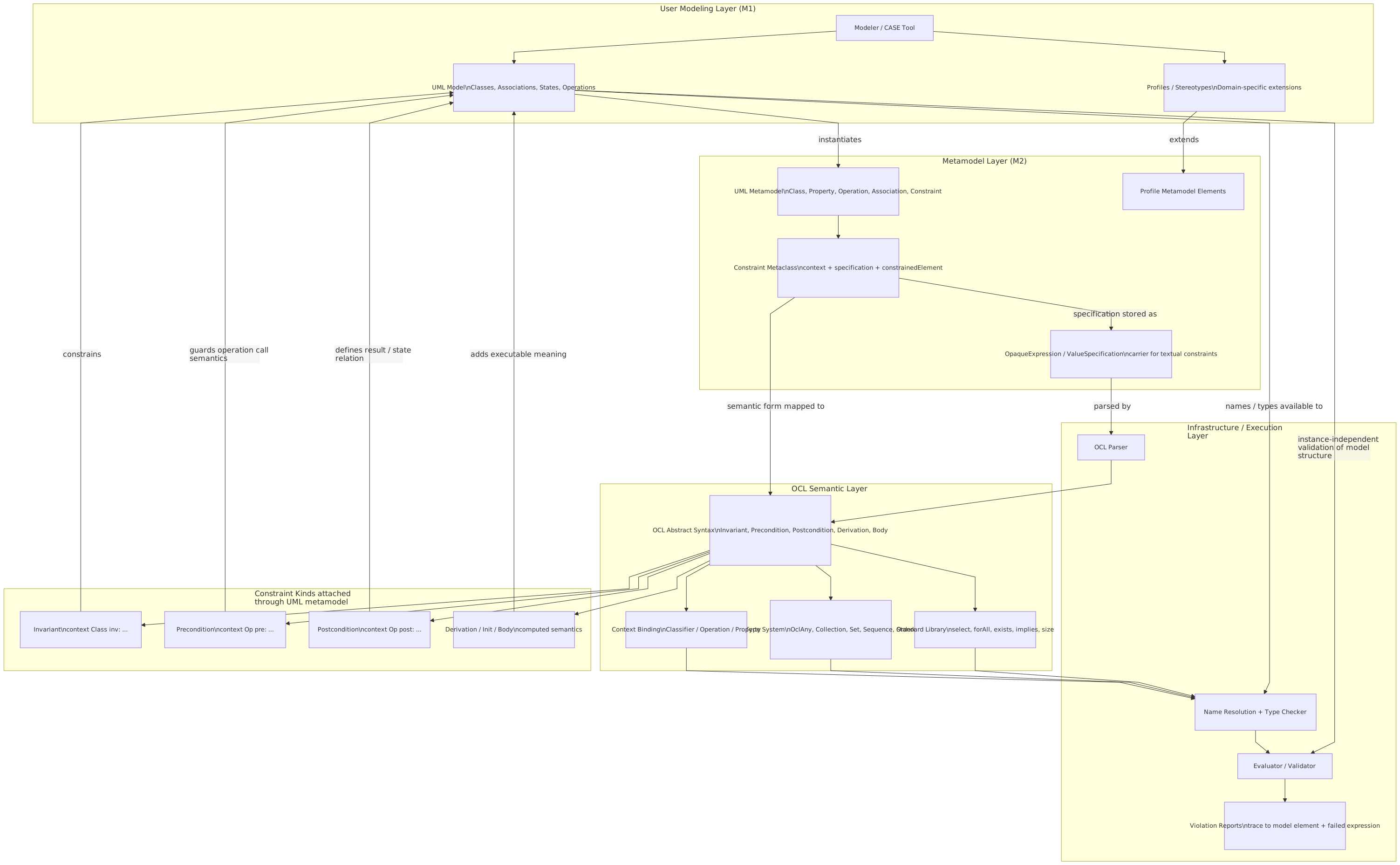
Diagram 1 — UML Constraint Semantics Architecture with OCL in the Metamodel
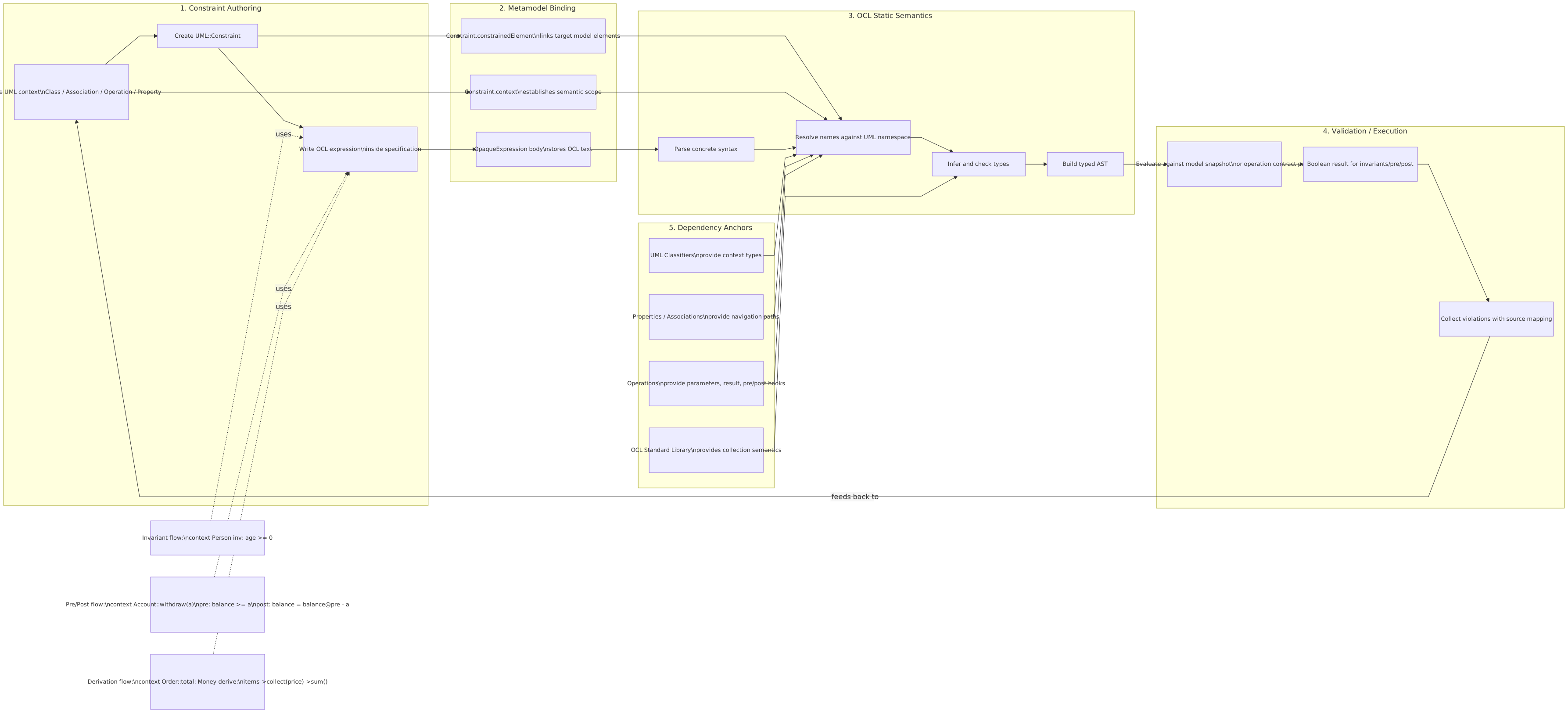
Diagram 2 — Flow of OCL Constraint Definition, Binding, and Validation in UML
Frequently Asked Questions
What is a UML metamodel?
A UML metamodel is a model that defines UML itself — it specifies what element types exist (Class, Interface, Association, etc.), what relationships are valid between them, and what constraints apply. It uses the Meta Object Facility (MOF) standard, meaning UML is defined using the same modeling concepts it uses to define other systems.
Why does the UML metamodel matter for enterprise architects?
The UML metamodel determines what is and isn't expressible in UML models. Understanding it helps architects choose the right diagram types, apply constraints correctly, use UML profiles to extend the language for specific domains, and validate that models are internally consistent.
How does the UML metamodel relate to Sparx EA?
Sparx EA implements the UML metamodel — every element type, relationship type, and constraint in Sparx EA corresponds to a metamodel definition. Architects can extend it through UML profiles and MDG Technologies, adding domain-specific stereotypes and tagged values while staying within the formal metamodel structure.