⏱ 18 min read
Most enterprise UML is not failing because UML is too old. It is failing because architects keep using extension mechanisms as a substitute for architectural thinking. UML modeling best practices
That’s the uncomfortable truth.
UML profiles were supposed to be the civilized answer to specialization. You take a general modeling language, extend it carefully for a domain, and keep enough consistency that different teams can still understand each other. In theory, that is elegant. In real enterprises, especially the large ones with banks, IAM sprawl, Kafka everywhere, and cloud platforms stitched together by seven governance committees, UML profiles often become a polite form of fragmentation. UML for microservices
Everyone says they are “standardizing.” What they are often doing is creating a local dialect no one else speaks.
And yes, I’m opinionated about this because I’ve seen the pattern repeat. One architecture team invents a profile for cloud workloads. Another defines one for identity and access management. A third creates one for event-driven architecture. Then the integration team adds tags for Kafka topics, retention, replay, schema ownership, and consumer accountability. Before long, you have a model repository full of boxes and stereotypes that technically look consistent, but practically behave like tribal artifacts. The notation says “enterprise.” The meaning says “depends who drew it.”
So let’s revisit UML profiles properly: what they are, where they help, where they hurt, and why the line between extension and fragmentation is much thinner than architects like to admit.
The simple version first: what is a UML profile?
For the SEO-friendly version, because people do actually search this:
A UML profile is a way to customize UML for a specific domain without changing UML itself. You do that mainly through:
- stereotypes — labels that extend existing UML elements
- tagged values — extra properties attached to those elements
- constraints — rules about how those elements should be used
So instead of a generic component, you might define stereotypes like:
<> <> <> <>
This is useful because enterprise architecture has concepts that plain UML does not express clearly enough out of the box.
That’s the good part.
The bad part is that many organizations abuse profiles to encode local terminology, tool limitations, governance politics, or modeler preferences. At that point, the profile is no longer extending UML. It is replacing shared understanding with custom symbols. architecture decision records
That’s where fragmentation starts.
Why architects keep reaching for profiles
Because the core problem is real.
Plain UML is general on purpose. Enterprise architecture is not. In real architecture work, we care about things like:
- trust boundaries
- data classification
- IAM relationships
- cloud deployment responsibility
- event ownership
- resilience patterns
- regulatory constraints
- operational accountability
If I’m modeling a payments platform at a bank, “this is a component” is almost useless by itself. I need to know:
- Is it customer-facing?
- Does it process PCI or PII data?
- Is access human, machine, or federated?
- Does it publish Kafka events or only consume them?
- Is it cloud-native, lifted-and-shifted, or SaaS?
- Who owns the schema?
- What are the blast-radius implications if it fails?
Architects create profiles because they need these distinctions to show up in diagrams and repositories. Fair enough.
But here is the contrarian point: the need is legitimate; the solution is often clumsy.
Too many profile designs are really metadata taxonomies disguised as notation. They become giant grab-bags of enterprise concerns shoved into UML because the repository happens to support stereotypes and tags. That is not architecture maturity. That is convenience.
Extension mechanism: the case for UML profiles
Let’s be fair before being critical. UML profiles do have a solid place in enterprise architecture when used with discipline.
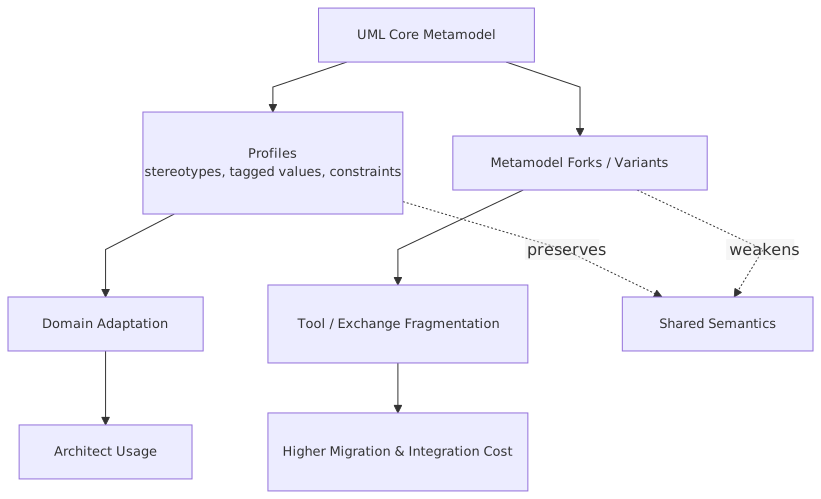
A good profile can do three important things.
1. Make enterprise concerns visible
A cloud migration diagram that distinguishes between:
<> <> <>
is more useful than one that treats everything as a generic node or component.
Similarly, an IAM model that marks:
<> <> <> <>
can make control points visible much faster.
2. Improve consistency across teams
If every Kafka-producing application in the bank uses the same stereotypes and tagged values for:
- topic ownership
- retention class
- data classification
- replay support
- schema authority
then architecture reviews become less subjective. You can compare like with like.
That’s valuable. Especially in large organizations where 50 teams all claim they are doing “event-driven architecture,” while half of them are just publishing integration exhaust and calling it decoupling.
3. Support automation and governance
This is where profiles become powerful. If your stereotypes and tags are stable enough, you can drive:
- review checklists
- documentation generation
- policy validation
- repository queries
- architecture decision traceability
For example, if a component is tagged as < and deployed in a public cloud region, you can automatically flag additional control requirements. If a < is tagged as “business critical,” you can require evidence of schema compatibility governance and recovery procedures.
That’s real enterprise value.
So no, the answer is not “never use UML profiles.” The answer is “use them like a surgeon, not like a toddler with a marker.”
Fragmentation: where it goes wrong
Now the harder part.
UML profiles become harmful when they stop being minimal semantic extensions and start becoming organizational dialects.
This usually happens in five ways.
1. Profiles encode politics instead of architecture
I’ve seen teams define stereotypes that exist mainly to reinforce ownership boundaries:
<> <> <>
These sound respectable. Often they are just labels in governance turf wars.
A profile should clarify the model, not smuggle in org-chart ideology. If your stereotype requires a steering committee to interpret it, it’s not architecture notation. It’s bureaucracy with angle brackets.
2. Every domain creates its own profile with no semantic alignment
Cloud team has one profile. Security has another. Data office has another. Integration has another. IAM has another. They all overlap. None align.
Then you get absurd situations where one application is simultaneously:
<> <> <> <>
depending on which view you opened.
This is not richness. This is semantic inflation.
3. Profiles become too detailed for diagrams and too vague for analysis
This is a classic enterprise architecture failure mode. Architects add dozens of stereotypes and tags because they can. But the resulting diagrams are unreadable, while the metadata still isn’t precise enough for serious governance.
So you get the worst of both worlds:
- diagrams no humans want to read
- metadata machines still can’t trust
4. Tooling starts driving the modeling language
This happens all the time. The repository tool supports certain extension patterns, so the profile is shaped around tool mechanics rather than architectural semantics.
Then architects say things like:
“We model Kafka topics as components because that’s easier in the tool.”
No. That may be convenient, but it has consequences. If your profile bends the meaning of core concepts to fit a repository product, the model is already compromised.
5. Profiles become substitutes for decisions
This one is subtle and common.
Teams start tagging things instead of deciding things.
A workload gets tagged <. Great. Does it actually meet resilience criteria? Unknown.
A system gets tagged <. Nice phrase. Has the IAM architecture removed implicit trust paths? Maybe not.
A topic gets tagged critical=true. Fine. Who owns consumer recovery behavior? Silence.
Profiles can create the illusion of architectural maturity. The model looks sophisticated. The architecture may still be sloppy.
The real distinction: semantic extension vs modeling fragmentation
Here is the test I use.
A UML profile is a valid extension mechanism when it does these things:
- adds domain meaning that UML lacks
- remains small and stable
- is understood across teams
- supports decisions or analysis
- avoids redefining the fundamentals of the language
It becomes fragmentation when it does these things:
- duplicates concepts already handled elsewhere
- reflects local team jargon
- grows faster than governance can manage
- changes interpretation from one domain to another
- creates models only specialists can decode
That difference matters in real architecture work because enterprise models are communication tools first, control mechanisms second, and repository artifacts third. Many organizations invert that order and then wonder why nobody trusts the architecture function.
What this looks like in actual enterprise architecture work
Let’s get concrete.

In real architecture work, UML profiles show up in four common places:
- Solution architecture diagrams
- Repository meta-models
- Architecture review templates
- Cross-domain reference models
And the pressure is always the same: make the model useful enough for specialists without making it incomprehensible for everyone else.
That balance is hard.
Example: banking payments modernization
Take a large retail bank modernizing payments. The landscape might include:
- core banking systems on legacy infrastructure
- payment initiation APIs in the cloud
- IAM integrated with workforce and customer identity platforms
- Kafka for event propagation and operational decoupling
- fraud services consuming transaction streams
- data platforms storing payment events for analytics and compliance
Now suppose the architecture team creates a UML profile to standardize modeling across programs.
Reasonable stereotypes might include:
<> <> <> <> <> <> <>
Useful tagged values might include:
- data classification
- recovery tier
- deployment model
- service owner
- schema owner
- trust zone
- region residency
- authentication mode
That can work well. You can trace where sensitive data flows, where identity decisions happen, and which Kafka topics are system-of-record versus derived projections.
But then the profile expands. Someone adds:
business_criticality_scoretransformation_wavestrategic_alignmentsunset_statustarget_state_conformanceplatform_funding_model
Now the profile is no longer just extending UML for architecture semantics. It is absorbing portfolio management, transformation governance, and operating model metadata. That may belong in the repository, but not all of it belongs in the profile, and definitely not all of it belongs on diagrams.
This is exactly how profile bloat happens in enterprises. Nobody says no early enough.
A useful rule: model the thing, not every opinion about the thing
Architects forget this all the time.
If you’re modeling an IAM service in a cloud platform, model:
- what authenticates
- what authorizes
- what identities exist
- where trust boundaries are
- which policies apply
- what systems consume identity assertions
Do not overload the profile with every governance opinion about lifecycle state, strategic preference, or team maturity.
Those things may matter. But if they dominate the profile, your architecture notation becomes an enterprise filing cabinet.
That is not the same thing.
Common mistakes architects make with UML profiles
Here’s the blunt version.
Mistake 1: creating a profile before agreeing on the core vocabulary
This is probably the biggest one.
Teams define stereotypes before agreeing what terms mean. Then six months later, everyone is using the same labels for different concepts.
If < means a deployable runtime to one team, a business capability exposure to another, and an API product to a third, your profile has failed before version 1.0.
Profiles should come after vocabulary alignment, not before it.
Mistake 2: trying to satisfy every stakeholder in one profile
Security wants control metadata. Data wants lineage metadata. Cloud wants platform metadata. Operations wants support metadata. Governance wants lifecycle metadata.
So the architecture team says yes to all of it.
Result: an overloaded profile no one can use consistently.
A profile should optimize for architectural meaning, not stakeholder appeasement.
Mistake 3: using stereotypes where plain text or documentation would do
Not every important note deserves a formal extension.
Sometimes a note is just a note.
If you create a stereotype for every recurring comment, you are not improving the model. You are formalizing noise.
Mistake 4: making diagrams carry repository-level detail
This one drives me slightly mad.
Architects cram tagged values, constraints, lifecycle states, compliance labels, and cloud attributes directly into diagrams until they look like customs declaration forms.
A diagram should communicate. The repository can hold the rest.
Mistake 5: confusing profile governance with architecture governance
A well-governed profile does not mean a well-governed architecture practice.
You can have a beautifully curated set of stereotypes and still have weak decisions, poor standards adoption, no meaningful roadmaps, and no operational accountability. ArchiMate in TOGAF ADM
Don’t let notation management become a vanity project.
Where UML profiles genuinely help: a practical view
Let’s be practical, not ideological.
Below is a simple way to think about where profiles help and where they usually hurt.
That’s the pattern. Use profiles to express stable architectural semantics. Don’t use them to mirror every moving part of the enterprise.
A real enterprise example: bank-wide event architecture and IAM collision
Let me give a real-style example based on a pattern I’ve seen more than once.
A multinational bank was standardizing event-driven integration using Kafka across retail banking, cards, fraud, and customer servicing. At the same time, the security architecture team was driving stronger IAM controls in cloud-native workloads.
Two architecture groups created extensions in parallel.
The integration group defined stereotypes like:
<> <> <> <> <>
The security group defined:
<> <> <> <> <>
Individually, both profiles looked sensible. Combined, they created confusion.
A payment orchestration service in Kubernetes:
- published transaction events to Kafka
- consumed fraud decision events
- used a workload identity
- handled customer PII
- called policy services for authorization
Depending on which team modeled it, the same service appeared primarily as an event producer, an IAM-controlled machine identity, a sensitive data processor, or a regulated workload. None of those were wrong. But there was no integrated semantic model explaining how these concerns related.
The result was predictable:
- architecture reviews duplicated effort
- diagrams contradicted each other
- ownership boundaries became blurry
- Kafka topic governance was disconnected from IAM trust assumptions
- cloud platform controls were designed separately from event access patterns
Eventually the bank fixed it, but not by creating a bigger profile. That would have made it worse.
They did three smarter things:
- Defined a small enterprise core profile
Only stable concepts were standardized across domains: workload, data store, event channel, identity principal, trust boundary, regulated data handler.
- Allowed domain overlays
IAM and event architecture each kept a small set of domain-specific stereotypes, but these were explicitly mapped to the core model.
- Separated diagram notation from repository metadata
Operational and governance details such as retention policy, encryption settings, lifecycle state, and support tier stayed in metadata, not in every view.
That worked because the enterprise stopped pretending one giant notation scheme would solve conceptual ambiguity. Instead, they aligned semantics and constrained the scope of extension.
That is the lesson many architecture teams need to hear.
The uncomfortable truth: many enterprises don’t need more profiles, they need less modeling vanity
A lot of architecture functions are addicted to visible structure. Profiles feel sophisticated. They signal rigor. They make repository demos look impressive.
But if I’m being honest, many teams would improve their architecture practice more by doing these three things than by launching yet another profile initiative:
- agree on 20 core concepts and use them consistently
- cut 40% of the notation clutter from diagrams
- connect models to actual decision-making and risk management
You don’t get points for taxonomy density.
The purpose of architecture is not to prove that your repository can represent complexity. The purpose is to help the enterprise make coherent change under constraints.
Sometimes UML profiles help with that. Sometimes they are just decorative governance.
So should enterprise architects use UML profiles?
Yes. Carefully. Skeptically. Minimally.
My position is not anti-profile. It is anti-sprawl.
Use UML profiles when you need to express stable enterprise concepts that matter across teams and can support real analysis. Do not use them to compensate for weak vocabulary, weak governance, or weak architecture leadership.
And definitely don’t let every domain invent its own semi-private language and call that standardization.
A practical set of principles
If you are designing or revising a UML profile in an enterprise, I’d recommend these principles:
1. Start with decisions, not notation
Ask what decisions the model must support:
- cloud placement?
- IAM trust design?
- Kafka ownership?
- regulated data handling?
If the extension does not improve a decision, question it.
2. Keep the enterprise core very small
Aim for a compact set of enterprise-wide stereotypes. Really compact. Single digits or low double digits, not fifty.
3. Separate domain overlays from core semantics
Let banking, IAM, cloud, and event architecture add domain-specific meaning, but force explicit mapping back to the core.
4. Put metadata in the repository, not all on the diagram
A readable model beats a complete mess.
5. Version the profile like a product
Profiles are not side documents. They are enterprise assets. Govern changes, retire unused elements, and publish examples.
6. Train people on meaning, not just notation
If modelers learn how to apply stereotypes but not what they mean architecturally, consistency is fake.
7. Review for semantic drift
Terms drift. Organizations change. Cloud patterns evolve. Revisit whether stereotypes still represent stable meaning or just old assumptions.
Final view
UML profiles are one of those enterprise architecture mechanisms that look cleaner in theory than in practice. They promise controlled specialization. And they can deliver it. But they sit dangerously close to fragmentation because enterprises are messy, politics leaks into modeling, and architects often overestimate the value of formal notation.
If you remember only one thing, make it this:
A profile should sharpen shared meaning, not multiply local language.
That’s the line.
In banking, this means your Kafka event models, IAM trust models, and cloud workload diagrams should become easier to relate, not harder. In architecture reviews, it means the profile should reduce ambiguity, not create another layer of interpretation. In governance, it should support decisions and controls, not become a museum of enterprise labels.
A good UML profile is boring in the best possible way. It makes important things visible, keeps semantics stable, and stays out of the way.
A bad one feels clever. And then slowly fractures the architecture practice around it.
Choose boring.
FAQ
1. Are UML profiles still relevant in modern enterprise architecture?
Yes, but only if they solve real modeling problems. They are still useful for cloud, IAM, event-driven systems, and regulated environments where plain UML is too generic. They stop being useful when they become overloaded with governance or portfolio metadata.
2. When should I create a UML profile instead of just using labels in diagrams?
Create a profile when the concept is stable, reused across teams, and important enough to support analysis or governance. If it’s just a one-off annotation or a local note, plain labels are usually enough.
3. How many stereotypes should an enterprise UML profile have?
Fewer than most enterprises think. The enterprise core should be small. If your profile has dozens and dozens of stereotypes, there is a good chance you are modeling organizational complexity rather than architectural semantics.
4. How do UML profiles apply to Kafka and event-driven architecture?
They help when they make ownership, producer/consumer roles, event classification, and trust boundaries explicit. They hurt when every topic setting or broker detail gets turned into notation. Keep the architecture visible; keep the operational detail in metadata.
5. What is the biggest mistake architects make with UML profiles?
Using them before agreeing on meaning. If the organization has not aligned on what a service, workload, identity, event, or data store actually is, a profile will just formalize confusion.
Frequently Asked Questions
What is the difference between UML and ArchiMate?
UML is a general-purpose modeling language primarily used for software design — class structures, sequences, components, states, deployments. ArchiMate is an enterprise architecture language covering business, application, and technology layers. They are complementary: ArchiMate for cross-domain EA views, UML for detailed software design.
When should you use ArchiMate instead of UML?
Use ArchiMate when you need to model cross-domain architecture (business capabilities linked to applications linked to infrastructure), traceability from strategy to implementation, or portfolio views for stakeholders. Use UML when you need detailed software design — class models, sequence interactions, state machines, component interfaces.
Can ArchiMate and UML be used together?
Yes. In Sparx EA, both exist in the same repository. ArchiMate models the enterprise landscape; UML models the internal design of specific application components. An ArchiMate Application Component can link to the UML class diagram that defines its internal structure, maintaining traceability across abstraction levels.