⏱ 20 min read
Most enterprise architects don’t struggle with UML because it’s “too technical.” They struggle because they were taught the wrong thing. UML modeling best practices
They were taught diagrams.
Boxes. Arrows. Nice notation. Maybe a class diagram in one meeting, a sequence diagram in another, and then everyone moves on to PowerPoint because at least PowerPoint doesn’t pretend to be rigorous.
That’s the problem.
If you’re an enterprise architect and you think UML is mainly about drawing pictures, you’re missing the only part that actually matters at scale: the metamodel. The metamodel is what makes UML more than drawing software. It’s the thing that says what a “component” is, what a “dependency” is, what can relate to what, and what those relationships actually mean. Without that, your repository becomes a graveyard of inconsistent diagrams and competing interpretations. Which, frankly, is where a lot of architecture tools end up.
Here’s the simple version up front:
> A UML metamodel is the model that defines the language of UML itself.
> It tells you what modeling elements exist, how they relate, and what rules govern them.
That’s the SEO-friendly explanation. It’s also the practical one.
If you remember nothing else, remember this: the metamodel is the architecture behind the architecture diagrams.
And yes, this matters in real enterprise work. A lot.
Because the moment you try to map business capabilities to applications, applications to APIs, APIs to Kafka events, events to cloud services, and all of that to IAM controls and ownership boundaries — you are no longer “just drawing.” You are building a semantic system. If your semantics are weak, your architecture practice is weak. Harsh, but true.
What is a UML metamodel, really?
Let’s make it plain.
A model describes some part of reality.
- A class diagram models software structure.
- A deployment diagram models runtime nodes and artifacts.
- A component diagram models system parts and dependencies.
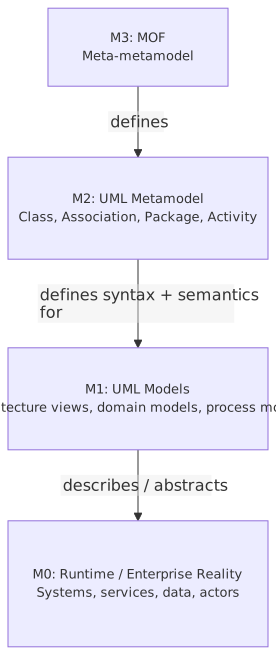
A metamodel describes the modeling language used to create those models.
So if your UML diagram has a Component, Interface, Node, Class, or Association, those are not random shapes. They are instances of concepts defined in the UML metamodel.
Think of it this way:
A lot of architects never need to care about the meta-metamodel. Fine. You can live a happy life without discussing MOF over coffee. But you absolutely should care about the metamodel, because it determines whether your repository is coherent or just decorated confusion.
And yes, this is where people start rolling their eyes. “We’re not building compilers.” True. But we are trying to make enterprise decisions based on representations. If those representations are inconsistent, your governance is theater.
Why enterprise architects should care
Here’s the contrarian view: UML notation by itself is overrated in enterprise architecture. The metamodel is underrated.
Most architecture teams obsess over whether to use UML, ArchiMate, BPMN, C4, or some homegrown notation. Honestly, that debate is often a distraction. The bigger issue is whether the underlying concepts are clear, stable, and reusable. ArchiMate modeling best practices
An enterprise architect cares about questions like:
- What is an application component versus a service versus an interface?
- Is a Kafka topic an information object, a channel, or an interface?
- Is IAM a platform component, a shared service, or a control domain?
- What is the difference between deployment, ownership, and dependency?
- Can we trace a business capability to a cloud workload and then to security controls?
You cannot answer those consistently with pretty diagrams alone. You need a metamodel mindset.
In real work, the metamodel helps with:
- Consistency across teams
If one team models “Customer API” as an application and another models it as an interface and a third models it as a data object, your repository becomes useless fast.
- Traceability
You want to trace from business capability → process → application service → application component → deployment node → IAM policy boundary. That only works if the underlying concepts are explicit.
- Automation and reporting
Every architecture team eventually wants impact analysis, technology risk views, ownership maps, lifecycle dashboards, cloud migration reports. Those reports rely on structured semantics, not drawing talent.
- Governance with less nonsense
Real governance should test architecture integrity, not diagram aesthetics. A metamodel makes that possible.
- Tool sanity
Most enterprise architecture tools are only as good as the metamodel discipline behind them. Otherwise they become expensive shape repositories.
This is why mature architects eventually stop asking, “What diagram should I draw?” and start asking, “What concepts are we managing, and what relationships are valid?”
That’s metamodel thinking.
The basic idea without the academic fog
Let’s strip the theory down.
In UML, the metamodel defines types of elements and allowed relationships.
Examples:
- A Class can have attributes and operations.
- A Component can realize interfaces.
- A Node can host deployed artifacts.
- A Dependency means one thing relies on another.
- A Generalization means inheritance or specialization.
This matters because a model is not just visual. It’s structured.
If you model a banking platform and say:
Payments Serviceis a ComponentCustomer Identity APIis an InterfaceKafka Event Brokeris an Infrastructure Node or ComponentIAM Platformis a shared security serviceAWS EKS Clusteris a deployment environment
…then the metamodel tells you what kinds of relationships make sense between those things.
Without that, architects invent semantics on the fly. Which they do all the time. And then six months later the architecture repository says a database “consumes” an IAM role and a Kafka topic “owns” a business process. At that point, don’t blame UML. Blame the lack of discipline.
UML metamodel versus just “using UML”
This distinction matters more than people admit. EA governance checklist
Using UML often means:
- drawing diagrams in Visio, Lucid, draw.io, or Sparx
- picking symbols that look approximately right
- explaining the meaning verbally in meetings
- exporting a PNG and forgetting it exists
Working with the UML metamodel means:
- identifying the actual model element types
- using relationships intentionally
- defining enterprise-specific specializations where needed
- maintaining consistency across models
- enabling traceability and analysis
There’s a huge difference.
One is communication. The other is architecture as a managed discipline.
You need both, by the way. I’m not saying every architect should become a modeling purist. That’s another trap. If your model is technically perfect and nobody can use it, congratulations, you built a museum piece.
But if your architecture is only conversational and visual, it won’t survive scale.
The enterprise architecture angle: where this gets real
Let’s bring this into real architecture work, because theory without enterprise pain is just classroom furniture.
Suppose you’re designing and governing a modern banking platform with:
- digital channels in the cloud
- core banking systems on-prem
- Kafka for event streaming
- centralized IAM with OAuth2/OIDC and privileged access controls
- multiple domain teams exposing APIs
- regulatory pressure around access, auditability, and resilience
Classic hybrid enterprise.
Now imagine you need to answer these questions:
- Which applications handle customer PII?
- Which services publish customer lifecycle events to Kafka?
- Which systems depend on IAM for authentication versus authorization?
- Which cloud workloads are internet-facing?
- Which business capabilities would be impacted if the identity provider fails?
- Which components are still coupled to the legacy core banking adapter?
This is where a metamodel stops being abstract.
Because to answer these questions, you need model elements like:
- Business Capability
- Application Component
- Application Service
- Interface / API
- Data Object / Information Entity
- Event Channel or Topic
- Deployment Node / Cloud Environment
- Security Service
- Identity Store / Policy Decision Point / Policy Enforcement Point
- Dependency
- Ownership
- Data Flow
- Deployment Relation
Some of these are straight UML concepts. Some are better represented through a UML profile or enterprise extension. That’s normal. In fact, this is one of the most useful ways to use UML in enterprise architecture: not raw vanilla UML everywhere, but UML with disciplined specialization for enterprise concerns.
And yes, that’s a strong opinion: vanilla UML is rarely enough for enterprise architecture repositories. If you stop at the standard notation and never adapt it, you’ll either oversimplify or force-fit concepts until the model lies.
A practical way to think about the UML metamodel
For enterprise architects, I’d break it into five practical concerns.

1. Element types
What things exist in your architecture language?
Examples:
- Business capability
- Application component
- API interface
- Kafka topic
- IAM service
- Database
- Cloud runtime node
2. Relationship types
How can those things relate?
Examples:
- depends on
- realizes
- exposes
- publishes to
- subscribes to
- deployed on
- owned by
- secures
- stores
3. Constraints
What rules must hold true?
Examples:
- Only application components expose application interfaces
- Kafka topics cannot “own” business capabilities
- IAM policies apply to identities, roles, and protected resources, not arbitrary diagrams
- A workload deployed to public cloud must map to a security zone
4. Specialization
How do you adapt the language to your enterprise?
Examples:
- A specialized
StreamingInterfacestereotype for Kafka-based integration - A specialized
IdentityProviderstereotype for IAM components - A
RegulatedDataStorestereotype for systems holding sensitive data
5. Traceability
How do you connect strategy, design, and operations?
Examples:
- capability → process → application service → component → deployment → control
That’s it. If your architecture team gets these five things right, the metamodel is doing its job.
Common mistakes architects make
Let’s be honest. The UML metamodel doesn’t fail most architecture teams. Architecture teams fail it.
Here are the mistakes I see constantly.
Mistake 1: Treating UML as notation instead of semantics
This is the big one.
Teams focus on whether to use the right symbol, but not whether the underlying concept is correct. So they produce diagrams that look professional and mean nothing consistent.
A clean-looking wrong model is still wrong.
Mistake 2: Modeling everything as a “component”
This happens in every repository.
Application? Component. API? Component. Kafka topic? Component. IAM role? Somehow also component.
When every noun becomes a component, you’ve abandoned the language. You’re not modeling, you’re labeling.
Mistake 3: Confusing runtime, logical, and organizational views
Architects mix deployment, design, and ownership in one diagram and then act surprised when nobody can maintain it.
For example:
- A Kubernetes cluster
- A payments microservice
- A product owner
- A Kafka topic
- An Okta tenant
All on one slide, all with generic arrows.
That’s not architecture rigor. That’s visual multitasking.
Mistake 4: No enterprise-specific profile or specialization
Raw UML is useful, but enterprise architecture usually needs specialization.
If your organization relies heavily on cloud, event streaming, IAM, and regulated data, your modeling language should reflect that. Otherwise architects improvise terminology in meetings and the repository drifts.
Mistake 5: No relationship discipline
People invent arrows with custom meanings every time.
Depends on. Uses. Calls. Integrates with. Connects to. Talks to. Sends data to.
Some variety is fine. Semantic chaos is not.
Mistake 6: Forgetting the audience
Some architects go full metamodel nerd and lose the room.
Business leaders don’t need a lecture on metaclasses. Delivery teams don’t need a philosophical argument about abstraction layers. The metamodel should improve clarity, not become a performance.
Mistake 7: Trying to model the whole enterprise before proving value
This is the classic EA overreach.
You don’t need a perfect enterprise metamodel to start. You need a useful one. Pick a problem domain — say IAM dependency mapping for customer-facing banking services — and model that well first.
Strong opinion again: architecture teams that start with repository completeness usually fail. Teams that start with decision support usually survive.
A real enterprise example: banking, Kafka, IAM, cloud
Let’s make this concrete.
Imagine a retail bank modernizing its customer onboarding and payments ecosystem.
The setup
The bank has:
- a legacy core banking platform on-prem
- new digital onboarding services running on AWS
- Kafka as the enterprise event backbone
- centralized IAM platform providing authentication and token issuance
- several domain APIs: Customer Profile, Payments, Fraud, Notifications
- compliance requirements around access, audit, and data residency
The architecture team is asked to answer:
- What are the critical dependencies in onboarding?
- What happens if IAM degrades?
- Which services publish customer events?
- Which cloud workloads touch regulated data?
- Can we trace onboarding capability to deployed technical assets?
A weak modeling approach
Without metamodel discipline, the team creates:
- one application landscape diagram
- one integration diagram
- one security diagram
- all manually maintained
- all using different naming conventions
- all with inconsistent meanings for “service,” “application,” and “interface”
Result:
- duplicate objects everywhere
- no impact analysis
- endless debate over interpretation
- governance meetings based on opinion, not structure
This is common. Also avoidable.
A better UML metamodel-driven approach
The team defines a core enterprise modeling subset:
Now the architecture model can represent:
Customer Onboardingcapability is realized byOnboarding Application ServiceOnboarding Application Serviceis implemented byOnboarding ComponentOnboarding ComponentusesIAM Token Servicefor authenticationOnboarding ComponentcallsCustomer Profile APIOnboarding ComponentpublishesCustomerCreatedevent to Kafka topiccustomer.lifecycleFraud Detection Servicesubscribes to that topicOnboarding Componentis deployed onAWS EKS ClusterCustomer Profile Storecontains regulated customer dataIAM Token Serviceis a shared dependency for multiple customer-facing services
Now you can ask useful questions.
If IAM fails:
- which application services degrade?
- which capabilities are impacted?
- which customer journeys break?
If Kafka topic schema changes:
- which publishers and subscribers are affected?
- which downstream fraud and notification flows are at risk?
If a cloud security review flags a public subnet:
- which regulated workloads are deployed there?
- which APIs expose sensitive data?
That is real architecture work. And it depends on model semantics, not just diagrams.
Where Kafka and IAM often break enterprise models
Kafka and IAM are two areas where weak metamodels get exposed quickly.
Kafka modeling problems
Architects often model Kafka badly because they try to force event-driven systems into request-response thinking.
Common errors:
- modeling a Kafka topic as an application
- confusing producer/consumer relationships with API invocation
- not distinguishing event schema from topic from broker runtime
- ignoring ownership of event contracts
A more useful approach is to distinguish:
- application component: Payments Service
- event contract or message type: PaymentInitiated
- event channel/topic: payments.initiated
- broker platform: Kafka Cluster
- publisher/subscriber dependencies
That distinction matters in governance. If the topic changes, that’s not the same as the message schema changing. If the broker platform is unavailable, that’s not the same as a producer defect.
IAM modeling problems
IAM gets flattened in many repositories into one magical “security service.”
That’s lazy, and dangerous.
IAM in enterprise terms usually includes:
- identity provider
- authentication service
- token issuance
- authorization policy decision
- directory or identity store
- privileged access controls
- federation with external parties
- policy enforcement points in apps or gateways
If you model all of that as one blob, you can’t do dependency or risk analysis properly.
For example, a banking mobile onboarding flow may depend on:
- external customer authentication through OIDC
- internal staff authorization through RBAC
- service-to-service tokens for API calls
- Kafka ACLs for event publishing rights
- cloud IAM roles for workload access to secrets and storage
These are not the same thing. They should not be modeled as the same thing.
A decent metamodel helps you avoid this flattening.
How this applies in day-to-day architecture work
Let’s get practical. What does this change in the life of an enterprise architect?
1. Better architecture reviews
Instead of reviewing vague diagrams, you review:
- valid component boundaries
- interface ownership
- security dependencies
- deployment mappings
- data handling classifications
The conversation improves immediately.
2. Better impact analysis
When a bank wants to retire a legacy identity store, you can identify:
- affected APIs
- dependent customer journeys
- cloud workloads using old credentials
- Kafka consumers relying on identity-enriched events
That’s useful. That gets funded.
3. Better cloud migration planning
You can trace:
- which services are on-prem
- which are already containerized
- which depend on IAM patterns not yet cloud-ready
- which integrations still rely on legacy middleware instead of Kafka
Now migration planning is evidence-based.
4. Better security architecture
If your metamodel includes security services, trust boundaries, and access dependencies, you can stop pretending security is a side annotation on application diagrams.
For regulated industries like banking, that’s not optional.
5. Better portfolio rationalization
When applications, services, interfaces, and deployment assets are modeled consistently, you can actually identify redundancy instead of just suspecting it.
A surprising amount of “application sprawl” is really “modeling sprawl.” Once semantics improve, the inventory gets clearer.
Should enterprise architects use UML metamodels directly?
Here’s my honest answer: usually not directly in full formal detail.
Most enterprise architects do not need to read the UML specification cover to cover. And if someone tells you that’s the starting point, they are confusing standards literacy with practical architecture.
What you do need is:
- a working understanding of core UML element types
- a disciplined enterprise subset
- clear definitions for enterprise-specific extensions
- governance over naming and relationships
- models tied to actual decisions
In other words, use the metamodel implicitly and intentionally, not academically.
This is similar to how good architects use TCP/IP. They don’t need to rebuild the protocol stack every morning. But they do need to understand enough to make sound decisions.
Same here.
A pragmatic adoption pattern
If you want to introduce metamodel discipline into an enterprise architecture practice, don’t overcomplicate it.
Step 1: Pick a high-value domain
Good candidates:
- IAM dependency architecture
- Kafka/event-driven integration landscape
- cloud workload deployment and data classification
- customer-facing banking services
Step 2: Define a small set of element types
Maybe 10–15 to start:
- Capability
- Process
- Application Component
- Application Service
- Interface/API
- Event Topic
- Data Object
- Security Service
- Deployment Node
- Team/Owner
- Dependency
- Data Flow
Step 3: Define allowed relationships
Be explicit.
- component exposes interface
- component depends on service
- component publishes event
- component subscribes to event
- component deployed on node
- component stores data object
- owner owns component
Step 4: Write plain-English definitions
Not standards prose. Real definitions people can use.
For example:
- Application Component: deployable software unit with clear ownership and lifecycle
- Application Service: business-relevant behavior exposed by an application component
- Event Topic: named asynchronous channel used for publish-subscribe integration
- Security Service: shared capability providing authentication, authorization, secrets, or policy enforcement
Step 5: Pilot with one real initiative
Such as digital onboarding in banking.
Step 6: Use the model to answer real questions
If it can’t answer impact, risk, ownership, or migration questions, refine it.
Step 7: Only then expand
Not before.
That’s how architecture practices become useful instead of ceremonial.
A blunt word on tools
Tools matter less than vendors claim and more than architects admit. TOGAF roadmap template
A tool won’t save a bad metamodel. But a bad tool will absolutely make a good metamodel painful.
What you need from a tool is:
- support for typed elements and relationships
- reusable object definitions across views
- specialization/stereotypes/profiles
- query and reporting capability
- governance workflow if possible
What you do not need is:
- a thousand notation options nobody understands
- repository complexity before use cases
- mandatory perfection before publication
And yes, plenty of teams can start in lightweight tools before moving into a formal repository. That’s not heresy. It’s often sensible.
But at some point, if your enterprise architecture function wants traceability and impact analysis, the semantics need to live somewhere structured.
Final thought
The UML metamodel is not some obscure standards artifact for modeling purists. For enterprise architects, it’s the quiet mechanism that separates architecture as a discipline from architecture as slide production.
If that sounds severe, good. It should.
Because in a real enterprise — especially one doing banking modernization, Kafka-based integration, IAM centralization, and cloud transformation all at once — ambiguity gets expensive very quickly. Systems get misclassified. Dependencies are missed. Security assumptions go unchallenged. Migration plans become fiction.
The metamodel is not there to make architecture more academic. It’s there to make it less sloppy.
My advice is simple:
- Don’t worship UML.
- Don’t dismiss it either.
- Use a small, disciplined metamodel.
- Extend it for enterprise reality.
- Tie it to decisions and governance.
- And stop pretending a diagram is enough just because it looks clean.
A good architecture model should help you answer hard questions under pressure. If it can’t, it’s decoration.
And enterprises already have enough decoration.
FAQ
1. What is the difference between a UML model and a UML metamodel?
A UML model represents a system or enterprise situation. A UML metamodel defines the concepts and rules used to create those models. Put simply: the model describes your bank’s onboarding platform; the metamodel defines what a component, interface, dependency, or node means.
2. Do enterprise architects really need to understand the UML metamodel?
Yes, but not at full standards-lawyer depth. You need enough understanding to define consistent element types, relationships, and constraints across your architecture practice. If you don’t, your repository turns into inconsistent diagrams with no analytical value.
3. How does this help with Kafka and event-driven architecture?
It helps you distinguish between the service, the event contract, the topic, and the broker platform. That distinction is essential for ownership, impact analysis, and governance. Otherwise teams model Kafka as a generic integration blob and lose the real dependencies.
4. How does the UML metamodel relate to IAM architecture?
It gives you a way to model IAM as structured architecture rather than a single security box. You can represent identity providers, token services, authorization dependencies, protected resources, and deployment boundaries more clearly, which matters a lot in banking and cloud environments.
5. Should we use UML or ArchiMate for enterprise architecture?
Use the one that supports clear semantics and practical outcomes in your organization. ArchiMate is often better for high-level enterprise viewpoints. UML is stronger for detailed structural and design-oriented modeling. In practice, many mature teams blend approaches. The real issue is not the logo on the notation — it’s whether your metamodel is disciplined enough to support real decisions. ArchiMate modeling guide
Frequently Asked Questions
What is a UML metamodel?
A UML metamodel is a model that defines UML itself — it specifies what element types exist (Class, Interface, Association, etc.), what relationships are valid between them, and what constraints apply. It uses the Meta Object Facility (MOF) standard, meaning UML is defined using the same modeling concepts it uses to define other systems.
Why does the UML metamodel matter for enterprise architects?
The UML metamodel determines what is and isn't expressible in UML models. Understanding it helps architects choose the right diagram types, apply constraints correctly, use UML profiles to extend the language for specific domains, and validate that models are internally consistent.
How does the UML metamodel relate to Sparx EA?
Sparx EA implements the UML metamodel — every element type, relationship type, and constraint in Sparx EA corresponds to a metamodel definition. Architects can extend it through UML profiles and MDG Technologies, adding domain-specific stereotypes and tagged values while staying within the formal metamodel structure.