⏱ 20 min read
Most enterprise architecture arguments about UML versus BPMN are a waste of oxygen. UML modeling best practices
Not because the topic is unimportant. It is important. Very important, actually. But because the debate is usually framed the wrong way, as if architects need to pick a winner. They do not. If you are still asking whether UML or BPMN is “better,” you are already solving the wrong problem. UML for microservices
Here is the blunt version: UML and BPMN are not competitors in serious architecture work. They are different lenses for different kinds of truth. One helps you reason about systems and structure. The other helps you reason about business flow, coordination, and operational behavior across people and systems. In enterprise architecture, you need both. And if you only use one, you will create blind spots large enough to drive a failed transformation through.
That is the practical answer. For SEO and clarity, let’s make it even simpler.
Simple explanation first: UML vs BPMN
UML (Unified Modeling Language) is mainly used to describe software and system design. It helps architects and engineers model things like components, interfaces, services, data relationships, and interactions between systems.
BPMN (Business Process Model and Notation) is mainly used to describe business processes. It helps model workflows, decisions, handoffs, approvals, events, exceptions, and the collaboration between teams and systems.
A very simple way to say it:
- UML explains what the system is and how parts interact
- BPMN explains how work flows through the business and systems
That is why they complement each other.
If you are designing a bank’s customer onboarding capability, BPMN can show the process from application submission to KYC review to account creation to welcome notification. UML can show the underlying service landscape: onboarding API, IAM platform, KYC vendor integration, Kafka events, customer master, fraud scoring service, and cloud deployment boundaries.
One is not replacing the other. They answer different questions.
And yes, there is overlap. Of course there is. Enterprise architecture lives in overlap. But overlap is not redundancy. It is where translation happens.
The real issue: architects confuse audiences and decisions
This is the mistake I see over and over again. Not a tooling mistake. Not a notation mistake. A thinking mistake.
Architects often create one model and expect it to satisfy everyone:
- business leaders want operational flow
- delivery teams want technical decomposition
- security teams want trust boundaries and identity flows
- platform teams want event paths and runtime dependencies
- auditors want controls and approvals
- product teams want ownership and change impact
One diagram cannot do all of that without becoming unreadable garbage.
So what happens? Someone draws a “high-level architecture” that mixes process steps, application boxes, API calls, roles, exceptions, and cloud services in a single page. It looks impressive for about 90 seconds. Then nobody can use it to make decisions.
That is why UML and BPMN matter together. They force discipline.
- BPMN says: show me the process, participants, decisions, triggers, and exceptions.
- UML says: show me the structure, responsibilities, interfaces, and interaction patterns.
This separation is healthy. It prevents the classic enterprise architecture disease: diagrams that are broad, vague, and politically acceptable, but operationally useless.
What UML is actually good at
UML gets treated unfairly these days. Some people act like it is an old relic from heavyweight design methods. That is lazy thinking.

Used badly, UML absolutely becomes ceremony. Used well, it remains one of the clearest ways to reason about software-intensive systems.
In enterprise architecture, the most useful UML views are usually not the full kitchen sink. You do not need every diagram type because a framework says so. You need the ones that clarify decisions.
Typically, that means:
- Component diagrams for application/service decomposition
- Sequence diagrams for interaction behavior across systems
- Class or domain diagrams for core business concepts and relationships
- Deployment diagrams when infrastructure boundaries matter
- Use case diagrams occasionally, though honestly they are often overused and underhelpful
UML shines when the architecture question is something like:
- Which service owns customer identity?
- How does IAM integrate with internal apps and external channels?
- Where does Kafka sit in the interaction model?
- Which components are synchronous, and which are event-driven?
- What interfaces are stable, and which are internal?
- How do cloud network boundaries affect service communication?
These are not process questions. These are system design questions with enterprise implications.
A BPMN diagram will not answer them well. It can hint at them, but it should not carry that load.
What BPMN is actually good at
BPMN also gets misunderstood. Business teams sometimes think it is just glorified flowcharting. Technical teams sometimes dismiss it as “business analyst stuff.” Both views are wrong.
BPMN is useful because modern enterprises do not run on isolated applications. They run on coordinated behavior across humans, systems, policies, third parties, and events.
That means process matters. Not in the old bureaucratic sense. In the operational sense.
BPMN is excellent when the architecture question is something like:
- What triggers this business capability?
- Which participant owns each step?
- Where are approvals required?
- What happens when an external check fails?
- Which events start, interrupt, or complete the process?
- Where do manual work and automated work meet?
- What is the escalation path when the happy path breaks?
That matters deeply in banking, insurance, healthcare, government, telecom, basically anywhere regulated or operationally complex.
A UML component model can tell you there is a fraud service and a case management system. BPMN can tell you when fraud review happens, who gets involved, what SLA applies, and what alternate path is taken when the service times out or returns a high-risk score.
That is architecture too. Maybe not code-level architecture, but definitely enterprise architecture.
The complementarity in one table
Here is the practical comparison architects should keep in their head.
That table looks simple. In practice, it is one of the most important modeling disciplines an architect can develop.
Where this becomes real in enterprise architecture work
Let’s leave theory behind for a minute.
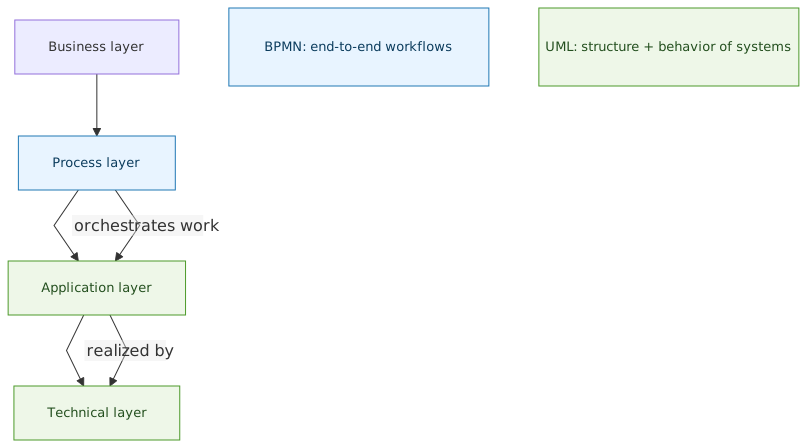
In real architecture work, UML and BPMN complement each other in four very practical ways.
1. They connect business capability design to solution design
Enterprise architecture is supposed to bridge strategy and implementation. That bridge is often weak because the artifacts do not line up.
You get a process deck from the business.
Then a solution architecture deck from IT.
Then an integration deck from middleware.
Then a security deck from IAM.
Then a cloud landing zone deck from infrastructure.
None of them tell a single coherent story.
BPMN helps define the business behavior of a capability. UML helps define the technical realization of that capability.
For example:
- BPMN shows the customer dispute resolution process in a bank
- UML shows the case system, payment platform, ledger integration, Kafka topics, IAM roles, and notification services that implement it
Now you can trace process steps to systems. That is architecture. Not just drawing, but traceability.
2. They expose broken ownership
One of the most valuable things a BPMN model does is reveal organizational confusion. Swimlanes do not lie.
If a process crosses six teams, three vendors, two approval boards, and four disconnected systems, that is not “enterprise complexity.” That is usually poor operating design wearing a suit.
Similarly, UML exposes technical ownership confusion. If five applications all manipulate customer status directly, and nobody owns the canonical customer state, you have an architecture problem, not just an integration problem.
Together, BPMN and UML show where ownership is fractured:
- process ownership
- data ownership
- service ownership
- decision ownership
- exception ownership
A lot of architecture pain is really ownership pain.
3. They make event-driven architecture understandable
This is especially relevant with Kafka.
Architects love saying “event-driven” because it sounds modern. Then they draw a few arrows around Kafka and act as if the architecture is complete. It is not.
BPMN helps answer:
- what business event matters?
- what process does it trigger?
- which path changes when the event arrives?
- what exception handling is needed if the event is late, duplicated, or missing?
UML helps answer:
- which services publish and consume?
- what interfaces and contracts exist?
- where is orchestration versus choreography?
- what are the dependencies and sequence interactions?
- how do cloud services and IAM controls fit into runtime behavior?
Without BPMN, event-driven design becomes technical theater.
Without UML, it becomes business theater.
4. They support governance without drowning in bureaucracy
I am not a fan of architecture governance that exists mainly to slow people down. A lot of review boards should be replaced by a checklist and a nap. ArchiMate for governance
But some governance is necessary, especially in regulated environments.
BPMN is useful for showing:
- control points
- approvals
- segregation of duties
- exception handling
- audit-relevant steps
UML is useful for showing:
- system boundaries
- trust boundaries
- integration paths
- IAM architecture
- deployment topology
- service dependencies
If you are in banking, and you cannot explain both the process control model and the technical implementation model, then your governance is mostly decorative. EA governance checklist
A real enterprise example: digital customer onboarding in a bank
Let’s ground this in something real enough to be useful.
Imagine a mid-sized bank modernizing customer onboarding for retail accounts. The current state is classic enterprise sprawl:
- web channel and mobile app built by separate teams
- legacy core banking platform
- external KYC and AML screening providers
- internal fraud engine
- IAM platform for customer identity and authentication
- Kafka introduced as the strategic event backbone
- some services in cloud, some still on-prem
- operations team handling exceptions manually in a case management tool
The leadership goal sounds simple: “Make onboarding faster and more digital.”
That sentence is where bad architecture begins, because it hides the actual complexity.
Step 1: BPMN to model the end-to-end process
A BPMN model would show something like:
- customer starts application through web or mobile
- identity is created or matched in IAM
- application data is validated
- KYC and AML checks are triggered
- fraud score is calculated
- if low risk and all checks pass, account creation proceeds automatically
- if medium or high risk, case is routed to manual review
- if application is incomplete, customer is asked for more documents
- once approved, account is created in core banking
- welcome notification is sent
- downstream event triggers CRM and analytics updates
This model is not just for business people. It reveals serious design questions:
- where does the process actually start?
- what is the system of record for application status?
- what happens when KYC returns asynchronously?
- who owns manual review?
- what is the timeout behavior?
- what if IAM identity exists but customer profile does not?
- which steps are legally required versus historical habits?
Those are architecture questions hiding inside process design.
Step 2: UML to model the technical realization
Now the UML view.
A component diagram might show:
- Channel Apps: Web, Mobile
- API Gateway
- Onboarding Service
- IAM Platform
- Document Service
- KYC Integration Service
- AML Integration Service
- Fraud Scoring Service
- Case Management System
- Core Banking Adapter
- Notification Service
- Kafka Cluster
- Customer Master
- Audit Service
A sequence diagram might show the happy path:
- Customer submits application via mobile app
- Mobile app calls Onboarding API through gateway
- Onboarding service calls IAM to create or link identity
- Onboarding service persists application state
- Onboarding service publishes
ApplicationSubmittedto Kafka - KYC and AML services consume event and perform checks
- Fraud service consumes event and returns risk result
- Aggregation logic updates application status
- If approved, onboarding service calls core banking adapter
- Account creation completes
AccountOpenedevent published to Kafka- Notification service sends welcome email/SMS
- CRM and analytics consume event downstream
Now we can see the actual architecture decisions:
- Is Kafka carrying business events or technical notifications?
- Is application state centralized or spread across services?
- Is IAM the source of truth for identity only, or also customer profile?
- Are KYC/AML integrations synchronous, asynchronous, or mixed?
- What is the retry and idempotency strategy?
- Which services run in cloud, and which remain near the core banking platform?
That level of clarity never comes from BPMN alone.
Step 3: Where the two models meet
This is the part architects often skip. They produce both diagrams, but they do not connect them.
That is a mistake.
For each major BPMN task or event, there should be a corresponding technical realization:
- Create identity → IAM platform + onboarding service integration
- Perform KYC/AML checks → external provider adapters + event handling logic
- Manual review → case management integration + human task ownership
- Create account → core banking adapter + transaction handling
- Notify customer → notification service + event subscription
That mapping matters because it exposes gaps.
For example, the BPMN process may show a manual review lane, but the UML model may reveal there is no proper case ownership service, only an email queue and a shared inbox. That is not a minor implementation detail. That is a broken architecture hidden behind a process box.
Step 4: Cloud and IAM implications
Now add cloud and IAM, because real enterprises do not get to ignore them.
Suppose the bank runs onboarding services, API gateway, and notification service in cloud, while core banking and some customer master functions remain on-prem. IAM is split: customer-facing identity in a modern cloud identity platform, workforce identity in a corporate directory.
This creates architecture concerns that BPMN and UML reveal differently:
BPMN reveals:
- where customer authentication matters in the process
- where employees enter manual review
- where approval authority changes by role
- where customer consent must be captured
UML reveals:
- trust boundaries between internet-facing channels and internal services
- token flows between IAM, API gateway, and services
- role mapping for operations users
- network path between cloud onboarding and on-prem core systems
- event publication and consumption boundaries around Kafka
Again: both views are needed. Otherwise security ends up bolted on after the fact, which is how many “digital transformation” projects quietly become incident response projects.
Common mistakes architects make
Let’s be honest. The problem is usually not UML or BPMN. The problem is how architects use them.
Mistake 1: Treating notation as the goal
If the conversation becomes “should we use UML or BPMN?” too early, the team is already drifting into methodology theater.
The question should be: what decision are we trying to enable?
Use the notation that makes the decision clearer.
Mistake 2: Modeling everything at one level
This is one of the worst habits in architecture.
Architects create a single diagram that mixes strategic process, application decomposition, interface design, and deployment detail. It satisfies no one.
Use levels:
- BPMN at capability or operational flow level
- UML component view at solution level
- UML sequence view for critical interactions
- deployment or trust-boundary view when runtime or security matters
Not every stakeholder needs every level.
Mistake 3: Ignoring exceptions
Happy-path architecture is fake architecture.
BPMN should show exception paths, manual intervention, retries, and alternate outcomes.
UML should show error interactions, timeout behavior, fallback patterns, and ownership.
If your model cannot explain what happens when Kafka is delayed, KYC fails, IAM is unavailable, or cloud connectivity to on-prem drops, then your model is decorative.
Mistake 4: Letting tools dictate thinking
Some repositories and modeling tools encourage overproduction. Suddenly there are hundreds of diagrams, all technically valid, none useful.
Good architecture models are not valuable because they are formal. They are valuable because they sharpen decision-making.
I would rather see three excellent, connected diagrams than forty stale ones in an enterprise repository nobody trusts.
Mistake 5: Separating business architecture and solution architecture too much
This is a political problem disguised as a process problem.
Business architects produce process models.
Solution architects produce system models.
Security architects produce control views.
Integration architects produce event flows.
Then everyone pretends these are all aligned because they use the same color palette.
They are often not aligned.
The architect’s job is not to protect modeling silos. The job is to create coherence across them.
A contrarian point: sometimes you should use neither
This may annoy notation purists, but it is true.
Sometimes a whiteboard sketch, a capability map, a context diagram, or a simple event storming session is a better starting point than a formal UML or BPMN model.
Why? Because early architecture work is often about discovery, not precision.
If the domain is unclear, forcing a team into notation too early can create false confidence. People start arguing about symbols instead of meaning.
So here is the contrarian view: do not worship UML or BPMN. Use them when the architecture is mature enough to benefit from precision, traceability, and communication discipline.
That said, once you move into enterprise decision-making, especially in regulated or large-scale environments, the lack of rigor catches up with you. At some point, the whiteboard has to become an architectural artifact. That is usually where UML and BPMN earn their keep.
How I’d use them in a real architecture engagement
If I were leading an architecture engagement for a bank modernizing onboarding, payments exceptions, or access governance, I would usually do something like this: architecture decision record template
Phase 1: Understand the operating reality
- workshop the process informally
- identify participants, systems, events, controls, and pain points
- capture where manual work exists
- identify IAM dependencies, Kafka usage, and cloud boundaries
Phase 2: Formalize the business flow in BPMN
- model the primary process
- model major exception paths
- identify control points and ownership
- validate with operations, compliance, and business teams
Phase 3: Formalize the technical realization in UML
- component diagram for solution structure
- sequence diagrams for critical flows
- deployment/trust-boundary view for cloud and IAM concerns
- domain model for key concepts if data ownership is messy
Phase 4: Map process to systems
- each BPMN task/event mapped to application/service responsibility
- identify gaps, duplicate logic, and ownership conflicts
- identify where Kafka events support process transitions
- identify where IAM decisions affect process access or identity lifecycle
Phase 5: Use the models to drive decisions
- simplify process
- rationalize services
- tighten ownership
- improve resilience
- define roadmap and transition states
That is the key point: the diagrams are not the outcome. The decisions are the outcome.
Practical guidance: when to reach for which
Here is the pragmatic rule set.
Use BPMN first when:
- the problem is operationally messy
- stakeholders disagree on how work actually happens
- compliance and exception handling matter
- there are many human and system handoffs
- you need to expose process bottlenecks or control failures
Use UML first when:
- the process is already understood
- the real problem is service decomposition
- integration design is the bottleneck
- event-driven interaction needs clarity
- cloud, IAM, or runtime topology are central concerns
Use both when:
- the business flow and technical realization are tightly coupled
- you are modernizing a regulated process
- there is significant manual-to-digital interaction
- you need traceability from business capability to implementation
- you are dealing with Kafka, IAM, and hybrid cloud in the same capability
Which, frankly, is a lot of enterprise work now.
Final thought
Good architects do not ask whether UML or BPMN is superior. They ask what kind of truth needs to be made visible.
That is the whole game.
BPMN makes operational truth visible:
how work moves, where it stalls, who decides, where controls apply, what happens when things go wrong.
UML makes technical truth visible:
what exists, who owns what, how services interact, where boundaries are, how the system behaves under the hood.
In enterprise architecture, these truths must meet. If they do not, you get one of two failures:
- elegant technical architecture that does not fit the business
- elegant process design that cannot be implemented cleanly
I have seen both. Neither is rare.
So yes, use UML.
Yes, use BPMN.
But more importantly, use them with intent, with discipline, and with enough honesty to model the ugly parts too.
Because in real enterprises, the ugly parts are usually where the architecture actually lives.
FAQ
1. Should enterprise architects learn both UML and BPMN?
Yes. Not necessarily every symbol in obsessive detail, but enough to use both confidently. If you can only model systems, you will miss operational reality. If you can only model processes, you will miss implementation risk.
2. Is BPMN only for business analysts?
No. That is an outdated and unhelpful view. BPMN is extremely useful for architects working on regulated flows, operational redesign, case management, IAM-heavy processes, and human-plus-system orchestration.
3. Can UML model business processes too?
Technically, to some extent, yes. Activity diagrams exist. But in enterprise settings, BPMN is usually better for end-to-end business process modeling, especially when participants, events, exceptions, and controls matter. UML can do it. BPMN usually does it better.
4. How do UML and BPMN help in event-driven architecture with Kafka?
BPMN helps define what business events mean in the process and what they trigger. UML helps define which services publish and consume those events, what the interaction patterns are, and where ownership and dependencies sit. You need both if you want event-driven architecture to be more than a buzzword.
5. What is the biggest mistake when using UML and BPMN together?
Failing to connect them. Teams often create a BPMN process model and a UML solution model, but never map process steps to system responsibilities. That gap is where misunderstandings, delivery drift, and governance failures start.
Frequently Asked Questions
What is the difference between UML and ArchiMate?
UML is a general-purpose modeling language primarily used for software design — class structures, sequences, components, states, deployments. ArchiMate is an enterprise architecture language covering business, application, and technology layers. They are complementary: ArchiMate for cross-domain EA views, UML for detailed software design.
When should you use ArchiMate instead of UML?
Use ArchiMate when you need to model cross-domain architecture (business capabilities linked to applications linked to infrastructure), traceability from strategy to implementation, or portfolio views for stakeholders. Use UML when you need detailed software design — class models, sequence interactions, state machines, component interfaces.
Can ArchiMate and UML be used together?
Yes. In Sparx EA, both exist in the same repository. ArchiMate models the enterprise landscape; UML models the internal design of specific application components. An ArchiMate Application Component can link to the UML class diagram that defines its internal structure, maintaining traceability across abstraction levels.