⏱ 21 min read
Most enterprise architecture teams say they “use UML,” but if you watch how they actually design systems, what they really use is a pile of boxes, arrows, and wishful thinking. UML modeling best practices
That’s the problem.
The UML metamodel sounds academic, almost annoyingly so. It gets dismissed as something for tool vendors, modeling purists, or architecture review boards that still think Rational Rose is coming back. But here’s the uncomfortable truth: if you design large systems without understanding the metamodel underneath UML, you usually end up with diagrams that look precise and communicate almost nothing. Worse, you make design decisions based on sloppy abstractions. And sloppy abstractions are how expensive enterprise mistakes happen. UML for microservices
This matters in real delivery. In banking, in IAM, in Kafka-heavy event platforms, in cloud migrations. Not because architects need to become UML theorists. They don’t. But because the metamodel defines what a modeling element actually is, what relationships are valid, what level of abstraction you’re working at, and where people accidentally mix business concepts, software components, runtime infrastructure, and implementation details into one unreadable mess.
So let’s say it simply, early:
The UML metamodel is the model behind the model.
It defines the types of things you can represent in UML—classes, components, deployments, interfaces, actors, use cases, relationships, behaviors—and the rules for how those things relate. If your architecture diagrams are inconsistent, ambiguous, or misleading, there is a good chance you are violating metamodel boundaries even if no one calls it that.
That’s the SEO-friendly version.
Now the real architect version: understanding the UML metamodel is less about drawing “correct UML” and more about preventing category errors in system design.
And category errors are everywhere.
The real issue: architects mix levels without noticing
In enterprise architecture work, the biggest modeling failure is not bad notation. It’s mixing abstraction levels in the same conversation and pretending that’s design.
You’ve seen this happen:
- a “component diagram” with Kafka topics, AWS accounts, customer personas, and microservices all on one page
- an IAM architecture where roles, groups, APIs, tokens, and legal entities are drawn as if they are the same kind of thing
- a banking integration diagram where “payments,” “payment service,” “payment event,” and “payment database” are connected by arrows with no distinction at all
People still nod and say, “looks good.”
It doesn’t look good. It looks familiar. That’s different.
The UML metamodel matters because it forces a discipline: what is this thing, exactly? Is it a business concept? An application component? A deployed runtime node? An interaction? A contract? A data structure? A behavior? A dependency? A realization?
If you don’t answer that, your design is soft in the middle. It may survive a steering committee. It won’t survive implementation.
What the UML metamodel actually is, without the textbook pain
At a practical level, the UML metamodel is the schema of UML itself.
Just like your enterprise data platform may have a schema defining what a Customer, Account, or Transaction means, UML has a schema defining what a Class, Component, Node, Artifact, Interface, Association, Dependency, UseCase, and Activity mean.
That gives you three things that matter in architecture work:
- Type discipline
Not every box is the same kind of box. Good. That’s the point.
- Relationship discipline
Not every line means the same thing. Dependency, association, realization, composition, communication path, deployment—they imply different design decisions.
- Abstraction discipline
UML separates concerns. Structural view, behavioral view, deployment view, interaction view. In real projects, this is not bureaucracy. It’s survival.
A lot of architects claim they don’t need UML because “we just need simple diagrams.” Fine. I’m sympathetic to that. Most enterprise diagrams should be simpler. But simplicity is not the same as imprecision. If your “simple diagram” collapses four different concerns into one visual soup, you didn’t simplify. You destroyed meaning.
That’s where metamodel thinking helps, even if you never mention the term in a meeting.
Why this matters in real architecture work
Real architecture is decision-making under constraints. The job is not to produce diagrams. The job is to reduce ambiguity so delivery teams can make good implementation choices.
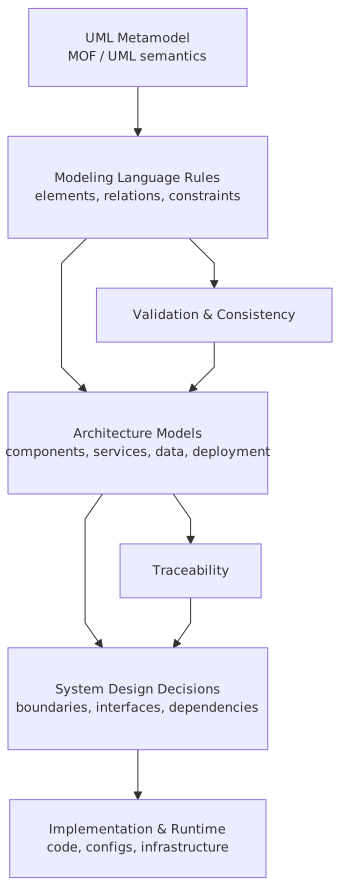
The UML metamodel impacts that in very concrete ways.
1. It helps separate logical architecture from physical architecture
This sounds basic, but many teams still fail here.
A logical component such as Customer Identity Service is not the same thing as:
- the Kubernetes deployment that hosts it
- the Kafka topics it publishes to
- the IAM policies controlling access to it
- the Terraform module that provisions it
- the Java package implementing it
These are related. They are not interchangeable.
When architects ignore that distinction, they create design artifacts that can’t answer basic questions:
- Is this a business capability or a deployable service?
- Is this dependency synchronous or asynchronous?
- Is this an API contract or a runtime connection?
- Is this environment-specific or platform-agnostic?
The metamodel gives you a mental guardrail. A component diagram is not a deployment diagram. A class is not a runtime node. An interface is not a business process. You can connect these views, but you should not blur them.
2. It exposes where your architecture is pretending to be more modular than it is
A classic enterprise anti-pattern is the fake component model.
Teams draw a clean diagram with six service boxes and nice interfaces. Then you discover:
- three services share the same database schema
- IAM rules are enforced inconsistently in each service
- Kafka topics expose internal data structures rather than stable event contracts
- one “shared library” contains half the business logic
- cloud networking makes two services effectively inseparable
The metamodel forces you to name relationships more honestly. If one thing depends on another implementation detail, that’s a dependency. If it owns lifecycle, that’s stronger. If it merely exposes a contract, that’s different. Those distinctions matter because they reveal coupling.
And enterprise architecture, if we’re honest, is mostly the management of coupling.
3. It makes cross-team communication less fragile
In large organizations, the real consumers of architecture are not just architects. They are delivery leads, platform engineers, IAM specialists, security teams, operations teams, auditors, and sometimes vendors who barely understand your context.
If your diagrams are semantically weak, everyone reads them differently.
That’s why one architect says “service,” another hears “container,” another hears “domain boundary,” and another hears “team ownership.” The metamodel gives a vocabulary for precision, even if lightly applied.
Not because everyone needs formal UML training. They don’t. But because architecture language needs stable meaning.
The contrarian view: most UML usage in enterprises is bad
Let me be blunt.
Most UML in enterprises fails for one of two reasons:
- it is too formal to be useful
- or too loose to be trustworthy
The first problem is old-school modeling theater. Teams spend weeks polishing class diagrams no one will ever use. They model every inheritance hierarchy and sequence message while the actual architecture risk is around IAM federation, Kafka replay behavior, or cloud network segmentation.
The second problem is now more common. Teams use “UML-ish” diagrams in Miro, Lucidchart, Draw.io, or PowerPoint, but they don’t maintain semantic discipline. Every shape is arbitrary. Every line means “some kind of thing happens.” Colors carry hidden meaning. Nothing is versioned. Nothing maps cleanly to implementation.
I’m not arguing for more UML ceremony.
I’m arguing for metamodel awareness with pragmatic modeling.
That is the sweet spot. Not academic purity. Not diagram chaos.
A practical way to think about the metamodel as an architect
You do not need to memorize the UML specification. Almost nobody should. What you need is a practical filter.
When creating or reviewing a design, ask these questions:
If a diagram can’t survive those five questions, it’s not architecture. It’s decoration.
How this plays out in banking architecture
Let’s use a realistic banking example.
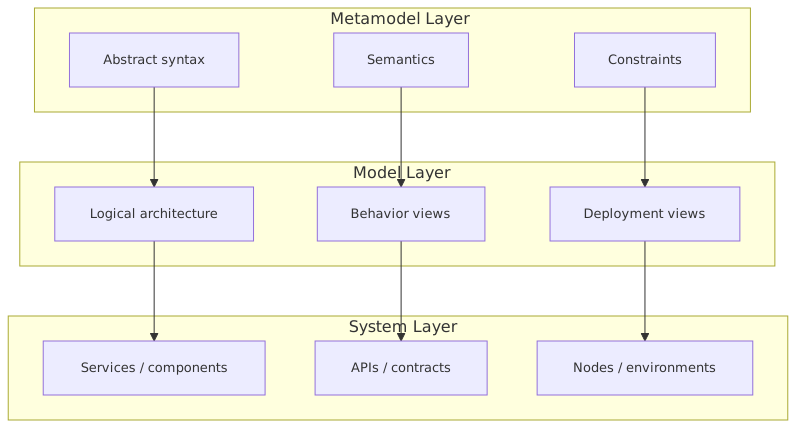
Imagine a retail bank modernizing its customer onboarding and account opening process. The target architecture includes:
- digital channels on web and mobile
- an IAM platform for customer authentication and consent
- Kafka for event-driven integration
- core banking systems still partly on-prem
- cloud-native services for onboarding workflows and risk checks
- fraud, AML, and KYC systems integrated across multiple domains
This is exactly the sort of environment where metamodel confusion causes damage.
What bad architecture looks like
A common architecture deck might show:
- “Mobile App”
- “Onboarding Service”
- “Kafka”
- “IAM”
- “Core Banking”
- “Fraud”
- “AWS”
- “Customer”
- “Database”
All connected with arrows.
This is useless.
Why? Because these elements are not of the same type.
- Customer is an actor or external participant.
- Onboarding Service is an application component.
- Kafka is middleware/platform infrastructure.
- IAM may be both a platform capability and a set of runtime services.
- AWS is a cloud provider context, not a system component.
- Database is a persistence technology, not a business capability.
- Core Banking may be a system boundary containing several subsystems.
- Fraud might refer to a business function, an application, or a decision service.
If you don’t distinguish these, you can’t make sound decisions about ownership, interfaces, failure modes, security boundaries, or deployment.
What better architecture looks like
A metamodel-aware architect would separate at least these views:
- Business interaction view
Customer starts onboarding, provides consent, identity is verified, account opening decision is made.
- Application/component view
Channel App, Onboarding Orchestrator, Identity Verification Service, Account Opening Service, Consent Service, Fraud Screening Service.
- Integration/event view
Commands, events, API calls, Kafka topics, schema ownership, retry patterns.
- Deployment/runtime view
Cloud VPCs, Kubernetes clusters, managed Kafka, IAM tenant, private connectivity to on-prem core banking.
- Security/IAM view
Authentication, token issuance, claims propagation, authorization decisions, privileged access boundaries, machine identities.
That sounds like more work. It is more work. But it is the right work.
Trying to collapse all of that into one “high-level diagram” is how architecture lies to itself.
Kafka is where weak metamodel thinking gets exposed fast
Kafka is a perfect example because teams often model it badly.
They treat Kafka as if it were:
- a generic integration arrow
- a queue
- a database
- an event bus
- a decoupling miracle
Usually all at once.
From a metamodel perspective, Kafka introduces at least three distinct concerns:
- platform/runtime element: the Kafka cluster or managed service
- logical integration contract: topics, schemas, event types, retention and ownership
- behavioral interaction: producer/consumer sequencing, retries, replay, idempotency, ordering assumptions
If you draw “Service A -> Kafka -> Service B” and stop there, you have hidden most of the architecture risk.
In banking, this becomes serious fast. Say the Onboarding Service publishes CustomerOnboarded. Fine. But what is that exactly?
- a business event?
- an internal technical event?
- a canonical enterprise event?
- a trigger for account provisioning?
- a durable audit artifact?
- a replayable source of truth?
Those are not the same.
The UML metamodel won’t answer those business questions for you. But metamodel discipline forces you to represent the element and its relationships in a way that reveals the question instead of hiding it.
That’s the point.
Common Kafka architecture mistake
Architects often model topics as if they were interfaces between bounded services. Sometimes they are. Sometimes they are not.
A topic can be:
- a contract boundary
- a broadcast mechanism
- a temporary integration convenience
- a leakage of internal domain state
If you don’t model the semantics explicitly, teams over-couple through events while congratulating themselves for being asynchronous.
That’s one of my favorite enterprise delusions: “We’re decoupled because we use Kafka.”
No. You may simply be asynchronously coupled.
IAM architecture suffers even more from sloppy modeling
IAM is where category mistakes become security mistakes.
In enterprise diagrams, I often see these drawn as equivalent objects:
- user
- role
- group
- token
- policy
- application
- identity provider
- service account
- permission
That is a disaster waiting to happen.
These are different kinds of elements with different lifecycles and semantics. If you don’t model them clearly, you get bad authorization design, poor federation decisions, and impossible audit trails.
A real-world banking IAM scenario
Consider a bank with:
- customer identities for retail users
- workforce identities for employees and contractors
- machine identities for services
- third-party fintech access via OAuth2/OpenID Connect
- internal admin access to cloud and core systems
- regional regulatory constraints on data and access
Now imagine the architecture team creates one “IAM box” on the diagram and claims identity is covered.
It isn’t.
A metamodel-aware approach separates:
- actors/principals: customer, employee, service account, partner client
- identity providers: customer CIAM, workforce IdP, federation broker
- credentials/tokens: sessions, JWTs, refresh tokens, certificates
- authorization constructs: roles, scopes, claims, policies, entitlements
- protected resources: APIs, Kafka topics, admin consoles, databases
- runtime enforcement points: API gateways, service mesh, application logic, cloud IAM, broker ACLs
This is not notation obsession. It’s operational reality.
If you don’t distinguish these, you will eventually design authorization in the wrong place. Usually everywhere.
And that leads to policy drift, duplicate logic, broken least privilege, and expensive audit remediation.
Cloud architecture makes the metamodel even more important
Cloud environments tempt architects into infrastructure-first diagrams. You get boxes for VPCs, subnets, clusters, serverless functions, managed Kafka, IAM roles, load balancers, secrets managers. Useful, sure. But if that becomes the main architecture view, the system design gets warped around deployment mechanics.
Again, the metamodel helps because it reminds you that deployment elements are not the same as application elements.
A service may be deployed as:
- a container on Kubernetes
- a Lambda function
- an ECS task
- a VM-hosted process
That deployment choice matters. But it does not redefine the business responsibility of the service.
Architects who skip this distinction often produce cloud-native designs that are operationally elegant and functionally confused. cloud architecture guide
I’ve seen onboarding domains split into six microservices not because the domain required it, but because the cloud platform template encouraged it. The result: over-distributed workflows, fragmented IAM enforcement, too many Kafka topics, and miserable support overhead.
That’s not architecture maturity. That’s platform-driven decomposition without semantic control.
Common mistakes architects make when they ignore the metamodel
Let’s make this concrete.
1. Treating every box as a “component”
This is probably the most common mistake. Business capabilities, applications, modules, topics, teams, and infrastructure all become “components.”
Result:
- ownership ambiguity
- bad dependency reasoning
- impossible traceability from design to implementation
2. Using arrows with no defined meaning
Arrow inflation is real.
An arrow might mean:
- API invocation
- event publication
- deployment
- data replication
- control dependency
- trust relationship
- ownership
- sequence
If you don’t define it, people infer whatever they want.
3. Mixing logical and physical views
This creates fake understanding. The audience leaves thinking they’ve seen the architecture, but they’ve really seen an unresolved blend of application design and infrastructure layout.
4. Modeling technology products as architecture responsibilities
“Kafka handles decoupling.”
“IAM handles authorization.”
“AWS handles resilience.”
No. Technologies support responsibilities. They do not replace architectural decisions.
5. Confusing data structures with contracts
A JSON payload is not automatically an interface contract. A Kafka schema is not automatically a business event model. A token claim is not automatically an entitlement strategy.
6. Ignoring behavior
Many architecture diagrams are structural only. They show boxes and connections, but not sequencing, failure handling, retries, compensations, token propagation, or eventual consistency.
In distributed banking systems, this is where most real risk lives.
A real enterprise example: customer onboarding in a bank
Let’s walk through a realistic architecture scenario and see how metamodel thinking changes the design.
The context
A bank wants to modernize onboarding for new retail customers. Current process is fragmented across:
- mobile and web channels
- legacy customer master
- KYC/AML vendor integrations
- document verification
- fraud scoring
- account opening in core banking
- customer notification
- downstream CRM and analytics
The target architecture uses:
- cloud-native services in AWS
- managed Kafka for events
- centralized IAM with customer identity and workforce federation
- API gateway for channels and partners
- gradual coexistence with on-prem core banking
The naive design
The first draft usually looks something like this:
Customer -> Mobile App -> API Gateway -> Onboarding Service -> Kafka -> Core Banking / Fraud / CRM / Notification
IAM is shown as a side box. AWS is shown as the outer box. cloud architecture patterns
This is not wrong, exactly. It’s just not enough to drive delivery.
The metamodel-aware redesign
A stronger design would separate the architecture into meaningful elements and relationships.
Application components
- Channel Experience API
- Onboarding Orchestrator
- Identity Proofing Service
- Consent Service
- Fraud Decision Service
- Account Provisioning Service
- Notification Service
- Customer Profile Service
Interfaces and contracts
- REST APIs for channel interactions
- OAuth2/OIDC contracts for authentication and access tokens
- Kafka event contracts for state transitions:
- OnboardingStarted
- IdentityVerified
- FraudCheckCompleted
- AccountOpened
- ConsentRecorded
Runtime/deployment elements
- AWS EKS cluster
- Managed Kafka cluster
- IAM tenant / identity provider
- API gateway
- secure connectivity to on-prem core banking
- secrets management and certificate authority
Behavioral views
- onboarding happy path
- identity verification failure path
- fraud review manual intervention path
- replay/recovery for account provisioning event failure
- token exchange and claims propagation across services
Security model
- customer authenticates via CIAM
- channel receives access token with scoped claims
- API gateway validates token
- services use machine identity for service-to-service auth
- Kafka ACLs restrict producer/consumer access by service identity
- workforce admin actions are federated separately from customer flows
Now we are doing architecture.
Why this matters
With this clearer metamodel-driven separation, the team can answer real questions:
- Which service owns the
AccountOpenedevent contract? - Is Fraud Decision synchronous or asynchronous?
- What happens if Core Banking account creation succeeds but notification fails?
- Which claims are propagated from customer identity to downstream services?
- Are Kafka topics domain contracts or internal workflow events?
- Where is authorization enforced for administrative override?
- What can be deployed independently, and what only appears independent on slides?
Those are architecture questions. The first diagram doesn’t answer them. The second one starts to.
The hidden value: traceability of decisions
One thing the UML metamodel quietly improves is traceability.
In enterprise work, architecture decisions often die because no one can connect:
- business need
- application design
- interface contract
- runtime deployment
- security control
- operational behavior
Metamodel-aware modeling gives you a chain.
For example:
- Business requirement: customer onboarding must complete in under 5 minutes
- Behavioral implication: fraud check cannot always be batch-only
- Application implication: orchestrator requires timeout and escalation path
- Integration implication: Kafka event processing cannot be assumed immediate for customer-facing completion
- IAM implication: customer session and consent context must survive async transitions appropriately
- Deployment implication: regional cloud deployment and connectivity to core banking must support latency target
That’s architecture coherence. And yes, the metamodel helps because it keeps each concern represented in its proper form.
You do not need “full UML,” but you do need modeling discipline
This is where I’ll take the contrarian middle path.
You do not need exhaustive UML compliance in most enterprise programs. In fact, forcing teams into rigid notation often backfires. It slows down communication and creates performative modeling.
But you absolutely do need:
- consistent element types
- explicit relationship semantics
- separation of abstraction levels
- a small number of purposeful views
- traceability between views
- just enough notation rigor that diagrams mean the same thing to different people
That is basically metamodel thinking, whether you call it that or not.
The architects who say “notation doesn’t matter” are usually the same ones who produce diagrams no one can implement confidently.
Notation matters less than semantics. But semantics still have to show up somewhere. The metamodel is where that discipline comes from.
A practical operating model for architects
If you want this to work in a real enterprise, don’t launch a UML education campaign. Nobody wants that.
Do this instead:
1. Standardize a small set of architecture views
For example:
- business context view
- application/component view
- integration/event view
- deployment/runtime view
- security/IAM view
2. Define element types for each view
Keep it lightweight. Maybe 6–10 element types max per view.
3. Define relationship meanings
If an arrow means API call, event publication, trust, deployment, or dependency, say so.
4. Ban mixed-level diagrams in formal reviews
If a diagram mixes business actors, Kafka topics, AWS accounts, and code modules without explicit structure, send it back.
5. Tie diagrams to decision records
A diagram without an architectural decision behind it is often just architecture art.
This approach works better than arguing about UML purity. It gets the benefit of the metamodel without turning your team into notation police.
Final thought
The UML metamodel is not important because UML is sacred. It’s important because enterprises are full of semantic confusion, and semantic confusion creates bad systems.
In banking, that means onboarding flows that can’t be audited.
In Kafka platforms, it means event-driven coupling nobody notices until replay day.
In IAM, it means security models that collapse under real-world federation and authorization needs.
In cloud programs, it means deployment diagrams pretending to be architecture.
A good architect does not worship diagrams. A good architect uses models to force better thinking.
That’s why the UML metamodel still matters. Not as a relic. As a discipline.
And honestly, in an era where everyone draws architecture in whatever tool is open and calls it “high level,” we probably need that discipline more than ever.
FAQ
1. Do enterprise architects really need to learn the UML metamodel?
Not in full detail. But they do need to understand the idea that model elements have types, relationships have meaning, and views should stay at a consistent abstraction level. That alone improves architecture quality a lot.
2. Isn’t UML outdated compared to C4, ArchiMate, or cloud-native diagrams?
Parts of UML are overused or misused, yes. But the metamodel concept is still highly relevant. Even if you use C4 or ArchiMate, the same discipline applies: know what kind of thing you are modeling and what the relationship actually means. ArchiMate layers explained
3. How does this help with Kafka-based architectures?
It helps distinguish platform components, event contracts, and runtime interactions. That prevents teams from treating Kafka as a magical decoupling layer and forces clearer thinking about ownership, schema design, replay, and coupling.
4. What is the biggest modeling mistake in IAM architecture?
Treating identities, roles, tokens, policies, and systems as if they are equivalent objects. They are different elements with different lifecycles. If you don’t model them distinctly, authorization design becomes inconsistent and audit becomes painful.
5. How many UML-style views should an enterprise architecture team maintain?
Usually four to six is enough for most programs: context, component, integration, deployment, and security views. More than that often becomes overhead. Fewer than that often hides important architectural risk.
Frequently Asked Questions
What is a UML metamodel?
A UML metamodel is a model that defines UML itself — it specifies what element types exist (Class, Interface, Association, etc.), what relationships are valid between them, and what constraints apply. It uses the Meta Object Facility (MOF) standard, meaning UML is defined using the same modeling concepts it uses to define other systems.
Why does the UML metamodel matter for enterprise architects?
The UML metamodel determines what is and isn't expressible in UML models. Understanding it helps architects choose the right diagram types, apply constraints correctly, use UML profiles to extend the language for specific domains, and validate that models are internally consistent.
How does the UML metamodel relate to Sparx EA?
Sparx EA implements the UML metamodel — every element type, relationship type, and constraint in Sparx EA corresponds to a metamodel definition. Architects can extend it through UML profiles and MDG Technologies, adding domain-specific stereotypes and tagged values while staying within the formal metamodel structure.