⏱ 19 min read
Most enterprise architecture work is far too polite about models.
We draw UML diagrams, we publish metamodels, we standardize viewpoints, and then we act surprised when none of it behaves coherently once real systems start moving. The usual problem is not that the diagrams are “wrong.” It’s that they are shallow. They describe shapes, not transformations. They capture nouns, not structure-preserving change. And in modern enterprises—especially banks running event streams, IAM controls, and multi-cloud platforms—that is exactly why architecture repositories become expensive wallpaper.
Here’s the blunt version: if you treat a UML metamodel as just a taxonomy of boxes and lines, you are leaving serious analytical power on the table. Category theory gives a better interpretation. Not because architects need to become mathematicians. They don’t. But because category theory forces you to ask the question that matters in real architecture work: what must remain true when models are translated, decomposed, federated, automated, or implemented?
That is the practical value.
And yes, this can sound academic. It often gets presented in a way that scares off sensible practitioners. That’s a mistake. The useful idea is actually simple.
The simple explanation
A UML metamodel defines the kinds of things that may appear in a UML model and the relationships between them. In plain English, it is the model of the modeling language.
Category theory, in equally plain English, is about structures and mappings that preserve meaning.
Put those together and you get a practical interpretation:
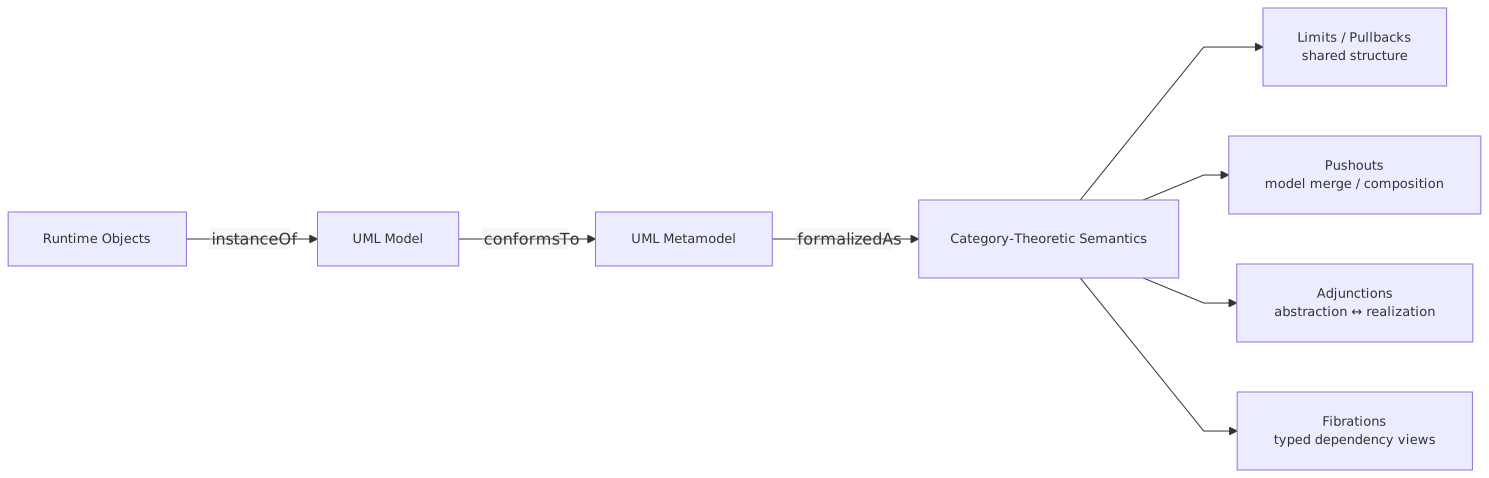
- a UML metamodel can be seen as a structured universe of model elements
- a UML model is an instance living inside that universe
- transformations between models are not just file conversions; they are mappings that should preserve key architectural relationships
- composition matters more than isolated diagrams
That’s the SEO-friendly summary, and honestly, for many architects, it is enough to improve their work.
If your application landscape model gets transformed into a deployment model, a Kafka topic design, an IAM policy model, or a cloud landing zone specification, then the question is not “did the tool export successfully?” The question is: did the transformation preserve the architectural invariants we actually care about?
That is a category-theoretic question, whether you use the phrase or not.
Why this matters more than most architects admit
Enterprise architecture today is not mostly about documentation. It is about translation across domains:
- business capability maps into services
- services map into APIs and events
- events map into Kafka topics and schemas
- applications map into IAM roles and trust boundaries
- systems map into cloud accounts, VPCs, policies, observability rules, and deployment pipelines
Every one of those steps is a model transformation.
And this is where standard UML practice starts to creak. UML is decent at expressing static structure and some behavior. But enterprise architecture work is full of cross-model consistency obligations. A customer onboarding service is not just a class diagram. It is also:
- a producer of KYC events
- a subject of IAM permissions
- a participant in segregation-of-duties control
- a workload in a cloud security boundary
- a source of audit evidence
If your metamodel cannot help you reason about those mappings, then it’s not architecture. It’s drawing.
That’s my first strong opinion: architecture metamodels should be judged by how well they support transformation and constraint preservation, not by how elegant they look in a repository tool.
A lot of enterprise repositories are beautiful graveyards.
UML metamodels, interpreted properly
Let’s make this concrete.
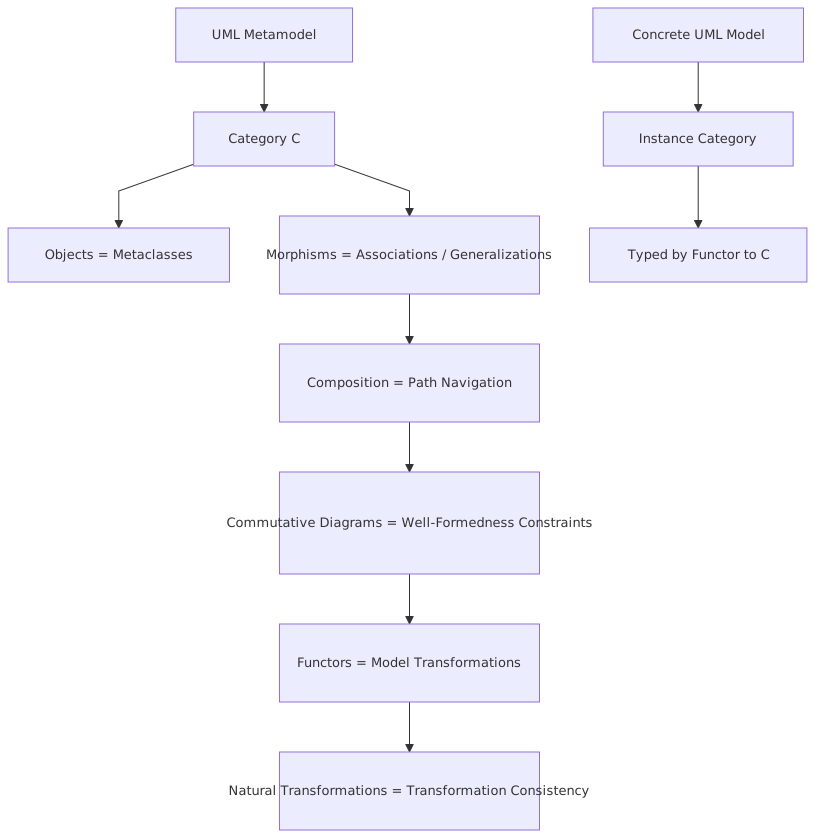
A UML metamodel defines concepts like Class, Association, Component, Interface, State, Activity, Dependency, and so on. In the OMG sense, it sits above the model instances. Fine.
Now, category-theoretically, you can read this as a structure where:
- objects correspond to model element types or model instances, depending on level of abstraction
- morphisms correspond to typed relationships, transformations, derivations, or refinement steps
- composition means if one transformation takes you from business model to service model, and another takes you from service model to deployment model, the combined transformation should be meaningful and traceable
- identity means a model element should preserve its essential role under self-mapping and controlled projection
- functors are a useful way to think about mappings between modeling domains that preserve structure
- natural transformations become relevant when there are multiple valid ways to transform one model into another and you need to reason about consistency between those paths
You do not need to write this in Greek letters in a steering committee paper. Please don’t. But if you understand it, your architecture decisions get sharper.
A UML metamodel is not just a schema. It is a space of valid architectural statements. Category theory helps you ask whether those statements survive movement.
That matters because enterprises do not have one model. They have dozens:
- capability models
- process models
- application portfolios
- event taxonomies
- IAM role models
- cloud reference architectures
- data lineage maps
- control frameworks
The hard part is not creating each one. The hard part is ensuring they do not contradict each other.
The key architectural idea: preserve invariants, not notation
This is where many architects get distracted by syntax. They obsess over whether UML is the right notation, whether ArchiMate is cleaner, whether BPMN should own process semantics, whether C4 is more readable. Those are not useless debates, but they are often secondary. ArchiMate modeling guide
The more important question is: what invariants are preserved across the architectural chain?
Examples of invariants in enterprise work:
- a service that processes regulated customer data must remain within approved trust boundaries
- event ownership must remain aligned with bounded context ownership
- IAM privileges must not expand beyond the accountability model defined at business level
- deployment segmentation must preserve the intended separation of production and non-production control planes
- auditability must survive decomposition into asynchronous processing
These are not drawing concerns. These are preservation concerns.
Category theory gives a disciplined way to think about preservation. UML metamodels give a formalized vocabulary. The combination is useful because it lets architects move from “I modeled it” to “I can reason about what remains true when this is implemented differently.” UML modeling best practices
That is a much more serious profession.
A practical interpretation for enterprise architects
Let me simplify the interpretation into language architects can actually use in delivery work.
That table is more useful to practitioners than most theory-heavy papers. Because once you see it this way, a lot of bad architecture habits become obvious.
Common mistakes architects make
There are several. Some are widespread enough to qualify as industry rituals.
1. Treating the metamodel as a glossary
This is the classic repository failure. Teams spend months defining what an “application service” is versus a “business service” versus a “platform service,” and yet they never define valid transformations between them.
So the metamodel becomes a dictionary, not a reasoning tool.
Result:
- lots of governance meetings
- very little analytical power
- endless debates about labels
- no trustworthy traceability into implementation
A metamodel that does not constrain transformation is weak. Full stop.
2. Confusing traceability with semantics
Architects love traceability matrices. They are often fake rigor.
A line saying “Application X supports Capability Y” is not enough. What kind of support? Under what constraints? Through what transformation? What properties must be preserved if the application is decomposed into event-driven services on Kafka?
Without semantics, traceability is just administrative string. TOGAF roadmap template
3. Modeling static structure while ignoring composition
This is particularly painful in cloud and event-driven architecture. Teams draw neat component diagrams, but they do not model the composition of runtime interactions, control boundaries, and policy derivation.
In a Kafka-centric bank, for example, the key issue is rarely “does Service A publish Topic B?” The issue is whether:
- topic ownership aligns with domain ownership
- schema evolution preserves downstream contracts
- IAM access to topics respects legal entity boundaries
- replay behavior does not violate business process assumptions
- audit evidence remains reconstructable
That is composition. Not just connectivity.
4. Assuming implementation tools preserve architecture automatically
They don’t. Terraform does not preserve your architecture. Kubernetes does not preserve your architecture. IAM policy generators definitely do not preserve your architecture.
They instantiate something. Whether that something is faithful depends on the transformation logic and constraints.
This is why category-theoretic thinking is useful. It makes you suspicious, in the healthy sense. It asks: what exactly is preserved by this mapping?
Often the answer is “less than we thought.”
5. Building one giant enterprise metamodel
This is a very enterprise move. Someone decides the answer is a universal metamodel that covers business, data, applications, security, cloud, integration, controls, risk, and vendors in one majestic ontology.
It collapses under its own vanity.
Contrarian thought: most enterprises do not need one grand metamodel. They need a federation of smaller metamodels with explicit mappings between them. Category theory is actually friendlier to this modular view than traditional central-repository thinking. It values relationships and composition, not imperial taxonomy.
That is a healthier operating model.
A real enterprise example: banking, Kafka, IAM, and cloud
Let’s take a realistic case.
A retail bank is modernizing customer onboarding. Historically, onboarding lived in a monolithic core workflow platform. The target architecture breaks it into domain services:
- Customer Profile
- KYC Verification
- Document Intake
- Risk Screening
- Account Opening
- Notification
The bank adopts Kafka for event streaming, cloud-native deployment for new services, and centralized IAM integrated with cloud roles and enterprise identity.
This is where most architecture teams start producing five disconnected documents:
- business process model
- application component diagram
- integration topic catalog
- IAM role matrix
- cloud landing zone design
Each document is decent. Together they are inconsistent.
What goes wrong in practice
Here’s the common failure pattern:
- The process model says KYC Verification is a controlled step requiring strict auditability.
- The application model shows KYC as a service used by several channels.
- The Kafka design introduces
customer.onboarding.updatedas a broad topic with multiple producers. - The IAM design grants a shared platform role read access to all onboarding topics “for operational flexibility.”
- The cloud deployment model places dev and test analytics consumers in a shared observability account with mirrored topic access.
On paper, each local decision is defendable. Together, the architecture has violated its own invariants:
- ownership of onboarding state is now ambiguous
- topic design no longer reflects bounded context responsibilities
- least privilege is broken
- audit reconstruction is harder because state changes are spread across generic events
- environment segregation is weakened
This is exactly the kind of issue category-theoretic interpretation helps expose.
Reading the situation through UML metamodels and structure-preserving mappings
Suppose your UML metamodel includes:
- Components for services
- Interfaces for service contracts
- Events as stereotyped information artifacts
- Dependencies and realizations
- Deployment nodes
- Security roles and access relationships as extensions or linked metamodel elements
Now define mappings:
- business task → application service responsibility
- application service → event ownership
- event ownership → Kafka topic authority
- service responsibility → IAM principal and policy scope
- environment classification → deployment boundary constraints
The critical thing is not just having these mappings. It is ensuring they preserve the intended semantics.
For example:
Invariant 1: single accountable owner for regulated onboarding state transitions
If the business model assigns KYC decision authority to KYC Verification, then the event model should not allow three unrelated services to publish authoritative KYC state changes.
Invariant 2: least privilege derived from responsibility
If Document Intake has no responsibility for Risk Screening outcomes, then its IAM role should not consume sensitive risk events by default just because they share a Kafka cluster.
Invariant 3: deployment boundary preserves regulatory separation
If production regulated data must remain in a restricted cloud account boundary, then observability tooling and replay consumers cannot casually bypass that through mirrored streams.
These are preservation questions. The UML metamodel gives the formal types. Category-theoretic interpretation gives the discipline to ask whether the mappings preserve architecture. UML for microservices
What a better architecture looks like
In a stronger design:
kyc.verification.completedis owned solely by KYC Verificationrisk.screening.completedis owned solely by Risk Screening- a derived onboarding progress event exists, but is explicitly non-authoritative
- IAM policies are generated from service ownership and topic classification, not from generic team membership
- cloud account boundaries reflect data classification and legal controls, not just team convenience
- traceability links are not free-form; they are typed and constrained
That is the practical payoff. Better models lead to fewer governance surprises later. architecture decision records
Why Kafka makes this issue impossible to ignore
Kafka is useful here because it punishes vague architecture.
In synchronous systems, you can hide semantic confusion behind APIs for a while. In event-driven systems, every ambiguity spreads:
- who owns the fact?
- what event is authoritative?
- what is merely a projection?
- what can be replayed?
- what is immutable?
- who may consume what?
- what schema changes are lawful?
These are not only integration questions. They are metamodel questions.
A category-theoretic reading helps because it forces distinction between:
- the source domain model
- the event representation
- the consumer projection
- the operational deployment model
- the access-control model
Architects who flatten these into one “integration view” usually create a mess. Different domains have different structures. The mapping between them matters more than any single diagram.
IAM is where weak metamodels become dangerous
If Kafka exposes ambiguity, IAM weaponizes it.
Many architects still treat IAM as an implementation detail owned by security engineers. That is naive. IAM is an architectural semantics engine. It decides which modeled relationships are actually executable in the enterprise.
If your metamodel says Service A depends on Event B, and your IAM model grants broad wildcard access to every service in the domain, then your implemented architecture no longer reflects your conceptual architecture. The mapping failed to preserve least privilege and accountability.
That is not a small issue. In a bank, it becomes an audit issue, an operational issue, and potentially a regulatory one.
A useful architecture practice is to model IAM not as an afterthought but as a first-class codomain of architectural transformation. In other words:
- service responsibilities should map to principals
- data classifications should map to policy constraints
- environment types should map to trust boundaries
- event ownership should map to publish/consume permissions
This is where category theory is practical, not decorative. It says: if these mappings do not preserve the intended structure, then your architecture is inconsistent, even if every local diagram looks valid.
Cloud architecture and the myth of neutral deployment
Another contrarian view: cloud is not a neutral hosting layer. It changes the architecture because it introduces its own category of objects and morphisms—accounts, networks, roles, policies, regions, services, pipelines, keys, logs, private endpoints, and so on.
If your UML metamodel stops at application components and deployment nodes in a generic sense, you will miss the meaningful transformations into cloud control structures.
For example, mapping an application component to “runs on Kubernetes” is too weak. Real architecture needs to preserve:
- blast radius boundaries
- operational ownership
- data residency
- identity trust chains
- encryption responsibilities
- observability scope
- recovery topology
A cloud deployment model is not just a lower-level technical view. It is another structured domain. If you do not model the mapping carefully, your enterprise standards become fiction.
I have seen banks with pristine target-state diagrams that claimed strict domain isolation, while in AWS or Azure the actual IAM trust model allowed broad cross-account assumptions for “temporary operational reasons.” Temporary, of course, means three years.
Again, the issue is preservation.
How to apply this in real architecture work
Let’s keep this grounded. You do not need a research program. You need a few disciplined habits.
1. Define invariants before defining views
Before drawing anything, write down what must remain true across transformations.
Examples:
- authoritative business events have one accountable owner
- regulated data access must be derivable from explicit business responsibility
- production and non-production control paths must remain segregated
- customer identity lifecycle changes must be auditable end to end
This step is more valuable than choosing notation.
2. Treat each architecture view as a domain with explicit mappings
Do not assume that your business, application, event, IAM, and cloud views naturally align.
State the mappings:
- capability to service
- service to event
- event to topic
- service to principal
- principal to policy
- service to deployment boundary
Then ask what each mapping preserves.
3. Type your traceability relationships
“Related to” is not architecture.
Use stronger relationship types:
- realizes
- owns
- publishes
- consumes
- constrained by
- deployed within
- delegated to
- derived from
If your repository tool cannot support typed relationships and validation, it is not helping enough.
4. Federate your metamodels
Keep separate but connected metamodels for:
- business semantics
- application/service structure
- event and data contracts
- IAM and control policy
- cloud/runtime topology
This is more maintainable than one giant enterprise ontology. The value lies in the mappings.
5. Review transformations, not just diagrams
Architecture review boards often inspect diagrams and standards. They should inspect transformations:
- how does a service design produce Kafka topics?
- how does domain ownership produce IAM policy?
- how does data classification produce deployment constraints?
- how does process criticality produce resilience patterns?
This is where architecture either becomes operationally real or remains decorative.
A concise anti-pattern checklist
Here is the ugly truth: if you see these, your metamodel practice is probably weaker than you think.
The uncomfortable truth about UML
Now a contrarian note that some people won’t enjoy: UML is not sacred, and in many enterprise contexts it is not even the best front-end notation. It is often too broad, occasionally too fussy, and badly used more often than well used.
But the metamodel idea behind UML is still valuable. Very valuable.
The point is not “use UML everywhere.” The point is: think metamodel-first and transformation-first. UML provides a mature formal basis for that thinking, especially if you extend it sensibly and avoid notation theater.
Some architects cling to UML as if standard notation alone creates rigor. It doesn’t. Others reject UML entirely because they associate it with dead documentation. That’s also lazy. The right position is more pragmatic:
- use whatever notation teams can read
- define metamodel semantics clearly
- validate transformations between model domains
- preserve the invariants that matter to the enterprise
That is architecture with teeth.
Final thought
If you remember only one thing, remember this:
A UML metamodel interpreted through category theory is not an academic curiosity. It is a practical way to reason about whether architecture survives translation into real systems.
In enterprises, especially banks, translation is the whole game. Business intent gets translated into services, events, IAM, cloud boundaries, controls, and evidence. If those transformations are weak, your architecture is weak no matter how polished the diagrams look.
And frankly, this is where the profession needs to grow up a bit. We have spent too long treating architecture models as communication artifacts only. They are also constraint systems. They should help us detect when structure, ownership, privilege, and accountability drift apart.
Because once Kafka topics are proliferating, IAM roles are multiplying, and cloud platforms are scaling across domains, drift is not a theoretical risk. It is the default outcome.
Category theory helps because it gives us a language for disciplined skepticism: what is the mapping, what is preserved, and what breaks when composition happens?
That is a better question than “which box color should platform services use?”
FAQ
1. Do enterprise architects really need to learn category theory?
Not deeply, no. You do not need formal proofs. But you do need the mindset: structure, mappings, composition, and preservation. Even a light understanding improves model quality and review rigor.
2. Is UML still worth using for enterprise architecture?
Yes, but selectively. UML is useful when you care about metamodel precision and model transformation. It is less useful when teams need quick, lightweight communication only. Use it where formal structure matters; don’t turn it into ceremony.
3. How does this help with Kafka-based architectures?
It helps you distinguish authoritative events from derived views, align topic ownership with domain ownership, and ensure that schema, access, and replay semantics preserve business meaning instead of distorting it.
4. What is the biggest mistake in applying this to IAM?
Treating IAM as an implementation afterthought. IAM should be derived from architectural responsibility and data sensitivity. If permissions are designed separately from service semantics, least privilege and accountability usually collapse.
5. Should we build one enterprise metamodel for everything?
Usually no. A federated set of metamodels with explicit mappings is more realistic and more maintainable. The enterprise challenge is not total unification. It is coherent transformation across domains.
Frequently Asked Questions
What is a UML metamodel?
A UML metamodel is a model that defines UML itself — it specifies what element types exist (Class, Interface, Association, etc.), what relationships are valid between them, and what constraints apply. It uses the Meta Object Facility (MOF) standard, meaning UML is defined using the same modeling concepts it uses to define other systems.
Why does the UML metamodel matter for enterprise architects?
The UML metamodel determines what is and isn't expressible in UML models. Understanding it helps architects choose the right diagram types, apply constraints correctly, use UML profiles to extend the language for specific domains, and validate that models are internally consistent.
How does the UML metamodel relate to Sparx EA?
Sparx EA implements the UML metamodel — every element type, relationship type, and constraint in Sparx EA corresponds to a metamodel definition. Architects can extend it through UML profiles and MDG Technologies, adding domain-specific stereotypes and tagged values while staying within the formal metamodel structure.