⏱ 21 min read
Introduction
The UML metamodel matters because it tells you what a modeling element is, not just how it looks. Ignore that distinction and architecture models become decorated PowerPoint: tidy, even persuasive, but unreliable across teams, tools, and time.
That is the real issue. Not notation. Not whether a component has the right icon. The issue is ontology: what kinds of things exist in the model, how they relate, what constraints apply, and what can be inferred. Syntax is only the visible skin.
Much enterprise architecture never gets this far. Teams produce UML-like diagrams, call them “logical views” or “solution designs,” and move on. Under deadline pressure, that is understandable. But when decisions become expensive—identity boundaries, event ownership, cloud tenancy, service decomposition, regulatory traceability—the hidden semantics matter a great deal.
The UML metamodel is often treated as a tooling detail. That is a mistake. It is the semantic backbone that lets a model represent more than shapes. If you care about consistency between business capability maps, application portfolios, IAM policies, Kafka event taxonomies, and deployment topologies, then you are already in ontological territory. ArchiMate capability map
“Ontology” sounds academic, but in practice it just means being precise about what sort of thing you are talking about. Is “Customer” a business concept, a data entity, an IAM subject, a Kafka event payload, or a bounded context? Those are not interchangeable. Architects blur them constantly, then wonder why integration gets ugly.
This article is about the foundations beneath UML’s metamodel: what it assumes exists, how meaning is carried, where semantics live beyond syntax, and why this matters in real architecture work. UML modeling best practices
UML is not the diagrams
Most people meet UML as a set of diagram types: class, sequence, component, deployment, and so on. That view is incomplete. UML is a modeling language whose notation is only one layer. Underneath sits the metamodel: a formal description of the kinds of modeling elements that can exist and the legal relationships among them. UML for microservices
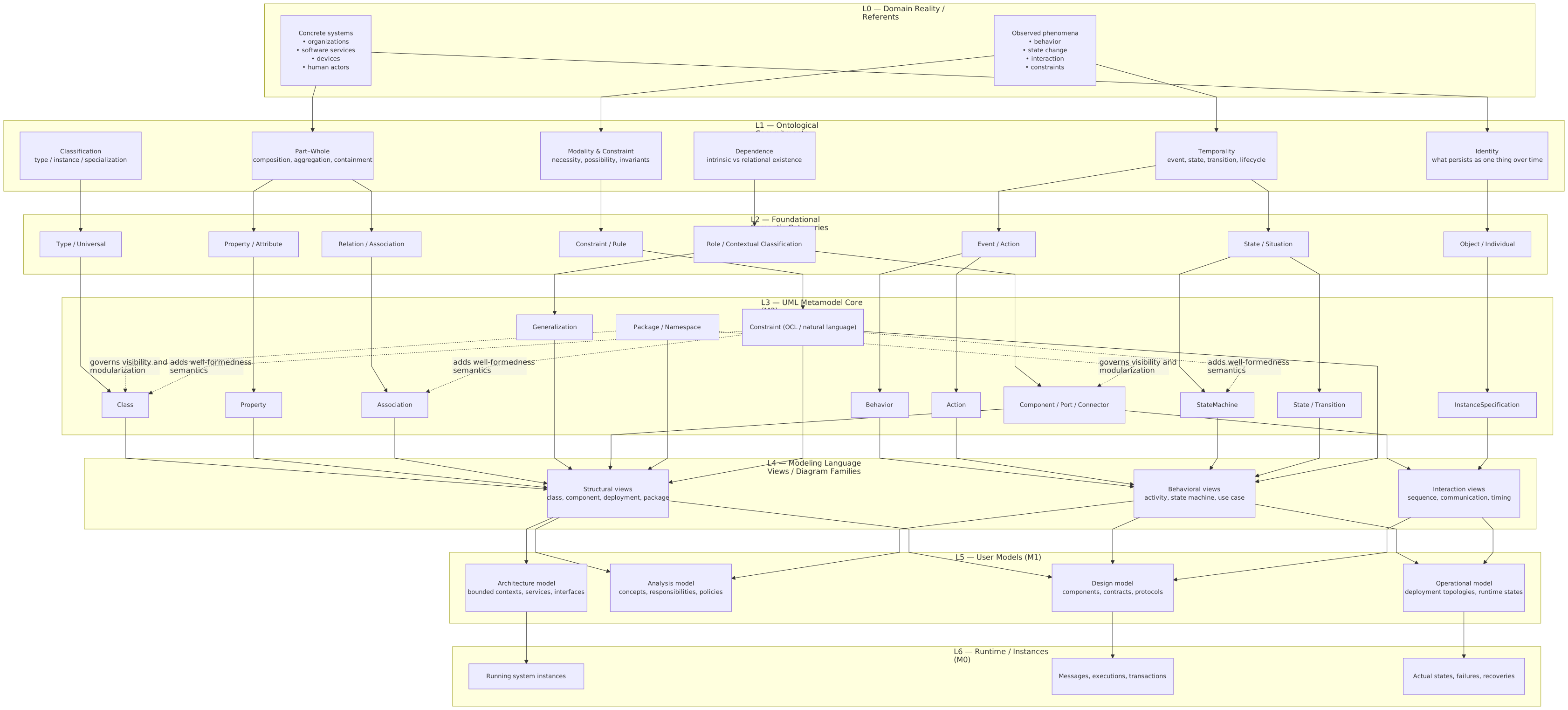
A class box on a diagram is not the key thing. What matters is that the element is an instance of the metaclass Class, which inherits semantics from broader metaclasses such as Classifier, Namespace, and Type. That inheritance chain is not cosmetic. It determines what the thing can own, how it can relate to other things, what constraints apply, and what tools can infer.
This is where ontology enters. The UML metamodel is a commitment about the categories of things that exist in a model universe: classifiers, instances, behaviors, relationships, packages, components, artifacts, nodes, and so forth. These categories have distinct meanings. A dependency is not an association. An artifact is not a component. An actor is not just any external box. Collapse these distinctions because “everyone gets the idea,” and you lose the semantics that make the model useful.
Many enterprise diagrams do exactly that.
Ontology in architecture: what sort of thing is this?
Ontology is really category discipline. In architecture, category discipline is the difference between a model that supports reasoning and one that merely narrates intent.
Take a banking example:
- Customer
- Account
- Payment Service
- Kafka topic
payment.initiated - IAM role
PaymentsOperator - Kubernetes namespace
payments-prod
All may appear on payment-related views, but they belong to different ontological categories.
If these are all drawn as rectangles with arrows, the diagram may still look plausible. But semantically it becomes mush. A customer does not “deploy to” a namespace. A Kafka topic does not “own” a payment service in the same sense a package owns a class. An IAM role is not equivalent to an application component, even if both affect runtime behavior.
This is the practical value of ontology: it prevents category mistakes before they harden into architecture decisions.
The metamodel gives semantics by structure
One of UML’s strengths is that semantics are embedded through typed relationships and inheritance structures. Meaning is carried by what the element is and how it is allowed to relate, not just by labels.
For example:
- A Component is a modular part of a system with provided and required interfaces.
- An Artifact is a physical piece of information or software, such as a JAR, container image, or deployment package.
- A Node is a computational resource where artifacts may be deployed.
- A Class describes a set of objects sharing structure and behavior.
- An Object is an instance.
- A Use Case captures a goal-oriented interaction.
- A Dependency expresses that one element depends on another for use or change.
These are not interchangeable because the metamodel gives them different semantics. If you model a Docker image as a Component instead of an Artifact, you distort the deployment story. That may seem harmless until someone asks which versioned thing is deployed to which environment, and the model cannot answer cleanly.
This is why “informal UML” needs care. Informality is fine. Sloppiness is not.
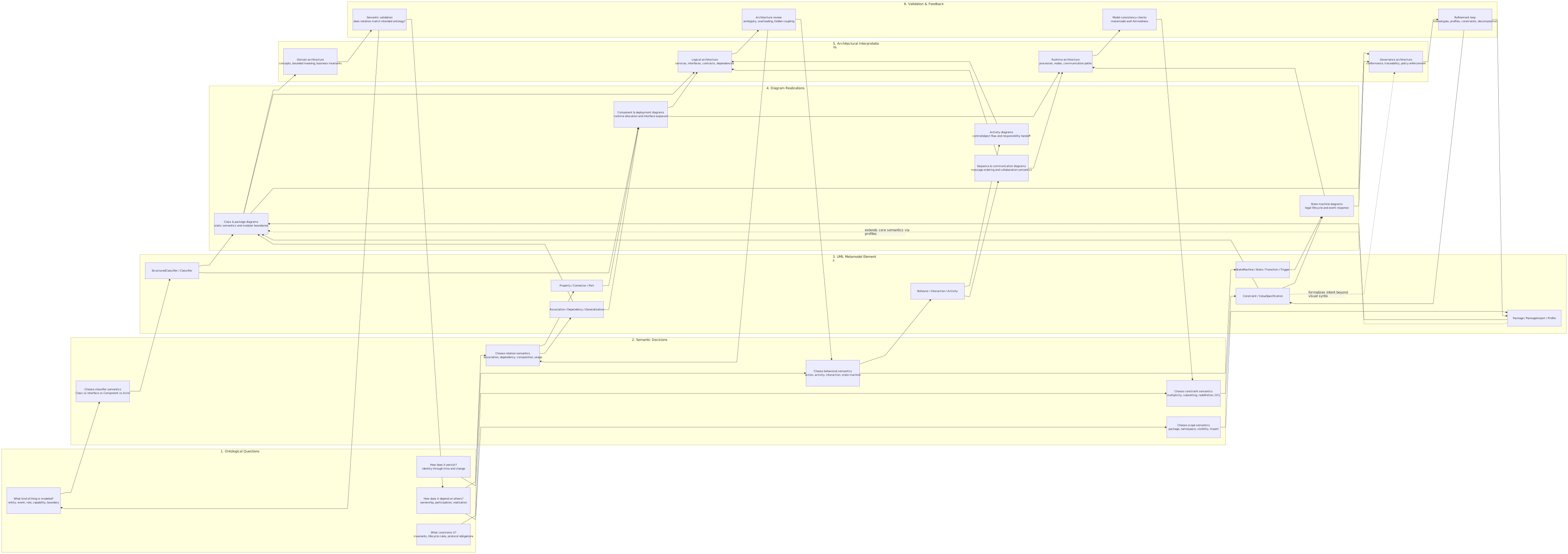
Semantics live beyond syntax
Syntax answers questions like:
- Is this notation legal?
- Can this symbol be placed here?
- Does this line style mean aggregation or dependency?
Semantics answer harder questions:
- What does this element represent in reality?
- What can be inferred from this relationship?
- What constraints are implied?
- What remains invariant across viewpoints?
That last point matters in enterprise architecture. A payment capability may appear in business, application, security, and deployment views. The notation changes. The semantics should not drift.
A mature architecture practice needs stable referents across views. If the “Payment Service” in a capability realization view is not the same semantic element as the “Payment Service” in a deployment view, traceability becomes fiction. The metamodel, used properly, gives you a way to anchor those identities.
This is also why profiles and stereotypes matter, though they are often abused. UML’s extension mechanisms let you adapt the language for enterprise concerns without discarding the underlying semantics. You can define stereotypes such as <, <, <, or < on top of existing metaclasses. Done well, this is powerful. Done badly, it becomes decoration.
The importance of meta-level thinking
Architects often skip past the modeling levels:
- M0: the real running system or real-world instances
- M1: the model of that system
- M2: the metamodel defining the language used in the model
- M3: the meta-metamodel foundation
You do not need to be a modeling theorist, but you do need to respect the levels.
A common failure mode is mixing M0 and M1 casually. A sequence diagram may show “Kafka” as if it were a single actor, while a deployment view shows a managed Kafka cluster, and an operations document refers to specific topics, partitions, and ACLs. These are different abstractions. If you do not state what is being modeled, teams infer their own meanings.
Cloud architecture gets messy here. Is “AWS IAM” being modeled as a platform service, a policy decision mechanism, a set of roles and trust relationships, or an operational control-plane dependency? All are valid. None are the same. The metamodel does not remove that ambiguity, but ontological discipline forces you to choose. cloud architecture guide
UML is not a complete domain ontology
UML’s metamodel is not rich enough to capture all enterprise meaning. That is fine. It was never meant to be your business ontology, security ontology, and event taxonomy all at once.
Teams still try to use plain UML as if it could naturally encode everything from legal-entity structure to data-retention policy to zero-trust posture. It cannot, at least not natively. You need domain-specific extensions, and sometimes complementary formalisms.
For example:
- Data lineage may be better expressed with specialized metadata models.
- IAM semantics may need policy languages and graph-based representations.
- Event contracts may need AsyncAPI or schema-registry artifacts.
- Cloud infrastructure may need IaC models and platform topology metadata.
The goal is not to replace UML with ten disconnected tools. The goal is to use the UML metamodel as a semantic coordination layer where appropriate, and to integrate domain models where UML would otherwise strain.
UML is not a religion. It is a language.
Where semantics break down in practice
The semantics of a model usually fail in three ways.
1. Notation without commitment to meaning
This is classic “box-and-line UML.” Components are drawn because component diagrams look enterprise-ish. Arrows are added because they imply interaction. The result is legible but semantically weak.
A cloud migration diagram shows Customer Portal, Auth, Kafka, Core Banking, and Data Lake with arrows between them. But what are the arrows: synchronous invocation, event publication, data replication, administrative dependency, trust relationship? If one arrow type stands for all five, the model is not merely underspecified. It is misleading.
2. Mixing conceptual and physical levels
A “Payments Domain” appears alongside EKS Cluster, Azure Key Vault, and Oracle Customer_Master. One is a business/domain boundary, one a runtime platform, one a managed secret service, one a physical datastore. All relevant. Not co-equal.
You can combine levels deliberately, but if you do, the semantics must be explicit. Otherwise stakeholders read causality into adjacency.
3. Undisciplined extensions
Teams love stereotypes: <, <, <, <, <. Fine—but what metaclass are they extending? What constraints do they imply? Are they mutually exclusive? Do they support tooling or just decoration?
A stereotype without semantics is just a badge.
How this applies in real architecture work
1. Better traceability across viewpoints
Consider a new digital onboarding flow for a bank. It touches:
- customer identity verification
- IAM for internal operators
- event streaming for status changes
- cloud deployment controls
- integration with core banking
- audit and regulatory reporting
You will need several views: business, application, interaction, data/event, deployment, security. If each uses the same names loosely but refers to different underlying things, traceability collapses. You cannot answer basic questions such as:
- Which application component handles PII?
- Which deployment node hosts regulated workloads?
- Which Kafka topics carry customer identity events?
- Which IAM roles can trigger manual overrides?
- Which business capability depends on a given cloud service?
A semantically grounded metamodel lets you establish those links intentionally. That is not governance theater; it reduces the meetings where architects discover they were using the same term for different things. architecture decision records
2. Sharper integration decisions
Event-driven architecture is a good example. Teams say “we’ll integrate via Kafka” as if that settles the matter. It does not.
You still need to model producers and consumers, event ownership, schema evolution, topic boundaries, durability expectations, replay semantics, security controls, and operational dependencies.
Now consider a CustomerUpdated event. If it is modeled as equivalent to the Customer entity, you are already in trouble. The event is not the entity. It is a time-bound statement about a state change from a producer’s perspective. That distinction affects schema design, data ownership, and downstream coupling.
Many organizations create “golden customer topics” that quietly become distributed databases over Kafka. It looks modern. It is often a category mistake.
3. More honest IAM modeling
IAM is where weak semantics become dangerous. Architects often draw a generic “Auth Service” and move on. But enterprise IAM includes several distinct ontological elements:
- identities
- credentials
- principals
- roles
- policies
- entitlements
- trust relationships
- authentication flows
- authorization decisions
- audit events
These are not the same category of thing. A role is not a policy. A token is not an entitlement. A principal is not an identity-proofing event. If your model collapses them, design discussions drift into confusion.
In zero-trust cloud architectures this matters even more. Workload identity for a Kubernetes service account, a human operator role in Entra ID, and a machine trust relationship for cross-account AWS access are related but not equivalent. If your architecture repository cannot distinguish them, your security model becomes mostly narrative.
4. More honest deployment models
The gap between logical and physical architecture is often where projects get ambushed.
A component view may show:
- Customer API
- Payment Orchestrator
- Fraud Service
- Notification Service
Fine. But deployment semantics matter:
- Is Payment Orchestrator one service or several workers and APIs?
- Is Fraud Service vendor-hosted SaaS?
- Are notifications asynchronous through Kafka or direct API calls?
- Which artifacts are deployed to which nodes?
- Which environments have network segregation?
- Which components share a trust boundary?
The UML distinction between component, artifact, and node is useful precisely because it prevents the lazy habit of treating a deployable image, a runtime service, and a conceptual module as the same thing.
Common mistakes architects make
Most architecture modeling errors are not notation errors. They are ontological errors.
Treating names as meaning
If two boxes are labeled “Customer,” many teams assume they mean the same thing. Often they do not. One may be a CRM record, one a core banking party entity, one an IAM subject, one an event payload aggregate, one a legal-person abstraction. Same word, different thing.
Using one relationship type for everything
The all-purpose arrow is probably the most expensive line in enterprise architecture.
Relationship semantics matter: dependency, association, realization, composition, information flow, deployment, control flow, inheritance. If your notation collapses all of these into “connects to,” you lose the ability to reason, while stakeholders infer certainty where none exists.
Confusing domain and technical boundaries
A bounded context is not the same as a microservice boundary, team boundary, VPC boundary, or IAM boundary. They may align, but often do not. Architects over-romanticize alignment because the neat story is appealing. Real enterprises are constrained by regulation, vendor platforms, shared data obligations, and operational realities.
Overloading UML instead of extending it carefully
“Pure UML” is often less useful than a pragmatically profiled UML. Enterprise architecture has domain constructs that deserve first-class treatment: Kafka topics, IAM roles, data classifications, cloud accounts, control objectives. But if you add stereotypes without defining semantics, constraints, or intended usage, you create a local dialect nobody else can read.
Modeling decisions without constraints
A model that shows a service consuming a topic is incomplete if it omits constraints such as:
- only one producer owns the schema
- retention is 7 days
- PII is encrypted at field level
- consumer access requires role-based ACL
- replay is forbidden in production without approval
Semantics are not only about thing-types. They are also about permissible states and rules.
A realistic banking example
Imagine a retail bank modernizing its payments platform. The estate includes:
- a core banking mainframe
- a payment hub
- batch fraud checks
- a customer portal
- a call-center application
- legacy LDAP plus cloud identity
- a Kafka integration backbone
- workloads split across on-prem and AWS
The target introduces:
- a Payment Orchestrator service
- event-driven payment status updates via Kafka
- centralized customer notification
- delegated authorization for operations staff
- cloud-native fraud scoring
- stricter auditability
A weak model shows Customer Portal, Payment Service, Kafka, Fraud, IAM, and Core Banking, all connected by arrows. It may note that “IAM secures all flows” and “Kafka is the source of truth for payment events.” Plausible, but too vague to survive implementation.
A stronger model distinguishes at least these categories:
With that structure, trade-offs become visible.
- Event ownership vs reporting convenience: Is Kafka carrying ownership-specific events or acting as a centralized payment journal?
- IAM centralization vs runtime autonomy: Where are policy decisions made, and where are they enforced?
- Logical service boundary vs deployment boundary: Is the Fraud Scoring Service one logical component but several runtime elements?
The value of the metamodel is that it lets you preserve identity across abstractions without pretending all abstractions are the same.
In practice, this leads to better decisions: Kafka ACLs are defined per topic and role; IAM roles for operators are separated from service principals; audit requirements attach to event classes and authorization actions; deployment constraints link to specific artifacts and nodes; data lineage becomes traceable.
None of this requires philosophical purity. It requires taking semantics seriously.
Closing thoughts
The ontological foundations of the UML metamodel are not an academic side quest. They are the reason a model can carry stable meaning across teams, tools, and time.
Syntax matters, but less than people think. The deeper value is semantic commitment: deciding what kinds of things your architecture contains, how those things relate, and what constraints make those relations meaningful. That is what separates architecture models from polished sketches.
In enterprise settings—banks, cloud platforms, Kafka-heavy estates, IAM-heavy environments—this becomes practical very quickly. You need to distinguish domain entities from events, components from artifacts, identities from roles, logical boundaries from deployment boundaries. If you do not, your models become ambiguous exactly where risk and cost concentrate.
So use UML, but do not stop at notation. Treat the metamodel as a semantic contract. Extend it carefully where enterprise concerns demand it. Be explicit about category boundaries. And be suspicious of diagrams that look clear but cannot answer hard questions.
A clean diagram is nice. A semantically trustworthy one is better.
FAQ
FAQ: The Ontological Foundations of the UML Metamodel: Semantics Beyond Syntax
1. What does “ontological foundations” mean in the context of the UML metamodel?
It means defining what UML elements really represent in the world, not just how they are drawn or named. For example, a class can be treated as a type of thing, an object as an individual thing, and an association as a real relation between things.
2. Why is syntax alone not enough for UML?
Syntax tells you whether a diagram is well-formed, but not what it means. Two models can use correct UML notation and still imply different realities unless their concepts—such as identity, part-whole, dependency, or behavior—are clearly defined.
3. How does ontology improve UML modeling in practice?
It helps modelers avoid ambiguity and category mistakes. For instance, it can clarify whether something should be modeled as a role, a type, an event, or a relationship, which leads to more consistent diagrams and better communication between teams.
4. What kinds of semantic problems appear without an ontological basis?
Common issues include confusing objects with types, treating temporary roles as permanent classes, and misusing aggregation or composition. These errors make models harder to interpret, implement, and maintain.
5. How does the UML metamodel benefit from semantics beyond syntax?
A stronger semantic foundation makes the metamodel more precise, supports better tool interoperability, and improves model validation. It also helps connect UML models to domain knowledge, business rules, and formal reasoning methods.
Diagram 1 — Layered Ontological Architecture of the UML Metamodel
Diagram 2 — Semantic Dependency Flow: From Ontology to Architectural Interpretation
Frequently Asked Questions
What is a UML metamodel?
A UML metamodel is a model that defines UML itself — it specifies what element types exist (Class, Interface, Association, etc.), what relationships are valid between them, and what constraints apply. It uses the Meta Object Facility (MOF) standard, meaning UML is defined using the same modeling concepts it uses to define other systems.
Why does the UML metamodel matter for enterprise architects?
The UML metamodel determines what is and isn't expressible in UML models. Understanding it helps architects choose the right diagram types, apply constraints correctly, use UML profiles to extend the language for specific domains, and validate that models are internally consistent.
How does the UML metamodel relate to Sparx EA?
Sparx EA implements the UML metamodel — every element type, relationship type, and constraint in Sparx EA corresponds to a metamodel definition. Architects can extend it through UML profiles and MDG Technologies, adding domain-specific stereotypes and tagged values while staying within the formal metamodel structure.