⏱ 19 min read
Most enterprise architecture diagrams are lying to you.
Not because architects are dishonest. Usually it’s the opposite. They’re trying to simplify. They’re trying to make complexity visible. But somewhere between “high-level view” and “executive-friendly picture,” the real structure disappears. Boxes become vibes. Arrows become wishful thinking. “Platform integration” becomes a line crossing the page like it means something.
This is where the UML metamodel matters more than most teams want to admit. ArchiMate in TOGAF ADM
And yes, I know: saying “metamodel” in a room full of delivery people is a good way to make them check their phones. UML itself has baggage. Too academic. Too old. Too much ceremony. Fair criticism. A lot of UML work in enterprises has been performative rather than useful. UML modeling best practices
But the underlying idea is still brutally relevant: if you don’t know what kind of thing you’re modeling, and what relationships are actually allowed between those things, your architecture becomes decoration.
That’s the practical value of the UML metamodel. It forces discipline. It says a component is not the same as a class, an interface is not the same as a deployment node, and a dependency is not the same as runtime communication. Sounds obvious. In real architecture work, it’s amazing how often teams blur all of that together. UML for microservices
So let’s make this simple early.
Simple explanation: what the UML metamodel actually is
The UML metamodel is the model behind UML itself. It defines the building blocks of UML diagrams and the rules for how they relate.
In plain English:
- A diagram is not just shapes on a page
- Each shape represents a specific kind of architectural element
- Each connector represents a specific kind of relationship
- The metamodel defines what those elements and relationships mean
Think of it like grammar for architecture.
You can say whatever you want in English, but if you ignore grammar completely, meaning falls apart. Same in architecture. You can draw any boxes and lines you want in Miro, Lucidchart, Visio, or Archi, but if you don’t have a disciplined model underneath, people will read different meanings into the same picture.
That’s not a tooling problem. It’s a thinking problem.
And in enterprise environments—banking, IAM, cloud migration, event-driven systems—that problem gets expensive fast.
Why architects should care, even if they “don’t do UML”
A lot of architects say they don’t use UML. Fair enough. Maybe they use C4, ArchiMate, BPMN, whiteboard sketches, cloud reference diagrams, or just PowerPoint with confidence. Fine. ArchiMate modeling best practices
But here’s the uncomfortable truth: whether you use UML notation or not, you still need metamodel thinking.
Because architecture work is fundamentally about these questions:
- What kinds of things exist in this system?
- What are their boundaries?
- Which relationships are structural vs behavioral?
- What exists at design time versus runtime?
- What is logical versus physical?
- What is owned by a team versus provided by a platform?
- What is an interface contract versus an implementation detail?
Those are metamodel questions.
If you don’t answer them explicitly, the team answers them implicitly. And implicit architecture is where bad surprises come from.
I’ve seen this over and over in large enterprises. The architecture repository says “Customer Service” is a service. The API gateway catalog says it’s an API product. The Kafka topic inventory treats it like an event producer. IAM treats it like a confidential client. Cloud landing zone tags treat it like an application. Finance maps it as a cost center. Operations maps it as a Kubernetes namespace.
None of those views are wrong. But if there’s no metamodel discipline connecting them, the enterprise ends up with six partial truths and no actual architecture.
The real contribution of the UML metamodel
The UML metamodel does one thing exceptionally well: it separates types of architectural concepts and gives them explicit semantics.
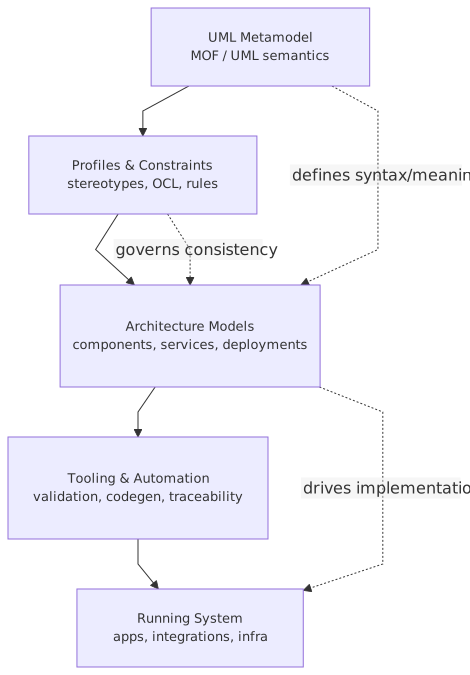
That matters because architecture has layers of meaning:
- Business capability
- Application/service
- Component/module
- Interface/API
- Data object/event
- Runtime instance
- Infrastructure node
- Identity/security principal
- Dependency
- Deployment mapping
- Ownership/responsibility
In weak architecture practice, these layers get collapsed into one visual language: rectangle plus arrow.
That’s where architecture starts to rot.
A metamodel gives you a way to say:
- This thing is a component
- This other thing is an interface
- This line means dependency
- That line means communication path
- This element exists in the deployment view
- That element exists in the logical design view
- This service publishes an event
- It does not own the event schema
- This API is exposed by the service
- It is not the service itself
These distinctions are not academic. They drive real decisions around security, operability, coupling, ownership, and change impact.
Where this hits reality: enterprise architecture is a translation job
A lot of architecture work is not creating systems from scratch. It’s translation.
You’re translating between:
- business and engineering
- delivery teams and platform teams
- security and developers
- cloud patterns and legacy constraints
- process models and runtime behavior
- procurement language and implementation reality
The UML metamodel helps because it gives you a disciplined vocabulary underneath the translation.
Without that, architects start saying things like:
- “The Kafka topic is the integration layer”
- “IAM is part of the application”
- “The API gateway is the service”
- “The cloud account is the system boundary”
- “The microservice owns the customer”
Every one of those statements is either incomplete, ambiguous, or flat-out wrong depending on the context. Yet they show up in architecture reviews constantly.
The metamodel doesn’t magically solve ambiguity, but it reduces accidental ambiguity. That’s a big deal.
A contrarian view: most architecture frameworks are too forgiving
Here’s the unpopular opinion.
A lot of modern architecture approaches are too tolerant of vagueness. They optimize for collaboration and accessibility, which is good. But they often underweight semantic precision. You get lots of nice diagrams and very little modeling discipline.
This is why teams can spend months “aligning” and still discover in test environments that nobody agreed on:
- where trust boundaries are
- which service owns which data
- what happens synchronously vs asynchronously
- whether a dependency is required at startup or only at runtime
- whether an identity is human, workload, or delegated
- whether a cloud resource belongs to a product team or a platform team
That’s not because people are stupid. It’s because fuzzy models let disagreement hide.
The UML metamodel, at its best, makes hiding harder.
Now, to be fair, UML also caused its own damage over the years. Teams over-modeled. They treated diagrams like deliverables instead of thinking tools. They generated shelfware. They made sequence diagrams for systems nobody intended to build. So yes, there’s a reason many architects have mild trauma around UML.
But throwing away metamodel discipline because some people abused UML is like banning source control because somebody once committed a binary dump into Git.
How this applies in real architecture work
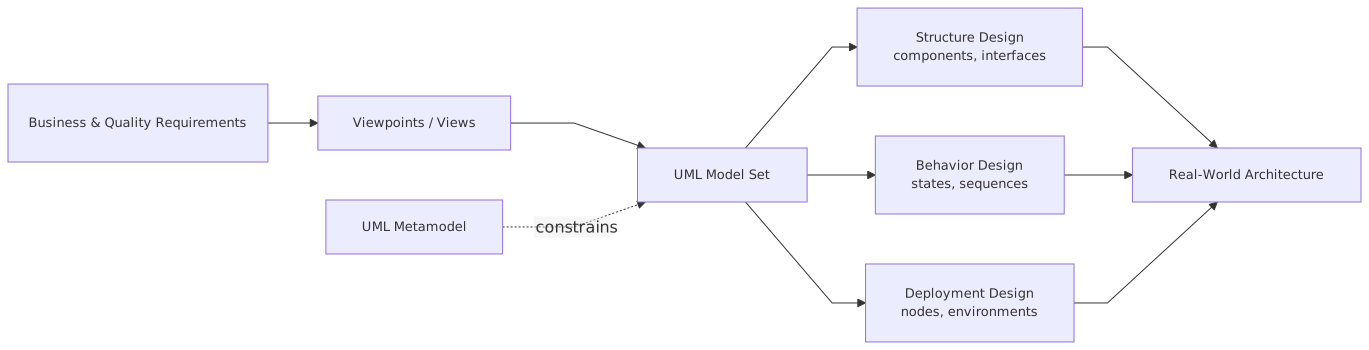
Let’s get practical. Here’s where metamodel thinking directly improves enterprise architecture.
1. Clarifying system boundaries
In real organizations, “system” is one of the most abused words in architecture.
Does “payments system” mean:
- the customer-facing app?
- the core payment processing engine?
- the settlement workflow?
- the set of APIs?
- the vendor package?
- the cloud deployment?
- the product team’s responsibility area?
Usually people mean different things in the same meeting.
A UML metamodel mindset forces you to distinguish:
- subsystem
- component
- service interface
- deployment unit
- actor
- external system
That clarity helps architecture reviews, controls, and funding conversations. It also stops teams from pretending a team boundary is the same thing as a technical boundary. It often isn’t.
2. Distinguishing design-time from runtime
This one matters a lot in cloud and Kafka-heavy environments.
Architects often mix up:
- a service definition
- a container image
- a pod instance
- a deployment target
- a runtime connection
- an event contract
These are not the same thing. Yet many architecture diagrams happily blend them together.
The metamodel helps keep the distinction visible:
- Component: what the software is
- Artifact: what is built and packaged
- Node: where it runs
- Instance/specification: what exists at runtime versus design time
- Connector/dependency: what kind of relationship exists
That matters when diagnosing resilience, failover, scaling, and blast radius.
3. Making security architecture less hand-wavy
Security is where vague models become dangerous.
Take IAM. In enterprise diagrams, IAM is often drawn as one box to the side, connected to everything. That’s not architecture. That’s superstition.
A metamodel approach helps you ask the right questions:
- Is this identity a user, service account, workload identity, or federated principal?
- Is this relationship authentication, authorization, token issuance, trust delegation, or policy enforcement?
- Is this interface interactive or machine-to-machine?
- Where is the trust boundary?
- What is the protocol contract: OIDC, OAuth2, SAML, mTLS, SCIM?
Without this precision, teams build systems that are “secured by IAM” in the same way a building is “secured by a lock somewhere.”
4. Governing event-driven architecture properly
Kafka is a great example because it exposes sloppy architecture almost immediately.
Teams say things like:
- “Service A integrates with Service B through Kafka”
- “The topic belongs to the platform”
- “The event is the API”
- “Consumers can just subscribe”
Maybe. Maybe not.
A metamodel mindset separates:
- producer component
- consumer component
- event schema
- topic
- broker cluster
- retention policy
- access policy
- ownership model
- business event vs technical event
That distinction changes governance entirely. A topic is not the same thing as an event contract. A producer owning publication is not the same as owning semantic meaning. And consumer freedom without schema discipline is just delayed coupling.
Common mistakes architects make
Let’s be blunt. These are the recurring mistakes.
Mistake 1: treating diagrams as presentations, not models
A lot of architecture diagrams are optimized for social comfort. They look clean, balanced, executive-safe. But they hide the hard parts.
If the diagram can’t answer what kind of relationship an arrow means, it’s not architecture. It’s visual diplomacy.
Mistake 2: confusing logical and physical architecture
This is everywhere in cloud transformations.
People draw an API, a microservice, an EKS cluster, a Kafka topic, and Azure AD on one diagram with identical boxes and arrows. Then they wonder why nobody can reason about failure modes or ownership.
Logical design and physical deployment are related, not interchangeable.
Mistake 3: using “service” to mean everything
Service can mean:
- business service
- application service
- microservice
- shared platform capability
- externally exposed API
- vendor SaaS
If every box is a “service,” architecture has stopped being precise.
Mistake 4: modeling integrations without semantics
An arrow between systems means almost nothing unless you know whether it is:
- synchronous request/response
- async event publication
- batch file exchange
- control plane interaction
- identity federation
- observability export
- admin-only dependency
This is one of the biggest reasons integration estates become fragile.
Mistake 5: forgetting that ownership is part of architecture
The UML metamodel doesn’t solve org design, but metamodel thinking absolutely should include ownership semantics.
Who owns:
- the API contract?
- the schema?
- the IAM role?
- the cloud resource policy?
- the Kafka topic?
- the customer data lifecycle?
If that’s not modeled somewhere, your architecture is incomplete.
A useful mapping table for enterprise architects
Here’s a practical way to think about UML metamodel concepts in enterprise work.
This is where UML becomes useful again—not as a religion, but as a disciplined mental model.
Real enterprise example: banking platform modernization with Kafka, IAM, and cloud
Let’s walk through a realistic case.
A mid-sized bank is modernizing its retail banking platform. It has:
- a mobile banking app
- an online banking web channel
- a legacy core banking platform
- new cloud-native domain services
- Kafka for event streaming
- centralized IAM using OAuth2/OIDC
- API gateway in front of customer-facing services
- workloads running across AWS and on-prem
The bank wants to implement real-time customer profile updates, transaction alerts, and delegated access for partner fintechs.
Sounds modern. Also sounds like a governance accident waiting to happen.
What the weak architecture version looks like
In the weak version, the architecture deck contains:
- a “Customer Service” box
- a “Kafka” box
- an “IAM” box
- an “API Gateway” box
- a “Core Banking” box
- arrows between everything
This diagram gets approved because everyone recognizes the nouns. But the model underneath is mush.
Questions it cannot answer:
- Is Customer Service the system of record for profile data or just a consumer-facing projection?
- Does Kafka carry domain events, integration events, or CDC streams?
- Does IAM authenticate end users only, or also machine identities?
- Is the API gateway enforcing authorization or just routing?
- Which service owns the
CustomerUpdatedschema? - What happens if core banking is unavailable?
- Are alerts triggered by event publication or synchronous API calls?
- Can fintech partners consume events directly?
- Which cloud account owns the Kafka ACLs?
These are not implementation details. These are architecture decisions.
What the metamodel-driven version looks like
A stronger architecture approach models the bank’s landscape in multiple disciplined views.
Logical component view
This view distinguishes:
- Channel applications: mobile app, web app
- Domain services: Customer Profile Service, Account Service, Notification Service
- Legacy subsystem: Core Banking Adapter, not “core banking” as a magical blob
- Platform capabilities: API Gateway, IAM Provider, Kafka Platform
Already, this helps. IAM and Kafka are not business services. They are platform capabilities with specific interfaces and trust relationships.
Interface view
This view shows:
- Customer Profile API exposed by Customer Profile Service
- Token issuance and introspection interfaces exposed by IAM
- Event publication interface for
CustomerProfileChanged - Partner API interface exposed through gateway
- SCIM or admin provisioning interfaces where relevant
This matters because the bank now sees which contracts are public, internal, or platform-level.
Information/event view
This view separates:
- customer master record
- customer profile projection
CustomerProfileChangedevent schema- notification request event
- transaction alert payload
The team stops pretending the Kafka topic is the business object. Good. Because it isn’t.
Deployment view
This view shows:
- mobile/web clients external to runtime estate
- API gateway in cloud edge zone
- domain services in AWS EKS
- Kafka brokers as managed platform service
- IAM provider as centralized enterprise service
- core banking adapter deployed near on-prem systems
- secure connectivity between cloud and on-prem
Now resilience, latency, and trust boundaries become visible.
Security/trust view
This view explicitly models:
- retail customer as actor
- partner fintech as external actor
- workload identity for Customer Profile Service
- gateway trust relationship with IAM
- service-to-service token exchange
- Kafka ACLs for producer/consumer identities
- privileged admin interfaces separated from customer channels
This is where a lot of architectures suddenly get uncomfortable, because hidden assumptions are now explicit.
The actual decision impact
Using this metamodel discipline, the bank made several better decisions:
- Customer Profile Service was defined as a projection service, not the system of record.
That stopped a common modernization mistake: pretending a new cloud service has become authoritative just because it has a nice API.
- Kafka topics were treated as transport resources, while event schemas were governed separately.
This prevented topic naming from becoming accidental business architecture.
- IAM was modeled as both user authentication and workload identity provider, with different trust paths.
Crucial distinction. Too many teams secure user login and then hand-wave service identity.
- The API gateway was recognized as policy enforcement and traffic mediation, not as the service itself.
Sounds obvious. It isn’t, apparently.
- Core banking integration was isolated behind an adapter component.
This reduced contamination of modern domain services with legacy protocols and data semantics.
- Partner fintechs were limited to API consumption, not direct Kafka event access.
A wise choice. Externalizing your internal event backbone is usually a terrible idea unless you are very deliberate about productized event contracts.
That’s what metamodel thinking does in practice. It changes decisions, not just diagrams.
Why this matters in cloud architecture specifically
Cloud made architecture faster. It did not make architecture simpler.
In fact, cloud often increases the need for metamodel clarity because the number of architectural elements explodes:
- accounts/subscriptions/projects
- VPCs/VNets
- clusters
- serverless functions
- managed services
- IAM roles and policies
- secrets
- service meshes
- topics, queues, streams
- observability pipelines
If you don’t distinguish what these things are and how they relate, your cloud architecture becomes a taxonomy problem disguised as a platform strategy.
One of the biggest mistakes I see is treating cloud resources as if they are the architecture. They are not. They are part of the deployment and operational realization of the architecture.
A Kafka cluster is not your event-driven architecture.
An IAM tenant is not your security architecture.
A Kubernetes platform is not your application architecture.
Terraform is definitely not your enterprise architecture, no matter how enthusiastic the platform team is.
These things matter. But they are not substitutes for a coherent model.
A second contrarian point: not every team needs more diagrams
Sometimes the best use of UML metamodel thinking is fewer diagrams, not more.
Really.
What teams often need is not twenty views. They need three views that are semantically clean:
- logical components and interfaces
- runtime/deployment topology
- trust boundaries and identity flows
If those three are modeled well, a lot of confusion disappears.
The mistake is believing architecture maturity equals diagram volume. It doesn’t. It equals decision clarity.
The metamodel helps because it forces discipline in what each view is allowed to express.
How to use this without becoming “the UML person”
If you’re an enterprise architect and don’t want to drag the organization into notation wars, good instinct. Don’t lead with UML vocabulary. Lead with architectural precision.
Practical steps:
- Define a small set of architectural element types for your organization
- Be explicit about relationship types
- Separate logical, information, deployment, and trust views
- Add lightweight stereotypes or tags for ownership, criticality, and data classification
- Use architecture reviews to challenge ambiguous elements
- Refuse diagrams where every connector means something different depending on who’s speaking
You can do all of this with UML-inspired metamodel discipline without forcing everyone into textbook notation.
That’s the sweet spot.
What good architects do differently
Good architects don’t just draw systems. They protect meaning.
They know that:
- a model is useful when it constrains interpretation
- ambiguity is sometimes necessary, but accidental ambiguity is poison
- architecture is not just structure, it’s semantics plus responsibility
- platform capabilities should not be confused with domain capabilities
- event-driven systems need stronger modeling, not weaker
- identity and trust deserve first-class modeling, not side notes
And they know one more thing that is worth saying plainly:
If your architecture cannot survive precise questions, it is not mature. It is just socially accepted.
That’s harsh, but enterprise work needs a bit more harshness. Too much architecture survives on politeness.
Final thought
The UML metamodel is not valuable because UML is elegant. Sometimes it isn’t. It’s valuable because enterprise architecture needs a disciplined way to distinguish kinds of things and kinds of relationships.
That sounds dry. In reality, it’s one of the most practical habits an architect can develop.
Because in real organizations, the failures are rarely caused by a total lack of boxes and lines. There are always boxes and lines. The failures come from false equivalence:
- API equals service
- topic equals event
- identity equals user
- deployment equals architecture
- platform equals product
- diagram equals understanding
The UML metamodel pushes back on that laziness.
And that’s why it still matters.
Not as a museum piece. Not as a certification artifact. Not as a way to impress people with notation.
As a way to think clearly when the enterprise gets messy. Which, to be honest, is most of the job.
FAQ
1. Do I need to use formal UML diagrams to benefit from the UML metamodel?
No. You need metamodel discipline more than formal notation. You can use C4, ArchiMate, or simple internal standards, as long as you define element types and relationship meanings clearly. ArchiMate modeling guide
2. How does UML metamodel thinking help with Kafka architectures?
It helps separate producers, consumers, schemas, topics, brokers, and ownership boundaries. That prevents the classic mistake of treating Kafka topics as if they are the business architecture.
3. Where does IAM fit in a UML-style architectural model?
Usually across multiple views. IAM can appear as a platform component, expose interfaces like token issuance, participate in trust relationships, and support both human and workload identities. If it’s just one side box on your diagram, you’re under-modeling it.
4. Is UML too heavyweight for modern cloud-native architecture?
It can be, if used dogmatically. But the underlying metamodel concepts are highly relevant in cloud-native systems because those environments have more moving parts, more identity relationships, and more deployment/runtime complexity.
5. What is the most common mistake architects make when modeling enterprise systems?
Using the same visual language for fundamentally different things—services, APIs, topics, infrastructure, identities, and teams. That makes diagrams easy to draw and hard to trust.
Frequently Asked Questions
What is a UML metamodel?
A UML metamodel is a model that defines UML itself — it specifies what element types exist (Class, Interface, Association, etc.), what relationships are valid between them, and what constraints apply. It uses the Meta Object Facility (MOF) standard, meaning UML is defined using the same modeling concepts it uses to define other systems.
Why does the UML metamodel matter for enterprise architects?
The UML metamodel determines what is and isn't expressible in UML models. Understanding it helps architects choose the right diagram types, apply constraints correctly, use UML profiles to extend the language for specific domains, and validate that models are internally consistent.
How does the UML metamodel relate to Sparx EA?
Sparx EA implements the UML metamodel — every element type, relationship type, and constraint in Sparx EA corresponds to a metamodel definition. Architects can extend it through UML profiles and MDG Technologies, adding domain-specific stereotypes and tagged values while staying within the formal metamodel structure.