⏱ 22 min read
Introduction
Here’s the short answer: meta-circularity in UML is the reason UML can describe itself, and that matters far more in enterprise architecture than most teams realize.
Not because it is philosophically cute. Not because model theorists enjoy recursive diagrams. It matters because every serious architecture organization eventually runs into the same problem: the language used to describe systems becomes part of the system landscape itself. At that point, the modeling language is no longer just notation. It becomes infrastructure.
UML is built on layers of abstraction where models describe systems, metamodels describe models, and—this is the interesting part—the language at the metamodel level uses concepts that are, to a degree, defined in terms of themselves. That reflexive structure is what people mean when they talk about UML being meta-circular or self-describing.
A lot of architects hear that and mentally file it under “academic, probably irrelevant.” I think that is a mistake. In practice, this is tied directly to repository design, governance, tool interoperability, model-driven automation, and the ugly question of who gets to define what a “service,” “capability,” “event,” or “policy” actually means across a large enterprise. ARB governance with Sparx EA
And yes, there is some theory underneath it. But the useful part is practical: if your architecture language cannot describe its own extensions, constraints, and semantics with enough precision, your architecture repository turns into a diagram graveyard. Plenty of enterprises are already there.
So this article is about that middle ground—the point where UML’s reflexivity stops being a standards-body curiosity and becomes relevant to banks, cloud platforms, Kafka estates, IAM programs, and architecture governance. UML modeling best practices
Core explanation
What meta-circularity means in UML
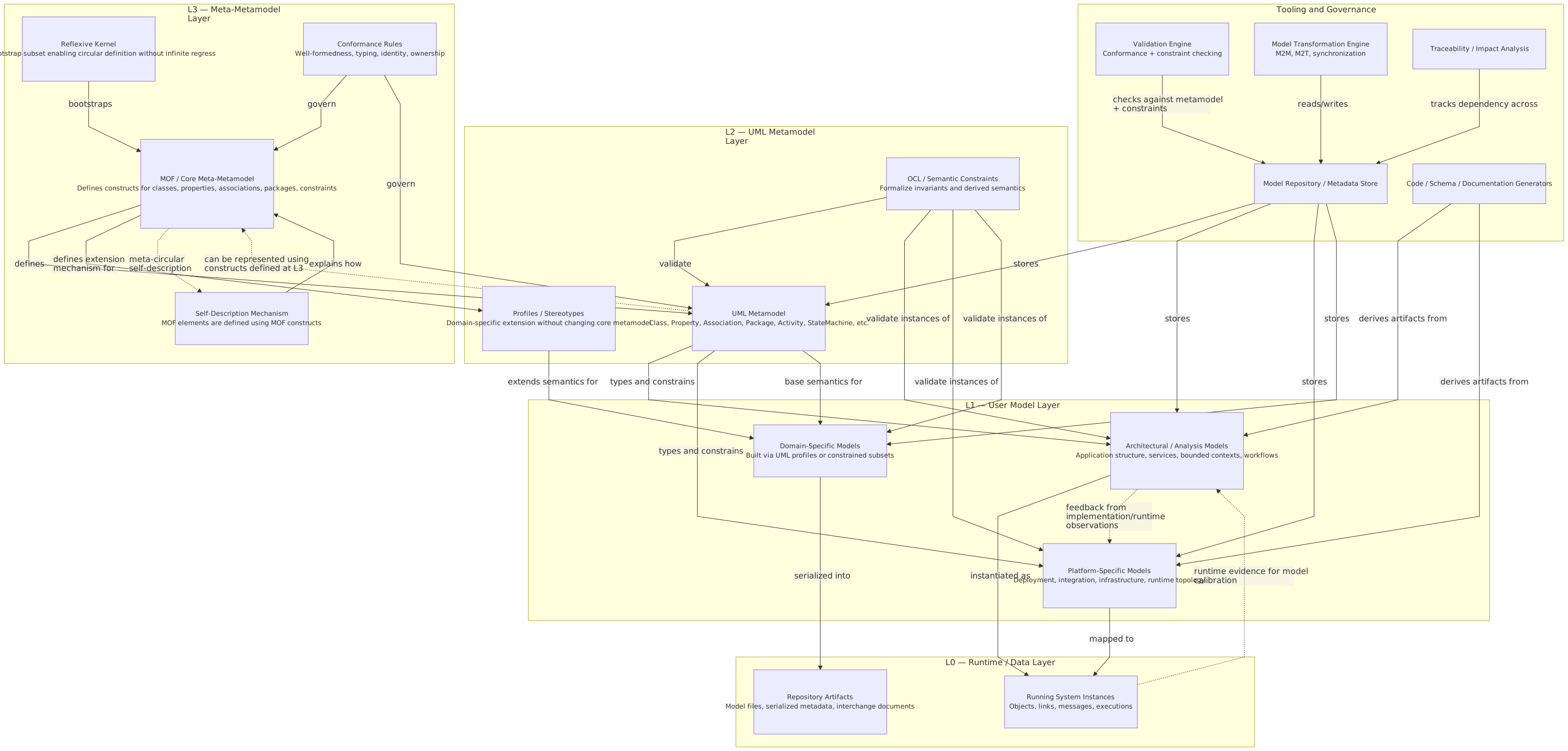
At a high level, UML works in layers. UML for microservices
- M0: the running world — actual systems, databases, APIs, Kafka brokers, IAM policies, customer records
- M1: models of those things — class diagrams, sequence diagrams, deployment diagrams
- M2: the UML metamodel — definitions of what a Class, Association, Property, Component, StateMachine, and so on actually are
- M3: the meta-metamodel layer — in the OMG stack, this is MOF territory
The slightly mind-bending part is that UML is specified using modeling constructs that resemble the same structural ideas it offers to users. In other words, the language is at least partly expressed using a language architecture that mirrors itself. It is not pure infinite recursion, and people often overstate that. But it is reflexive enough that the language can define the rules for its own definition.
That is the core of self-description.
A Class in your application model might represent CustomerAccount. But at the metamodel level, UML also has a notion of Class as a modeling element. And that metamodel element has properties, associations, constraints, and specialization relationships. So the language used to model systems also has a formal description of its own building blocks.
This is why UML can be extended in disciplined ways. Profiles, stereotypes, tagged values, and constraints are not random decorations. They work because UML has a metamodel capable of talking about what its own elements are.
Why reflexivity is not just a technical curiosity
In enterprise architecture, language drift is one of the most expensive silent failures.
One team says “service” and means a deployable microservice.
Another means a logical business capability exposed over APIs.
A third means an AWS service.
A security architect means a trust boundary with policy enforcement.
A platform team means a Helm chart and some Terraform.
All of them will draw boxes labeled “service.” Then everyone nods. Then six months later, integration funding gets approved for the wrong thing.
Meta-circularity matters because it gives you a mechanism to define the language about your architecture with enough precision that the diagrams stop lying by omission.
If you create a UML profile for enterprise architecture, and define stereotypes like <, <, <, <, or <, you are using the self-descriptive nature of the language to shape the language itself. You are not merely drawing prettier pictures. You are deciding what kinds of architectural statements can be made consistently.
That is the practical value.
UML’s self-description is disciplined, not magical
It helps to be precise here. UML is not “self-describing” in the loose marketing sense where a tool can infer whatever it wants. The self-description exists through a formal metamodel and associated constraints.
That distinction matters. A lot.
Architects sometimes act as if once they have a metamodel, they have semantics. They do not. They have structure. Semantics comes from a combination of metamodel, constraints, interpretation rules, and organizational discipline.
This is one of my mildly contrarian views: the industry often gives UML too much credit for precision and too little credit for extensibility. The language itself does not rescue sloppy thinking. But it does provide a solid enough scaffold to encode architectural intent if you actually do the work.
Reflexivity and the enterprise modeling stack
In a real enterprise, the stack usually looks something like this:
That third layer is where most architecture teams either create leverage or create chaos.
If you define an enterprise metamodel badly, every downstream view becomes unreliable. Your dependency maps become inconsistent. Your risk reporting becomes subjective. Your cloud migration dashboard starts mixing applications, workloads, subscriptions, and business processes in one category soup.
If you define it well, the architecture function can support traceability across domains:
- business capability to application
- application to data classification
- data classification to IAM policy
- IAM policy to cloud deployment pattern
- deployment pattern to Kafka topic ownership
- Kafka topic ownership to operational accountability
That traceability is not produced by diagrams alone. It is produced by a language that can describe itself and its extensions in a coherent way.
The useful kind of recursion
There is a tendency to hear “meta-circularity” and think of recursion for recursion’s sake. That is not what matters here.
The useful recursion is this:
- You model systems.
- You define the language rules for those models.
- You use the same modeling discipline to describe and evolve those language rules.
- You govern architecture by governing the language.
That fourth point is the one enterprises usually miss.
Most architecture governance boards review solutions. Fewer review the modeling vocabulary being used to describe those solutions. That is backwards. If the vocabulary is unstable, the reviews are mostly theater. EA governance checklist
For example, if your architecture repository contains the concepts Application, Platform, Product, Service, Capability, and Data Product, but no one has defined:
- which are logical vs physical
- which can own data
- which can expose APIs
- which can be deployed independently
- which can consume Kafka topics
- which are subject to IAM trust policy
then your repository is not a source of truth. It is a source of diagrams.
UML, MOF, and why the layering still matters
You do not need to become a standards expert to use this well, but the layering is worth understanding.
MOF provides the meta-metamodel foundation. UML is a metamodel defined on top of that. Your enterprise profile or extension sits on top of UML. Your actual architecture models sit on top of that.
This layering gives you two important things:
- Consistency: tools can reason about model structure
- Extensibility: you can tailor the language without inventing an entirely new notation
That said, I’ll offer a second contrarian insight: many enterprises would be better off using less UML notation but more metamodel rigor.
Teams often obsess over whether to use component diagrams versus deployment diagrams versus package diagrams. Meanwhile they have no enterprise definition for “critical dependency” or “customer identity master.” That is upside down. The notation choice is secondary. The metamodel choice is where the architectural truth lives.
Self-description and semantic control
When architects talk about self-description, there are really three levels of ambition:
At the advanced level, the architecture language becomes operationally relevant.
Suppose a bank defines:
<> <> <> <> <>
Then it defines rules such as:
- A
<must connect only through approved trust boundaries> - A
<must have lineage to an IAM authority> - An
<sending regulated events must map to a data classification policy> - A
<cannot directly consume topics from a non-governed Kafka cluster>
Now the model is not just descriptive. It is governable.
That is where UML’s reflexive structure earns its keep. It lets you define not only the systems, but the categories and constraints by which systems are judged.
How this applies in real architecture work
1. Defining a common enterprise vocabulary
This is the most immediate use case.
In a large organization, architecture work breaks down when each domain invents its own local ontology. Cloud teams define “workload” one way. Security defines “resource” another. Data teams define “domain” in a way that collides with business architecture. Integration teams call Kafka topics “interfaces,” which is usually wrong and occasionally disastrous.
A metamodel-driven approach lets you define:
- what elements exist
- what relationships are allowed
- what attributes are mandatory
- what constraints apply
That sounds dry. In practice, it is what prevents your architecture repository from turning into a semantic landfill.
2. Making architecture repositories actually useful
Most repositories fail because they collect artifacts, not models.
A Visio file, a PowerPoint export, and a wiki page are not a coherent model just because they all mention the same application. If the underlying concepts are not defined and related through a metamodel, repository search and reporting become unreliable.
With a reflexive modeling language, you can ask questions like:
- Which applications process regulated customer data and publish to Kafka?
- Which IAM trust relationships span business units?
- Which cloud workloads depend on an on-prem identity provider?
- Which systems classified as systems of record expose events without ownership metadata?
Those are architecture questions with operational consequences. They require model semantics, not just diagrams.
3. Governing cloud architecture patterns
Cloud architecture especially benefits from this.
Cloud diagrams are notorious for mixing:
- logical architecture
- deployment topology
- service ownership
- security boundaries
- cost constructs
- vendor products
all in one picture.
A metamodel can separate those concerns.
For example:
CloudWorkloadis a deployable unitPlatformServiceis a managed capability provided by the cloud vendorTrustBoundaryis a security constructSubscriptionorAccountis an administrative boundaryDataStoreis a persistence conceptIdentityAuthorityis an IAM role provider or directory source
Once those distinctions exist formally, you can model an AWS or Azure estate without collapsing everything into “boxes connected by arrows.”
That matters for migration planning, IAM design, resilience analysis, and cost governance. architecture decision record template
4. Aligning event-driven architecture with ownership and control
Kafka is a good example because it exposes semantic sloppiness quickly.
In many enterprises, topic design starts as a technical exercise. Then governance arrives late and ugly. Suddenly people realize:
- no one knows who owns key topics
- event schemas drift
- regulated data leaks into broad-consumption streams
- retention policies do not match business policy
- consumers treat events as query APIs
A stronger enterprise metamodel can define:
EventStreamTopicEventSchemaProducerSystemConsumerSystemDataClassificationOwnershipBoundary
Then add constraints:
- A
Topicmust have one accountable owner - A regulated
EventStreammust map to a classification policy - Cross-domain topic consumption requires an approved contract
- Event schemas with PII require lineage to a data authority
That is not bureaucracy. That is architecture finally catching up to runtime reality.
5. Connecting IAM architecture to system models
IAM is another area where self-description pays off.
Identity architecture is usually modeled inconsistently because teams mix:
- human identity
- workload identity
- authorization policy
- trust federation
- directory hierarchy
- application roles
A metamodel-based approach can distinguish:
IdentityProviderDirectoryServicePrincipalRoleBindingTrustFederationPolicyDecisionPointProtectedResource
Then architecture reviews can reason about things that matter:
- Which applications depend on a single corporate IdP?
- Which machine identities are used across cloud accounts?
- Where are role bindings defined locally rather than centrally?
- Which trust federations cross regulatory regions?
Without a disciplined language, those become workshops full of hand-waving.
Common mistakes architects make
Mistake 1: Treating UML as drawing notation only
This is the classic one.
Architects use UML shapes, maybe some stereotypes, but never define the semantics of those stereotypes. So < means whatever the author intended that day.
That defeats the point. If the language is not constrained, the diagrams are decorative.
Mistake 2: Confusing extension with invention
Some teams discover UML profiles and immediately create a private language so elaborate that nobody else can read it. Every box gets a stereotype. Every line gets a tagged value. Every diagram needs a legend and an apology.
That is over-engineering.
The goal is not to create a baroque architecture dialect. The goal is to create just enough semantic control to support consistency, governance, and analysis.
Mistake 3: Assuming the metamodel itself guarantees meaning
It doesn’t.
A metamodel can tell you that Application relates to DataStore. It does not tell you whether that relationship means ownership, usage, replication, authority, or dependency unless you define it.
This is where architects get lazy. They stop one layer too early.
Mistake 4: Mixing abstraction levels in the same model
This happens constantly in enterprise diagrams.
A single view will show:
- a business capability
- a microservice
- a Kafka topic
- an Azure subscription
- an Okta tenant
- a legal entity
- a customer journey
all connected as if they belong to the same semantic layer.
They don’t. Some relationships may be valid, but the model becomes incoherent if abstraction levels are not explicit.
Meta-circular thinking helps because it forces the question: what kind of thing is this, exactly? That question is annoyingly basic, and very useful.
Mistake 5: Letting tool constraints define the language
This one irritates me more than it should.
A repository tool has a default metamodel. The architecture team adopts it uncritically. Soon the enterprise vocabulary is shaped by whatever the vendor happened to implement cleanly in 2019.
That is not architecture. That is surrender.
Tools matter, obviously. But the enterprise metamodel should be a deliberate design choice, not a side effect of dropdown menus.
Mistake 6: Going fully formal where ambiguity is acceptable
Now for a counterbalance.
Not every architecture concern needs metamodel precision. Sometimes a rough context diagram is enough. Sometimes ambiguity is useful early in a strategy conversation. Architects who try to formalize everything usually create resistance and slow the work down.
This is the subtle trade-off:
- too little semantic structure and the repository is useless
- too much and nobody models anything honestly
Good architecture teams know where precision pays and where it does not.
Real example from enterprise context
Let’s take a plausible banking scenario.
A retail bank is modernizing its customer platform. It has:
- a core banking system on-prem
- a cloud-native customer engagement platform
- Kafka as the event backbone
- a central IAM platform with federation to SaaS and cloud workloads
- multiple regulatory zones
- a data governance program trying, not always successfully, to keep up
The architecture team has a repository, but it mostly contains inconsistent application diagrams. The same system is labeled “platform,” “application,” or “service” depending on who modeled it. Kafka topics are documented in Confluence. IAM trust relationships live in a security tool. Data classification sits in spreadsheets. Everyone claims to support “traceability.” Nobody can actually answer cross-domain questions.
The problem they were really facing
The visible issue was governance friction. The real issue was semantic fragmentation.
The bank could not reliably answer:
- Which applications publish customer PII into Kafka?
- Which event streams cross regulatory boundaries?
- Which cloud workloads trust the central IAM authority?
- Which systems of record are being bypassed by derived data stores?
- Which customer-facing services depend on legacy identity assertions?
This is exactly where UML’s self-descriptive structure becomes useful.
What the architecture team did
They did not launch a giant “model-driven transformation” program. Good. Those often become expensive theater.
Instead, they defined a lean enterprise profile on top of their modeling approach. It included stereotypes such as:
<> <> <> <> <> <> <> <> <>
Then they defined allowed relationships:
ApplicationpublishesKafkaTopicApplicationconsumesKafkaTopicApplicationdepends onIdentityProviderRegulatedWorkloadis contained withinTrustBoundaryPIIDataStoreis owned byApplicationSystemOfRecordauthorizesDataEntity
And they added a few constraints:
- A
KafkaTopiccarrying customer data must have classification and owner - A
RegulatedWorkloadcannot depend directly on an unclassified topic - A
SystemOfRecordmust be identified for each mastered customer entity - Cross-zone trust requires federation metadata
Not glamorous. Very effective.
What changed in practice
Within a few months, architecture review improved because the questions got sharper.
Before:
- “Does this service integrate with customer data?”
- “Is security involved?”
- “Will this be event-driven?”
After:
- “Which mastered customer entity is this service authorized to publish?”
- “Which Kafka topics consumed by this workload carry regulated fields?”
- “Which IAM trust path is used for workload-to-workload access?”
- “Does this deployment cross a regulated boundary without a declared federation model?”
That is what a better language buys you. Better questions.
Trade-offs they had to manage
There were real trade-offs.
Trade-off 1: Precision vs adoption
If they made the profile too rich, delivery teams would stop using it. So they limited mandatory attributes and focused on the handful of concepts that unlocked governance and traceability.
Trade-off 2: UML purity vs enterprise usefulness
Some modelers wanted strict UML correctness. The architecture lead made the right call and optimized for enterprise meaning instead. I agree with that choice. Standards compliance is helpful; operational clarity is more helpful.
Trade-off 3: Central control vs domain autonomy
The central team defined core concepts, but domain teams could extend them locally within guardrails. That kept the language coherent without forcing every team into the same exact detail level.
Tangible outcomes
The bank got three concrete benefits.
- Kafka governance improved
Topic ownership and classification became visible in the architecture repository rather than hidden in tribal knowledge.
- IAM dependencies became traceable
The team could identify which customer-facing workloads had risky dependencies on legacy identity infrastructure.
- Cloud migration planning got more honest
Applications previously labeled “cloud-ready” were shown to depend on on-prem trust and regulated data paths that made migration non-trivial.
That last one is worth emphasizing. Better metamodels often produce uncomfortable truths. Good. Architecture should do that sometimes.
Practical trade-offs architects should think about
When to use UML reflexivity explicitly
Use it when you need:
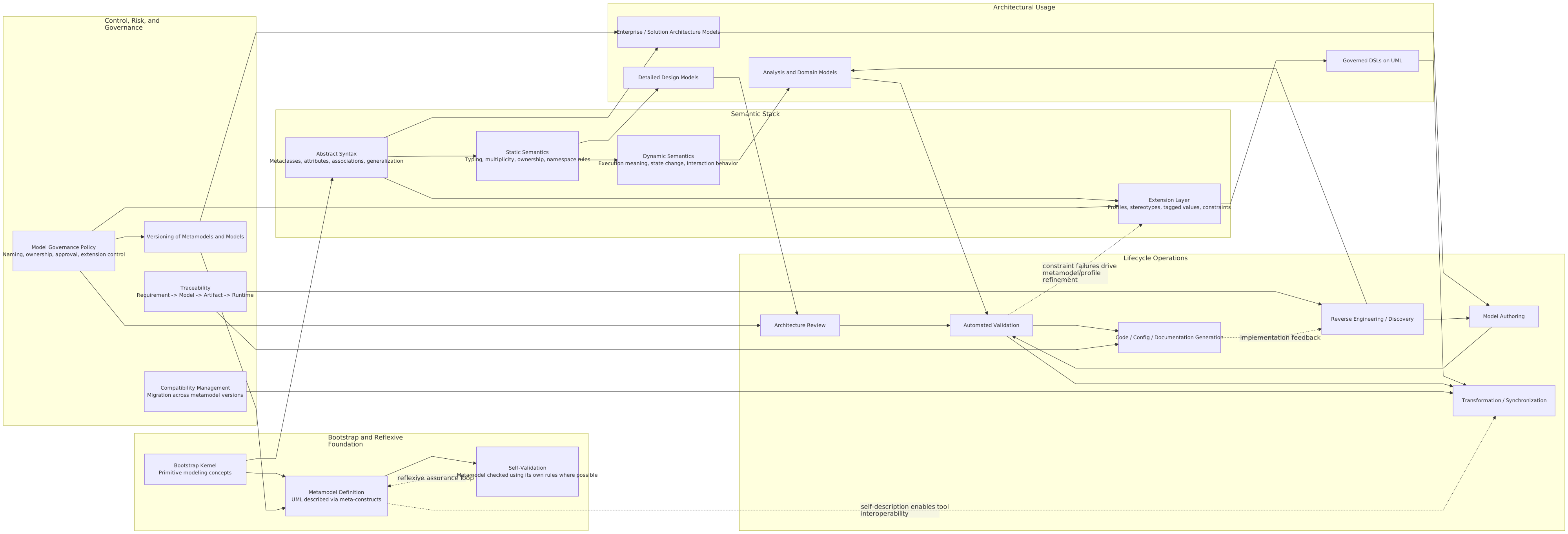
- repository consistency
- cross-domain traceability
- architecture governance with evidence
- tool interoperability
- repeatable extension of modeling concepts
Do not overuse it for:
- lightweight discovery workshops
- one-off strategy sketches
- informal whiteboard conversations
- early ideation where semantics are still fluid
Where the return on effort is highest
In my experience, the highest return comes from defining metamodel semantics around:
These are the places where ambiguity creates expensive operational consequences.
What not to formalize too early
Don’t rush to formalize:
- every deployment nuance
- every business term variation
- every integration style
- every operational metric
If you do, the metamodel becomes brittle and adoption collapses.
A good rule: formalize where ambiguity causes either risk, cost, or governance friction. Leave the rest lighter.
Why this topic is still underrated
I think enterprise architecture as a discipline has a strange blind spot here.
Architects love discussing target states, reference architectures, platform strategies, and governance operating models. Fair enough. But many teams underinvest in the architecture language itself—as if the vocabulary used to reason about the enterprise is somehow secondary.
It isn’t secondary. It is foundational.
If your modeling language cannot describe its own categories and constraints coherently, then every capability map, integration map, and cloud blueprint built on top of it inherits that weakness.
And to be blunt, this is one reason architecture functions often struggle to prove value. They produce artifacts without controlling the semantics of those artifacts. The result looks polished but doesn’t hold up under operational questioning.
Meta-circularity in UML is not a silver bullet. It does not make architecture truthful by itself. But it gives you a mechanism to make the language of architecture an explicit design object rather than an accidental byproduct.
That is a big shift.
Closing view
So, what is meta-circularity in UML really about?
At enterprise level, it is about using a modeling language that can describe not only systems, but the rules by which systems are described. That reflexivity is what enables disciplined extension, semantic consistency, and architecture governance that goes beyond slideware.
The practical takeaway is simple:
- model the system, yes
- but also model the language you are using to model the system
- and govern that language deliberately
Do that, and UML becomes more than notation.
Ignore it, and UML becomes clip art with arrows.
I know that sounds harsh. Still true.
For architects dealing with banking platforms, cloud estates, Kafka sprawl, IAM complexity, or any serious cross-domain environment, this is not abstract theory. It is one of the quiet mechanisms that separates architecture repositories that inform decisions from repositories that merely store diagrams.
And in enterprise work, that difference is everything.
FAQ
FAQ: Meta-Circularity in UML: Reflexivity and Self-Description in Modeling Languages
1. What does meta-circularity mean in UML?
Meta-circularity means UML is used to describe parts of itself. Its modeling concepts, such as classes and relationships, are defined using a UML-based metamodel.
2. How is reflexivity different from meta-circularity?
Reflexivity is the ability of a language to refer to or model its own structure. Meta-circularity is a specific form of reflexivity where the language is used to define itself.
3. Why does UML describe itself this way?
It creates consistency between the language and its definition. This also makes UML easier to extend, analyze, and implement in modeling tools.
4. Does self-description make UML harder to understand?
Sometimes yes. Beginners may find it abstract because they must distinguish between user models and the UML metamodel. Good examples and tool support usually reduce the confusion.
5. What is a practical example of UML self-description?
A UML Class can be defined at the metamodel level as an element with attributes, operations, and associations. Users then create ordinary class diagrams based on that definition.
Diagram 1: Meta-Circular UML Architecture for Self-Describing Modeling Languages
Diagram 2: Reflexivity and Dependency Flow in UML Self-Description
Frequently Asked Questions
What is enterprise architecture?
Enterprise architecture is a discipline that aligns an organisation's strategy, business processes, information systems, and technology. Using frameworks like TOGAF and modeling languages like ArchiMate, it provides a structured view of how the enterprise operates and how it needs to change.
How does ArchiMate support enterprise architecture practice?
ArchiMate provides a standard modeling language that connects strategy, business operations, applications, data, and technology in one coherent model. It enables traceability from strategic goals through business capabilities and application services to the technology platforms that support them.
What tools are used for enterprise architecture modeling?
The main tools are Sparx Enterprise Architect (ArchiMate, UML, BPMN, SysML), Archi (free, ArchiMate-only), and BiZZdesign Enterprise Studio. Sparx EA is the most feature-rich option, supporting concurrent repositories, automation, scripting, and integration with delivery tools like Jira and Azure DevOps.