⏱ 19 min read
Most enterprise architecture artifacts die young.
They’re born in workshops, blessed in steering committees, exported to PowerPoint, and quietly abandoned the moment delivery teams hit real infrastructure, real IAM constraints, real Kafka topic sprawl, and real cloud bills. That’s the uncomfortable truth. We say architecture should guide implementation, but a lot of what passes for architecture is just static description with better formatting.
This is why Executable UML matters. And yes, I know that phrase makes some architects tense up. It sounds academic. It sounds like one of those ideas that gets applause at a modeling conference and eye-rolls in a platform engineering review. But the core idea is actually very practical: if your model cannot meaningfully drive, constrain, or validate runtime behavior, it is probably too weak to be trusted as architecture.
That’s the opinion up front.
Executable UML, combined with a serious understanding of the metamodel underneath it, gives enterprise architects a way to close the gap between specification and runtime. Not perfectly. Not magically. But materially. It moves architecture from “diagram as suggestion” to “model as operational contract.”
And that’s the shift many organizations still haven’t made.
The simple explanation first
Let’s make this plain early.
Executable UML is UML used in a way that allows models to do more than document a system. The model can simulate behavior, generate code, validate rules, or directly shape runtime configuration and orchestration.
A metamodel is the model of the modeling language itself. It defines what a valid model is. In UML terms, the metamodel says what a class is, what a state machine is, what an association is, what rules apply, and how those concepts relate.
So if UML is the language, the metamodel is the grammar and structure behind the language.
Why does this matter in enterprise architecture?
Because if you want architecture artifacts to drive real outcomes—service contracts, event flows, IAM policies, deployment boundaries, cloud topology, resilience behavior—you need more than pretty boxes. You need machine-readable semantics. You need enough rigor that tools, teams, and runtime platforms can all work from the same intent.
That’s the bridge:
- Specification = what we intend the system to be
- Runtime = what the system actually does
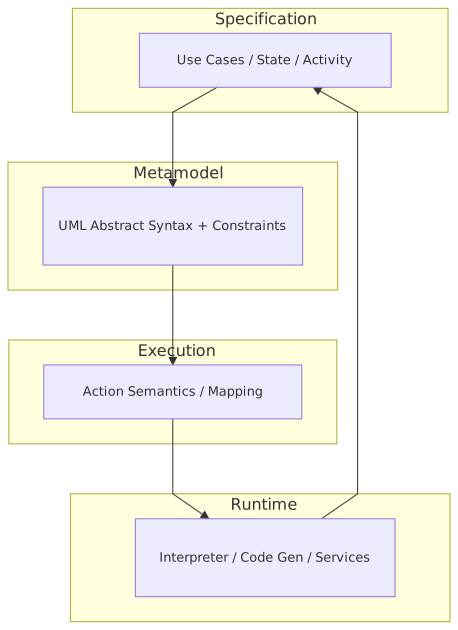
- Executable UML + metamodel = mechanism to reduce drift between the two
That’s the simple version. Now let’s go deeper.
The real problem: enterprise architecture is too descriptive
A lot of enterprise architects still work like cartographers of a country that no longer exists.
They map systems after the fact. They create “target states” with no execution path. They define capabilities and principles and reference architectures and then act surprised when delivery teams bypass them. Honestly, delivery teams are often right to do so. If architecture cannot participate in implementation speed, verification, or operational governance, it becomes theater. ArchiMate for governance
The old pattern looks like this:
- Architect creates UML or ArchiMate diagrams.
- Teams interpret them differently.
- Developers build what works under deadline pressure.
- Platform teams impose IAM, networking, and cloud controls.
- Event flows evolve in Kafka based on local decisions.
- Runtime reality diverges from the architecture.
- Architecture review happens later and pretends divergence is an exception.
It isn’t an exception. It’s the default outcome of non-executable architecture.
Executable UML is one answer to this. Not the only answer, and not always the best answer, but a serious one.
What Executable UML actually means in practice
There’s a tendency to overcomplicate this topic. Some people hear “Executable UML” and imagine full code generation from elaborate models, with developers reduced to button-pushers. That caricature has done a lot of damage. UML modeling best practices

In practice, executable modeling can sit on a spectrum.
At the light end
The model is used to validate architecture rules:
- service dependencies
- event sequencing
- state transitions
- identity trust boundaries
- deployment constraints
In the middle
The model drives partial generation:
- API contracts
- event schemas
- state machine implementations
- workflow definitions
- infrastructure templates
- IAM policy scaffolding
At the heavy end
The model becomes the primary source of truth, with code and configuration generated from it and runtime behavior aligned tightly to the model semantics.
Most enterprises won’t live at the heavy end. And frankly, many shouldn’t. But even the middle ground is far more useful than what most architecture teams do today.
The point is not “replace engineering with models.” The point is “encode enough architecture semantics that implementation and runtime can’t casually drift.”
That distinction matters.
Why the metamodel is the part architects ignore—and shouldn’t
Now we get to the part many people skip.
Architects love diagrams. They are less enthusiastic about the metamodel because it feels abstract. But the metamodel is where the real discipline lives.
If you don’t understand the metamodel, you don’t really control the meaning of your model. You’re just drawing.
The metamodel determines:
- what kinds of elements exist
- what relationships are legal
- what attributes matter
- what constraints apply
- what can be validated
- what can be transformed into code, config, tests, or runtime policies
This is not a side issue. This is the foundation of executable architecture.
For example, if your enterprise model says “Customer Onboarding Service publishes KYCCompleted,” that sounds useful. But unless your metamodel captures:
- event ownership
- schema versioning rules
- topic classification
- producer trust boundary
- consumer authorization model
- idempotency expectations
- retention and compliance tags
…then the model isn’t executable in any meaningful sense. It’s just a sentence wearing a diagram.
A proper metamodel lets you define not just “there is an event,” but “this event belongs to a regulated business domain, is emitted only after IAM-backed identity verification, must be published to Kafka with PII tagging, must not cross regions without tokenization, and may only be consumed by services with a specific authorization scope.”
Now we’re talking like architects, not illustrators.
The bridge between specification and runtime
Here’s the core architectural value.
When the model is grounded in a metamodel with enterprise semantics, you can create traceability from business intent to runtime behavior.
That sounds grand. It’s actually practical.
Example chain
- Business requirement: reduce fraudulent account opening
- Domain model: onboarding, customer identity, risk assessment
- Behavioral model: state transitions from application submitted to approved
- Security model: IAM policies for identity proofing and access delegation
- Event model: Kafka events for verification completed, risk scored, account created
- Deployment model: cloud services, trust zones, regional controls
- Runtime enforcement: generated schemas, policy templates, workflow guards, observability expectations
That is the bridge.
Without this bridge, architects say things like:
- “The onboarding process should be event-driven”
- “Zero trust principles must be applied”
- “The target state is cloud-native”
- “Access must be least privilege”
All true. All useless unless translated into something operational.
Executable UML doesn’t solve every problem, but it forces a more honest architecture practice. You have to define enough precision that the model can be checked, transformed, or executed against reality.
That’s healthy pressure.
A useful table: static UML vs executable UML in enterprise work
That last row matters. Executable UML can absolutely become a trap if used badly. More on that shortly. UML for microservices
How this applies in real architecture work
This is where a lot of articles become vague. Let’s not do that.
In real enterprise architecture work, Executable UML is useful when you need architecture to do one or more of these things:
1. Define behavior across system boundaries
Enterprise systems fail at boundaries, not inside neat component boxes. State machines, sequence models, and interaction models become powerful when they drive:
- workflow orchestration
- compensation logic
- event sequencing
- timeout and retry policies
- exception paths
This is especially relevant in banking, where onboarding, payments, fraud, and lending all involve cross-system coordination.
2. Enforce architectural invariants
Some rules should not depend on memory or good intentions:
- no service may consume PII-tagged Kafka topics without approved IAM scope
- no workload in a public subnet may directly access regulated data stores
- only domain owners can publish canonical business events
- customer identity transitions require auditable state changes
If your metamodel captures these rules, you can validate them before deployment.
3. Generate partial implementation artifacts
Again, not everything. Just the parts where consistency matters more than individual creativity:
- API skeletons
- event schemas
- state machine implementations
- policy-as-code templates
- cloud resource descriptors
- test cases for conformance
This reduces handoff loss.
4. Improve governance without slowing delivery
This is a contrarian point: most architecture governance fails because it relies on meetings. Meetings are a terrible runtime control mechanism. EA governance checklist
Executable models let governance happen through: architecture decision record template
- conformance checks
- model validation
- generated baselines
- drift detection
- deployment pipeline gates
That is better governance. Less ceremonial, more real.
A real enterprise example: retail banking onboarding on cloud with Kafka and IAM
Let’s make this concrete.
Imagine a retail bank modernizing customer onboarding. The bank has:
- a legacy core banking platform
- a cloud-native onboarding portal
- a Kafka event backbone
- centralized IAM with federated identity
- fraud and KYC services
- regional compliance constraints
The business goal is to reduce onboarding time from two days to under ten minutes for low-risk customers, while maintaining regulatory controls.
The old architecture approach
The enterprise architecture team creates:
- a context diagram
- an application interaction diagram
- a target-state architecture slide
- a security principle document
- a sequence diagram for onboarding happy path
This gets approval. Delivery starts.
Then reality hits:
- Kafka topics are created ad hoc by different teams
- IAM scopes are inconsistent between onboarding and KYC services
- fraud service introduces a synchronous dependency that wasn’t modeled
- cloud deployment splits across regions due to data residency
- exception handling for failed document verification becomes manual
- observability is bolted on late
- architecture no longer matches runtime after sprint 4
Very common story.
The executable architecture approach
Now let’s do the same thing with Executable UML supported by an enterprise-specific metamodel.
The metamodel includes concepts such as:
- BusinessProcess
- DomainEvent
- Service
- StateTransition
- IdentityProvider
- AccessScope
- TrustBoundary
- DataClassification
- KafkaTopic
- CloudZone
- ComplianceConstraint
- DeploymentUnit
- PolicyControl
That’s important. Standard UML alone is not enough. You extend or profile it with enterprise semantics.
The onboarding model defines:
- customer application states: Draft, Submitted, IdentityVerified, RiskScored, Approved, Rejected, Escalated
- transitions triggered by events or decisions
- required IAM assertions before identity verification can proceed
- Kafka event publication rules for each state transition
- data classification tags for payloads
- cloud deployment restrictions for services handling regulated data
- compensating actions if downstream fraud scoring times out
What happens next?
From the model, the architecture team and platform team derive:
- event schema contracts for Kafka
- IAM policy templates for service-to-service access
- state machine code for onboarding orchestration
- cloud deployment guardrails by trust zone
- conformance tests to ensure only approved services publish canonical onboarding events
- observability expectations tied to state transitions
Now architecture is not just advising. It is shaping runtime.
Why this matters
When a team tries to add a new consumer for CustomerIdentityVerified, the model-based governance can check:
- is the consumer in an approved trust boundary?
- does it have the required IAM scope?
- is the event payload classification compatible with that environment?
- does the schema version preserve compatibility?
- is cross-region replication permitted?
That’s architecture doing real work.
And yes, this can be done with other model-driven or policy-driven approaches too. Executable UML is not the only route. But it is a coherent route, especially where behavior and state matter.
Where banking especially benefits
Banking is a good fit because banks live with:
- complex stateful processes
- strict auditability
- identity-heavy interactions
- event-rich integration patterns
- strong compliance boundaries
- high operational risk from drift
In banking, the gap between “designed” and “running” is expensive. It creates:
- fraud exposure
- compliance failures
- customer friction
- operational incidents
- uncontrolled integration patterns
Executable UML helps because many banking flows are fundamentally state machines with strong policy constraints:
- account opening
- loan origination
- payment processing
- dispute handling
- customer lifecycle management
These are not just CRUD apps. They are behavior-rich systems with rules. That’s exactly where executable models earn their keep.
Common mistakes architects make
Let’s be blunt here. Most failures in this area are not because Executable UML is flawed. They happen because architects misuse it.
1. Treating UML as a drawing tool instead of a semantic tool
This is the big one.
If your UML model has no enforced meaning, no constraints, no profile extensions, and no transformation path, it is not executable architecture. It is decoration.
2. Modeling everything
This is the classic overreach.
Not every part of an enterprise needs executable models. If you try to model every field, every endpoint, every deployment nuance, every internal class, your initiative will collapse under its own weight. Architects do this because they confuse completeness with usefulness.
Model the parts where enterprise consistency, risk, and coordination matter most.
3. Ignoring the metamodel
I’ll say it again: if you don’t define the enterprise semantics, your model won’t scale. Generic UML elements are too loose for serious runtime alignment.
You need a metamodel or profile that reflects your enterprise realities:
- regulated data
- IAM scopes
- trust zones
- event ownership
- cloud boundaries
- resilience classes
- operational controls
4. Believing code generation is the goal
It isn’t.
The goal is architectural integrity across design and runtime. Sometimes that includes generation. Sometimes it includes validation only. Sometimes simulation is enough. Architects who obsess over full generation usually lose the room.
5. Separating architecture from platform engineering
Executable architecture without platform integration is fantasy.
If your cloud platform team, IAM team, and event platform team are not involved, the model will never reach runtime. You’ll end up with a modeling island.
6. Forgetting runtime feedback
This is another big one.
The bridge goes both ways. Runtime data should inform the model:
- topic usage patterns
- IAM failures
- state transition bottlenecks
- deployment drift
- policy exceptions
If the model never learns from production, it becomes stale again. Just more sophisticated stale.
7. Making the tooling the story
Nobody cares about your modeling repository if it doesn’t solve delivery pain.
Architects often pitch this topic as a tooling transformation. Wrong angle. The real pitch is:
- fewer broken integrations
- faster governance
- clearer ownership
- safer cloud adoption
- stronger IAM consistency
- better traceability for regulated change
That gets attention.
Contrarian thought: most enterprises do not need “pure” Executable UML
Here’s the contrarian view.
A lot of writing on this subject implies that the future is model-driven everything. I don’t buy that. Not in mainstream enterprise IT.
Most organizations are too heterogeneous, too tool-fragmented, too delivery-driven, and too politically decentralized for pure Executable UML to become the dominant engineering method. And that’s fine.
What they do need is selective executable architecture.
Use executable models where they create leverage:
- critical stateful business processes
- regulated event flows
- IAM-heavy trust interactions
- cloud deployment governance
- integration contracts across domains
Do not force executable modeling into every team, every microservice, or every product area. That becomes religion, and religion is terrible architecture.
The smart move is to apply it where ambiguity is costly and consistency is valuable.
Executable UML, Kafka, IAM, and cloud: the practical connection
These four belong together more than many architects realize.
Kafka
Kafka turns integration into a living ecosystem. That’s great until topic sprawl, schema drift, and ownership confusion hit. Executable modeling helps define:
- which service may publish which event
- schema compatibility rules
- event lifecycle and state linkage
- consumer authorization expectations
- data classification and retention
Kafka without modeling discipline becomes enterprise folklore at scale.
IAM
Identity and access are often treated as implementation details. They are not. They are architecture. In modern enterprises, especially on cloud, IAM defines what can talk to what, under what trust assumptions, with what delegated authority.
Executable models can make identity flows explicit:
- user authentication path
- token exchange
- service identity
- delegated scopes
- trust boundary crossing
- authorization decision points
If your architecture diagrams don’t express this, they’re missing the point.
Cloud
Cloud is where architecture lies go to die. You can write “segmented trust zones” on a slide all day. The cloud platform will reveal whether you meant it.
Executable architecture can connect models to:
- network segmentation rules
- workload placement constraints
- environment classification
- policy-as-code baselines
- encryption and key management controls
- region and residency constraints
This is where specification finally meets infrastructure reality.
What a sensible adoption path looks like
If I were advising an enterprise architecture team starting this journey, I would not begin with a giant UML transformation program. That sounds expensive and doomed.
I’d do this instead.
Phase 1: pick one painful domain
Choose a domain with:
- cross-team coordination pain
- state complexity
- security significance
- event-driven integration
- measurable business impact
Banking onboarding, payment exceptions, or IAM access provisioning are good examples.
Phase 2: define a narrow enterprise metamodel
Don’t boil the ocean. Define only the concepts you need:
- service
- event
- state
- trust boundary
- scope
- data classification
- deployment zone
Enough to be useful. No more.
Phase 3: connect the model to one or two runtime outputs
For example:
- generate Kafka event schemas and ownership metadata
- generate IAM policy templates
- validate service-to-topic access conformance
This creates credibility.
Phase 4: add runtime feedback
Bring in:
- schema registry data
- IAM policy violations
- deployment drift
- event lineage metrics
Now the model starts living.
Phase 5: expand carefully
Only after proving value should you widen the scope. And even then, stay selective.
That’s how this survives contact with enterprise reality.
What success looks like
You know this is working when:
- architecture reviews focus on model constraints and runtime evidence, not diagram aesthetics
- platform teams use the architecture model as an input, not a poster
- Kafka topic governance becomes mostly automated
- IAM patterns are consistent across domains
- cloud controls are traceable to business and regulatory intent
- delivery teams complain less about architecture because it actually helps them ship safely
That last one is underrated. Good architecture should reduce friction in the right places and add friction in the dangerous ones.
Final thought
Executable UML and the metamodel are not about making architecture more formal for the sake of formality. They are about making architecture accountable.
That’s the real issue.
If architecture claims to define the enterprise, it should be able to influence runtime behavior, validate conformance, and absorb production feedback. Otherwise it is mostly commentary.
The metamodel gives structure to meaning. Executable UML gives behavior to specification. Together, they offer a way to bridge a gap that has embarrassed enterprise architecture for years: the distance between what we say systems are and what they actually do.
Will this solve every architecture problem? Of course not.
Will some teams overdo it and create a modeling bureaucracy? Absolutely.
But the alternative—static diagrams disconnected from Kafka event estates, IAM realities, and cloud runtime controls—is worse. We’ve been living with that alternative for decades. It produces drift, confusion, and governance theater.
Enterprise architects should expect more from their models.
And frankly, so should everyone else.
FAQ
1. Is Executable UML realistic in a modern cloud-native enterprise?
Yes, selectively. Not as a universal replacement for code-centric engineering, but as a focused way to model and enforce critical behaviors, policies, and integration contracts. It works best in domains with state complexity, compliance needs, and cross-team dependencies.
2. How is this different from just using Infrastructure as Code and policy as code?
IaC and policy as code are essential, but they usually start lower in the stack. Executable UML can connect business behavior, service interaction, identity flow, event semantics, and deployment policy in one architectural chain. Think of it as earlier and broader semantic control, not a replacement.
3. Do I need a custom UML metamodel?
In most enterprises, yes, at least a lightweight extension or UML profile. Standard UML alone rarely captures enough enterprise meaning for Kafka ownership, IAM scopes, trust zones, regulated data, or cloud policy constraints.
4. What’s the biggest mistake when adopting Executable UML?
Trying to model everything. The second biggest is treating it as a code generation project instead of an architecture integrity project. Start with one domain, one pain point, and one or two runtime outputs.
5. Where should an enterprise start first?
Start where architecture drift is expensive: banking onboarding, IAM access provisioning, payment exception handling, or regulated event flows over Kafka. Pick a domain where better modeling can directly reduce risk, speed up governance, or prevent integration failures.
Frequently Asked Questions
What is a UML metamodel?
A UML metamodel is a model that defines UML itself — it specifies what element types exist (Class, Interface, Association, etc.), what relationships are valid between them, and what constraints apply. It uses the Meta Object Facility (MOF) standard, meaning UML is defined using the same modeling concepts it uses to define other systems.
Why does the UML metamodel matter for enterprise architects?
The UML metamodel determines what is and isn't expressible in UML models. Understanding it helps architects choose the right diagram types, apply constraints correctly, use UML profiles to extend the language for specific domains, and validate that models are internally consistent.
How does the UML metamodel relate to Sparx EA?
Sparx EA implements the UML metamodel — every element type, relationship type, and constraint in Sparx EA corresponds to a metamodel definition. Architects can extend it through UML profiles and MDG Technologies, adding domain-specific stereotypes and tagged values while staying within the formal metamodel structure.