⏱ 19 min read
Most architects don’t have a UML problem. They have a thinking problem. UML modeling best practices
That sounds harsher than I mean it. But after years of reviewing architecture decks, platform blueprints, solution designs, and “target state” diagrams across banks, insurers, telecoms, and public cloud migrations, I keep seeing the same failure pattern: people use UML as if it were just a diagramming toolkit. A set of boxes and arrows. A compliance artifact. Something to make design look serious. UML for microservices
And then they wonder why nobody understands the architecture, why engineering teams ignore the models, why governance becomes theater, and why every design review turns into a debate about notation instead of a discussion about risk. ArchiMate for governance
The issue is not UML itself. UML is fine. Imperfect, yes. Overused in some places, underused in others. But still useful.
The issue is abstraction.
Most architects misunderstand UML abstraction layers because they confuse different viewpoints of a system with different levels of detail about the same thing. Those are not the same. And when you mix them up, your diagrams become misleading even if the notation is technically correct.
That is the part many people miss.
The simple explanation
Here’s the simple version first.
UML abstraction layers are about deciding what matters at a given level of architecture discussion.
- At a high level, you care about capabilities, business services, trust boundaries, integration patterns, and ownership.
- At a mid level, you care about applications, interfaces, event flows, IAM decisions, deployment zones, and dependencies.
- At a low level, you care about classes, components, message schemas, retry logic, API contracts, and implementation mechanics.
If you put low-level design details into a high-level architecture diagram, you create noise.
If you put high-level intent into a low-level design diagram without implementation reality, you create fiction.
And if you use the same UML style for every conversation, you flatten the architecture into something that is technically dense but strategically useless.
That’s why abstraction matters.
UML was never supposed to save bad architecture thinking
A lot of enterprise architects inherited UML in the worst possible way: through process-heavy organizations where diagram production became a proxy for design quality.
You know the pattern.
- Someone says “we need a logical model.”
- Someone else opens a modeling tool from 2009.
- Out comes a component diagram with 47 boxes, 118 arrows, and exactly zero clarity.
- Then another person adds deployment nodes, security notes, Kafka topics, and API labels to the same view because “we want one diagram for the steering committee and the engineers.”
That one sentence usually kills the architecture.
There should almost never be one diagram for everyone. Not if the system is non-trivial.
A CIO reviewing a cloud migration for a retail bank does not need to see the same abstraction layer as the lead engineer implementing Kafka consumer idempotency in the payments domain. If you show both concerns in one model, you are not being thorough. You are being lazy.
That’s the contrarian view I’ll defend all day: many architects hide poor abstraction discipline behind “completeness.”
Completeness is overrated. Precision at the right level is what matters.
What abstraction layers actually mean in UML
Let’s get specific.
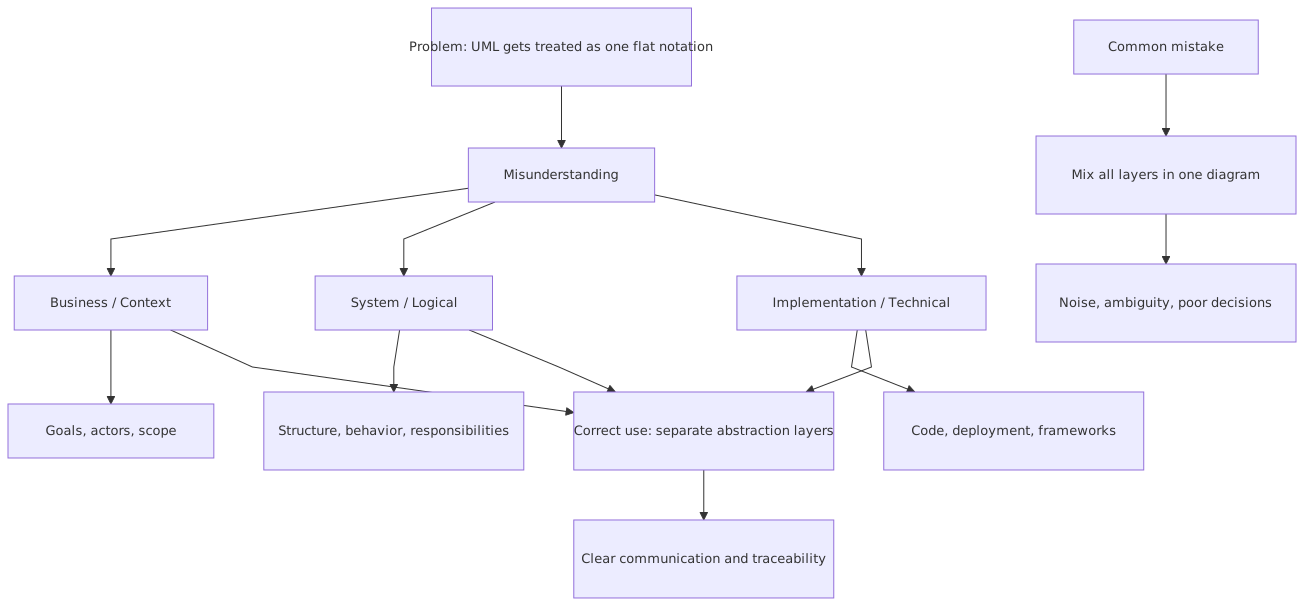
When people talk about abstraction layers in UML, they often mean one of three things, and they blend them together badly:
- Conceptual abstraction – what the system is, in business or domain terms.
- Logical abstraction – how responsibilities are organized, without committing too hard to technology specifics.
- Physical/implementation abstraction – how the solution is actually built and deployed.
These are not just different diagram scales. They represent different questions.
This seems obvious. It isn’t. In practice, architects regularly violate this separation.
They put AWS account structures into conceptual diagrams. They put “Customer Onboarding Capability” into deployment views. They put Kafka topic naming conventions into enterprise context diagrams. Then they act surprised when the audience either gets lost or starts arguing over details that don’t belong in the conversation.
UML doesn’t force this confusion. Architects do.
The first misunderstanding: more detail does not mean lower abstraction in a useful sense
This is probably the biggest mistake.
People assume abstraction is a simple ladder:
- Level 1 = very broad
- Level 2 = more detail
- Level 3 = even more detail
But architecture is not just zooming in on Google Maps.
Different abstraction layers are often different cuts of reality, not merely denser versions of the same drawing.
Let’s say you’re designing an IAM modernization in a bank.
At the conceptual layer, the important statement might be:
- Workforce identities and customer identities must remain separated.
- Authentication is centralized.
- Authorization decisions are domain-owned but policy-enforced consistently.
- Privileged access paths are isolated and monitored.
That is architecture.
At the logical layer, you might model:
- IAM platform services
- identity providers
- application relying parties
- token issuance and validation flows
- policy decision points and policy enforcement points
- integration with HR, customer onboarding, and fraud systems
Also architecture.
At the implementation layer, you might show:
- Azure AD / Entra for workforce
- CIAM platform for retail banking customers
- OIDC for web channels
- mTLS between internal APIs
- Kafka event publication for identity lifecycle changes
- IAM admin functions isolated in a dedicated cloud subscription
- break-glass accounts in a separate vault workflow
Still architecture, but now close to engineering reality.
These are not just “same diagram, more labels.” They are different models serving different decisions.
That’s the key point. Abstraction layers are decision layers.
If a model doesn’t support a decision at the level it’s shown, it’s the wrong abstraction.
The second misunderstanding: UML diagrams are not architecture layers
This one annoys me because it shows up in architecture teams that should know better.
People say things like:
- “Use use case diagrams for high level.”
- “Use component diagrams for middle level.”
- “Use class diagrams for low level.”
No. Not reliably.
A UML diagram type is not an abstraction layer. It’s a notation mechanism.
You can create a shallow, useless component diagram. You can create a highly strategic deployment diagram. You can create a class model that is actually conceptual rather than implementation-specific. The notation does not automatically determine the abstraction.
That matters in enterprise work.
For example:
- A component diagram for a Kafka-based event platform can be conceptual if it only shows core domains, event ownership boundaries, and strategic integration channels.
- The same component diagram can be logical if it shows producer/consumer responsibilities and contract boundaries.
- It can become implementation-level if it includes cluster topology, schema registry dependencies, dead-letter handling, and consumer group behavior.
Same diagram family. Different abstraction.
Architects who treat UML notation as a substitute for architectural judgment usually create diagrams that are formally acceptable and practically weak.
Why this goes wrong in real enterprise architecture work
Because enterprise architecture lives in the messy middle.
Not pure strategy. Not pure engineering. It sits between investment decisions, organizational politics, technical constraints, security requirements, and delivery pressure. Which means abstraction discipline is hard.
In theory, everyone agrees we should separate concerns. In reality:
- governance boards want “enough detail to be comfortable”
- engineering wants “just tell us what constraints are real”
- security wants threat-relevant architecture, not pretty boxes
- platform teams want deployment truth
- business stakeholders want impact clarity
- procurement wants vendor names
- operations wants support boundaries
- auditors want traceability
So architects start shoving everything into a single model.
That is understandable. It is also exactly the wrong move.
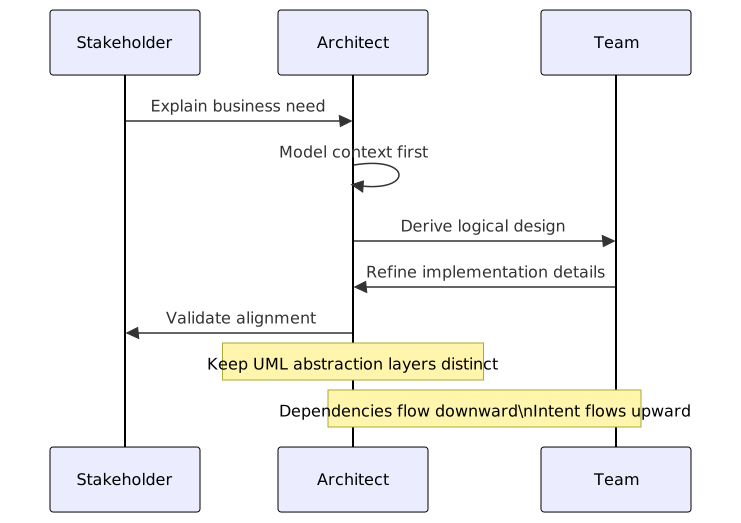
Good architects don’t create one giant artifact that tries to satisfy everybody. They create a coherent set of views, each with a clear abstraction layer, and they maintain traceability between them.
That’s the real work.
Not notation purity. Not “model completeness.” Coherent views.
A real enterprise example: retail banking payments modernization with Kafka, IAM, and cloud
Let’s make this practical.
Imagine a retail bank modernizing its payments architecture. Legacy batch systems still exist. Mobile and online banking channels are growing fast. Fraud controls need near-real-time signals. The bank is moving part of the estate to cloud, but core ledger systems remain on-prem for now. Kafka is introduced as the event backbone. IAM is being tightened because the regulator has raised concerns about privileged access and inconsistent authorization patterns.
A typical bad architecture deck for this program includes:
- a capability map
- a target application landscape
- Kafka topics
- IAM roles
- cloud landing zones
- deployment nodes
- API gateways
- fraud services
- customer channels
- batch systems
- and some random sequence arrows
All on 8 to 12 slides with almost no abstraction discipline.
Looks impressive. Explains very little.
Here’s how a real architect should think about it.
1. Conceptual view
At this layer, you are not modeling Kafka topics or IAM claims. You are clarifying architectural intent.
What matters?
- Payments domain emits business events.
- Fraud domain consumes payment-relevant events and emits risk decisions.
- Customer channels initiate payment requests but do not own payment state.
- IAM separates customer authentication from internal operator access.
- Cloud-hosted digital services interact with bank-controlled payment processing domains through governed interfaces.
- Trust boundaries between internet-facing channels, digital services, event backbone, and core processing are explicit.
This view should help answer:
- What are the major domains?
- Who owns what?
- Where are the trust boundaries?
- What interactions are central to the architecture?
- What constraints shape the target state?
That’s all.
If you’re listing payments.authorized.v2 and fraud.score.requested here, you’ve already dropped too low.
2. Logical view
Now we can introduce structure.
This layer would show:
- mobile banking app, web channel, API gateway
- customer identity provider
- payment orchestration service
- payment authorization service
- fraud decision service
- event publishing service or event ownership inside domain services
- Kafka backbone
- notification service
- core banking adapter
- audit service
- policy decision and enforcement points for authorization-sensitive actions
Now the architect can discuss:
- synchronous vs asynchronous interactions
- event ownership
- service boundaries
- IAM integration patterns
- where authorization decisions happen
- what systems are coupled and how
- where resilience patterns are required
Still not the place for exact Kubernetes namespaces, broker counts, or subnet design.
3. Physical view
Only here do we show:
- cloud VPC/VNet segmentation
- managed Kafka or self-managed cluster placement
- private connectivity to on-prem core systems
- IAM runtime identities
- admin plane separation
- deployment across regions
- container platforms
- secrets management
- WAF, load balancers, API gateway runtime placement
- observability stack
- DR topology
This is where platform engineering, security operations, and SRE need concrete reality.
And yes, this is often where architecture gets real for the first time. But if you skip the earlier abstractions, this level becomes a pile of infrastructure choices with no clear design intent behind them.
Common mistakes architects make
Let’s call these out directly.
1. They confuse viewpoint with abstraction
A security view is not automatically lower level than an application view. A deployment view is not automatically more detailed than a logical service model. A data flow view might be conceptual or implementation-specific depending on what it emphasizes.
Different viewpoint, different concern. Not necessarily different abstraction.
2. They put implementation commitments too early
This is common in cloud programs.
An architect starts with a business architecture problem and immediately draws:
- AWS accounts
- EKS clusters
- IAM roles
- Kafka brokers
- transit gateways
That might be useful later, but at the wrong stage it narrows thinking too soon. The architecture starts orbiting the platform instead of the business and risk problem.
Cloud vendors love this confusion, by the way. It turns architecture into product assembly.
3. They stay too abstract for too long
The opposite mistake is equally bad.
Some enterprise architects produce conceptual models so sanitized and generic that they become impossible to challenge. “A digital channel interacts with core services through an integration layer.” Fine. That sentence could describe half the banking industry.
If your abstraction is so high that no one can derive design constraints from it, it’s not architecture. It’s wallpaper.
4. They mix runtime, design-time, and governance concerns in one picture
This kills clarity fast.
For example, in one diagram people show:
- business domains
- CI/CD pipeline
- Kafka topics
- IAM approval workflows
- runtime applications
- cloud regions
- support ownership
All valid concerns. Terrible to mix indiscriminately.
5. They think UML correctness equals communication quality
I’ve seen formally correct UML diagrams that are almost unreadable.
Architecture is communication under constraint. If the audience cannot understand what decision the model supports, your notation discipline doesn’t matter much.
6. They don’t state what is intentionally omitted
This is subtle but important.
Every model hides things. Good architects say what they are hiding. Bad architects let the audience assume the model is complete.
A simple note like “This logical view omits deployment topology and detailed IAM role mappings” prevents half the confusion in review meetings.
How this applies in real architecture work
This is not an academic modeling debate. It affects actual delivery.
In architecture reviews
If your abstraction layers are wrong, review boards ask the wrong questions.
A conceptual architecture review should debate:
- domain boundaries
- trust assumptions
- ownership
- resilience strategy at a pattern level
- regulatory implications
- sourcing constraints
Instead, many reviews get derailed into:
- exact topic names
- whether Kafka should be managed or self-hosted
- whether OAuth scopes should be pluralized
- whether a service should use gRPC
Those are valid questions. Just not yet.
In engineering handoff
If a solution architecture never transitions from conceptual to logical cleanly, engineering teams reverse-engineer intent from implementation diagrams. That usually means they optimize locally.
Example:
A bank’s target architecture says “event-driven payments modernization.” Fine. But if the logical model does not clearly define event ownership, canonical vs domain event policy, and consistency boundaries, teams will produce a Kafka estate full of integration events masquerading as business events. Six months later everyone is tightly coupled through topics and nobody admits it.
That happens all the time.
In security architecture
IAM is a perfect test case for abstraction maturity.
At the conceptual level, you define:
- identity domains
- trust relationships
- authentication authority
- authorization ownership principles
- privileged access constraints
At the logical level, you define:
- token flows
- federation patterns
- policy evaluation points
- lifecycle integration
- service-to-service trust
At the physical level, you define:
- specific IdPs
- key stores
- network paths
- managed identities
- role mappings
- logging and control enforcement
When these are mixed, security reviews become either too hand-wavy or too implementation-obsessed. Neither helps reduce risk.
In cloud transformation
Cloud architecture suffers badly from abstraction confusion because diagrams tend to become vendor maps.
A proper conceptual cloud architecture might simply state:
- customer-facing workloads run in cloud
- regulated data handling is segmented by classification
- shared security controls are platform-provided
- critical system dependencies require private connectivity and resilience patterns
- runtime identity is centrally governed
That’s architecture.
A physical cloud diagram then shows:
- subscriptions/accounts
- hub-spoke or landing zone topology
- managed Kafka placement
- IAM runtime identities
- private endpoints
- cross-region failover
- logging and security services
Also architecture, but for a different decision set.
A practical way to model correctly
Here’s the approach I use and recommend.
Notice something important: I said risk-focused overlays.
This is where many architects improve fast once they stop trying to cram all concerns into one base model.
For example, for the banking payments scenario, you can keep one clean logical model and then overlay:
- IAM trust flows
- Kafka event ownership and consumer boundaries
- resilience and failure handling
- data classification zones
- operational ownership
That is far more effective than redrawing the system five times from scratch or loading one diagram with every concern.
The Kafka trap: where abstraction collapses fast
Kafka is where a lot of otherwise decent architects lose discipline.
Why? Because Kafka sits at multiple abstraction layers at once:
- conceptually, it can represent event-driven integration strategy
- logically, it defines producer/consumer interaction patterns and ownership
- physically, it introduces broker topology, clusters, partitions, replication, security, and operations
So people jump between these layers carelessly.
A conceptual statement:
- “Domain events decouple payment processing from fraud analytics and notifications.”
A logical statement:
- “Payments publishes business events owned by the payments domain; fraud and notifications consume them asynchronously; command-style interactions are not implemented via Kafka.”
A physical statement:
- “Managed Kafka runs in the cloud landing zone with private connectivity to on-prem consumers; ACLs align to service identities; schema registry enforces compatibility.”
All valid. But if you draw them together too early, people stop understanding whether Kafka is being discussed as strategy, integration mechanism, or infrastructure.
That confusion leads to bad decisions like:
- using Kafka for synchronous request/response because “it’s our strategic backbone”
- treating topics as enterprise canonical interfaces
- centralizing event ownership in an integration team
- ignoring IAM alignment for producer and consumer identities
- underestimating operational complexity in regulated environments
My strong opinion: many “UML debates” are actually ownership debates
Here’s the uncomfortable truth.
A lot of modeling confusion is not about notation at all. It’s about organizations that haven’t decided who owns what.
When ownership is fuzzy:
- abstraction layers get blurred
- diagrams become compromise documents
- architects over-model to avoid making hard calls
- every view tries to preserve optionality that should have been resolved
In banking, this often shows up between:
- enterprise architecture and platform architecture
- security architecture and application teams
- integration teams and domain teams
- cloud center of excellence and delivery programs
If nobody agrees whether IAM policy ownership sits centrally or with domain teams, the diagrams will wobble between conceptual principles and implementation detail because the decision itself is unresolved.
So yes, use UML. But don’t pretend better notation will solve governance indecision. EA governance checklist
What good looks like
A good architect using UML abstraction layers well will produce models that feel almost boring in the best sense.
They are clear.
They are scoped.
They answer a specific question.
They omit deliberately.
They connect to each other.
They expose risk instead of hiding it.
For the banking example, a strong architecture pack might include:
- one conceptual domain/context view
- one logical interaction view for payments, fraud, IAM, and eventing
- one IAM trust and authorization overlay
- one physical cloud/on-prem deployment view
- one operational/resilience view
- short decision notes linking them
That is enough for serious work.
Not 40 diagrams. Not one mega-diagram. Just the right views, at the right abstraction layers, with the right decisions attached.
Final thought
Most architects misunderstand UML abstraction layers because they think abstraction is a formatting exercise. It isn’t.
It’s judgment.
It’s deciding what matters now, for whom, and for what decision.
If you get that right, UML becomes useful again. Maybe even elegant.
If you get it wrong, all you produce is decorative ambiguity with arrows.
And enterprise architecture already has enough of that.
FAQ
1. What is the difference between a UML abstraction layer and a viewpoint?
An abstraction layer is about the level of decision and detail being represented. A viewpoint is about the concern being emphasized, such as security, deployment, data, or behavior. A security view can exist at conceptual, logical, or physical abstraction levels.
2. Which UML diagrams are best for enterprise architecture?
There is no universal mapping. Component, deployment, package, sequence, and even class diagrams can all be useful depending on the question. The important thing is not the diagram type itself but whether the model is at the right abstraction for the intended audience and decision.
3. How do I know if my architecture diagram is too detailed?
Ask whether the audience can still identify the main architectural decision without getting distracted by implementation specifics. If executives argue about Kafka topic names or engineers cannot tell where trust boundaries are, the abstraction is wrong.
4. How should UML abstraction layers be used in cloud and Kafka architectures?
Use conceptual models for strategy and boundaries, logical models for service and event interaction design, and physical models for cloud deployment, runtime identity, network segmentation, and broker topology. Don’t mix cloud infrastructure choices into early business/domain models unless they are truly architectural constraints.
5. What is the most common mistake architects make with UML?
They try to make one diagram serve every audience. That usually produces a model that is too detailed for business stakeholders and too vague for engineers. Better architecture comes from a small set of connected views, each with a clear abstraction level.
Frequently Asked Questions
What is enterprise architecture?
Enterprise architecture is a discipline that aligns an organisation's strategy, business processes, information systems, and technology. Using frameworks like TOGAF and modeling languages like ArchiMate, it provides a structured view of how the enterprise operates and how it needs to change.
How does ArchiMate support enterprise architecture practice?
ArchiMate provides a standard modeling language that connects strategy, business operations, applications, data, and technology in one coherent model. It enables traceability from strategic goals through business capabilities and application services to the technology platforms that support them.
What tools are used for enterprise architecture modeling?
The main tools are Sparx Enterprise Architect (ArchiMate, UML, BPMN, SysML), Archi (free, ArchiMate-only), and BiZZdesign Enterprise Studio. Sparx EA is the most feature-rich option, supporting concurrent repositories, automation, scripting, and integration with delivery tools like Jira and Azure DevOps.