⏱ 18 min read
I’ve seen more than one architecture review drift off course because the diagram on the wall looked clean.
One example I still remember was a citizen identity verification service in a government programme. The delivery team brought a very polished sequence diagram to the review board: citizen submits identity details, portal calls verification service, service checks the national identity provider, response comes back, citizen is either verified or rejected. Neat. Elegant. Reasonable.
Except it wasn’t the real interaction model.
What the diagram left out were the awkward but important parts: asynchronous fraud screening that happened after the initial response, a separate audit write path into the department’s evidence store, and a manual exception route when identity confidence scores landed in a grey zone. Procurement decisions were made on the assumption of a low-latency synchronous architecture. The security review treated the design as though trust boundaries stopped at the portal and identity provider. Operations planning missed the backlog risk in the fraud queue. Six months later, people were somehow surprised when the solution behaved like a distributed, policy-constrained workflow rather than a simple API exchange.
That, in my experience, is exactly why sequence diagrams matter more in regulated environments than they do in a startup with three engineers and a healthy tolerance for improvisation. In government, a sequence diagram is not just an explanatory artifact. It quietly shapes integration contracts, latency assumptions, segregation of duties, auditability, control design, resilience expectations, and sometimes even supplier scope.
So this is not a beginner’s UML tutorial. I’m assuming you already know what a lifeline is, what an alt fragment does, and roughly how the notation works. The real issue is not notation literacy. It’s that too many sequence diagrams are architecturally dishonest while still being visually competent.
And that’s dangerous.
The mistakes come first, because that’s where the value is
Let me start with the failure modes I run into most often.
Treating the diagram as application behavior instead of enterprise interaction behavior
A lot of teams still draw sequence diagrams as if they were object-oriented design relics: class A calls method B, which invokes repository C. Fine for a code review. Mostly useless for enterprise architecture. Sparx EA performance optimization
In government programmes, the interactions that matter are often not inside the application at all. They sit between the portal, the IAM boundary, the payment provider, the records archive, the sanctions or fraud service, the external authority, the ministerial reporting pipeline. That is where latency, accountability, legal obligation, and support ownership actually live.
If your sequence diagram is full of internal component chatter and says almost nothing about the national identity provider or records management archive, you are modeling the wrong thing.
Hiding compliance-relevant steps because they “clutter the picture”
This one is incredibly common.
Audit logging disappears because “it’s implied.” Consent verification gets omitted because “we don’t want to distract from the main flow.” Manual review gets pushed into a footnote. Retention or archive actions are assumed to happen “somewhere later.” Token exchange is abstracted away so aggressively that the trust model becomes invisible.
I understand the instinct. Big diagrams get ugly quickly. But in regulated settings, some clutter is actually the architecture.
If a step establishes legal evidence, creates the authoritative record, enforces a policy decision, or crosses a trust boundary, it is not decoration.
Drawing a happy path and calling it architecture
A happy-path-only diagram might be acceptable for a sales presentation. It is not acceptable for architecture governance. architecture decision records
Where is the timeout from the external regulatory authority? What happens when the citizen submits the same permit request twice because the browser hung? What if payment is authorized but case creation fails? What if the fraud service is degraded and returns “pending”? What if notification dispatch fails after approval?
If those outcomes materially affect service behavior, support load, legal state, or citizen experience, they belong in the architectural conversation.
Not every exception. But every materially different class of outcome.
Confusing synchronous request chains with operational reality
I have a strong view on this: fake synchronicity has probably done more damage to architecture decisions than bad cloud diagrams.
A sequence diagram often implies an immediate end-to-end response because it is drawn as a tidy chain of request-response arrows. But the actual implementation may involve Kafka topics, queues, callbacks, overnight batch windows, manual review teams, or policy checks that complete hours later.
When the diagram suggests “Portal calls Permit Service, Permit Service calls Fraud Service, Fraud Service responds, approval returned,” people start making all the wrong assumptions. They understate response time. They overpromise the UX. They misdesign SLAs. They forget resilience patterns. They procure the wrong support model.
If the real system is event-driven or partially asynchronous, draw it that way. Otherwise you are lying with notation.
Using one diagram to answer every question
This is where architecture gets political.
Someone asks for a sequence diagram. The team then tries to satisfy architects, designers, security, delivery, operations, procurement, and vendors with one giant artifact. It becomes unreadable. After that, everyone selectively interprets the bits they care about.
You need different diagrams for different decisions. One for architecture governance. Another for interface design. Another for control assessment. Potentially another for operational readiness. Sometimes a simplified one for vendor discussion.
A single diagram trying to be all things is usually a sign that nobody has clarified the question.
Forgetting that time is political in government systems
In commercial digital products, “later” can often mean “eventually, probably soon.” In government, “later” may collide with batch windows, statutory deadlines, overnight synchronizations, inter-agency dependencies, and escalation procedures.
I’ve sat in meetings where one omitted timing assumption triggered weeks of rework. The architecture diagram showed eligibility confirmation as an immediate interaction. In reality, the external agency published updates only twice daily. That tiny detail changed citizen messaging, case handling, escalation procedures, and ministerial reporting.
Time matters. Elapsed time matters even more. And in public-sector systems, it often has governance implications.
When a sequence diagram is the right tool — and when it isn’t
Sequence diagrams are excellent when the question is: who talks to whom, in what order, under what conditions?
That’s their sweet spot.
They are particularly good at exposing trust boundaries, surfacing control points, showing orchestration versus choreography, and making visible the consequences of sync versus async choices. If I want to understand where an API gateway enforces IAM, where a token is exchanged, where a message is handed to Kafka, or where a human reviewer interrupts the flow, a sequence diagram can do that very well.
But they are bad at other things.
If you need capability decomposition, use something else. If the issue is organizational ownership, don’t force it into a sequence. If you need data lineage across the estate, a sequence diagram will only help partially and often misleadingly. Infrastructure topology? Not the right instrument. Business motivation? Definitely not.
My practical rule is simple: if the problem is interaction order, use a sequence diagram. If the problem is what exists, who owns it, or why it exists, choose another view.
C4 dynamic diagrams can be simpler for software teams. BPMN is better when process semantics and human workflow dominate. ArchiMate is stronger for cross-domain traceability. Service blueprints help with frontstage-backstage citizen service design. Event storming outputs are brilliant for discovering domain behavior, though they are often too messy to serve as governance artifacts without some refinement. ArchiMate layers explained
Use the right lens. Not the familiar one.
A grounded example: digital permit issuance across agencies
Let’s anchor this in a realistic scenario.
A citizen submits a permit request through a government portal. The portal invokes a case management or permit orchestration platform through an API gateway. Identity is validated through a central identity service. A fee is collected through a treasury-approved payment provider. Eligibility is checked with an external regulatory authority. A fraud analytics service produces a risk score. Records are archived in a government records repository. Notifications are sent through the official communications platform. Some applications get routed to manual review.
This is architecturally interesting because it contains almost everything that makes sequence diagrams useful and dangerous at the same time: multiple trust zones, synchronous and asynchronous interactions, legal audit obligations, human decision points, external agency dependencies, and policy constraints that prevent full automation.
It’s also common. Variations of this show up in permits, licensing, grants, benefits, and border processes all the time.
First, build the diagram badly on purpose
Here is the sort of version many teams produce early on:
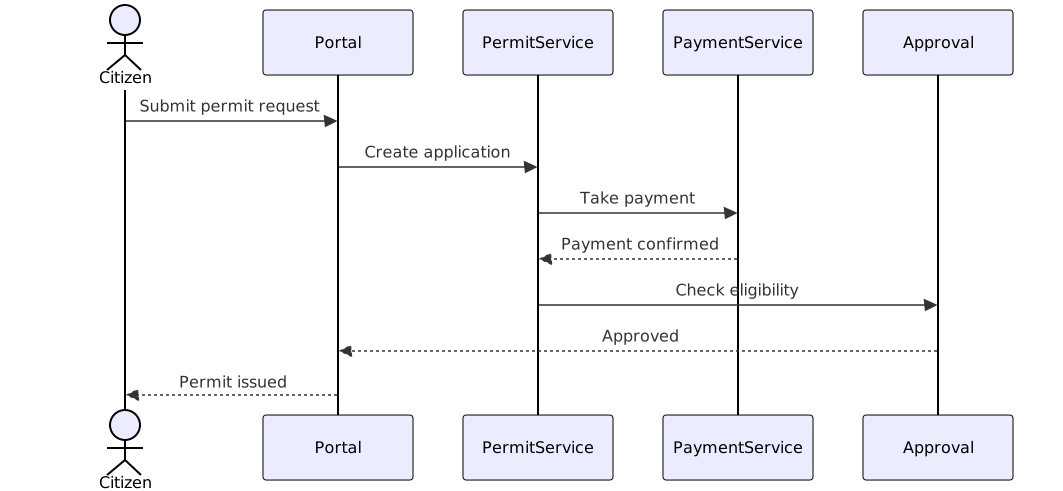
It wins applause because everyone can understand it in twenty seconds. It fits on one slide. It makes the programme look straightforward. It reassures non-technical stakeholders that the architecture is under control.
And it conceals almost everything that will actually hurt you.
There is no token issuance or validation. No indication that a case record may be created before payment settles. No asynchronous fraud screening. No retries. No idempotency. No archive write after the decision. No notification failure path. No manual review branch. No depiction of external authority latency or unavailability.
In other words, it is not a harmless simplification. It is a diagram that actively biases decisions.
I’ve watched review boards derive the wrong non-functional requirements from diagrams like this. I’ve seen support models under-budgeted because nobody noticed the manual queue. I’ve seen weak control design because the evidence path wasn’t visible. I’ve seen procurements framed around “real-time eligibility determination” when the dependency was clearly not real-time in practice.
Good-looking diagrams can be expensive.
Reworking it into something architecturally honest
A more truthful version needs lifelines that reflect actual systems and actual control points:
- Citizen
- Government Portal
- API Gateway
- Identity Provider
- Permit Orchestrator
- Case Management
- Payment Provider
- Fraud Service
- Regulatory Authority
- Manual Reviewer
- Records Archive
- Notification Service
- Audit Log
And it needs enough logic to show materially different outcomes.
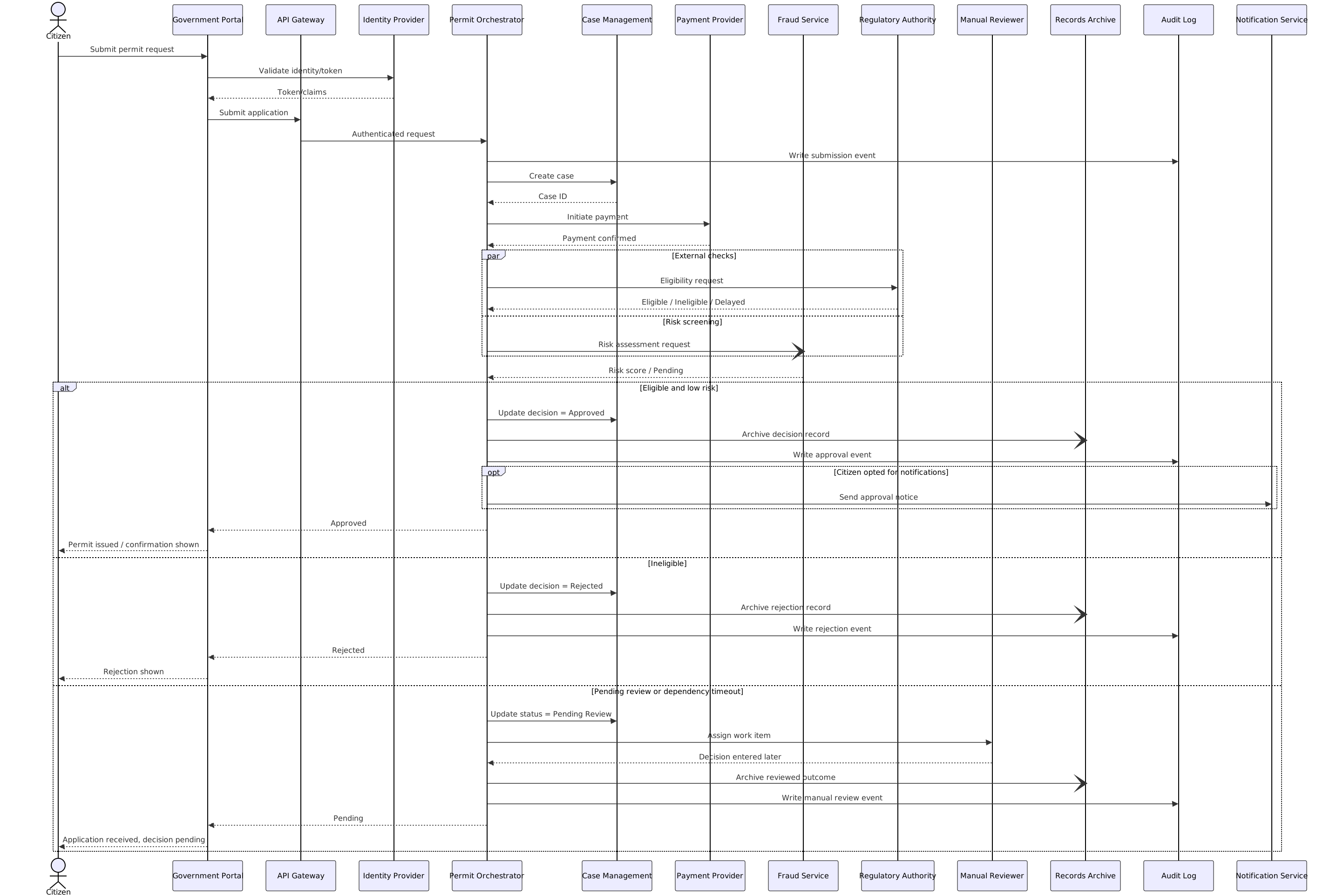
This is still not “complete,” and that’s fine. Architecture-grade does not mean exhaustive.
A couple of judgment calls matter here.
Some internal components should stay collapsed. I do not need to see every microservice inside the permit platform if the architecture question is about external dependencies, trust boundaries, and control timing. But some technical steps absolutely should appear because they are control-relevant. Identity validation is one. Audit logging often is. Archive write may be. Authoritative case creation definitely might be.
This is the balance experienced architects learn: collapse what is merely implementation structure; expose what changes risk, control, timing, or accountability.
What sequence diagrams reveal that static views tend to hide
Static application landscape diagrams are useful, but they flatter architectures. Everything looks composed and intentional. A sequence diagram is much less forgiving.
It exposes hidden coupling. You realize the portal depends not just on the permit service, but indirectly on treasury payments, the fraud platform, the regulatory authority, and notifications.
It surfaces trust boundary crossings. The IAM picture stops being abstract once you see token validation, API gateway mediation, and calls leaving the departmental zone.
It reveals chatty integrations. I’ve seen teams discover that a supposedly simple transaction required twelve blocking calls over the network because nobody had ever written the sequence down honestly.
It shows control bottlenecks. In our permit case, if archive write is synchronous before citizen confirmation, response time becomes hostage to records infrastructure. Maybe that is required. Often it isn’t. But you won’t ask the question unless the interaction is visible.
It exposes misplaced orchestration logic. If every decision and retry sits in the portal layer, you probably have a problem. If manual review is the hidden centre of gravity, pretending the process is fully automated is fantasy.
And maybe most importantly, it punctures false assumptions of transactional consistency. Government systems love to behave as though distributed actions are one atomic outcome. They rarely are. Payment confirmation, case update, archive write, and notification dispatch are usually separate state transitions, often across different platforms and support teams.
A sequence diagram forces you to confront that.
The modeling arguments architects always have — and my view
These questions come up constantly.
Should you show authentication and token exchange every time?
Not every time. But usually, yes, when crossing trust boundaries.
If the diagram is for enterprise architecture review, and calls move between portal, gateway, external SaaS, agency service, or cloud security zones, then hiding authentication details often removes the very thing security and assurance need in order to reason about the design. Sparx EA guide
For an internal refactoring discussion inside a trusted platform boundary, maybe not. But in regulated settings, token exchange is often architecture, not plumbing.
Should databases appear as lifelines?
Sometimes.
I include persistence explicitly when the timing of the write matters, when legal record creation matters, or when consistency assumptions are being disputed. If everyone is arguing about whether “submitted” means written to case management, stored in the transactional database, or archived to the records repository, then yes, show it.
If it’s just a generic repository call that adds noise, leave it out.
Should human actors sit inside the same sequence?
Absolutely, if they alter control flow or elapsed time.
Manual review is not “business stuff off to the side.” It changes SLA commitments, staffing assumptions, segregation-of-duties controls, and operational behavior. I get irritated when teams omit human review because they think it makes the solution look more digital. Architecture is not branding.
How much exception handling is enough?
Not every exception.
But you do need every materially different outcome class: rejected, timed out, pending, compensated, escalated. Those outcomes typically drive different policy, support, and citizen messaging. If they matter operationally or legally, they deserve explicit representation.
How many lifelines are too many?
There is no magic number.
Too few, and the reader cannot identify ownership, timing, or trust transitions. Too many, and no decision can be made from the page. My rough test is practical: can the review board use the diagram to make one meaningful architecture decision? If not, it is either over-compressed or over-expanded.
Anti-patterns worth calling out plainly
I would add one unofficial anti-pattern: diagrams with lifelines named after aspirations. “Compliance Service.” “Decision Engine.” “Integration Layer.” If those are not actual owned systems or clearly accountable services, they muddy governance.
How to read a sequence diagram like an architect
Developers often read sequence diagrams as execution stories. Architects should read them as risk maps.
Start with trust boundaries. Where does identity get established, propagated, transformed, or trusted? Then ask which calls are blocking the citizen experience. Then ask what happens if an external agency is unavailable for four hours. Then ask where the legal record is actually created. Then ask which step establishes authoritative state. Then ask whether any hidden human dependency is carrying the process in practice.
And ask the uncomfortable one: are we pretending distributed steps are transactional?
A governance-ready sequence diagram usually has visible control points, explicit material alternatives, realistic timing assumptions, named accountable lifelines, and enough context to support a review decision.
A team-level design sequence might still be perfectly good for engineering, but it won’t survive scrutiny from security, operations, or audit. That’s fine. The problem is when people confuse the two.
A second example: benefits eligibility re-assessment
A less obvious use case is benefits eligibility re-assessment after a policy rule change.
This is not a single citizen transaction. It is often an event-driven bulk process. A policy engine changes rules. A recalculation trigger is published, maybe onto Kafka or a managed event bus. Thousands or millions of cases fan out for reassessment. Document management gets involved. Notifications are delayed or batched. Some cases create appeal pathways.
This matters because architects often try to cram all of that into one giant diagram and call it “the re-assessment flow.” Don’t.
Appeal initiation is not just another alt branch on the original sequence. It is a new sequence with its own actors, records, deadlines, and evidence requirements. Bulk recalculation and citizen appeal are related, but they are not the same interaction narrative.
Split the diagrams. The discipline to split is one of the things experienced architects do better.
Where sequence diagrams fit in governance
Used well, sequence diagrams are extremely useful in target-state definition, integration design authority reviews, security and privacy review, operational readiness preparation, resilience testing design, and vendor onboarding.
They can support evidence. But carefully.
They are helpful for showing intended control placement, dependency behavior, and interaction logic. They are not process documentation. They are not a control library. They are not deployment architecture. They are definitely not test evidence.
I’ve seen audit teams over-trust architecture diagrams, and I’ve seen engineering teams under-value them. Both are mistakes. A sequence diagram should inform the governance conversation, not replace supporting artifacts.
Producing diagrams that survive contact with delivery
Some practical habits make a big difference.
Keep the notation disciplined, but don’t become doctrinaire about UML purity. Clarity beats purity nearly every time in architecture communication. UML modeling best practices
Add annotations that matter in enterprise settings: trust zone markers, sync/async labels, SLA-sensitive steps, control points, authoritative record creation. A simple note saying “authoritative case state established here” can save a lot of argument later.
Version the diagrams with decision history. Tie them to ADRs, interface contracts, and NFR assumptions. If a team switches from synchronous fraud scoring to asynchronous risk events, that should leave a trace.
And here is one of the most useful habits I know: update sequence diagrams after the first production outage involving cross-system interaction. Not before. After. Outages are brutally clarifying. They reveal the actual runtime dependencies, hidden retries, IAM surprises, and operational ownership gaps in ways design workshops rarely do.
Tooling and notation hygiene
I’m not religious about tools.
PlantUML ages well because text-based diagrams are easier to diff, review, and keep in source control. In regulated programmes, that matters. draw.io is fine for collaborative workshops and quick packs. Enterprise repository tools can help with traceability, though in my experience they often make simple things laborious.
Accessibility matters more than teams expect. Governance packs get printed, exported, screenshared, copied into board papers, and passed to people who did not attend the workshop. Dense decorative UML usually degrades badly in those contexts.
If details are classified or commercially sensitive, produce a sanitized architecture sequence for wider governance and a restricted variant for delivery and security review. Don’t solve sensitivity by making the public version vague to the point of uselessness.
And one final note on strict UML correctness: useful up to a point. If you are spending more time debating arrowhead orthodoxy than clarifying whether the regulatory authority responds in real time or by overnight file drop, you are focusing on the wrong thing.
What experienced architects do differently
They model failure first.
They show the external dependencies everyone is tempted to hand-wave away.
They separate the citizen-facing response from backend completion. That one is huge, especially in cloud-native and event-driven designs where Kafka, queues, serverless handlers, or managed integration platforms create delayed completion patterns.
They include manual and policy-driven interruptions because they know public services are full of them.
They know when to split one sequence into three.
And they treat the diagram as a decision instrument, not just as documentation for the architecture repository.
That, to me, is the real shift. Sequence diagrams become genuinely valuable when they expose uncomfortable truths early enough for someone to do something about them.
The point is not prettier UML. It is fewer expensive surprises
Back to that opening identity verification story. The original diagram wasn’t wrong because it used bad notation. It was wrong because it failed to show the interactions that mattered for architecture decisions: control points, waiting points, failure points, and accountability boundaries.
That is the standard I would use.
If a sequence diagram does not show where trust changes, where the process can pause, where failure materially changes outcome, where evidence is written, and who owns the critical interactions, it is not architecture-grade. It may still be useful. Just not for the decisions people are about to make with it.
So here’s the practical challenge.
Take one “approved” sequence diagram from a current programme. Mark everything omitted that would matter during an audit, an outage, a privacy incident, or a ministerial escalation. Then ask whether the diagram is merely tidy, or actually truthful.
That exercise is usually sobering.
And useful.
Frequently Asked Questions
Can UML be used in Agile development?
Yes — UML and Agile are compatible when used proportionately. Component diagrams suit sprint planning, sequence diagrams clarify integration scenarios, and class diagrams align domain models. Use diagrams to resolve specific ambiguities, not to document everything upfront.
Which UML diagrams are most useful in enterprise architecture?
Component diagrams for application structure, Deployment diagrams for infrastructure topology, Sequence diagrams for runtime interactions, Class diagrams for domain models, and State Machine diagrams for lifecycle modelling.
How does UML relate to ArchiMate?
UML models internal software design. ArchiMate models enterprise-level architecture across business, application, and technology layers. Both coexist in Sparx EA with full traceability from EA views down to UML design models.