⏱ 19 min read
Most enterprise architecture framework discussions are still weirdly detached from actual enterprise architecture work.
They read like exam prep. Clean boxes. Nice acronyms. Zero mention of budget fights, security exceptions, Kafka topic sprawl, IAM politics, cloud platform drift, or the fact that nobody in a large bank has time to “complete” a framework. That’s the first hard truth.
Here’s the second: the best enterprise architecture framework is almost never the one you adopt in full. It’s the one you can use to make better decisions in the mess you actually have.
And in 2026, that matters more than ever. Enterprises are not choosing between “legacy” and “modern” anymore. They are running both. They have cloud-native platforms beside mainframes, event-driven integration beside batch files that somehow still settle money, centralized IAM strategies beside business-unit exceptions, and a Kafka estate growing faster than governance can keep up with. So if your framework cannot help with those realities, it’s not architecture. It’s decorative process. ArchiMate for governance
What is an enterprise architecture framework, really?
Simple version first.
An enterprise architecture framework is a structured way to describe how an organization’s business, applications, data, technology, and governance fit together — and how they should change over time.
That’s the SEO-friendly answer. Fair enough.
But in real life, a framework is more practical than that. It gives architects a way to answer recurring questions like:
- What are we standardizing versus allowing to vary?
- How do business capabilities map to systems and teams?
- Which platforms are strategic, tolerated, or being retired?
- How should we govern cloud, data, IAM, integration, and security decisions?
- How do we move from the current mess to a better future without stopping delivery?
That’s what matters.
Frameworks are not the architecture. They are the scaffolding around architecture work.
And yes, that distinction matters because too many EA teams still confuse producing framework artifacts with improving enterprise outcomes.
Why framework choice matters more in 2026
A few things changed over the last several years.
First, cloud adoption matured. The question is no longer “should we move to cloud?” The real question is “how do we govern multi-cloud, sovereign constraints, platform teams, and cost without strangling delivery?” Traditional frameworks often have answers, but they need interpretation.
Second, event-driven architecture moved from niche to normal in many large enterprises. Kafka is now part of the core landscape in banking, insurance, telecom, retail. But most EA frameworks were born in a world of applications and interfaces, not streams, domains, schemas, and event ownership.
Third, IAM became architecture again. Identity used to get pushed into security or infrastructure. That no longer works. In 2026, identity is deeply tied to customer experience, regulatory controls, zero trust, partner ecosystems, and cloud operating models. If your framework doesn’t help you reason about IAM, it’s incomplete for modern enterprise work.
Fourth, boards and regulators want traceability. They want to know how strategy maps to systems, risks, controls, data, and resilience. Frameworks can help. Or they can bury everyone in diagrams. architecture traceability in Sparx EA
So let’s compare the major frameworks with that reality in mind.
The major enterprise architecture frameworks worth discussing
These are the frameworks that still matter in enterprise conversations:
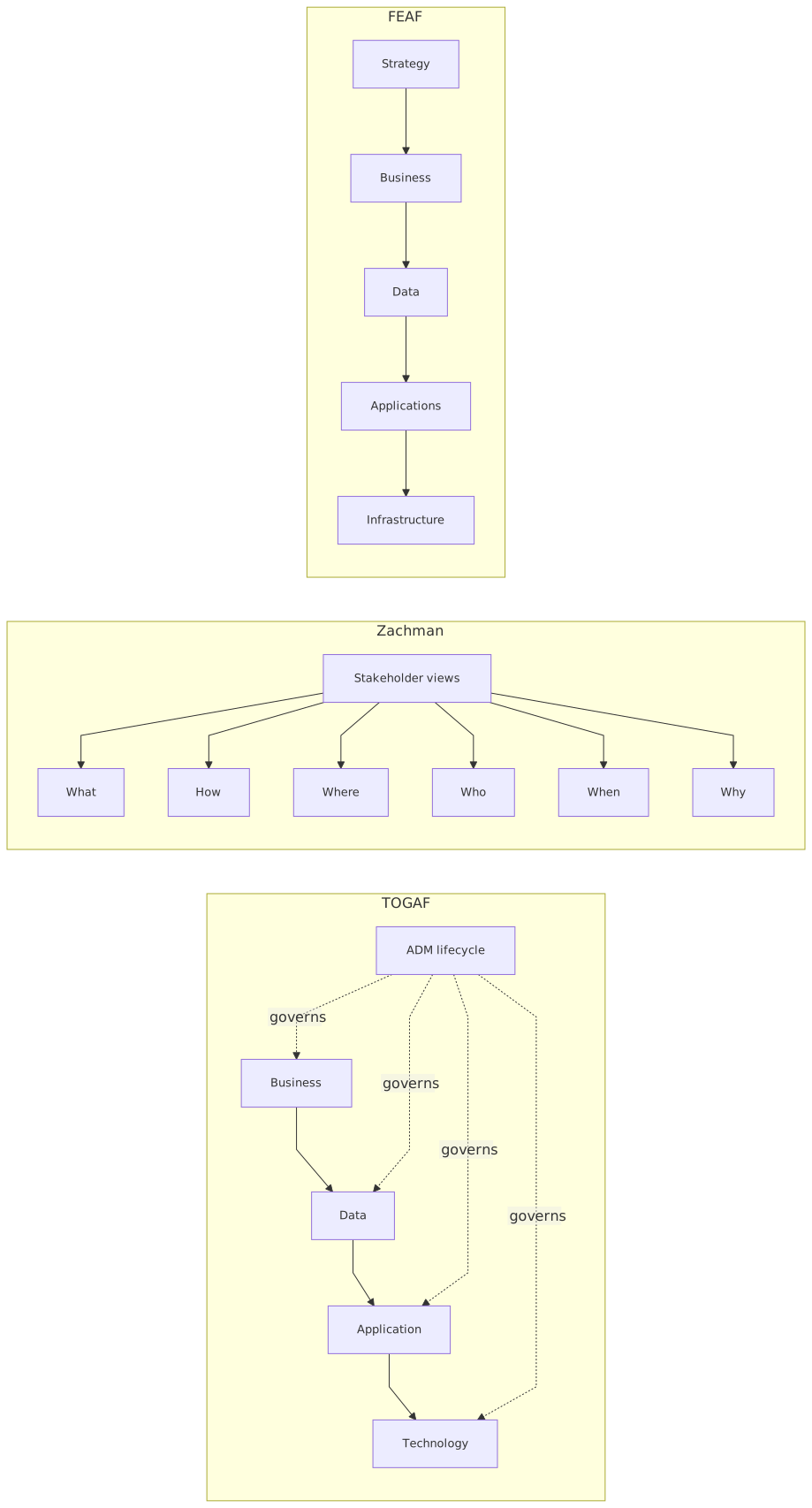
- TOGAF
- Zachman Framework
- FEAF
- Gartner Enterprise Architecture approach
- DoDAF / MODAF / NAF style defense frameworks
- ArchiMate as a modeling language, not a framework, but it belongs in the conversation
- A practical hybrid approach, which is what most competent enterprises actually use
I’ll be blunt: if you are looking for one winner, you’re asking the wrong question. Different frameworks solve different problems. Some are good for governance. Some are good for taxonomy. Some are good for communication. Some are mostly useful as career certifications. That may sound harsh. It’s also true. EA governance checklist
Quick comparison table
1) TOGAF: still dominant, still misunderstood
TOGAF is still the default enterprise architecture framework in many large organizations. Not because it is perfect. Because it is broad, recognized, and gives enterprises something they desperately want: a repeatable architecture method.
At its core, TOGAF gives you:
- the ADM (Architecture Development Method)
- content structures
- governance concepts
- capability guidance
- a common vocabulary
That is useful. Especially in large banks, insurers, and government-linked organizations where architecture has to be auditable, not just clever.
What TOGAF is good at
TOGAF is good at giving architecture teams a process backbone:
- understand business drivers
- assess current state
- define target state
- identify gaps
- plan transitions
- govern implementation
That sounds basic, but a lot of enterprises still don’t do this consistently.
In a banking context, let’s say the enterprise wants to modernize customer onboarding. The current state includes:
- branch onboarding systems
- a web channel
- a mobile app
- manual KYC checks
- fragmented IAM
- point-to-point integrations
- batch synchronization into core banking
TOGAF helps structure the work:
- Business architecture defines onboarding capability, regulatory drivers, and customer outcomes
- Application architecture maps channel systems, KYC platforms, CRM, IAM, and core banking components
- Data architecture identifies customer identity data, consent, risk flags, and golden record issues
- Technology architecture covers cloud landing zones, API gateways, Kafka, IAM federation, and resilience requirements
- Migration planning sequences change without breaking compliance
That’s real enterprise architecture work. Not abstract. Very useful.
Where TOGAF goes wrong
TOGAF’s problem is not TOGAF. It’s how people use it.
Common mistakes:
- Trying to implement all of TOGAF
- Turning ADM into a gated waterfall ritual
- Producing architecture deliverables nobody reads
- Separating EA from delivery too aggressively
- Treating governance as approval theater
A lot of architects say they are “doing TOGAF” when what they are really doing is creating too many documents and slowing teams down. ArchiMate in TOGAF ADM
My opinion: TOGAF is valuable only when aggressively simplified.
Use the logic. Use the structure. Use the governance concepts. But do not force every initiative through a giant architecture machine. That’s how EA loses credibility. ADR template
Best fit
TOGAF fits:
- large enterprises
- regulated sectors
- organizations building or rebuilding EA capability
- environments where traceability and governance matter
It fits less well in:
- fast-moving digital-native firms
- product organizations allergic to central process
- companies looking for a lightweight strategic lens only
2) Zachman: brilliant taxonomy, poor operating model
Zachman is one of the most respected frameworks in architecture circles, and one of the least properly used.
The basic idea is elegant: classify architecture artifacts by asking different questions — what, how, where, who, when, why — across different perspectives. It pushes completeness and discipline in thinking.
As a thinking tool, it’s excellent.
As a complete operating framework for enterprise transformation, it’s not enough.
That’s the contrarian take some people still resist. Zachman has intellectual clarity, but enterprises don’t transform through taxonomy alone.
Where Zachman shines
If your architecture practice is chaotic, Zachman can help you identify blind spots.
For example, in a cloud and IAM modernization program, teams often over-focus on technology:
- landing zones
- Kubernetes clusters
- network patterns
- CI/CD
- identity providers
But they miss:
- business ownership
- operating processes
- policy timing
- role/accountability models
- rationale and decision traceability
Zachman forces the conversation wider. That’s valuable.
Where it falls short
It doesn’t tell you enough about:
- how to run architecture as a change discipline
- how to govern transitions
- how to sequence change
- how to integrate with portfolio and delivery
- how to make trade-offs under pressure
So yes, Zachman is useful. But mostly as a classification schema, not as the main engine of enterprise architecture.
Best fit
Use Zachman:
- as a completeness check
- as a taxonomy reference
- to improve architecture repository structure
Don’t use Zachman alone if you need:
- transformation governance
- practical roadmapping
- architecture operating model guidance
3) FEAF: stronger than people think, but context matters
The Federal Enterprise Architecture Framework often gets dismissed as “government architecture.” That’s too simplistic.
FEAF is strong when you need:
- structured reference models
- policy alignment
- consistency across large organizational boundaries
- traceability from mission to implementation
That’s not just government. Plenty of regulated commercial enterprises have similar needs.
A major bank, for example, often behaves more like a public institution than a startup:
- strong controls
- external regulators
- formal operating models
- data retention requirements
- resilience obligations
- audit pressure
In that world, FEAF-style thinking can be surprisingly relevant.
Strengths
FEAF’s reference model approach can help standardize conversations around:
- performance
- business operations
- service components
- data
- technology
That can be useful when multiple divisions use different language for the same thing.
Weaknesses
It can feel rigid. And outside policy-heavy environments, it often feels unnatural.
Commercial enterprises usually need more flexibility, more product orientation, and more room for platform evolution than FEAF naturally encourages.
Best fit
FEAF works best in:
- public sector
- quasi-public institutions
- highly regulated environments
- organizations needing formal cross-agency or cross-division alignment
It is less attractive for:
- decentralized product companies
- organizations prioritizing speed over formal consistency
4) Gartner-style EA: practical, outcome-first, less framework theater
This is less a single formal framework and more an approach. But it deserves a place here because many modern EA leaders work this way, whether they admit it or not.
The Gartner-style view of enterprise architecture is more focused on:
- business outcomes
- strategic decision support
- enabling change
- product/platform operating models
- fewer useless artifacts
Frankly, a lot of architects who got tired of framework-heavy EA migrated mentally toward this model.
Why it works
Because it starts from a truth that should be obvious: architecture exists to improve enterprise decisions.
Not to maintain a repository.
Not to produce perfect target-state posters.
Not to review every solution in exhausting detail.
In a cloud platform program, for example, a Gartner-style EA team might focus on:
- defining enterprise guardrails for cloud usage
- clarifying platform versus product team responsibilities
- establishing IAM principles for workforce and customer identity
- setting Kafka event ownership and schema governance rules
- shaping technology investment decisions
- measuring outcomes like reuse, resilience, risk reduction, and time-to-market
That’s architecture as a strategic capability, not architecture as paperwork.
The catch
This approach depends heavily on the quality of the architects. There is less procedural safety net.
A weak team can turn “outcome-driven” into vague advisory work with no structure.
A strong team can turn it into the most effective EA model in the enterprise.
Best fit
Very strong for:
- modern enterprises
- platform operating models
- cloud-first organizations
- organizations trying to reconnect EA to strategy and delivery
Less suitable if:
- you need a highly formalized method for audit or capability build-out
- your architecture function is immature and needs more scaffolding
5) DoDAF, MODAF, NAF: heavy, yes. Also excellent in the right context.
Most commercial architects ignore defense architecture frameworks. Usually fair. Sometimes a mistake.
DoDAF and related frameworks are built for environments where:
- systems are highly complex
- assurance matters
- traceability matters
- multiple stakeholders need consistent views
- system-of-systems interactions are critical
That sounds military. It also sounds a lot like certain banking and critical infrastructure environments.
Why commercial architects should at least know them
If you are working on:
- payment infrastructure
- national identity platforms
- high-assurance IAM ecosystems
- operational resilience architecture
- cross-enterprise command-and-control style integration
there is something to learn from these frameworks.
They are particularly strong in viewpoint discipline and traceability across concerns.
Why they are usually not the answer
Because they are heavy. Really heavy.
For most enterprises, applying them directly would be absurd. You don’t need defense-grade architecture views to rationalize SaaS sprawl or define Kafka tenancy patterns.
Still, they are worth understanding when architecture rigor needs to go beyond normal corporate standards.
6) ArchiMate: not a framework, but incredibly useful
ArchiMate is often thrown into framework comparisons even though it is really a modeling language.
Still, it matters because many architecture teams fail not from lack of ideas, but from lack of a shared way to visualize those ideas.
ArchiMate gives you a way to model:
- business capabilities
- value streams
- applications
- data objects
- technology components
- relationships and dependencies
- motivation and strategy elements
That is powerful.
Where ArchiMate helps real work
Suppose a bank is redesigning its IAM estate. It has:
- legacy Active Directory dependencies
- cloud identity federation
- customer identity and access management
- privileged access management
- API authorization
- inconsistent role models
- fragmented audit trails
Without a common modeling language, discussions become hand-wavy fast.
With ArchiMate, you can create views showing:
- which business capabilities depend on which identity services
- where customer and workforce identity diverge
- which applications rely on legacy directories
- how target-state cloud IAM integrates with policy enforcement and Kafka-based event propagation
- transition architectures for phased migration
That’s practical.
The trap
The trap is obvious: diagram addiction.
Some teams produce beautiful ArchiMate models that no one uses to make decisions. If your diagrams don’t help funding, sequencing, risk, or implementation alignment, they are architecture wallpaper. ArchiMate relationship types
What this looks like in real architecture work
Let’s get concrete.
Example: retail banking modernization
A regional bank wants to modernize customer servicing across channels. The current estate looks familiar:
- core banking on older platforms
- CRM in partial use
- mobile and web channels built by separate teams
- IAM split between workforce and customer stacks
- Kafka introduced for event streaming but with weak domain ownership
- cloud adoption growing, but with inconsistent landing zone patterns
- compliance and audit concerns around identity, data access, and resilience
This is where frameworks stop being academic.
How a good architecture team would apply them
TOGAF might be used to structure the overall transformation:
- current state assessment
- target architecture
- transition architectures
- governance checkpoints
ArchiMate might be used to model:
- customer servicing capability
- application dependencies
- IAM components
- event flows through Kafka
- cloud platform services
Gartner-style outcome focus would shape the actual priorities:
- reduce onboarding time
- improve service consistency across channels
- reduce IAM risk
- standardize event governance
- lower integration complexity
Zachman might be used quietly as a completeness lens:
- have we covered process, ownership, timing, motivation, geography, data?
That’s how mature teams work. They don’t worship one framework. They combine what is useful.
Some actual architecture decisions in that scenario
Real architecture work would include decisions like:
- Should customer identity remain separate from workforce IAM? Usually yes, but with shared policy principles and common audit patterns.
- Should Kafka be the integration backbone for all interactions? No. That’s a common mistake. Use Kafka for event-driven patterns where decoupling and streaming matter, not as a religion.
- Should cloud landing zones be standardized centrally? Yes, but with product team self-service and clear exceptions.
- Should every application integrate directly with the enterprise IdP? No. Introduce patterns and tiers. Some apps need federation, some need token brokering, some need modernization first.
- Should architecture standards be mandatory? Some should. But standards without adoption paths are fantasy.
This is where frameworks help if they are used with judgment.
Common mistakes architects make with frameworks
This is the part people usually skip. They shouldn’t.
1) Treating the framework as the deliverable
The point is not “we adopted TOGAF.” Nobody outside architecture cares. TOGAF roadmap template
The point is whether architecture improved:
- decision quality
- reuse
- resilience
- compliance
- modernization speed
- cost control
- strategic coherence
2) Over-documenting current state
Some current-state work is necessary. Too much is a trap.
I’ve seen teams spend months documenting applications in painful detail while cloud spend balloons, Kafka topics multiply, and IAM exceptions become permanent. Documentation can become avoidance.
3) Creating target states with no transition logic
A target architecture that ignores funding cycles, delivery capacity, regulatory deadlines, and technical debt is not architecture. It is imagination.
4) Ignoring operating model realities
This is huge.
A framework may suggest neat accountability, but if the enterprise has:
- centralized infrastructure
- federated business technology teams
- fragmented data ownership
- separate security governance
- outsourced run operations
then architecture must work with that reality. Not pretend it doesn’t exist.
5) Confusing standards with strategy
“Use Kafka.”
“Move to cloud.”
“Adopt zero trust.”
“Standardize IAM.”
Those are not strategies. They are directionally useful statements. Architecture work starts when you define:
- where
- why
- how
- for whom
- by when
- with what constraints
6) Underestimating identity
Many architects still treat IAM as a technical subdomain. That is outdated.
Identity shapes:
- customer journeys
- access risk
- platform trust boundaries
- auditability
- partner integration
- cloud operations
- data protection
If your framework application doesn’t elevate IAM, you are missing a major enterprise concern.
7) Making Kafka someone else’s problem
Another modern failure.
Kafka often grows outside normal EA governance because it starts as a platform or engineering initiative. Then a year later you have:
- duplicate events
- unclear ownership
- incompatible schemas
- weak retention policies
- poor lineage
- hidden coupling
Enterprise architecture absolutely should care about event architecture. Not at the code level, but at the domain, ownership, governance, and platform pattern level.
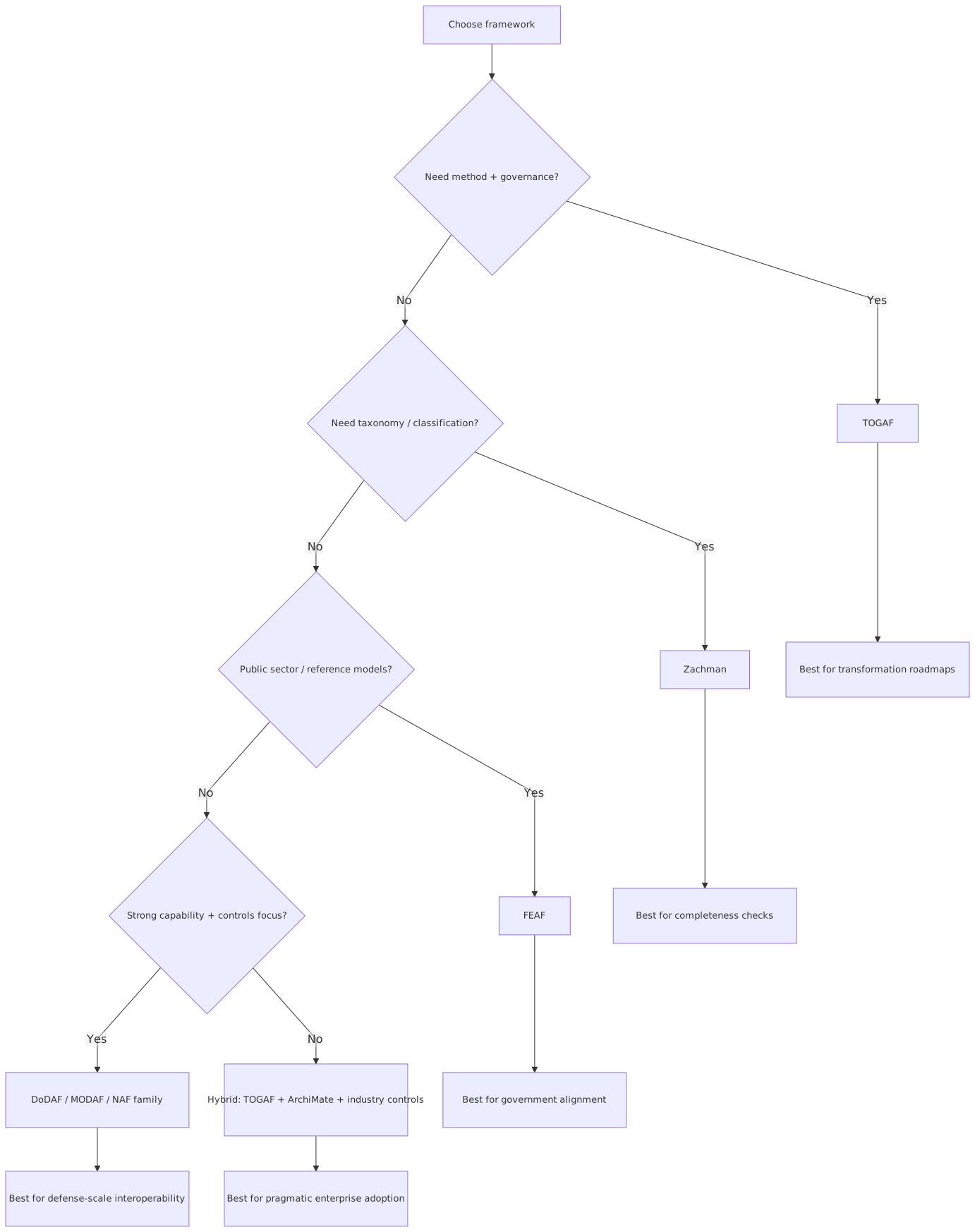
So which framework should you use?
Here’s the opinionated answer.
Use TOGAF if:
- you need a formal EA backbone
- you operate in a large regulated environment
- your architecture function needs structure
- governance and traceability matter
But tailor it hard. Ruthlessly.
Use Zachman if:
- you need a taxonomy
- you want a way to test completeness
- your architecture artifacts are inconsistent
But don’t expect it to run your transformation.
Use FEAF if:
- policy alignment and structured reference models are central
- you are in government or similar environments
Use a Gartner-style EA approach if:
- you want architecture to influence strategy and execution
- your organization is platform-oriented and cloud-heavy
- you need fewer artifacts and stronger decision support
Use ArchiMate if:
- you need consistent visual modeling across business, application, data, and technology layers
Use a hybrid if:
- you are serious about getting results
That last one is the real answer for most enterprises.
My recommended approach for 2026
If I were setting up or resetting an enterprise architecture practice in 2026, especially in a bank or similarly complex enterprise, I would do this:
1) Use TOGAF as the structural backbone
Not the whole thing. The backbone.
Keep:
- architecture vision
- baseline and target thinking
- transition architectures
- governance concepts
- repository discipline
Drop or simplify:
- excessive content formality
- ceremony-heavy ADM usage
- document templates nobody needs
2) Use ArchiMate for key views
Not for everything. For the views that matter:
- business capability maps
- platform landscapes
- IAM dependency views
- event/data flow views
- transition roadmaps
3) Use Gartner-style principles for operating the EA team
Focus architects on:
- strategic decisions
- investment shaping
- platform guardrails
- measurable outcomes
- engagement with delivery
4) Borrow Zachman as a quality check
Use it to ask:
- what did we miss?
- which perspective is under-modeled?
- where is ownership unclear?
5) Add explicit architecture patterns for cloud, IAM, and eventing
This is the modern addition frameworks often need.
Define enterprise patterns for:
- cloud landing zones
- identity federation
- customer IAM
- privileged access
- API security
- Kafka tenancy and topic ownership
- event schema governance
- resilience and recovery tiers
This is where architecture becomes useful to engineering teams.
Final thought
Frameworks matter. But not in the way framework marketing suggests.
No enterprise gets better because it picked the “best” framework. It gets better because architects use structure, judgment, and influence to help the organization make better trade-offs.
That means:
- less framework purity
- more practical tailoring
- more attention to IAM, cloud, and event architecture
- more transition planning
- fewer dead artifacts
- stronger connection to delivery and risk
If that sounds less glamorous than framework debates, good. Enterprise architecture is not supposed to be glamorous. It is supposed to be useful.
And in 2026, useful architecture is architecture that can survive contact with reality.
FAQ
1) What is the best enterprise architecture framework in 2026?
For most large enterprises, there is no single best one. TOGAF plus a pragmatic operating model and ArchiMate for visualization is still the strongest general-purpose combination. If you use TOGAF literally and fully, though, it often becomes too heavy.
2) Is TOGAF still relevant in cloud-native enterprises?
Yes, but only if tailored. Cloud-native enterprises still need target states, governance, transition planning, and capability mapping. What they do not need is bloated documentation and slow review cycles. capability map template
3) What framework works best for banking and regulated industries?
Usually a hybrid centered on TOGAF, with stronger governance, risk traceability, and explicit patterns for IAM, data, resilience, and Kafka/event architecture. Banking needs formal structure, but delivery cannot stop for architecture paperwork.
4) Is Zachman better than TOGAF?
Not really a fair comparison. Zachman is better as a taxonomy and completeness tool. TOGAF is better as a method and governance structure. In practice, TOGAF is more usable as the primary enterprise framework.
5) How do architects actually use frameworks in day-to-day work?
Mostly by applying selected pieces:
- capability mapping
- current/target state modeling
- architecture principles
- transition planning
- standards and guardrails
- governance for major decisions
In real work, frameworks support choices around things like cloud platforms, IAM integration, Kafka governance, application rationalization, and investment sequencing. They are not followed page by page.
Frequently Asked Questions
What is enterprise architecture?
Enterprise architecture is a discipline that aligns an organisation's strategy, business processes, information systems, and technology. Using frameworks like TOGAF and modeling languages like ArchiMate, it provides a structured view of how the enterprise operates and how it needs to change.
How does ArchiMate support enterprise architecture practice?
ArchiMate provides a standard modeling language that connects strategy, business operations, applications, data, and technology in one coherent model. It enables traceability from strategic goals through business capabilities and application services to the technology platforms that support them.
What tools are used for enterprise architecture modeling?
The main tools are Sparx Enterprise Architect (ArchiMate, UML, BPMN, SysML), Archi (free, ArchiMate-only), and BiZZdesign Enterprise Studio. Sparx EA is the most feature-rich option, supporting concurrent repositories, automation, scripting, and integration with delivery tools like Jira and Azure DevOps.