⏱ 5 min read
Recommended Reading
Executive summary
An EA knowledge base is architecture memory: decisions, standards, and current-state relationships that stay usable beyond individual projects. Sparx EA supports this with DBMS repositories and cloud access patterns, plus governance primitives: baselines for approved snapshots, auditing for accountability, and model reviews for structured collaboration. WebEA enables broad stakeholder access and can serve as the publication layer for the knowledge base. Sparx EA training
- Knowledge base structure: standards, capabilities, decisions
- Lifecycle and curation: baselines and review cadences
- Publication: WebEA and controlled outputs

- DBMS repositories support.
- Cloud repos overview (WAN optimization).
- WebEA installation/config.
- Baselines definition.
- Auditing.
- Model reviews.
- Sparx EA DBMS repositories overview.
- Sparx EA repository definition and types (file/DBMS/cloud).
- Sparx EA file-based projects overview.
- Sparx EA cloud repositories overview (WAN optimization, encrypted links).
- Sparx EA Pro Cloud Server repositories concept.
- Sparx EA Pro Cloud Server features and integrations (SBPI).
- Sparx EA Pro Cloud Server configuration persistence (SSProCloud.config).
- Sparx EA WebEA installation and configuration.
- Sparx EA controlled packages (Native/XMI externalization).
- Sparx EA XMI for version control integration.
- Sparx EA package version control operations.
- Sparx EA baselines definition (snapshot/compare/revert).
- Sparx EA compare model to baseline behavior.
- Sparx EA auditing (records who/what/when changes).
- Sparx EA auditing note (does not replace baselines/version control).
- Sparx EA model reviews (formal assessment collaboration).
- Sparx EA review elements (discussion capture).
- Sparx EA model security overview.
- Sparx EA permissions list.
- Sparx EA replication support and DBMS limitation.
- Sparx EA developing profiles (XML + MDG deployment).
- Sparx EA tagged values in profiles (auto addition on creation).
- Sparx MDG Technologies guide (packaging extension resources).
- Sparx OSLC Architecture Management overview (integration concept).
- TOGAF standard overview (Open Group).
- TOGAF compliance review concept.
- TOGAF architecture board definition.
- TOGAF architecture contracts definition.
- Open Group architecture governance framework deck.
- ArchiMate 3.2 reference cards (Open Group).
- ArchiMate 3.2 specification framing (Open Group).
- Capability map viewpoint description and heatmap use.
- ADR blog post “Documenting Architecture Decisions.”
- ADR practice site.
- GDPR Article 30 (records of processing activities).
- EDPB position paper on Article 30(5) derogations.
- AWS ARB guidance (multi-disciplinary board, reduce recycle).
- SAFe agile architecture guidance.
- SAFe Lean Portfolio Management.
Four pillars of an EA knowledge base
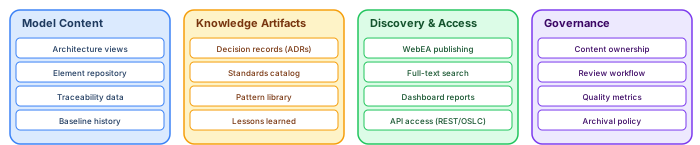
An EA knowledge base transforms the Sparx EA repository from a modeling tool into an organizational knowledge asset. The repository already contains architecture models — extending it into a knowledge base adds decision records, standards, patterns, and discovery mechanisms that make architecture knowledge accessible to the entire organization. Sparx EA best practices
Model content is the foundation: architecture views (ArchiMate, UML, BPMN), the element repository (all components, services, processes with their properties and relationships), traceability data (requirement-to-implementation chains), and baseline history (snapshots of the architecture at key decision points). This content exists in any well-maintained Sparx EA repository.
Knowledge artifacts extend beyond models: Architecture Decision Records (ADRs) documenting what was decided, why, and what alternatives were rejected. A standards catalog listing all active architecture standards with their rationale, scope, and exceptions. A pattern library containing reusable architecture patterns (integration patterns, security patterns, deployment patterns) with guidance on when to use each. Lessons learned from completed projects, capturing what worked, what did not, and what the team would do differently.
Discovery and access determines whether the knowledge base is used or ignored. WebEA publishing makes architecture content accessible through a web browser — stakeholders do not need the Sparx EA thick client. Full-text search enables finding elements, decisions, and patterns by keyword. Dashboard reports provide at-a-glance views of portfolio health, compliance status, and architecture debt. API access (REST via Pro Cloud Server, OSLC) enables integration with other enterprise tools.
Governance ensures the knowledge base stays current and trustworthy. Content ownership assigns responsibility for each section. Review workflows ensure new content is validated before publication. Quality metrics track freshness and completeness. Archival policies prevent the knowledge base from becoming a graveyard of stale content — unused or outdated material is archived, not just accumulated.
Making it self-sustaining
The biggest risk for an EA knowledge base is entropy — it starts strong and gradually decays as teams stop contributing. Three mechanisms prevent this: make contribution part of the workflow (every architecture decision automatically creates an ADR entry), make consumption valuable (teams find the knowledge base faster than asking colleagues), and measure usage (track page views, search queries, and contribution rates to identify declining engagement early).
If you’d like hands-on training tailored to your team — Sparx Enterprise Architect, BPMN, SysML, Apache Kafka or the Archi tool — or modelling coaching in ArchiMate and TOGAF-aligned governance, you can reach us via our contact page.
Frequently Asked Questions
What is Sparx Enterprise Architect used for?
Sparx Enterprise Architect (Sparx EA) is a comprehensive UML, ArchiMate, BPMN, and SysML modeling tool used for enterprise architecture, software design, requirements management, and system modeling. It supports the full architecture lifecycle from strategy through implementation.
How does Sparx EA support ArchiMate modeling?
Sparx EA natively supports ArchiMate 3.x notation through built-in MDG Technology. Architects can model all three ArchiMate layers, create viewpoints, add tagged values, trace relationships across elements, and publish HTML reports — making it one of the most popular tools for enterprise ArchiMate modeling.
What are the benefits of a centralised Sparx EA repository?
A centralised SQL Server or PostgreSQL repository enables concurrent multi-user access, package-level security, version baselines, and governance controls. It transforms Sparx EA from an individual diagramming tool into an organisation-wide architecture knowledge base.