⏱ 21 min read
I’ll start with the part most architecture teams rarely say plainly: most pattern libraries end up as shelfware.
Not because architects are lazy. Usually it’s the opposite. People put serious effort into them. They create package structures, naming conventions, metamodels, review gates, reference diagrams, color coding — all the things architecture teams naturally reach for when they’re trying to impose order on complexity.
And still, when delivery pressure hits, nobody goes near the library.
I’ve seen this play out in utilities, generation businesses, retail energy, and transmission and distribution programs. I’ve seen it during billing platform transformations, OT/IT integration around substations, smart meter rollouts, and the rush to onboard telemetry from wind and solar assets acquired faster than the enterprise could standardize them. The symptoms are usually the same. The Sparx EA repository fills up with “patterns,” but in reality it contains a blend of old solution diagrams, target-state views, standards references, governance notes, and conceptual models that only the architecture team can really interpret. Sparx EA training
That is not fundamentally a reuse problem. It’s a trust problem.
Delivery teams do not reuse things they don’t trust to help them make a decision when time is short. And they especially don’t trust repository content that looks polished but doesn’t tell them when to use it, when not to use it, which technologies are approved, which security controls are non-negotiable, or whether anyone has actually implemented it in a live environment.
So this article is intentionally a little contrarian. The question is not “how do we document more patterns in Sparx EA?” The more useful question is much more grounded: what actually makes a pattern reusable when the program is already slipping, security is understandably nervous, vendors are pushing their own stack, and engineering just wants a design they can build without regretting it six months later? Sparx EA guide
My view, after 15 years of doing this, is fairly simple. A useful pattern library in Sparx EA is not a catalog first. It is a small set of opinionated, governed, context-rich building blocks tied directly to recurring delivery decisions. Sparx EA maturity assessment
Build that, and people will use it.
Build a museum, and they won’t.
First, define “pattern” properly or the repository will collapse into mush
One of the biggest reasons pattern libraries fail is that teams get sloppy about what a pattern actually is.
A standard is not a pattern.
A reference architecture is not a pattern.
A solution blueprint is not a pattern.
A template is not a pattern.
All of those can be useful. They’re just not the same thing.
A pattern, in practical enterprise architecture terms, is a reusable response to a recurring architectural problem in a known context, with clear constraints and trade-offs.
That last part matters more than most repositories admit. Constraints and trade-offs are what make a pattern usable in the real world. Without them, what you have is generic architecture wallpaper.
To make that concrete:
If you say, “event-driven ingestion of smart meter interval data into analytics platforms,” that can be a pattern. It addresses a recurring problem. It applies in a known context. It has real forces around throughput, ordering, replay, data quality, cost, and operational support. It also tends to come with familiar implementation choices: Kafka, cloud event services, stream processing, schema management, IAM integration, maybe object storage for cold retention.
If you say, “our target application architecture for digital grid operations,” that is not a pattern. That’s a broad reference view. Potentially useful. But reusable at the point a team has to make a decision? Usually not.
Another example: “secure OT telemetry broker isolation zone for renewable generation sites” can absolutely be a pattern. It addresses a recurring problem — how to move telemetry from operational systems into enterprise platforms without pretending cyber-segmentation isn’t real. It carries specific constraints: no direct write-back, approved protocols only, local buffering, certificate management, firewall zoning, and the usually messy realities of patch windows and site connectivity.
By contrast, “one-off wind farm integration design” is not a pattern. It may contain pattern candidates, but the design as a whole is not reusable as-is.
Sparx EA needs to represent these differences explicitly. If everything in the repository is just an “architecture artifact” with a note attached, the library will eventually become hard to search, hard to govern, and hard to trust.
I’ve watched that happen more than once.
The repository starts as a place to preserve knowledge. It ends as sediment.
The mistake I made early on
I should say this plainly: I got this wrong myself.
Years ago, on a large utility transformation, I spent months building what I thought was a very elegant pattern library structure in Sparx EA. It had beautifully nested packages. Thoughtful stereotypes. Naming standards. Matrix views. Tagged values for lifecycle status. Cross-links to standards. A proper taxonomy across business, data, application, and technology domains. If you were an architect browsing the repository, it looked serious. Mature, even.
The architecture team admired it. ArchiMate in TOGAF
Delivery teams ignored it.
At the time, I was irritated, which in hindsight was unfair. I assumed they were bypassing something useful. What they were really doing was telling me, in the only way that mattered, that the library was not helping them deliver.
Why did it fail?
Because the patterns were too abstract. Because there was no blunt “when to use this” guidance. Because they weren’t tied to approved products and services. Because there were no examples from real programs. Because an engineer couldn’t take one, adapt it, and build from it. Because the repository had architecture neatness, but not delivery gravity.
That was an expensive lesson. Also a very useful one.
Pattern libraries should start from recurring implementation pain, not repository elegance.
Once I accepted that, the whole approach changed. We stopped asking, “What is the best taxonomy?” and started asking, “What decisions keep coming up in projects, and where are teams repeating the same mistakes?”
That question got us somewhere.
Start with recurring decisions, not architecture layers
Most teams begin in the wrong place because architecture frameworks make the wrong place look respectable.
Business layer, data layer, application layer, technology layer. It’s tidy. It works on slides. It keeps everyone calm.
But patterns are not chosen during framework reviews. They are chosen in the middle of decisions.
A solution architect is not thinking, “I am now selecting from the technology architecture layer pattern subset.” They are asking, “How do I ingest telemetry from field devices without violating OT segregation?” Or, “Do I put this meter data flow on batch or Kafka?” Or, “How do I expose operational data to analytics without someone trying to connect directly into SCADA?”
That is how people actually work.
So for a first version of a pattern library, I strongly prefer organizing around recurring decision points.
In an energy enterprise, those decision points usually look something like this:
- How do we integrate field device telemetry?
- When do we use batch versus event streaming for meter data?
- How do we segregate OT and corporate IT traffic?
- How do we expose grid operational data to analytics safely?
- How do we support multi-region monitoring for solar and wind assets?
- How do we isolate vendor platforms while still integrating with enterprise systems?
- How do we broker identity across operational and enterprise domains?
Each decision becomes an entry point. Under that entry point, one or more patterns sit in Sparx EA with enough context to support a real choice.
That is much more useful than a pristine package called “Integration Architecture Reusable Artifacts.”
Nobody searches for that when things are on fire.
They search for “how do we get this data across the boundary safely?”
What the first 12 patterns probably should be
I’m not a fan of giant initial libraries. If your first release has 60 patterns, you almost certainly have 10 useful ones and 50 future maintenance liabilities.
For a typical energy organization, I’d start with 8 to 12. Here’s an opinionated set I’ve found credible in practice.
1. API Façade for Legacy Billing and Customer Platforms
For exposing brittle billing functions without letting every channel or downstream service integrate directly with a legacy core. Use it when you need controlled access, abstraction, throttling, and a path to modernization. Don’t use it if you’re just wrapping a bad interface and pretending the underlying data model problem has gone away.
2. Event-Driven Meter Data Ingestion
For high-volume smart meter interval data, event notifications, and operational events consumed by downstream analytics and settlement processes. Typical stack: Kafka, schema registry, stream processing, cloud object storage, IAM-integrated producers and consumers. Not ideal where source systems can only produce stable batch extracts and the business latency is measured in days.
3. OT/IT DMZ Telemetry Mediation
A core pattern. More on this later. Securely mediates telemetry flow from substations, plants, or renewable sites into enterprise platforms.
4. Site-to-Cloud Edge Buffering for Intermittent Connectivity
Very useful in remote solar and wind environments. Local collection and buffering at the edge, replay on reconnect, integrity checks, eventual publication upstream. Don’t use it if the real problem is poor source data quality or if the site has hard restrictions against your chosen edge runtime.
5. Canonical Asset Event Model for Generation Assets
A pattern for standardizing how turbines, inverters, transformers, and related assets publish operational events into enterprise event streams. Helpful, but easy to overdo. Canonical models should be small and driven by actual cross-domain use cases, not by abstract perfectionism.
6. SCADA Read-Only Analytics Replication
For moving operational data into analytics environments without direct polling from enterprise tools into control systems. Often implemented with historians, replication services, or brokered feeds. Security teams usually like this pattern, and usually for good reason.
7. Identity Brokering Across Operational and Enterprise Domains
Needed when users, applications, or service identities span IAM boundaries. Think enterprise IdP on one side, operational platform identities on the other, with strict federation and role mapping. Hard to do well. Very easy to oversimplify.
8. Data Product Publication for Market and Operations Reporting
Useful where multiple teams need governed, reusable data outputs instead of direct database access. Typical technologies might include cloud data platforms, cataloging, role-based access, and event- or API-based publication.
9. Vendor Platform Isolation with Integration Gateway
For energy platforms that arrive as “black boxes” from OEMs or specialist vendors. The pattern limits coupling, contains vendor churn, and stops your enterprise integration estate from becoming hostage to proprietary models.
10. Time-Series Storage and Retention Partitioning
Because not all telemetry belongs in the same storage platform for the same duration. This pattern separates hot operational use, mid-term analytics, and long-term compliance or historical retention.
11. Alarm/Event Prioritization and Routing
A practical pattern for reducing alert floods and ensuring operationally meaningful events reach the right systems and people. Especially useful when renewable sites, substations, and enterprise observability tools all generate overlapping noise.
12. Digital Twin Synchronization
A pattern for maintaining synchronization between physical asset state, engineering models, and analytical or simulation views. Worth having only if you have genuine digital twin use cases. Otherwise it quickly becomes a fashionable bucket for vague diagrams.
For each pattern, the repository version should be blunt about four things:
- what problem it solves
- when not to use it
- what technologies are typical
- what security or regulatory caveats apply
That “when not to use it” field is one of the most neglected and most valuable additions you can make.
It prevents misuse. It also makes the pattern feel honest.
What reusable patterns actually need in Sparx EA
Most libraries leave out the fields that make reuse possible, then wonder why people just copy old project diagrams instead.
Here’s the minimum set I’ve come to rely on.
You do not need a PhD-grade metamodel to support this in Sparx EA. You need disciplined modeling and a willingness to say no to ambiguity.
How to model it in Sparx EA without building a museum
This is where teams often overcomplicate things.
Yes, Sparx EA can support a robust reusable pattern library. No, you do not need to turn version one into a fully customized MDG technology with 40 stereotypes, scripted validations, and a governance board just to publish the first useful pattern.
In fact, I’d avoid that.
My usual package structure is boring on purpose:
- Pattern Library
- Integration Patterns
- Security / Segmentation Patterns
- Data Patterns
- Edge and Site Connectivity Patterns
- Industry Reference Examples
- Deprecated / Retired Patterns
That is enough.
Within each pattern package, include:
- an overview element
- one canonical structural diagram
- one or two behavior or sequence views
- explicit constraints
- metadata via tagged values
- links to technology standards and reference components
- at least one real implementation example
For stereotypes, keep it simple:
PatternPatternVariantAntiPatternReferenceImplementation
Tagged values should carry things people actually care about:
- status
- owner
- criticality
- regulatory scope
- approved technologies
- last reviewed date
Use diagram templates sparingly. If every pattern page looks identical in a robotic way, authors will resent maintaining it and readers will skim past the important differences.
A little inconsistency is fine. Useful inconsistency, not chaos.
Versioning matters too. Use baselines or controlled package management. Otherwise patterns drift. Someone updates the technology view, forgets the sequence flow, and three months later two teams think they are implementing the same pattern when they definitely are not.
I’ve seen pattern drift create more confusion than having no library at all.
Diagrams are not evidence
This is the part most articles skip because it’s awkward: a pattern is not reusable just because you drew it well.
Every pattern should carry proof.
Where has it been used? What changed in the local implementation? What happened operationally afterward? Did it reduce interface count, improve security posture, survive bad connectivity, simplify IAM, reduce review cycles? Or did it look great in architecture review and then create pain in production?
In energy programs, evidence changes the conversation.
For example:
- An event-driven meter ingestion pattern might show that during a smart meter rollout it reduced the number of bespoke downstream interfaces and made replay possible when data quality issues surfaced.
- A telemetry buffering pattern at remote solar sites may have prevented data loss during unstable backhaul conditions and allowed operations to recover missed intervals cleanly.
- A read-only SCADA replication pattern may have avoided a high-risk direct analytics connection into control systems, which both security and operations care about deeply.
In Sparx EA, model these as ReferenceImplementation elements and link them back to the pattern. Also link patterns to projects, capabilities, applications, and standards. Capture approved deviations. Note the local adaptations.
That is how a library becomes credible.
Not by asserting that a pattern is reusable, but by showing where it was reused and what happened.
Why governance-heavy pattern libraries usually die
This may be my least popular opinion with architecture review boards: you cannot govern your way into reuse.
A common failure mode looks like this. The architecture board mandates that solutions must reference approved patterns. The library is incomplete, badly named, and difficult to navigate. So teams cite patterns performatively in design documents, everybody nods, and then the real design work happens somewhere else.
That is not governance. That is theater.
There is a big difference between governance as enforcement and governance as acceleration.
If a pattern reduces design effort, shortens review time, narrows technology choices sensibly, and gives security confidence, teams will adopt it willingly. If it adds overhead without reducing uncertainty, they will comply cosmetically and ignore it in practice.
Minimum viable governance works better.
Approved patterns for common scenarios. A lightweight exception process. Visible owners. A short retirement cycle for stale content. Clear linkage to technology standards and security controls. That’s enough to start.
And in OT-heavy environments, be careful. Plant-specific constraints are real. Renewable sites differ. Substations differ. OEM support boundaries differ. If you force rigid reuse where the context materially changes, you can create unsafe designs while telling yourself you are increasing standardization.
I have very little patience for that kind of architecture purity.
What a good pattern page actually looks like
Let’s go deep on one pattern, because examples beat principles.
Pattern: OT/IT Telemetry Mediation Zone
This is one of the most useful patterns in energy organizations dealing with substations, generation sites, or distributed assets.
Problem
Operational telemetry from substations or renewable sites must reach enterprise platforms for analytics, monitoring, forecasting, or optimization. But direct access from enterprise or cloud platforms into protected OT networks is unacceptable from a cyber, operational, and often regulatory standpoint.
Context
Mixed vendor devices. Different protocols. Patchy connectivity. Separation of duties between plant operations and enterprise IT. Security requirements around segmentation, protocol control, credential management, and often local resilience.
Structure
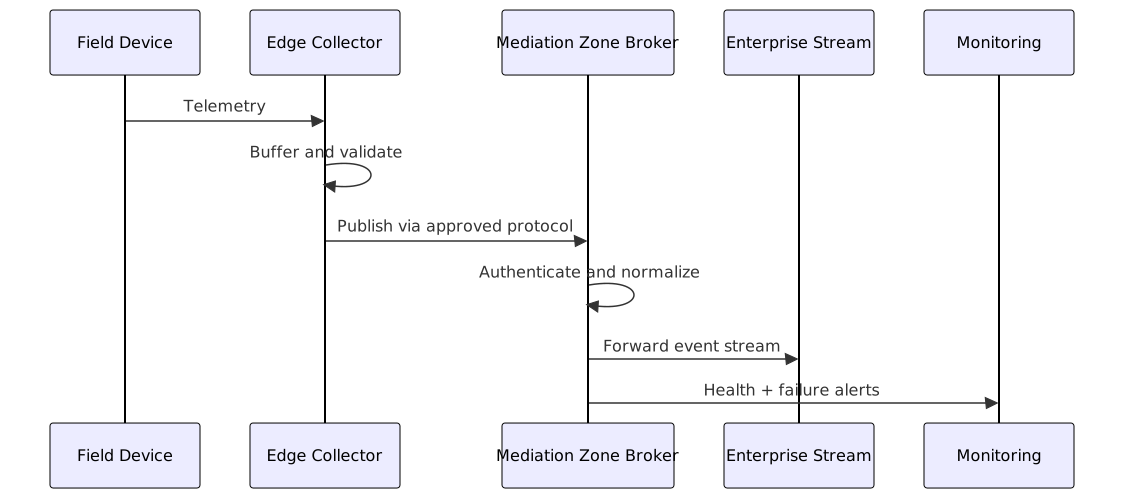
Field devices feed an edge collector or local gateway. Protocol normalization happens near the source or in a local site service. Data crosses into a mediation zone or DMZ via approved channels. From there, a broker or replication service publishes into enterprise event streams, historians, or analytics platforms.
A simple view:

Behavior
Ingest. Authenticate. Buffer. Validate. Transform. Publish. Monitor. Retry if links fail. Alert on integrity or availability issues.
Constraints
No direct write-back path from enterprise into the protected OT segment. Approved protocols only. Local buffering required where connectivity is unstable. Certificates rotated under defined operating procedures. Firewall rules tightly scoped. Changes controlled jointly by OT and security stakeholders.
Variants
A remote wind site variant may require larger local buffers, more autonomous recovery logic, and sparse upstream bandwidth assumptions. An urban substation variant may have better resilience and lower tolerance for local runtime sprawl.
Anti-pattern
Installing a direct cloud agent inside the protected OT segment because “it’s faster.” I’ve seen this proposed more than once. It usually sounds efficient right up until you ask who patches it, who approves the outbound path, how credentials are handled, and what the fallback is during loss of connectivity or vendor support changes.
Known uses
Renewable telemetry onboarding. Distribution analytics pilots. Centralized performance monitoring for mixed asset fleets.
In Sparx EA, I would represent this with:
- a
Patternelement for the base pattern - one structural diagram
- one sequence diagram
- linked
Constraintelements - linked
Requirementelements for cyber, availability, audit, and retention needs - linked
TechnologyStandardelements for approved brokers, protocols, gateways, Kafka integration, IAM controls - linked
ReferenceImplementationelements for specific projects - one or more
PatternVariantelements - an
AntiPatternelement with explanatory notes
That is enough to make the pattern discoverable, reviewable, and reusable.
Not perfect. Useful.
That’s the bar.
Reuse is social before it is technical
This is the part many architects underplay because it makes our repositories feel less central than we might like.
Teams reuse patterns because someone they trust recommends them. Because they saw the pattern work on a similar program. Because the pattern comes with enough specificity to save time. Because engineers feel it reflects reality rather than governance fantasy.
In my experience, libraries grow when engineers and delivery architects co-own them. They die when enterprise architecture curates them in isolation.
What actually helps?
Architecture office hours.
Pattern walkthroughs with solution leads.
Using patterns in initiation checkpoints.
Pairing architects with lead engineers to refine variants.
Reviewing a live project and updating the pattern afterward based on what really happened.
Sending links to a repository page is not enough. It never was.
Bad names quietly kill reuse
This sounds trivial. It isn’t.
If your library contains patterns named things like “Integration Pattern 4.2” or “Target State Event Mediation Construct,” people will avoid it or misuse it. Bad names make search harder, conversation harder, and memory harder.
Good pattern names are problem-led, memorable, domain-relevant, and stable.
Examples:
- Remote Site Telemetry Buffer
- SCADA Read-Only Analytics Feed
- Legacy Billing API Façade
- OT Telemetry Mediation Zone
Inside Sparx EA, naming matters even more because people use searches, reports, diagrams, and package browsers imperfectly. If the name does not quickly suggest purpose, discoverability falls apart.
Architecture people often underestimate this because we get used to our own abstractions. Delivery teams don’t.
Don’t make every pattern universal
Another trap is trying to make each pattern enterprise-wide, timeless, and universally applicable.
That ambition usually produces vague content.
A meter-data event ingestion pattern for retail and network analytics may not fit generation operations. A cloud-centric edge buffering approach may be invalid in restricted plant environments. An IAM brokering pattern that works for enterprise users may fail badly for machine identities in operational domains.
So don’t pretend universality exists where it doesn’t. Scope the pattern. State its boundaries. Add variants where needed.
Sparx EA handles this reasonably well if you keep the relationship model readable: base pattern, specialized variants, reference implementations, anti-patterns, and known constraints. That is enough. You do not need to model a grand theory of all possible inheritance paths.
I would much rather have a narrow pattern that gets used than a universal one that nobody trusts.
The maintenance problem nobody budgets for
Here is the unglamorous truth: pattern libraries are products, not publications.
And products need maintenance.
What goes stale fastest? Usually not the diagrams. It’s the approved technologies, security assumptions, deployment topologies, regulatory references, and known use cases. Kafka versioning changes. Cloud services evolve. IAM controls tighten. Vendor integrations shift. Security incidents reshape acceptable patterns almost overnight.
So build a maintenance rhythm.
Quarterly review for strategic patterns. Event-triggered updates after major incidents, audits, or platform changes. Explicit retirement dates for patterns that are no longer approved. Simple health indicators in Sparx EA:
- status: draft / approved / watch / deprecated / retired
- last reviewed date
- owner
- number of active implementations
And one very practical rule: if no one owns the pattern after the project that created it ends, the pattern is already dead. The repository just hasn’t admitted it yet.
Mistakes worth avoiding
I’ll keep this part blunt.
Modeling patterns as generic diagrams with no decision context.
Mixing standards, target architectures, and patterns into one object type.
Overusing custom stereotypes that only three architects understand.
Capturing only happy-path design and ignoring failure modes.
Leaving out security controls because they live “somewhere else.”
Not linking patterns to actual implementations.
Allowing dozens of near-duplicates instead of managing variants.
Treating the repository as architecture’s property rather than enterprise memory.
Forcing compliance where site conditions clearly differ.
Never retiring obsolete patterns.
I’ve seen every one of these in energy organizations.
One particularly common example: a team creates a “renewable telemetry integration pattern” that quietly assumes permanent stable connectivity, centrally managed certificates, unrestricted cloud egress, and homogeneous site hardware. In other words, it assumes an environment that does not exist. Then everyone wonders why projects create local exceptions.
The pattern was wrong, not the project.
How to do this in 90 days without creating a “repository program”
You do not need a major initiative to prove value.
A practical 90-day rollout is enough.
Weeks 1–2: Review recent projects and identify recurring architectural decisions. Don’t brainstorm in a vacuum. Look at real work: smart meter initiatives, billing modernization, telemetry onboarding, analytics enablement, IAM integration, SCADA replication.
Weeks 3–4: Select 8–12 high-value patterns. No more. Pick the ones where better reuse would save time or reduce risk quickly.
Weeks 5–6: Model a lightweight pattern structure in Sparx EA. Create the core stereotypes if needed, but keep customization minimal. Focus on clarity, not elegance.
Weeks 7–8: Attach at least two real reference implementations per pattern where possible. This is where credibility starts to build.
Weeks 9–10: Test the library with solution architects on active initiatives. Watch how they search, what they misunderstand, what they ignore, and what they copy.
Weeks 11–12: Refine. Assign owners. Add pattern use into architecture initiation and review touchpoints. Keep the exception process light.
That is enough to know whether you have something real.
And frankly, if you need a steering committee before the first useful reusable pattern exists, you are probably already overcomplicating the problem.
What the library is actually for
This is the part I’d want people to remember.
The purpose of a pattern library is not architectural neatness.
It is faster, safer, more coherent decision-making.
Teams do not reuse diagrams. They reuse proven ways of reducing risk under pressure. They reuse patterns that carry operational memory: what works, where it works, what can go wrong, which technologies are approved, what security controls matter, and who to talk to when the context changes.
Sparx EA can absolutely support that kind of library. It is perfectly capable of being more than a drawing tool.
But only if you stop treating reuse as documentation and start treating it as operational architecture memory.
That is the difference between a repository people admire and a library people actually use.
Frequently Asked Questions
What is enterprise architecture?
Enterprise architecture aligns strategy, business processes, applications, and technology. Using frameworks like TOGAF and languages like ArchiMate, it provides a structured view of how the enterprise operates and must change.
How does ArchiMate support enterprise architecture?
ArchiMate connects strategy, business operations, applications, and technology in one coherent model. It enables traceability from strategic goals through capabilities and application services to technology infrastructure.
What tools support enterprise architecture modeling?
The main tools are Sparx Enterprise Architect (ArchiMate, UML, BPMN, SysML), Archi (free, ArchiMate-only), and BiZZdesign. Sparx EA is the most feature-rich, supporting concurrent repositories, automation, and Jira integration.