⏱ 19 min read
Most enterprise architecture content is either too abstract to be useful or so sanitized it stops resembling real work. You get pretty diagrams, perfect target states, and a suspicious lack of politics, budget constraints, or legacy systems from 2007 that somehow still run payroll. That’s not architecture. That’s wallpaper.
Here’s the blunt version: enterprise architecture is not about drawing boxes. It’s about making hard trade-offs across business capability, technology, risk, and time. If your architecture examples don’t show tension—between speed and control, standardization and autonomy, innovation and regulation—they’re not examples. They’re marketing.
So let’s fix that.
Enterprise architecture examples, simply explained
At a simple level, enterprise architecture (EA) is the practice of aligning business strategy, operating model, applications, data, security, and infrastructure so the organization can change without breaking itself.
That’s the clean definition.
In real life, EA answers practical questions like:
- Why do we have 11 customer systems?
- Should this integration be API-based, event-driven, or batch?
- Where should identity live across cloud and on-prem?
- Which platforms should be standardized, and which should be left to teams?
- How do we modernize core banking without creating a new kind of mess?
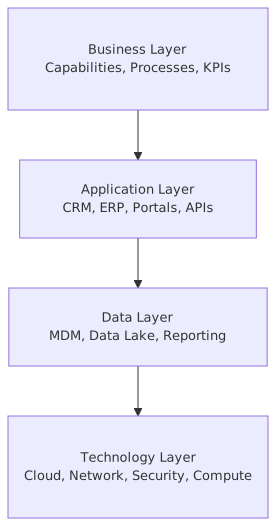
If you want a simple mental model, enterprise architecture works across a few layers:
That’s the textbook view. Useful enough. But the reason EA matters is not because these layers exist. It matters because large organizations fail at change when nobody sees the whole system.
And yes, I said “whole system,” not “all systems.” Big difference.
The mistake people make about enterprise architecture examples
A lot of articles present enterprise architecture examples as if an architect wakes up, creates a target-state diagram, and the company obediently transforms itself. That’s fantasy. Real architecture work is messier and more political.
Good enterprise architecture examples should show:
- the business problem
- the architectural options
- the trade-offs
- the constraints
- the organizational reality
- what actually got implemented
- what went wrong anyway
Because something always goes wrong anyway.
Also, one strong opinion early: enterprise architecture is not the same thing as enterprise-wide standardization. Standardization is useful, but architects who try to standardize everything become the reason people bypass architecture. Some variation is healthy. Some local optimization is rational. The job is not “one platform for all things.” The job is coherence where coherence matters.
Let’s walk through real kinds of enterprise architecture examples, using banking, Kafka, IAM, and cloud—because those are exactly the kinds of things architects get pulled into.
Let’s start with banking because it exposes every enterprise architecture problem at once: regulation, legacy, customer expectations, risk, security, and lots of systems that nobody wants to touch but everyone depends on.
The situation
A mid-sized retail bank wants to improve digital onboarding, payment notifications, fraud detection, and customer service. Customers expect near-real-time experiences. Internally, the bank still runs several core capabilities on legacy platforms:
- core banking ledger on a mainframe-based platform
- customer data spread across CRM, online banking, branch systems, and credit systems
- overnight batch jobs for some critical updates
- point-to-point integrations everywhere
- fragmented identity across internal users, partners, and customers
The CIO says, “We need to modernize.” Fine. Everyone says that. The actual architectural question is: modernize what, in what order, and with what operating model?
The bad architecture response
A weak architect says: “We should replace the legacy core with a cloud-native banking platform.” cloud architecture guide
That may be true in theory. It may also be a seven-year distraction.
This is a classic EA mistake: confusing the ultimate destination with the next responsible move.
The better architecture response
A better architect starts from business capabilities and constraints.
The bank needs to improve:
- customer onboarding speed
- event visibility across channels
- fraud response time
- service agent access to current customer context
- auditability and access control
The architect doesn’t begin with “replace the core.” They begin with decoupling the bank from the core’s integration limitations.
That usually means introducing:
- A capability map
- A domain-oriented integration model
- An event backbone, often Kafka
- A clearer IAM architecture
- A cloud strategy that respects regulatory boundaries
What this looks like in practice
The bank identifies key business domains:

- Customer
- Accounts
- Payments
- Cards
- Fraud
- Notifications
- Identity and Access
Then it creates an architecture principle that matters:
Systems of record remain authoritative, but systems of engagement should not depend on direct synchronous access to every legacy platform.
That principle changes everything.
Instead of every digital channel calling legacy systems directly, the bank builds a more controlled architecture:
- APIs for transactional access where synchronous behavior is necessary
- Kafka for event distribution where asynchronous propagation is enough
- domain-owned services that expose stable contracts
- customer IAM centralized for digital channels
- workforce IAM federated across enterprise tools
- cloud used selectively for digital and analytics workloads, not blindly for everything
A simple target-state pattern
This is enterprise architecture because it connects business outcomes to application, data, technology, and security decisions. Not because it uses nice words like “target state.”
The real enterprise example angle
I’ve seen versions of this in banking more than once. One bank had payment events buried in legacy integration middleware that nobody trusted. Customer notifications were inconsistent because one channel got updates in near real time and another waited for a batch file. Fraud teams had to pull data from multiple stores because there was no clean event stream. The architecture team introduced Kafka, but the real success was not “we deployed Kafka.” The success was defining which business events mattered, who owned them, and what consumers were allowed to rely on.
That distinction matters. Enterprises don’t fail because they picked Kafka. They fail because they used Kafka without governance, ownership, event contracts, or operating discipline. ARB governance with Sparx EA
Let’s talk about Kafka because people misuse it constantly.
There’s a pattern in enterprises: someone discovers event streaming, gets excited, and suddenly every integration problem becomes “put it on Kafka.” That’s how you create distributed confusion at scale.
What Kafka is good for
Kafka is great when you need:
- high-throughput event distribution
- decoupled producers and consumers
- replayability
- streaming analytics
- event-driven workflows across domains
It is not automatically the answer for:
- immediate request-response interactions
- transactional consistency across business processes
- simple one-off integrations
- replacing all APIs
- hiding bad domain design
That last one especially. Kafka does not rescue weak architecture. It amplifies it.
A realistic enterprise architecture use case
In a bank, Kafka can support enterprise architecture in these ways:
- account events published when balances or statuses change
- payment events consumed by notifications, fraud, and analytics
- customer profile changes propagated to downstream systems
- operational telemetry supporting observability and incident response
But this only works if the enterprise architecture team helps define:
- event taxonomies
- ownership by domain
- schema governance
- retention policies
- security controls
- integration boundaries
- when to use events vs APIs vs batch
Common mistake: event-driven everything
A common architectural mistake is forcing event-driven patterns into cases where a direct API call is more appropriate.
For example:
- customer mobile app needs current transaction status now
- fraud service must block a payment synchronously
- a service needs immediate confirmation of a business rule
That’s not a Kafka problem. That’s an API or orchestration problem.
Strong architects are willing to say:
Not every interaction should be asynchronous.
That sounds obvious. It apparently isn’t.
How this applies in real architecture work
In real work, the architect has to mediate between platform teams, application teams, and business sponsors.
The conversation usually sounds like this:
- Platform team: “Use Kafka for all integrations.”
- App team: “We just need a simple REST call.”
- Security team: “Who is allowed to publish customer events?”
- Compliance team: “How long are these records retained?”
- Business team: “Why did notifications arrive before the transaction looked complete in the app?”
That last question is where architecture gets real. Event-driven systems create timing realities the business must understand. If the app reads from one source and notifications are triggered from another, users may see inconsistency. Not because the architecture is bad, but because distributed systems are not magic.
The architect’s job is to design for acceptable consistency and make those behaviors explicit.
Contrarian thought: stop worshipping real-time
Another strong opinion: enterprises overvalue “real-time” and undervalue “reliable enough.” Some processes genuinely need sub-second propagation. Many do not. Architects who force real-time everywhere increase complexity, cost, and operational fragility.
Sometimes a five-minute delay is fine. Sometimes a nightly batch is still the right answer. Yes, I said it. Batch is not a moral failure.
Identity and Access Management gets treated like a security side topic. It isn’t. IAM is central enterprise architecture because identity crosses every capability, system, cloud platform, and trust boundary in the enterprise.
If your enterprise architecture ignores IAM, it’s incomplete.
The typical enterprise mess
A large enterprise often has:
- Active Directory or Entra ID for workforce identity
- separate customer identity platform for digital users
- local app accounts still living inside old systems
- partner access managed through ad hoc federation
- privileged access handled badly
- cloud IAM policies inconsistent across AWS, Azure, and GCP
- no clear ownership of authorization decisions
This creates operational drag and risk. Users get too much access, not enough access, or the wrong kind of access. Audits become painful. Mergers make it worse. Cloud adoption multiplies the problem.
A real architecture example
Imagine a bank expanding digital services while also moving analytics and customer-facing workloads into cloud. It has:
- workforce users in branches, operations, fraud, and support
- customers using mobile and web channels
- partners connecting for payment services and data exchange
- applications in on-prem data centers and multiple clouds
The enterprise architecture challenge is not just “pick an identity provider.” It’s defining a coherent identity model across user types and platforms.
A practical architecture might look like this:
- Workforce IAM centralized on enterprise identity directory with federation to SaaS and internal apps
- Customer IAM (CIAM) separated from workforce identity, supporting MFA, consent, self-service, and high scale
- Partner IAM handled through federation and contractual trust controls
- Privileged access isolated with stronger controls and session oversight
- Application-to-application identity managed with certificates, secrets rotation, and workload identity patterns
- Cloud IAM guardrails standardized by landing zones and policy baselines
That is enterprise architecture because it affects process design, system design, cloud operating model, security, and compliance.
Common IAM mistakes architects make
Here are some of the big ones:
1. Treating authentication as the whole problem
Authentication is only part of IAM. Authorization is usually the bigger mess. Who can do what, under which conditions, and based on which business attributes? That’s where architectures often collapse into hard-coded chaos.
2. Mixing workforce and customer identity carelessly
They have different lifecycles, risk models, user experience needs, and regulatory implications. Forcing them into one model usually makes both worse.
3. Ignoring application and machine identities
Modern architectures have more non-human identities than human ones. If the EA content only talks about users logging in, it’s out of date.
4. Designing role models nobody can operate
Architects love elegant role hierarchies. Operations teams hate them when they become impossible to administer. Simpler, governed models usually win.
5. Assuming cloud IAM will sort itself out
It won’t. Multi-cloud without IAM governance becomes a slow-motion security incident. EA governance checklist
How this applies in real architecture work
Real architecture work here means:
- mapping identity domains
- defining authoritative identity sources
- separating authentication from authorization concerns
- aligning HR, customer, partner, and application identity lifecycles
- establishing cloud IAM standards
- integrating IAM decisions into application architecture reviews
This is one area where enterprise architects need to be opinionated. If every team invents its own access model, you don’t have agility. You have future audit findings.
A lot of cloud architecture discussion is still stuck at the level of “move workloads to cloud.” That’s not enterprise architecture. That’s hosting strategy.
The real enterprise question is:
How does cloud change platform ownership, security controls, cost management, delivery speed, resilience, and governance?
The classic bad pattern
A company announces a cloud-first strategy. Business units move independently. One team builds on AWS, another on Azure, a third keeps buying SaaS, and a legacy integration team remains on-prem. Within two years:
- networking is inconsistent
- IAM is fragmented
- observability differs by platform
- data is duplicated everywhere
- costs are poorly understood
- platform controls are negotiated team by team
- audit evidence takes forever to assemble
Technically, the company is “in the cloud.” Architecturally, it is all over the place.
The enterprise architecture response
A strong enterprise architecture function does not try to approve every deployment. That would be hopeless. It defines enterprise guardrails and platform patterns.
For example:
That’s where EA adds value. Not by saying “use cloud,” but by defining what good looks like across the enterprise.
Contrarian thought: multi-cloud is often an organizational problem disguised as strategy
I’ll say the quiet part. A lot of multi-cloud strategy is not strategic. It’s the result of acquisitions, vendor politics, or teams doing their own thing. There are valid reasons for multi-cloud—regulatory resilience, specific platform capabilities, negotiation leverage. But many enterprises claim multi-cloud when what they really have is uncontrolled cloud sprawl.
Architects should challenge this. Not with ideology, but with evidence.
If the enterprise cannot operate one cloud well, adding a second doesn’t create resilience. It creates duplicated confusion.
Real architecture work here
In actual enterprise architecture work, cloud decisions often turn into operating model decisions:
- Who owns the landing zone?
- Who can create new accounts or subscriptions?
- How are exceptions approved?
- Which services are approved by default?
- How is shared platform engineering funded?
- How are domain teams enabled without bypassing controls?
This is why enterprise architecture cannot stay at conceptual altitude forever. At some point, architecture becomes platform design, governance, and organizational negotiation. architecture decision record template
A credible enterprise architecture example usually includes these ingredients:
- A business trigger
Growth, compliance pressure, poor customer experience, M&A, cost pressure, operational risk.
- A current-state problem
Fragmented systems, duplicated data, fragile integrations, identity sprawl, unmanaged cloud growth.
- A target direction, not fantasy perfection
Better capability alignment, cleaner domain boundaries, controlled integration patterns, stronger IAM, cloud guardrails.
- Transition states
Because nobody goes from legacy mess to elegant target state in one move.
- Governance and ownership
Who owns standards, platforms, data, events, access, and exceptions.
- Trade-offs
What got optimized, what was deferred, and what risk remains.
That last point is where many architecture write-ups fail. They present architecture as if every problem gets solved. It doesn’t. Architecture is often choosing which problems to solve now and which problems to contain.
Let’s be honest about the profession for a minute.
1. Creating target states with no migration reality
If your architecture requires six simultaneous transformations, it isn’t strategy. It’s fiction.
2. Confusing principles with decisions
“Reuse before buy before build” is not a decision. It’s a slogan. Real architecture says which platform, for which domain, under which constraints.
3. Ignoring organizational design
If your architecture depends on collaboration patterns the company does not have, it will fail. Conway’s Law is still undefeated.
4. Over-centralizing standards
Some standardization is essential. Too much creates bottlenecks and shadow IT. Architects who say no to everything become irrelevant fast.
5. Underestimating data ownership
Enterprises love talking about “single source of truth.” In practice, truth is often contextual. Architects need to define authoritative sources by domain and use case, not chase mythical universal data purity.
6. Treating security as a review gate instead of a design concern
Security architecture, especially IAM, should shape the design early. Bolting it on later costs more and works worse.
7. Picking fashionable patterns without operational maturity
Kafka, service mesh, zero trust, multi-cloud, domain-driven design—good concepts, all of them. But not every enterprise can operate them well on day one. Architecture should respect operational maturity, not just technical possibility.
Let’s bring the pieces together in one scenario.
Scenario: regional bank digital transformation
A regional bank wants to launch faster digital products, improve fraud detection, and reduce integration complexity. Current pain points:
- legacy core banking platform
- customer data split across channels
- inconsistent authentication experiences
- point-to-point integrations
- rising cloud usage without standards
- audit pressure on access control
Enterprise architecture approach
Business architecture
The bank identifies priority capabilities:
- customer onboarding
- payments
- fraud management
- customer servicing
- digital identity
Application architecture
The bank groups applications by domain and defines stable service boundaries:
- customer domain services
- payment services
- notification services
- fraud services
- IAM services
Legacy systems remain systems of record where needed, but new digital capabilities do not integrate directly with all of them.
Data architecture
The bank defines:
- customer master ownership rules
- event contracts for payment and account changes
- canonical data only where it adds value, not everywhere
- retention and lineage requirements for regulated data
Integration architecture
The bank uses:
- APIs for synchronous interactions like balance inquiry and transaction initiation
- Kafka for events like payment posted, account updated, customer preference changed
- batch only where timing is non-critical or legacy dependency makes it practical
Security and IAM architecture
The bank separates:
- workforce identity
- customer identity
- partner federation
- privileged access
- machine identity for services and cloud workloads
Authorization models are reviewed for high-risk business actions, not left to each team.
Cloud architecture
The bank establishes:
- landing zones with policy baselines
- centralized logging and monitoring
- approved patterns for secrets, encryption, and network segmentation
- workload placement rules for sensitive data
- platform engineering support for product teams
What changed in practice
Within 12–18 months, the bank can:
- publish payment events to Kafka for fraud and notification consumers
- onboard customers through a more unified digital identity flow
- expose controlled APIs for mobile and web channels
- reduce some direct legacy dependencies
- improve audit posture through cleaner IAM and cloud controls
What did not change:
- the core banking platform did not disappear
- some batch jobs remained
- some older applications still had local access models
- data duplication still existed in places
And that is exactly why this is a realistic enterprise architecture example. Progress without pretending to have achieved purity.
A real architect often says things like:
- “We do not need to replace the core to improve the customer journey.”
- “This integration should be an API, not an event.”
- “Kafka is a platform capability, not a substitute for domain ownership.”
- “Customer IAM and workforce IAM are different problems.”
- “Cloud adoption without operating model changes is just relocation.”
- “No, we should not standardize that globally yet.”
- “Yes, we need a transition state because the target state is three years away.”
That’s the tone of real architecture work. Less perfection. More judgment.
Enterprise architecture examples are only useful if they reflect how enterprises actually work: under pressure, with legacy, with politics, with partial funding, and with uneven maturity across teams.
The best examples are not the cleanest. They’re the ones that show how architects make systems more coherent without pretending they can redesign the company from scratch.
So if you’re looking at enterprise architecture examples, ask better questions:
- What business problem is this solving?
- What trade-offs were made?
- What remained messy on purpose?
- How does IAM fit?
- Where do events help, and where are APIs better?
- What cloud guardrails exist?
- Who owns the thing after the architects leave the room?
If the example can’t answer those, it’s probably not architecture. It’s just a diagram with confidence.
FAQ
1. What is a simple example of enterprise architecture?
A simple example is a bank improving customer notifications and fraud detection by introducing APIs for real-time account access, Kafka for payment events, centralized customer IAM for digital login, and cloud guardrails for new services. The value comes from aligning business needs with technology patterns, not from any single tool.
2. How is enterprise architecture different from solution architecture?
Enterprise architecture looks across the organization—capabilities, standards, platforms, governance, and long-term change. Solution architecture focuses on designing a specific solution within that broader context. In practice, good enterprise architecture sets direction; good solution architecture makes it real.
3. When should an enterprise use Kafka in its architecture?
Use Kafka when you need decoupled event distribution, replayable streams, and multiple consumers across domains. Don’t use it just because it’s modern. If you need immediate request-response behavior or strict synchronous control, APIs or orchestration are often better.
4. Why is IAM considered part of enterprise architecture?
Because identity touches every system, user type, cloud platform, and control model in the enterprise. IAM shapes user experience, security, compliance, and application design. If enterprise architecture ignores IAM, it usually ends up with fragmented access models and audit problems.
5. What is the most common mistake in enterprise architecture?
Probably creating target-state visions with no realistic transition path. A close second is over-standardizing too early. Real enterprise architecture is about sequencing change and applying control where it matters most, not forcing theoretical consistency everywhere.
Enterprise Architecture Examples Explained
1. Layered Enterprise Architecture
2. Capability-to-Solution Dependency Flow
Frequently Asked Questions
What is enterprise architecture?
Enterprise architecture is a discipline that aligns an organisation's strategy, business processes, information systems, and technology. Using frameworks like TOGAF and modeling languages like ArchiMate, it provides a structured view of how the enterprise operates and how it needs to change.
How does ArchiMate support enterprise architecture practice?
ArchiMate provides a standard modeling language that connects strategy, business operations, applications, data, and technology in one coherent model. It enables traceability from strategic goals through business capabilities and application services to the technology platforms that support them.
What tools are used for enterprise architecture modeling?
The main tools are Sparx Enterprise Architect (ArchiMate, UML, BPMN, SysML), Archi (free, ArchiMate-only), and BiZZdesign Enterprise Studio. Sparx EA is the most feature-rich option, supporting concurrent repositories, automation, scripting, and integration with delivery tools like Jira and Azure DevOps.