⏱ 19 min read
Most companies don’t have an enterprise architecture problem. They have a decision problem that they keep trying to solve with diagrams.
That’s the uncomfortable truth.
A lot of organizations hire enterprise architects because the technology estate is messy, cloud costs are climbing, every team is buying its own tools, security is nervous, and delivery is slowing down. Then they make the architect produce standards, capability maps, and PowerPoint decks that nobody reads. Six months later, the estate is still messy, but now it’s documented.
That is not enterprise architecture. That is decorative governance. ArchiMate for governance
So let’s answer the question directly.
What does an enterprise architect do?
An enterprise architect helps an organization make better technology decisions across the business, not just inside one project or one platform. The role exists to connect business strategy, operating model, data, applications, security, and infrastructure so that change can happen with less waste, less duplication, and less risk.
Simple version, early and clear: an enterprise architect makes sure technology choices work together at enterprise scale.
That means they do things like:
- define target architecture and technology direction
- guide big cross-domain decisions
- reduce duplication and unnecessary complexity
- align delivery teams around principles and constraints
- balance speed, risk, cost, and long-term maintainability
- translate business change into architectural choices
- challenge bad investments before they become expensive habits
Not every enterprise architect does all of this well. Plenty of them become policy writers, review-board regulars, or diagram specialists. But the real role is much more practical than that.
A good enterprise architect is not the person who knows the most frameworks. It’s the person who can walk into a room where the CIO wants agility, the CISO wants control, the operations team wants stability, and the product teams want autonomy—and still help the company make a coherent decision.
That’s the job.
Enterprise architecture is not “big picture thinking” by itself
People love saying enterprise architects “see the big picture.” Fine. But that phrase is so vague it’s almost useless.
The big picture only matters if it changes decisions on the ground.
If your architecture doesn’t affect:
- what gets funded
- what gets standardized
- what gets retired
- what patterns teams are allowed to use
- how risks are handled
- how integration actually works
- how identity is controlled
- how cloud is adopted
- how data moves
…then you don’t have enterprise architecture. You have commentary.
This is where a lot of architecture functions go wrong. They stay abstract. They produce future-state visions with no migration path. They talk in capability models while engineering teams are trying to solve ugly real problems like duplicate customer identities, Kafka topic sprawl, IAM exceptions, or five cloud landing zones built five different ways.
Real enterprise architecture lives in those messy decisions.
The actual role: what enterprise architects are responsible for
The role changes a bit by company, but the responsibilities usually fall into a few core areas.
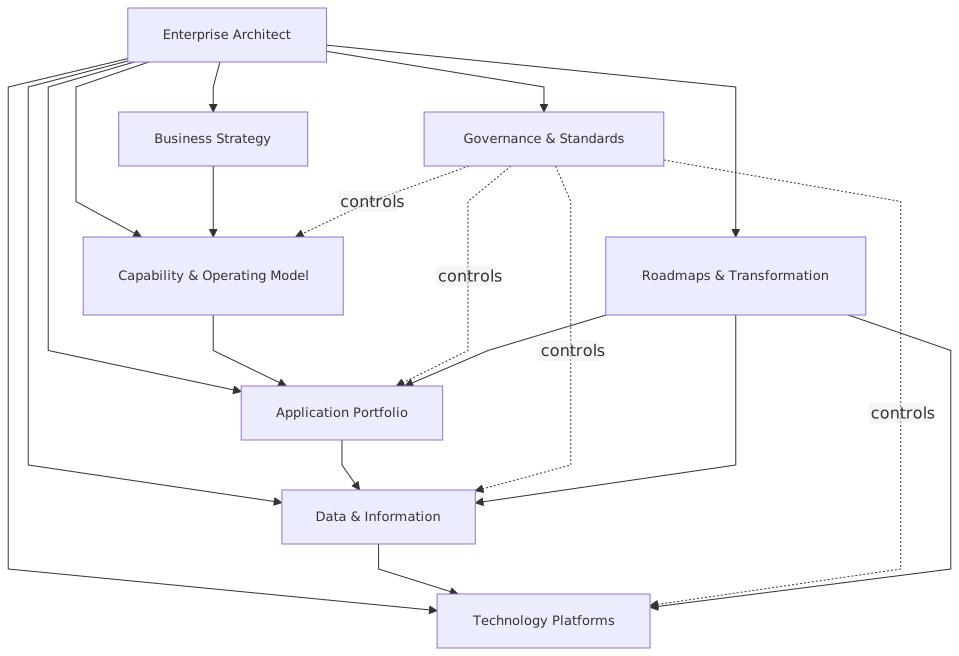
1. Translating strategy into technology direction
If the business says:
- “We want to launch digital products faster”
- “We’re expanding into new markets”
- “We need stronger resilience”
- “We want to use AI safely”
- “We’re reducing cost”
…the enterprise architect asks: what does that mean for platforms, integration, security, data, operating model, and investment priorities?
This is where architecture gets strategic without becoming fluffy.
Example:
A bank decides it wants to improve customer onboarding across mobile, branch, and partner channels. That sounds like a business initiative. But underneath it, architecture questions show up immediately:
- Is customer identity mastered in one place?
- Are onboarding rules duplicated across channels?
- Are fraud checks synchronous or event-driven?
- How do IAM and consent work across products?
- Can legacy core systems support real-time onboarding?
- Does Kafka become the event backbone, or do teams keep building point-to-point APIs?
- What cloud controls are needed if onboarding services move off-prem?
An enterprise architect turns business ambition into a set of architectural decisions and constraints. That is not theoretical work. It shapes roadmaps, funding, and delivery patterns.
2. Setting principles and guardrails
Guardrails matter more than detailed control.
A healthy enterprise architecture function does not try to design every system. It defines principles, approved patterns, decision criteria, and constraints that let teams move faster without creating chaos.
Examples of useful guardrails:
- customer identity must integrate with enterprise IAM
- event streams carrying regulated customer data must follow approved Kafka security patterns
- cloud workloads must use standard landing zones, observability, and policy controls
- new integrations should prefer APIs or events over custom file transfers unless justified
- data ownership must be explicit; no shared database access across domains
- buy before build for commodity capabilities, unless differentiation is proven
Notice the tone here: practical, not religious.
Too many architects turn principles into ideology. “Everything must be microservices.” “Everything must be event-driven.” “Everything must be multi-cloud.” Nonsense. Enterprise architecture should reduce bad decisions, not replace them with fashionable bad decisions.
3. Managing enterprise-wide complexity
This is one of the least glamorous but most important parts of the job.
Every large organization accumulates complexity:
- multiple CRMs
- duplicate IAM stacks
- overlapping integration tools
- inconsistent data definitions
- cloud environments with no common controls
- application portfolios nobody can explain
- projects that solve local problems while making global ones worse
Enterprise architects are supposed to manage this. Not eliminate all complexity—that’s impossible—but make it intentional.
There are two kinds of complexity:
- necessary complexity, caused by real business or regulatory needs
- accidental complexity, caused by poor decisions, duplication, or lack of standards
A good architect spends a lot of time distinguishing between the two.
In banking, some complexity is unavoidable. Different regulatory domains, legacy cores, fraud controls, data retention rules, and regional requirements are real. But if the bank has four separate customer identity stores because every division bought its own tool over ten years, that’s not necessary complexity. That’s organizational drift.
4. Enabling large change across domains
Projects can optimize within a scope. Enterprise architects work across scopes.
That means they get involved when change cuts across:
- business units
- data domains
- security boundaries
- infrastructure layers
- vendor contracts
- operating models
For example, moving to cloud is never just an infrastructure change. It affects:
- IAM and federation
- network segmentation
- data sovereignty
- resilience patterns
- logging and monitoring
- platform ownership
- FinOps
- regulatory controls
- vendor risk
- application modernization priorities
If nobody is looking across those dimensions, cloud adoption turns into a collection of migrations with no enterprise coherence. Which, frankly, is how many companies do it.
The enterprise architect is supposed to prevent that.
5. Governing major decisions without becoming a bottleneck
Architecture governance has a bad reputation, and honestly, a lot of it is deserved.
Review boards that meet once a week to reject designs they barely understand are not governance. They are delay mechanisms. EA governance checklist
Good governance does a few things:
- identifies decisions that truly need enterprise-level review
- pushes routine decisions down to teams
- uses standards and reusable patterns to avoid repeated debates
- makes trade-offs explicit
- records exceptions and their expiry
- ties architecture decisions to risk and business value
The goal is not to centralize intelligence. The goal is to make sure local choices don’t damage enterprise outcomes.
That distinction matters.
What enterprise architects actually do in real architecture work
Let’s get more concrete, because this is where articles often drift into generic language.
A real enterprise architect’s week might include things like:
- reviewing a proposal to use Kafka as the enterprise event backbone and challenging whether the operating model exists to support it
- working with security teams on IAM modernization: SSO, federation, privileged access, service identities, role design, lifecycle controls
- deciding whether a customer master capability should be consolidated or remain federated
- helping cloud platform teams define landing zones, policy-as-code, network patterns, encryption standards, and tenancy models
- pushing back on a business case that introduces another workflow platform with overlapping capabilities
- mapping which legacy systems can be wrapped, replatformed, retired, or replaced
- mediating between product teams that want autonomy and risk teams that want standardization
- defining transition architectures, not just target architectures
- identifying where a strategic initiative is blocked by operating model issues, not technology
That last point is important.
A lot of architecture problems are not actually technology problems.
You can define the cleanest Kafka architecture in the world, but if nobody owns topic standards, event contracts, schema governance, retention policies, access controls, and support boundaries, the platform will become a mess. Same with IAM. Same with cloud. Same with APIs. architecture decision record template
Enterprise architects need to understand technology deeply enough to be credible, but they also need to understand that architecture fails through organization design just as often as through bad engineering.
A useful way to think about the role
Here’s a practical breakdown.
That distinction matters because enterprise architects often fail by doing too much of the wrong kind of work. Either they stay too high-level, or they drop so deep into project design that they stop being enterprise architects at all.
The real balancing act: standardization vs autonomy
This is the central tension in enterprise architecture. Everything else is secondary.

Large organizations need standardization because:
- risk has to be managed
- costs have to be controlled
- security has to be consistent
- integration has to be possible
- operations have to be supportable
But they also need autonomy because:
- delivery teams move faster when they can decide locally
- business domains have real differences
- not every problem deserves an enterprise platform
- innovation dies under excessive central control
Bad architects pick one side and turn it into a belief system.
The “control everything” architect creates bureaucracy, exceptions, and shadow IT.
The “let teams decide everything” architect creates fragmentation, duplication, and expensive entropy.
A good enterprise architect knows where standardization creates leverage.
For example, in banking:
- IAM should be heavily standardized. Identity is too critical, too regulated, and too interconnected to let every domain invent its own model.
- Kafka platform controls should be standardized: security, schema governance, observability, retention classes, access patterns.
- Cloud landing zones should absolutely be standardized: account structure, networking, encryption, secrets handling, logging, policy guardrails.
- UI frameworks for low-risk internal tools? Maybe standardize lightly, maybe not at all.
- Domain service design? Give teams more room, as long as they stay within enterprise constraints.
This is where judgment matters more than frameworks.
A real enterprise example: bank modernization with Kafka, IAM, and cloud
Let’s make this real.
Imagine a mid-to-large retail bank. It has grown through acquisition. It now has:
- multiple customer channels
- legacy core banking systems
- separate identity stores for retail, commercial, and internal staff
- a mix of on-prem integration middleware and newer cloud services
- several teams pushing event-driven architecture using Kafka
- a cloud migration program under pressure from leadership
- increasing regulatory scrutiny around resilience and access control
The business goal is straightforward enough: improve digital customer experience, speed up product launches, and reduce operational cost.
Sounds familiar. Also sounds dangerous.
What goes wrong without enterprise architecture
Without a strong enterprise architecture function, here’s what usually happens:
- one division builds a new onboarding platform in cloud
- another team introduces Kafka for notifications
- a third modernizes IAM only for workforce users
- APIs are built inconsistently across channels
- customer identity remains fragmented
- cloud controls are implemented differently by each program
- security exceptions pile up
- duplicate event models emerge
- the bank ends up with modern-looking components and old structural problems
This is very common. Modernization in pieces. Nice demos. Weak coherence.
What the enterprise architect should do
A competent enterprise architect would not start by drawing a giant future-state diagram and calling it done.
They would ask hard questions:
On customer identity and IAM
- What is the enterprise identity model for customers, staff, partners, and services?
- Where is authentication centralized, and where is authorization delegated?
- How are entitlements managed across channels and products?
- What does identity lifecycle look like?
- How are privileged and machine identities controlled?
- Are there regulatory or fraud implications of fragmented identity?
This matters because IAM is not just a security tool. In a bank, it is part of the operating backbone. If identity is fragmented, customer experience, fraud controls, compliance, and support all suffer.
On Kafka and event architecture
- What business events are enterprise-significant?
- Who owns event schemas?
- Are teams publishing facts or implementation noise?
- What retention and replay rules apply?
- How is PII handled in streams?
- What are the patterns for topic naming, access, observability, and failure handling?
- Is Kafka being used because it solves a real integration problem, or because teams think event-driven sounds modern?
Strong opinion here: many organizations adopt Kafka before they are ready to govern events as products. Then they blame the platform. The issue is rarely Kafka itself. It’s weak ownership.
On cloud
- What workloads should move, and why?
- What is the target operating model for cloud platform ownership?
- How are landing zones standardized?
- What controls are preventive versus detective?
- How do resilience requirements map to cloud architecture?
- Which legacy systems are worth modernizing versus containing?
- How does cloud change integration, IAM, and data movement?
Another contrarian point: cloud migration is not automatically modernization. Moving a badly structured system to cloud often just gives you a more expensive badly structured system with better dashboards.
The architecture outcome
A real enterprise architecture response might define:
- a federated but enterprise-governed IAM model with shared authentication services, central policy standards, and domain-level authorization where appropriate
- Kafka as a strategic event platform for selected business domains, not as a mandatory hammer for every integration nail
- a canonical set of customer and account events with schema governance and ownership
- standard cloud landing zones with required security, logging, secrets, and network controls
- transition architectures for legacy systems that cannot be replaced immediately
- a phased roadmap linking identity consolidation, integration modernization, and channel simplification
- clear decisions on what is standardized enterprise-wide and what remains domain-specific
That is architecture work. Not just “big picture.” Decision shaping, trade-off management, and migration design.
Common mistakes enterprise architects make
Let’s be honest. Architects create a lot of their own credibility problems.
Here are the common mistakes I see.
1. Confusing documentation with architecture
If your main output is diagrams and repositories, you are at risk.
Documentation matters. But architecture is only real when it changes decisions, investment, or delivery behavior.
2. Designing target states with no transition path
This is probably the classic failure.
A pristine target architecture is easy to draw. The hard part is getting from a bank with five identity stores, thirty integration patterns, and a mainframe dependency to something better without breaking the business.
Transition architecture is where architects earn their keep.
3. Being too abstract to be useful
Some enterprise architects hide behind vague language:
- enable agility
- improve alignment
- support transformation
- create business value
Fine. How exactly?
If you can’t explain what changes in IAM design, Kafka governance, cloud controls, application portfolio, or operating model, then you’re not done thinking.
4. Becoming technology fashion victims
Architects are very susceptible to trends because they are expected to have a point of view.
But a point of view is not the same as trend adoption.
I’ve seen architects push:
- microservices where modular monoliths were enough
- Kafka where APIs would have been cleaner
- multi-cloud for “flexibility” when it mostly created complexity
- zero trust slogans with no practical identity architecture
- platform strategies with no product operating model
Strong opinion: architects should be more skeptical than enthusiastic. It’s part of the job.
5. Ignoring organization design
You cannot architect around broken ownership forever.
If no one owns enterprise IAM, data definitions, API standards, or Kafka platform operations, the architecture will drift no matter how elegant it looks.
A lot of architecture problems are really ownership problems with technical symptoms.
6. Over-centralizing decisions
This is how architecture turns into bureaucracy.
Not every technology choice needs enterprise review. If architects insist on reviewing every design, teams route around them. And honestly, they should.
Enterprise architects need to focus on high-impact decisions:
- cross-domain standards
- strategic platforms
- security and resilience patterns
- major investment choices
- exceptions with enterprise consequences
Everything else should be delegated.
7. Failing to retire things
Many architecture teams are happy to define standards for new technology but reluctant to force retirement of old technology.
But enterprise architecture without rationalization is just additive architecture. New layers on top of old ones. More tools, more platforms, more complexity.
Real architects should have a retirement instinct.
Skills that actually matter in the role
Not just certifications. Actual skills.
Technical breadth with selective depth
You need enough depth in areas like cloud, IAM, integration, data, and resilience to challenge bad designs. You do not need to be the best engineer in every room. But you do need to be credible.
Business literacy
You should understand operating models, cost drivers, regulatory constraints, and how the company makes money. Otherwise you’ll optimize architecture in ways the business does not value.
Decision framing
This is underrated. Architects often think their job is to provide answers. A lot of the time, the real job is to frame the decision properly:
- what are the options?
- what trade-offs matter?
- what constraints are fixed?
- what risk is being accepted?
- what is reversible and what is hard to unwind?
Influence without direct authority
Most enterprise architects do not own engineering teams. So the role depends heavily on persuasion, credibility, and timing.
Ruthless simplification
This might be the most important one. Can you reduce unnecessary variation? Can you say no to one more platform, one more exception, one more bespoke integration path?
Because if you can’t, the estate will bloat.
How success should be measured
This is another place companies get it wrong.
If you measure enterprise architects by number of reviews completed or artifacts produced, you will get administrative architecture. ArchiMate in TOGAF ADM
Better measures are things like:
- reduction in duplicated platforms
- fewer exception patterns over time
- faster delivery through reusable standards
- improved cloud control consistency
- simplified IAM landscape
- better resilience and recoverability
- clearer ownership across domains
- reduced integration sprawl
- more coherent technology investment
Architecture success is visible in the shape of the estate and the quality of decisions, not in the quantity of documents.
So what does an enterprise architect really do?
Here’s the blunt version.
An enterprise architect is supposed to help the enterprise avoid stupid technology decisions at scale.
That sounds harsh, but it’s accurate.
They help the company:
- standardize where it matters
- allow variation where it’s useful
- modernize without fragmentation
- govern without paralysis
- connect business ambition to technical reality
- manage complexity instead of admiring it
At their best, enterprise architects create leverage. They make it easier for delivery teams to build the right things on sound foundations. They prevent local optimization from wrecking enterprise outcomes. They force trade-offs into the open.
At their worst, they produce architecture theater.
And companies usually know which one they have.
If you’re hiring enterprise architects, don’t ask whether they know a framework. Ask whether they can simplify a messy bank, rationalize IAM, bring discipline to Kafka adoption, shape cloud standards, and still talk to executives without sounding like a vendor brochure.
That’s the real role. Not glamorous, not always popular, but absolutely necessary when the enterprise gets big enough that isolated good decisions start creating collective bad outcomes.
FAQ
1. What is the difference between an enterprise architect and a solution architect?
A solution architect focuses on a specific initiative, product, or project. An enterprise architect works across the organization, shaping standards, target states, cross-domain decisions, and long-term coherence. Solution architects optimize a solution. Enterprise architects optimize the estate.
2. Does an enterprise architect need to be technical?
Yes. Absolutely. Not necessarily hands-on every day, but technically credible. If an enterprise architect cannot discuss cloud controls, IAM models, integration patterns, resilience, and data architecture with confidence, they will become a process person instead of an architect.
3. Is enterprise architecture still relevant in cloud-native organizations?
Yes, maybe more than ever. Cloud and product operating models increase team autonomy, which is good. But autonomy without enterprise guardrails leads to duplicated platforms, inconsistent security, rising cost, and fragmented data. The role changes, but it does not disappear.
4. What are the biggest mistakes enterprise architects make?
The big ones: staying too abstract, over-governing, chasing trends, ignoring transition states, and failing to tackle organizational ownership problems. Also, producing target architectures that look clever but are impossible to implement in the real estate.
5. What should an enterprise architect focus on first in a large enterprise?
Start where enterprise leverage is highest: identity, integration, cloud controls, data ownership, and platform duplication. In many organizations, cleaning up IAM, defining sane cloud guardrails, and rationalizing event and API patterns will do more good than creating another conceptual architecture model.
Frequently Asked Questions
What does an enterprise architect do?
An enterprise architect designs and governs an organisation's technology landscape to align with business strategy. Responsibilities include capability mapping, application portfolio management, architecture governance, technology roadmapping, and ensuring that delivery programs build toward a coherent target architecture rather than accumulating technical debt.
What is the average enterprise architect salary?
Enterprise architect salaries vary significantly by region, sector, and seniority. In Western Europe (UK, Belgium, Netherlands, Germany), senior enterprise architects typically earn €90,000–€150,000. In the US, salaries range from $130,000–$200,000+. Financial services, healthcare, and government are typically the highest-paying sectors.
What certifications are most valuable for enterprise architects?
The most recognised certifications are TOGAF (The Open Group Architecture Framework), ArchiMate (Foundation and Practitioner), and AWS/Azure/GCP cloud architecture certifications. For Sparx EA specialists, formal Sparx EA training and MDG development skills add significant market value.