⏱ 20 min read
Let’s start with the uncomfortable truth: a lot of enterprise architects are underpaid, and a smaller but still significant number are overpaid for doing glorified PowerPoint governance. ArchiMate for governance
That sounds harsh. It’s also true.
In 2026, “enterprise architect” means wildly different things depending on the company. In one bank, the EA is the person who can stop a multimillion-dollar cloud migration from turning into a regulatory incident. In another, they’re stuck maintaining capability maps nobody reads and attending steering meetings where nothing gets decided. Same title. Very different value. Very different salary.
So if you’re trying to understand enterprise architect salary in 2026, here’s the simple version first:
Enterprise architect salaries are high when the role is tied to business risk, platform decisions, and cross-domain execution. They are mediocre when the role is vague, ceremonial, or disconnected from delivery.
That’s the whole game.
This article is a practical salary guide, but not the fluffy kind. We’ll cover what enterprise architects actually earn in 2026, what drives the top-end compensation, where companies get it wrong, what architects get wrong, and how this plays out in real work—especially in banking, cloud, IAM, and event-driven environments like Kafka.
Because salary doesn’t exist in a vacuum. Compensation follows accountability. And architecture, real architecture, is accountability with diagrams attached.
Enterprise Architect Salary in 2026: The Short Answer
If you need the SEO-friendly answer early, here it is.
In 2026, enterprise architect salary typically falls into these ranges in mature markets:
For the UK, Western Europe, and APAC, the pattern is similar, just with local market adjustments. In London, for example, senior enterprise architects in financial services commonly land around £120,000–£180,000 base, with total comp often above that once bonus is included. In major EU markets, think €110,000–€170,000 base for strong senior profiles, more in specialized regulated sectors.
But salary benchmarks alone are misleading. The spread is too wide. The same person can be worth 30–50% more simply by moving from “architecture as review board” to “architecture as enterprise decision leverage.”
That distinction matters more in 2026 than it did five years ago.
Why Enterprise Architect Salaries Are So Uneven
Here’s the contrarian view: the market does not consistently reward architecture knowledge. It rewards decision-making power under uncertainty.
A lot of architects still think salary is mainly tied to certifications, frameworks, or years in IT. It isn’t. Those things help at the margins. But the big money comes when an architect is trusted to answer questions like:
- Should we centralize identity or federate it?
- Should the bank use Kafka as an enterprise event backbone or keep line-of-business messaging separate?
- Which workloads really belong in cloud, and which ones absolutely do not?
- Can we retire three IAM products without increasing operational risk?
- What architecture constraints are necessary versus just architectural vanity?
If you can answer those questions in a way that survives finance, security, operations, and delivery scrutiny, your salary goes up. If all you do is produce target-state diagrams with pastel colors, eventually someone notices.
This is why enterprise architecture salaries vary so much between organizations:
1. Some companies use architects to make real decisions
These organizations pay more. The architect influences platform strategy, investment sequencing, risk reduction, and business operating model changes.
2. Some companies use architects as policy librarians
These organizations pay less, or they pay well but get poor return. The architect writes standards nobody follows, reviews designs too late, and gets blamed for “slowing delivery.”
3. Regulated industries value architecture differently
Banking, insurance, healthcare, and public sector often pay a premium for architects who understand resilience, identity, data lineage, auditability, and control design. Not because regulation is glamorous. Because failure is expensive.
4. Cloud changed the economics
Cloud was supposed to flatten infrastructure decisions. It did the opposite. It created more choices, more spending paths, and more architectural failure modes. Architects who can connect cloud economics to operating model are worth more now, not less.
What Enterprise Architects Actually Do in Real Work
This is where salary discussions usually go off the rails. People describe the role in abstract terms—“align business and IT strategy,” “ensure technology consistency,” that sort of thing. Fine. But let’s make it real.
A good enterprise architect in 2026 typically operates across five practical areas:
1. Investment shaping
Before a program gets funded, the architect helps define whether the idea is structurally sound.
Example: A retail bank wants to launch a real-time fraud decisioning capability. The architect has to determine whether existing event streams, customer identity models, and latency constraints can support it—or whether the organization is pretending it has a platform it doesn’t actually have.
2. Technology simplification
This is less glamorous than innovation, but often more valuable. A lot of enterprise architecture is saying, “No, we do not need six workflow tools, four API gateways, and three overlapping IAM stacks.”
3. Cross-domain tradeoff management
This is where the role becomes real. Security wants central control. Delivery teams want autonomy. Operations wants stability. Finance wants lower run cost. Product wants speed. The architect has to make tradeoffs explicit.
4. Guardrail design
Not architecture review theater. Actual guardrails. Meaning: the minimum set of constraints that prevent chaos without strangling teams.
5. Legacy transition design
Every company says it wants transformation. Most actually need staged coexistence. Architects who understand the migration path from current mess to future state are far more valuable than those who only talk about the future state.
That’s why salaries are higher for architects who can work through ugly realities:
- mainframe dependencies
- fragmented IAM
- Kafka topics with no ownership model
- cloud landing zones that exist on paper but not in behavior
- duplicated customer master data across lines of business
You don’t get paid top-end money to admire complexity. You get paid to reduce it safely.
The Biggest Salary Drivers in 2026
Not all enterprise architects are paid for the same things. Here are the factors that actually move compensation.
1. Industry matters more than many architects admit
Banking still pays strongly, especially for architects who understand:
- identity and access management
- event-driven integration
- operational resilience
- data governance
- hybrid cloud controls
- third-party risk impacts
A bank doesn’t care that you can recite architecture frameworks. It cares whether you can keep customer onboarding, payments, fraud, and compliance functions aligned while systems evolve under regulatory pressure.
An architect who can do that is expensive for a reason.
2. Platform depth beats generic strategy language
A lot of enterprise architects came up through infrastructure, applications, or integration. In 2026, the ones commanding higher salaries usually still have a real “home field” somewhere:
- cloud platform architecture
- IAM architecture
- data/event architecture
- core banking modernization
- enterprise integration and API strategy
This matters because executives eventually ask hard questions. “Why are we spending $18 million on this cloud platform and still provisioning manually?” “Why are there 14 ways to authenticate a workforce user?” “Why is Kafka adoption increasing but data product ownership still unclear?”
If the architect can’t go deep, they lose credibility fast.
3. Scope of influence
There’s a massive salary difference between:
- architect for one portfolio
- architect for one business unit
- architect for enterprise platform strategy across regions
The more cross-functional the scope, the more political and financially consequential the role becomes. Salary follows that.
4. Ability to connect architecture to money
This is where many architects fail. They talk in patterns, not in economics.
A highly paid enterprise architect can explain:
- how IAM consolidation reduces audit overhead and support cost
- how Kafka standardization lowers integration lead time
- how cloud tenancy design affects chargeback and budget predictability
- how application rationalization reduces resilience risk and licensing waste
If you can’t tie architecture to spend, speed, and risk, you limit your own salary ceiling.
Salary by Experience: What Changes as You Mature
Experience does matter, but not in a linear way.
8–12 years: first true enterprise architecture roles
At this stage, many architects are transitioning from solution architecture, infrastructure architecture, or domain architecture. Salaries can be strong, but they’re often still proving they can work at enterprise scope.
Typical signs of value:
- can facilitate across teams
- understands standards and operating models
- can shape roadmaps
- still needs support in political navigation
12–18 years: high-value senior architect territory
This is often the sweet spot. Enough technical and organizational scar tissue to be useful, not so detached from delivery that reality becomes optional.
Typical signs of value:
- can arbitrate competing priorities
- can simplify technology sprawl
- can challenge senior stakeholders without becoming theatrical
- can turn strategy into sequencing
18+ years: principal, chief, or highly trusted senior EA
At this level, the market splits. Some become extremely valuable. Others become expensive abstractions.
The valuable ones:
- maintain real technical judgment
- know where governance helps and where it creates drag
- influence budgets and operating model
- mentor other architects
- can walk into a crisis and impose clarity
The less valuable ones:
- speak mostly in framework language
- confuse broad scope with shallow relevance
- avoid hard calls
- produce elegant target states with no migration path
Brutal, yes. Also common.
A Real Enterprise Example: Banking, Kafka, IAM, and Cloud
Let me make this concrete.
A large regional bank—call it NorthRiver Bank—wanted to modernize customer servicing across retail and commercial operations. Nothing unusual there. Their goals were familiar:
- unify customer identity
- improve real-time event processing
- move selected workloads to cloud
- reduce integration complexity
- support stronger fraud and compliance controls
On paper, they had all the ingredients:
- an enterprise Kafka platform
- two IAM products plus one legacy access management stack
- a cloud landing zone in AWS
- API management tooling
- several digital programs already in flight
Leadership assumed they were halfway done.
They were maybe 20% done.
What the real architecture problem was
The issue wasn’t lack of technology. It was lack of coherent enterprise decisions.
- Kafka existed, but topic ownership was inconsistent and event contracts were weak.
- IAM existed, but workforce, partner, and customer identities were governed separately with overlapping policies.
- Cloud existed, but application teams used different network patterns, secret management approaches, and observability baselines.
- Customer data existed everywhere, meaning “single customer view” was mostly a presentation trick.
This is classic enterprise architecture territory. Not because it needs a framework. Because it needs someone to define what must become standardized, what can stay federated, and in what order to move.
What the enterprise architect actually did
The lead enterprise architect did three things right.
First, they refused to frame the initiative as a “customer 360 transformation.” Good. That phrase usually means “we don’t know where to start.” Instead, they broke it into enterprise decision domains:
- identity authority and trust boundaries
- event backbone governance
- cloud control baseline
- customer data mastering rules
- service interaction patterns
Second, they established hard architecture guardrails:
- Kafka topics required named product ownership and schema governance
- IAM patterns were reduced to a defined set for workforce, B2B, and customer scenarios
- cloud deployments had to use a common control plane for logging, secrets, and network policy
- customer identity resolution rules had to be explicit before downstream analytics consumed them
Third, they sequenced change based on business pain, not architectural beauty:
- fix customer authentication inconsistency
- standardize event publishing for fraud and servicing signals
- stabilize cloud controls for new digital services
- retire duplicate integration patterns
- only then expand broader data unification
That sequencing mattered.
Why this affected salary-level value
This architect wasn’t just “aligning IT.” They were reducing audit risk, improving fraud signal timeliness, lowering integration cost, and preventing cloud sprawl. That is executive-level value.
Someone doing this job well in 2026 is not a $150K generic architect. They are in the upper band because they are making enterprise decisions with financial and regulatory consequences.
This is the part people miss. Enterprise architect salary is not about title prestige. It’s about whether your judgment changes the trajectory of expensive systems.
Common Mistakes Enterprise Architects Make
Now the other uncomfortable truth: architects often hurt their own market value.
Here are the mistakes I see repeatedly.
1. Staying too abstract for too long
If your architecture language is permanently one level above implementation reality, stakeholders stop trusting you.
Saying “we need a federated identity strategy” is not enough. In practice, you need to answer:
- which identities are authoritative?
- where does lifecycle management occur?
- how do privileged access controls differ?
- where do tokens terminate?
- how are audit events correlated?
The same goes for Kafka, cloud, APIs, data platforms, everything.
Top-paid architects can zoom in and zoom out. Lower-paid ones stay in the clouds.
2. Confusing standards with outcomes
Some architects think publishing standards equals solving problems. It doesn’t.
A 70-page cloud standard nobody can operationalize is not architecture. A concise set of enforced landing zone controls, observability defaults, and exception paths—that’s architecture.
3. Being anti-delivery in the name of governance
This is a career limiter.
Yes, governance matters. Especially in banking. But if every interaction with architecture feels like delay, teams route around you. And honestly, they should.
Good architects reduce unnecessary decisions. Bad architects create approval rituals.
4. Not understanding IAM deeply enough
IAM is one of the most underestimated salary multipliers in enterprise architecture.
Why? Because identity touches security, user experience, compliance, operations, and integration. If you really understand workforce IAM, customer IAM, federation, entitlements, privileged access, and identity data flows, you become much more valuable.
A surprising number of enterprise architects still treat IAM as a specialist side topic. In 2026, that’s outdated.
5. Treating Kafka as just a messaging tool
This one shows up everywhere.
Kafka in the enterprise is not simply a faster queue. It becomes a product model, a governance model, a data contract model, and an operational responsibility model. If the architect doesn’t define ownership, retention expectations, replay implications, schema discipline, and service boundaries, the platform turns into distributed confusion. EA governance checklist
6. Over-romanticizing cloud
Cloud is still useful. Obviously. But many architects still present cloud as a strategic answer instead of a set of tradeoffs.
Some workloads belong in cloud. Some should stay on-prem for latency, resilience coupling, regulatory posture, or plain cost reasons. Mature architects say this out loud. Less mature ones still act like cloud skepticism is somehow old-fashioned.
It isn’t. Blind cloud enthusiasm is old-fashioned now.
What Companies Get Wrong About Enterprise Architect Compensation
Organizations make mistakes too.
They hire for polish instead of judgment
A smooth-speaking architect with a nice deck can survive interviews too easily. The better hiring signal is whether the person can reason through messy tradeoffs in a realistic scenario.
They underpay architects who can bridge business and platform
This is a big one. Companies often pay application or cloud specialists aggressively, then expect enterprise architects to coordinate the whole picture for only slightly more. That doesn’t make sense. The bridge role is where expensive mistakes get prevented.
They create vague roles and then complain about low impact
If an architect owns “alignment” but has no authority over standards, exceptions, roadmap shaping, or investment gating, the role becomes decorative. Compensation follows. TOGAF roadmap template
They reward governance theater
Some firms still reward visibility over impact. Lots of committees, lots of review gates, lots of architecture artifacts. Meanwhile the real platform decisions happen in engineering side channels. If that’s your model, don’t be surprised when strong architects leave.
How to Increase Your Enterprise Architect Salary
A practical section, because this is usually what people really want.
1. Build one area of undeniable depth
Pick something enterprise-critical:
- IAM
- cloud platform governance
- data/event architecture
- integration modernization
- resilience architecture in regulated environments
You don’t need to be a narrow specialist forever. But you do need one domain where nobody can bluff past you.
2. Learn to talk in business consequences
Not “we need canonical event models.”
Instead:
- “Without contract governance, fraud and servicing teams will consume inconsistent customer events, increasing reconciliation effort and audit risk.”
That’s better. That gets funded.
3. Work closer to portfolio decisions
If you want higher pay, move upstream:
- business case shaping
- platform rationalization
- investment review
- operating model design
- architecture exception decisions
Architects near money decisions get paid more.
4. Get real with delivery teams
You need credibility with engineers and product teams. If they think you only appear to say no, your influence stays shallow. If they see you simplify decisions and remove ambiguity, your value rises.
5. Use frameworks lightly
TOGAF, capability maps, reference architectures—fine. Useful sometimes. But they are not the job. The job is making better enterprise decisions.
This is maybe my strongest opinion in the article: framework fluency is not architecture maturity. It can even hide the opposite.
2026 Market Trends Affecting Enterprise Architect Salaries
A few trends are pushing compensation upward for strong architects.
1. AI governance is creating new enterprise complexity
Not just AI models. Identity, data lineage, platform controls, inferencing boundaries, vendor risk, and integration patterns. This is architecture work, whether companies label it that way or not.
2. IAM is now central, not peripheral
Workforce identity, machine identity, customer identity, privileged access, and policy enforcement are converging into a bigger enterprise concern. Architects who understand that convergence are in demand.
3. Event-driven architecture is maturing, but governance is lagging
Kafka adoption is widespread. Good event architecture is not. Enterprises now need architects who can move beyond platform rollout into ownership and value realization.
4. FinOps and cloud economics are forcing harder decisions
The era of “just migrate and optimize later” has mostly ended. Architects who can shape cloud usage rationally are more valuable now.
5. Resilience and regulatory scrutiny remain high
Especially in banking. Outage tolerance, recovery design, identity assurance, third-party dependency visibility—these are board-level concerns now, not just operations concerns.
That lifts demand for architects who can connect technology design to enterprise control.
A Practical Reality Check on Titles
A title alone tells you almost nothing.
“Enterprise Architect” can mean:
- senior solution architect with broader remit
- strategy architect with no technical depth
- governance lead
- platform decision-maker
- chief architect minus the title
- experienced generalist trapped in committee culture
So when evaluating salary, ask these questions instead:
- What decisions does this role actually influence?
- Is the architect involved before funding, or only at design review?
- Do they shape standards that are enforced?
- Are they accountable for simplification and roadmap coherence?
- Do business leaders trust them with tradeoffs?
- Can they say no to expensive nonsense and be heard?
If yes, compensation should be high. If no, the role is probably inflated.
Again, not a popular opinion. But a necessary one.
Final Thoughts
Enterprise architect salary in 2026 is strong, but uneven for good reasons. The market is rewarding architects who can operate at the intersection of business risk, platform complexity, and delivery reality.
And that’s as it should be.
The old caricature of the enterprise architect—the person drawing target states from a safe distance—is fading. Not completely, sadly. But fading. The architects who matter now are the ones who can walk into a bank, look at the Kafka estate, the IAM sprawl, the cloud control gaps, the duplicated customer data, and say: here is what we standardize, here is what we leave alone, here is the migration path, here is the risk if we don’t do it.
That person is valuable.
Not because they know architecture vocabulary.
Because they reduce expensive uncertainty.
If you’re an architect, that’s the salary lesson.
If you’re hiring one, that’s the hiring lesson too.
FAQ
1. What is the average enterprise architect salary in 2026?
In the US, a realistic average for experienced enterprise architects is roughly $180,000 to $240,000 base, with total compensation often higher depending on bonus, equity, and industry. Large banks, regulated enterprises, and platform-heavy organizations often pay above that.
2. Why do enterprise architect salaries vary so much?
Because the role varies massively. Some architects influence enterprise investment, IAM strategy, cloud controls, and integration patterns. Others mainly review documents and attend governance meetings. Same title, different value. architecture decision record template
3. Do certifications like TOGAF increase salary?
A little, sometimes. But not dramatically on their own. Certifications may help you get shortlisted. They rarely drive top-end compensation. Deep practical capability in cloud, IAM, Kafka/event architecture, or regulated enterprise transformation matters much more.
4. Which industries pay enterprise architects the most?
Banking, insurance, healthcare, large-scale public sector, and complex global enterprises usually pay strongly—especially where resilience, identity, compliance, and hybrid cloud matter. Tech-adjacent enterprises may also pay very well, especially when equity is part of compensation.
5. How can an enterprise architect increase earning potential?
Develop depth in a high-value domain like IAM, cloud governance, or event architecture. Get closer to investment and portfolio decisions. Learn to explain architecture in terms of cost, speed, and risk. And stay connected to delivery reality—because architects who are trusted by both executives and engineers are the ones who get paid more.
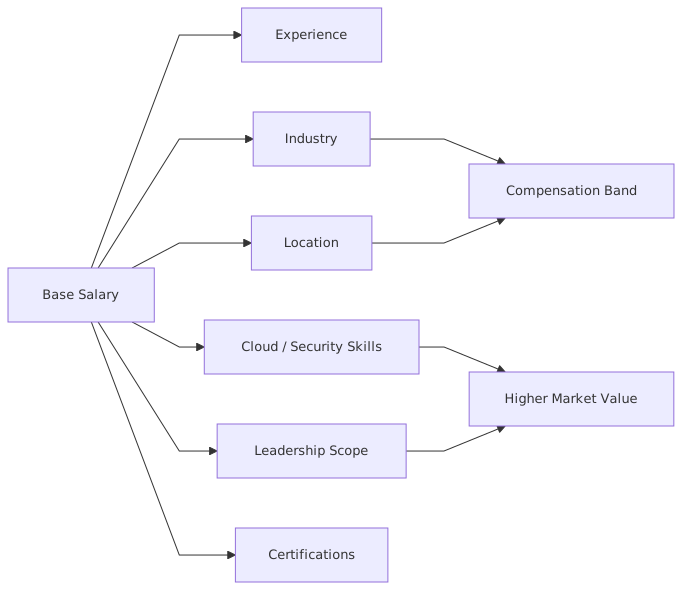
Salary drivers and architecture impact
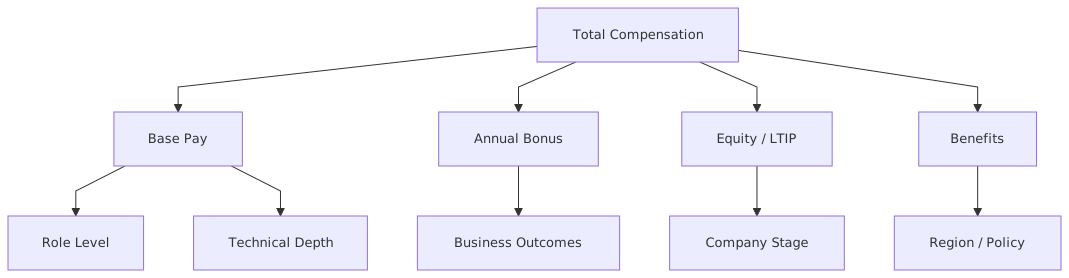
Enterprise architect compensation stack
Frequently Asked Questions
What does an enterprise architect do?
An enterprise architect designs and governs an organisation's technology landscape to align with business strategy. Responsibilities include capability mapping, application portfolio management, architecture governance, technology roadmapping, and ensuring that delivery programs build toward a coherent target architecture rather than accumulating technical debt.
What is the average enterprise architect salary?
Enterprise architect salaries vary significantly by region, sector, and seniority. In Western Europe (UK, Belgium, Netherlands, Germany), senior enterprise architects typically earn €90,000–€150,000. In the US, salaries range from $130,000–$200,000+. Financial services, healthcare, and government are typically the highest-paying sectors.
What certifications are most valuable for enterprise architects?
The most recognised certifications are TOGAF (The Open Group Architecture Framework), ArchiMate (Foundation and Practitioner), and AWS/Azure/GCP cloud architecture certifications. For Sparx EA specialists, formal Sparx EA training and MDG development skills add significant market value.