⏱ 20 min read
Most enterprise architecture problems are not caused by bad technology. They’re caused by bad architectural behavior.
That’s the uncomfortable truth.
In most large organizations, especially banks, insurers, governments, and big retail groups, the biggest EA failures come from architects doing one of two things: either they become diagram-producing spectators, or they become control freaks who slow everything down. Both are damaging. One creates chaos with nice PowerPoint. The other creates governance theater with no outcomes. ArchiMate for governance
Enterprise architecture is supposed to help the business make better change decisions. That’s it. Not produce a 200-page target state nobody reads. Not rename old integration problems as “digital transformation.” Not force every team into a pattern because it looked clean on a reference diagram.
So let’s say it simply, early: the most common enterprise architecture mistakes are overdesign, weak business alignment, ignoring execution reality, treating standards as dogma, and failing to govern identity, integration, and cloud decisions properly. If you avoid those, you avoid most of the pain.
Now the deeper version: these mistakes rarely show up as “architecture mistakes” in the postmortem. They show up as delayed migrations, brittle Kafka estates, IAM sprawl, cloud bills that exploded, duplicate data platforms, and product teams bypassing architecture entirely because they see it as a blocker.
That’s where this article goes. Real architecture work. Real mistakes. Real examples. Some opinions too, because frankly this field needs fewer neutral platitudes and more honesty.
What enterprise architecture is actually supposed to do
Before talking about mistakes, let’s clean up one thing.
Enterprise architecture is not just technology standardization. It’s not solution architecture at a bigger scale. And it’s definitely not “future-state diagram management.”
A good enterprise architecture function does four practical things:
- Connect business strategy to technology change
- Reduce unnecessary complexity
- Create decision guardrails, not bureaucratic traps
- Enable execution across domains, teams, and platforms
That sounds obvious. Yet many EA teams miss all four.
In real organizations, enterprise architecture sits in a messy middle. It has to balance business ambition, risk, regulation, security, delivery speed, data needs, and operational reality. In a bank, for example, architecture decisions are never just technical. A Kafka event model affects fraud processing, auditability, privacy, latency, customer service workflows, and operational support. IAM decisions affect employee joiner-mover-leaver controls, customer authentication journeys, privileged access, regulatory reporting, and cloud service design. Cloud architecture affects resilience, data residency, cost allocation, and vendor concentration risk.
So if your architecture work doesn’t survive contact with those realities, it isn’t architecture. It’s illustration.
The biggest enterprise architecture mistakes
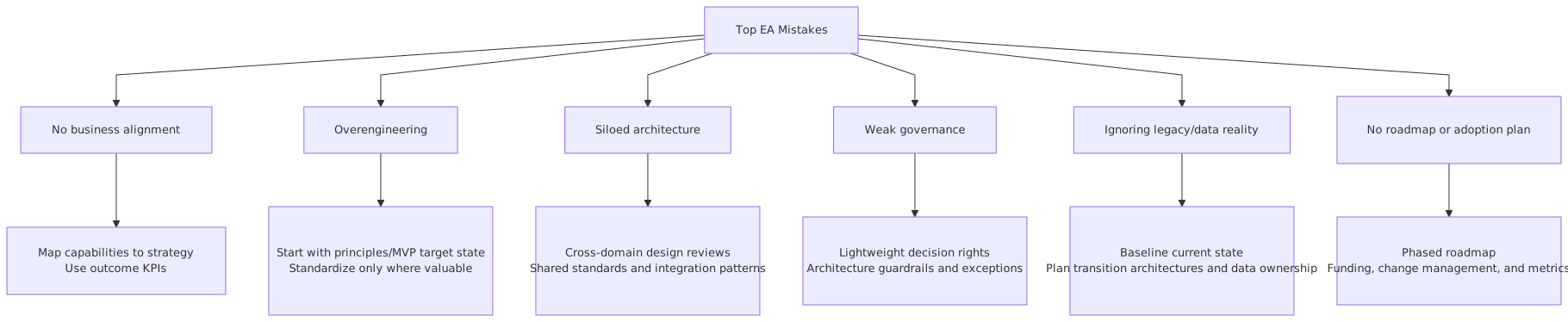
Here are the mistakes I see most often, and yes, some of them are still surprisingly common in organizations that claim to be “mature.”
Quick view: mistakes and fixes
Now let’s unpack the ones that matter most.
Mistake #1: Producing architecture artifacts instead of architectural decisions
This is probably the most common EA failure.
Some enterprise architects are extremely busy and almost completely ineffective. They produce capability maps, reference models, standards catalogs, current-state assessments, maturity heatmaps, target-state diagrams, transition-state diagrams, and architecture principles. But if you ask a hard question — what decision changed because of this work? — the answer is often vague.
That’s the problem.
Architecture is not the artifact. The artifact is only useful if it helps people make a decision they would otherwise struggle to make.
Examples of actual enterprise architecture decisions:
- Should the bank centralize IAM for workforce and customer identity, or separate them?
- Should event streaming via Kafka be the strategic integration pattern for domain events, and where should it not be used?
- Which workloads belong in public cloud, and which should remain on-prem for latency, regulation, or resilience reasons?
- Should customer master data be consolidated, federated, or virtualized?
- Which legacy core systems are strategic enough to wrap and retain, and which must be replaced?
Those are architecture decisions. A 50-slide deck is not.
How to avoid it
Force every architecture artifact to answer three things:
- What decision does this support?
- Who needs to make that decision?
- What changes if they agree?
If you can’t answer those clearly, stop polishing the artifact.
In real architecture work, this means less time perfecting notation and more time with business leaders, platform owners, security, operations, and delivery teams. Slightly messier process, much better outcomes.
Contrarian view: a lot of architecture frameworks have made this worse. They encourage completeness over usefulness. Completeness is seductive. It feels mature. It’s often waste.
Mistake #2: Creating target states that ignore the transition
A target architecture without a transition path is fantasy.
This one shows up everywhere. Architects define a clean future state: cloud-native services, event-driven integration, centralized IAM, domain-aligned data products, API-led access, zero trust, maybe some AI layer sprinkled on top because the board asked. Looks great.
Then reality arrives.
There are 400 applications.
Half of them have no clear owner.
The customer data model is inconsistent across regions.
Three business units already bought overlapping SaaS platforms.
The identity estate includes Active Directory, Azure AD/Entra ID, a legacy customer IAM stack, two partner portals, and custom authentication inside old Java apps.
Kafka exists, but six teams use it six different ways.
And now the target state means very little unless you can explain how to move from here to there, with sequencing, dependencies, funding, control points, and compromises.
Real enterprise example: retail banking modernization
A retail bank wants to modernize customer servicing. The business goal is simple enough: faster onboarding, better digital servicing, reduced call center load, improved fraud controls.
The architecture team designs a target state:
- customer identity centralized in a modern CIAM platform
- workforce identity standardized on enterprise IAM with role-based access and stronger PAM controls
- customer profile events published via Kafka
- servicing APIs exposed through a managed API platform
- customer interaction workloads moved to cloud
- legacy core banking retained but wrapped through services
That’s not a bad target state. In fact, it’s fairly sensible.
The mistake would be stopping there.
Because the real work is in the transition:
- Which customer journeys move first?
- How do you migrate identities without breaking login and MFA enrollment?
- Which events are canonical, and who owns them?
- How do you reconcile customer identifiers across old and new systems?
- What happens when cloud-hosted servicing depends on on-prem core systems with unstable response times?
- How do operations teams monitor Kafka topics, API failures, IAM issues, and cloud dependencies end to end?
- What controls satisfy audit and regulatory expectations during the hybrid period?
That hybrid period, by the way, lasts much longer than most architects admit. Usually years. Not quarters. TOGAF roadmap template
How to avoid it
Always create three views, not one:
- Target state
- Transition states
- Decision roadmap
The transition states matter most. They need owners, dates, dependencies, and a clear explanation of what gets temporarily worse before it gets better. Because something always does.
A real architect respects the ugly middle.
Mistake #3: Thinking standards are automatically good
Standards are necessary. Blind standardization is not.
This is where enterprise architects often become lazy. They discover one good pattern or platform and then try to turn it into universal law. Every integration must use Kafka. Every application must go to cloud. Every identity use case must use one IAM stack. Every domain must expose APIs in the same way. Every team must follow the same reference architecture.
No. Context matters.
Kafka is a good example. It’s powerful. In the right place, it’s transformative. In the wrong place, it creates asynchronous confusion, replay issues, schema drift, operational overhead, and debugging pain. Not every integration problem is an event-streaming problem. Some are still just request-response workflows. Some are batch. Some are file-based because a regulator, partner, or core platform says so. Architects who can’t admit this create more fragility, not less. ArchiMate in TOGAF ADM
Same with cloud. “Cloud-first” is a strategy slogan, not an architecture. There are valid reasons to use cloud aggressively. There are also valid reasons not to. Low-latency transaction processing tied to mainframe-backed banking services, data residency restrictions, software licensing traps, concentration risk concerns, and operational maturity gaps are real constraints. Pretending they’re not is not progressive. It’s reckless.
How to avoid it
Use standards as default positions, not religious doctrine.
A mature standard should say:
- preferred pattern
- where it fits
- where it does not fit
- required controls
- exception process
- operational implications
That last one gets ignored too often. A pattern that works for development but breaks support teams at 2 a.m. is not an enterprise standard. It’s an architect’s hobby.
Mistake #4: Underestimating IAM because “security owns that”
This is a major error, especially in regulated industries.
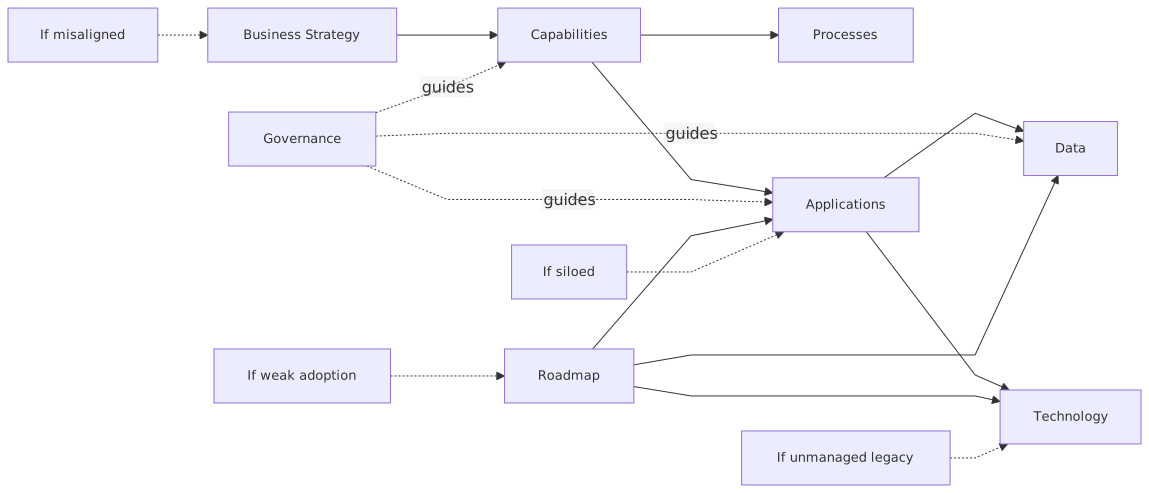
Identity and access management is not just a security control set. It is core enterprise architecture. It shapes user experience, operational control, compliance, integration design, cloud access, and organizational scalability.
But many architects still treat IAM as a specialist side topic. Big mistake.
In a bank, IAM touches:
- customer login and authentication
- employee access to critical systems
- privileged access management
- third-party and partner access
- segregation of duties
- cloud role and policy design
- auditability and regulatory evidence
- API authorization
- service-to-service trust
- identity lifecycle automation
If enterprise architecture ignores this, the result is usually fragmented identity domains, duplicated directories, custom authorization logic hidden inside applications, inconsistent MFA approaches, and ugly access recertification processes nobody trusts.
And then during cloud migration, things get worse. Teams move workloads into AWS, Azure, or GCP, but identity federation, role design, secrets management, and cross-platform policy models were never architected properly. So now you have cloud sprawl and access sprawl.
How this applies in real architecture work
If you are doing enterprise architecture and not reviewing IAM as part of application, integration, and cloud decisions, you are missing one of the most important control layers.
For example:
- A new customer platform should not define its own identity model in isolation.
- A Kafka platform should not allow uncontrolled producer and consumer access patterns without enterprise identity and authorization policy.
- A cloud landing zone is incomplete if IAM federation, privileged access, break-glass controls, and workload identities are not defined upfront.
How to avoid it
Treat IAM as a first-class architecture domain. That means:
- enterprise-wide identity principles
- clear separation of workforce, customer, partner, and machine identities
- federation strategy
- authorization model patterns
- lifecycle and governance ownership
- cloud IAM integration patterns
- audit and compliance alignment
Strong opinion: if your enterprise architecture team leaves IAM mostly to the security team and occasionally attends a steering meeting, that’s not delegation. That’s avoidance.
Mistake #5: Using Kafka as a modernization badge instead of an integration capability
I’ve seen organizations deploy Kafka and then act as if they’ve become event-driven by default. They haven’t.
Kafka is not a strategy. It is a tool and a platform capability. Used well, it supports scalable event distribution, decoupling, replay, streaming use cases, and near-real-time data flow. Used badly, it becomes a giant pipe of unclear messages that nobody truly owns.
The common mistakes:
- no clear event ownership by business domain
- topics named by technical system rather than business meaning
- no schema governance
- “event-carried state transfer” used everywhere without discipline
- consumers depending on internal fields they should never have seen
- no retention strategy linked to business and compliance needs
- no operational accountability for lag, replay, failure handling, and dead-letter patterns
- using Kafka where synchronous orchestration was actually required
This matters because architects often approve Kafka broadly without defining the enterprise rules around it.
Real-world banking scenario
A bank introduces Kafka to modernize integration between payments, fraud, customer notifications, and analytics.
Good ambition.
But over time:
- payments publishes technical events tied to internal processing stages
- fraud consumes them and builds assumptions on field semantics
- notifications starts using the same stream for customer alerts
- analytics subscribes directly instead of using curated streams
- another team republishes transformed events with nearly identical names
- no one agrees which event is authoritative
- schema changes start breaking downstream consumers
This is not event-driven architecture. It is distributed misunderstanding.
How to avoid it
Architect Kafka around business domains and operating model, not just platform setup.
That means:
- define domain event ownership
- establish schema governance
- separate business events from technical events
- classify event types and retention needs
- define producer and consumer responsibilities
- put observability and support model in place
- be explicit about where Kafka is not the right pattern
A useful rule: if nobody can explain an event in plain business language, it probably should not be an enterprise event.
Mistake #6: Assuming cloud adoption automatically simplifies architecture
Cloud can simplify some things. It can also multiply complexity very fast.
A lot of enterprise architecture teams were too optimistic about this. They assumed moving to cloud would naturally reduce technical debt, improve resilience, and standardize operations. Sometimes yes. Often no.
What often really happens:
- old application designs get lifted into expensive cloud environments
- networking becomes harder, not easier
- IAM becomes more fragmented
- teams adopt overlapping managed services
- resilience design is assumed rather than engineered
- data copies multiply
- cloud costs become politically sensitive
- operational responsibilities blur between platform teams and app teams
In other words, the same old problems move faster and cost more.
For banks and heavily regulated firms, cloud architecture has even more dimensions:
- data residency
- encryption and key management
- third-party risk
- concentration risk
- exit strategy
- resilience testing
- logging and evidence retention
- regulatory interpretation
How this applies in real architecture work
An enterprise architect should not ask only, “Can this workload move to cloud?”
They should ask:
- What operational model will support it?
- What IAM pattern controls access?
- What are the resilience requirements?
- What data classifications apply?
- How will cost be managed?
- What dependencies remain on-prem?
- How will incidents be handled across shared responsibility boundaries?
That’s real cloud architecture. Not migration tally charts.
How to avoid it
Architect cloud around enterprise operating principles:
- landing zones with real controls
- identity federation by design
- standard connectivity patterns
- resilience patterns by workload type
- platform product model
- FinOps discipline
- clear policy exceptions
Contrarian thought: “cloud-first” often becomes a substitute for actual decision-making. It sounds modern. It avoids hard trade-offs. Good architects make the trade-offs explicit.
Mistake #7: Staying too far from delivery teams
Some enterprise architects still behave like they are above implementation. They define principles, approve standards, attend governance meetings, and maybe review architecture exceptions. But they don’t spend enough time with engineering teams, platform owners, product managers, support leads, or operations. EA governance checklist
That creates a dangerous gap.
Because architecture quality is tested in delivery. That is where patterns meet deadlines, technical debt, staffing limits, vendor constraints, and production incidents. If architects are absent from that reality, their guidance degrades quickly.
This is especially obvious in hybrid architecture work:
- cloud service consumes on-prem banking API
- Kafka stream feeds analytics and operational apps
- IAM policy crosses SaaS, cloud, and internal systems
- customer journey spans mobile app, API gateway, fraud engine, and legacy core
Those boundaries are where architecture succeeds or fails.
How to avoid it
Embed more than you review.
That doesn’t mean enterprise architects become solution architects full time. It means they stay close enough to delivery to understand friction, learn from exceptions, and refine standards based on actual outcomes.
Useful habits:
- attend design reviews selectively, not ceremonially
- join incident postmortems for key platforms
- review production metrics, not just project documents
- spend time with platform engineering and security operations
- track which standards teams are bypassing and why
If teams constantly bypass your standards, the teams are not always the problem.
Mistake #8: Governance that slows change instead of improving it
Architecture governance has a bad reputation for a reason. A lot of it deserves that reputation.
Too many review boards are designed around approval theater. Teams present. Architects ask broad questions. Risks are vaguely noted. Actions are assigned. Approval is conditional. Everyone leaves slightly annoyed. Delivery slows down. Little improves.
Good governance should increase decision quality with minimal friction. If it doesn’t, it’s just process overhead.
What bad governance looks like
- architecture review happens too late
- decisions are revisited repeatedly
- no clear criteria for approval
- exception handling is political, not structured
- standards are enforced inconsistently
- governance focuses on documents, not risk and outcomes
- architects have veto power without accountability for delivery impact
That last one is especially toxic.
How to avoid it
Make governance:
- early
- lightweight
- risk-based
- transparent
- measurable
For example, not every initiative needs the same level of review. A low-risk internal workflow tool should not face the same architectural burden as a customer identity migration in a bank. Review depth should reflect impact.
And governance should produce usable outputs:
- approved decisions
- constraints
- required controls
- known exceptions
- follow-up checkpoints
Not “please update slide 14.”
Strong opinion: if your architecture governance model requires teams to become presentation experts, your governance model is broken. architecture decision record template
Mistake #9: Forgetting that politics is part of architecture
Architects like to think problems are mostly logical. They’re not. In enterprises, architecture is deeply political.
Different business units have budgets, vendors, histories, priorities, and power. Security wants control. Delivery teams want speed. Operations wants stability. Data teams want consistency. Business leaders want outcomes quickly. Regulators want evidence. Procurement wants leverage. Vendors promise simplification while increasing dependency.
If you pretend architecture exists outside this, you lose influence.
This doesn’t mean architects should become political operators in a cynical sense. It means they need organizational awareness. They need to know where standardization is realistic, where federation is smarter, where compromise is necessary, and when pushing too hard on purity will backfire.
A classic example is enterprise IAM. Centralization sounds clean. But in a large bank with regional entities, legacy acquisitions, and product-specific customer journeys, full centralization may be neither feasible nor desirable in the near term. A federated architecture with stronger common controls may produce better outcomes than a forced all-at-once consolidation.
Purists hate that answer. Real enterprises need it.
What good enterprise architecture looks like in practice
Here’s the part that matters most. Good enterprise architecture is not the absence of mess. It is the ability to reduce mess without lying about it.
In practice, strong enterprise architecture teams do the following:
- tie architecture decisions to business goals, risk, and cost
- define a small number of strong enterprise standards
- allow justified exceptions with visibility
- treat IAM, integration, data, and cloud as connected domains
- design transition states, not just target states
- stay close to delivery and operations
- measure whether architecture decisions improve outcomes
- simplify where possible, federate where necessary
And yes, they say no sometimes. But good architects don’t just say no. They say:
- no, because this creates identity fragmentation
- no, because Kafka is the wrong pattern for this interaction
- no, because this cloud design has no operational ownership
- no, because the transition risk is higher than the benefit right now
That’s a real architecture voice. Specific. Evidence-based. Grounded in enterprise consequences.
A practical checklist for architects
If you’re leading enterprise architecture work, ask yourself these questions regularly:
If several of those warning signs feel familiar, that’s not unusual. But it is a signal to reset the function before the organization starts routing around it.
Final thought
The worst enterprise architecture mistake is forgetting that architecture exists to enable change, not to admire complexity from a safe distance.
That’s what too many architects do. They stand slightly outside the mess, naming it, mapping it, and classifying it. Sometimes intelligently. But architecture earns its place only when it helps the enterprise move through the mess with less risk, less duplication, and better decisions.
In banking, that means making hard calls about IAM, Kafka, cloud, legacy core integration, and control models under real constraints. In any enterprise, it means accepting that perfect target states are easy and useful transitions are hard.
So be useful, not elegant.
Be opinionated, but not doctrinaire.
Standardize what matters.
Federate what must remain local.
And never confuse a polished architecture deck with architectural impact.
That confusion has wasted enough time already.
FAQ
1. What is the most common enterprise architecture mistake?
The most common mistake is treating enterprise architecture as documentation instead of decision support. Architects produce models and diagrams, but they don’t influence real investment, platform, integration, IAM, or cloud decisions.
2. Why do enterprise architecture target states often fail?
Because they ignore transition reality. A target state may be technically sound, but without sequencing, ownership, funding, and hybrid-state design, delivery teams can’t use it. Enterprises live in transition far longer than architects like to admit.
3. How should enterprise architects think about Kafka?
As a strategic capability, not a default answer. Kafka works well for domain events, streaming, and decoupled distribution, but it needs event ownership, schema governance, operational controls, and clear boundaries. It is not the right solution for every integration problem.
4. Is IAM really an enterprise architecture concern or just security?
It is absolutely an enterprise architecture concern. IAM affects customer experience, workforce access, cloud design, compliance, integration, API authorization, and operational control. Treating it as “security only” leads to fragmentation and long-term risk.
5. What makes architecture governance effective?
Effective governance is early, risk-based, lightweight, and tied to clear decisions. It should improve speed and quality, not create presentation rituals. If teams see governance mainly as delay, the model needs redesign.
Frequently Asked Questions
What is enterprise architecture?
Enterprise architecture is a discipline that aligns an organisation's strategy, business processes, information systems, and technology. Using frameworks like TOGAF and modeling languages like ArchiMate, it provides a structured view of how the enterprise operates and how it needs to change.
How does ArchiMate support enterprise architecture practice?
ArchiMate provides a standard modeling language that connects strategy, business operations, applications, data, and technology in one coherent model. It enables traceability from strategic goals through business capabilities and application services to the technology platforms that support them.
What tools are used for enterprise architecture modeling?
The main tools are Sparx Enterprise Architect (ArchiMate, UML, BPMN, SysML), Archi (free, ArchiMate-only), and BiZZdesign Enterprise Studio. Sparx EA is the most feature-rich option, supporting concurrent repositories, automation, scripting, and integration with delivery tools like Jira and Azure DevOps.