⏱ 6 min read
Introduction
Sparx Systems’ Enterprise Architect (EA) is one of the most extensible modeling platforms in the enterprise space. At the heart of its customization capabilities lies MDG Technology—a powerful mechanism that allows architects and modelers to define, extend, and enforce modeling standards, visual styles, and tool behaviors tailored to specific business or technical domains.
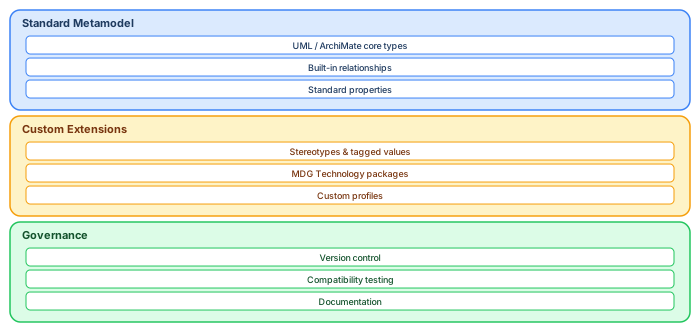
In this article, we’ll explore what MDG Technologies are, why they matter, and how to design and deploy your own MDG Technology in Sparx EA. This guide is perfect for solution architects, enterprise architects, tool administrators, and modeling leads looking to enhance modeling governance and productivity across their teams. TOGAF roadmap template
1. What Is MDG Technology in Sparx EA?
MDG stands for Model Driven Generation. An MDG Technology in Sparx EA is essentially a packaged extension that allows you to:
- Define custom stereotypes and UML profiles
- Create toolboxes with reusable modeling elements
- Customize diagram types, rules, and element icons
- Generate code, reports, or structured output
- Integrate with external systems (via scripts or add-ins)
These packages are loaded into EA as XML files (or zipped) and can be shared across teams or published to a centralized repository using Pro Cloud Server. enterprise cloud architecture patterns
2. Why Use MDG Technology?
Using MDG Technologies in EA delivers strategic benefits such as:
- Standardization: Enforce modeling best practices and domain-specific templates
- Scalability: Share consistent modeling artifacts across teams and projects
- Automation: Leverage tagged values, quicklink rules, and generation templates
- Governance: Integrate with reviews, validations, and change control
3. Components of an MDG Technology
A typical MDG package may include:
- UML Profiles: Define stereotypes and constraints (via Class diagrams with stereotypes)
- Toolboxes: Custom palettes for your elements and connectors
- Diagram Types: Define custom diagram styles, backgrounds, and layout behavior
- Quicklinker: Define allowed relationships between elements
- Templates: RTF, HTML, XSLT, or code generation templates
- Scripts: JScript, VBScript, or JavaScript-based helpers
4. Building an MDG Technology Step-by-Step
To build your own MDG:
- Create a new model with a UML Profile diagram
- Define your stereotypes using UML classes and set their base metaclass (e.g., Class, Component, Actor)
- Use the UML Toolbox Profile to organize your toolboxes
- Define custom diagram types in a “Diagram Profile” and associate your toolbox
- Optionally, create a “Quick Linker” CSV file to control connections
- Go to Specialize > Technologies > Publish > Technology Wizard to generate the .XML
- Deploy it using the MDG Technologies manager in EA
5. Deploying and Sharing MDG Technologies
Once your MDG XML file is ready, it can be deployed:
- Locally: By placing it in EA’s
AppData\Sparx Systems\MDGTechnologiesfolder - Enterprise-wide: Publish via Pro Cloud Server so all users have access
- Bundled: Include in an EA Project Template or RAS asset library
6. Advanced Features
MDG Technology supports:
- Custom Code Generation: via EA’s built-in code generation framework
- Image assets: Icons for new elements, toolboxes, and diagrams
- Model Validation Rules: Enforce business logic during modeling
- Custom Templates and Scripts: Auto-fill tagged values or validate inputs
7. Best Practices
- Modularize profiles by domain or team
- Document stereotypes and toolboxes clearly
- Include example diagrams in your MDG project file
- Use versioning: update MDG XML filenames with version numbers
- Test on sandbox projects before enterprise rollout
Conclusion
MDG Technology empowers Sparx EA users to customize the modeling environment, enforce standards, and extend capabilities across disciplines. Whether you’re creating a custom framework for banking, telecom, defense, or pharma, MDGs make EA the backbone of your enterprise modeling strategy. Sparx EA training
MDG Technology, Sparx Enterprise Architect, EA MDG Customization, UML Profiles, Stereotypes, Custom Diagrams, EA Toolbox Profiles, Quick Linker, EA Code Generation, EA Governance Modeling Sparx EA best practices
If you’d like hands-on training tailored to your team — Sparx Enterprise Architect, BPMN, SysML or the Archi tool — or modelling coaching in ArchiMate and TOGAF-aligned governance, you can reach us via our contact page.
Getting more from your Sparx EA investment
Most organizations use less than 20% of Sparx Enterprise Architect's capabilities. Three underutilized features deliver disproportionate value when activated: model validation, document generation, and the automation API. free Sparx EA maturity assessment
Model validation checks every element and relationship against metamodel rules, catching errors that human reviewers miss. Enable ArchiMate validation under Specialize → Technologies to prevent invalid relationships (for example, a Composition between elements in different layers). Add custom validation scripts that enforce your organization's naming conventions, required tagged values, and maximum elements per diagram.
Document generation produces Word or PDF reports directly from the model. Configure templates that pull element properties, tagged values, relationships, and diagrams into formatted documents. When the model changes, regenerate the document — it is always synchronized. This eliminates the manual document maintenance that typically consumes 30-40% of architect time.
The automation API (JavaScript, VBScript, or .NET) enables bulk operations that would take hours manually: updating tagged values across hundreds of elements, generating traceability matrices, exporting element catalogs to Excel, or validating naming conventions. A single validation script that runs nightly catches more errors than a monthly manual review.
Frequently Asked Questions
What is Sparx Enterprise Architect used for?
Sparx Enterprise Architect (Sparx EA) is a comprehensive UML, ArchiMate, BPMN, and SysML modeling tool used for enterprise architecture, software design, requirements management, and system modeling. It supports the full architecture lifecycle from strategy through implementation.
How does Sparx EA support ArchiMate modeling?
Sparx EA natively supports ArchiMate 3.x notation through built-in MDG Technology. Architects can model all three ArchiMate layers, create viewpoints, add tagged values, trace relationships across elements, and publish HTML reports — making it one of the most popular tools for enterprise ArchiMate modeling.
What are the benefits of a centralised Sparx EA repository?
A centralised SQL Server or PostgreSQL repository enables concurrent multi-user access, package-level security, version baselines, and governance controls. It transforms Sparx EA from an individual diagramming tool into an organisation-wide architecture knowledge base.