⏱ 21 min read
Most enterprise architecture content is too clean to be useful.
It shows tidy diagrams, perfect capability maps, and “target states” that look like they were designed for companies with no politics, no legacy, no budget constraints, and no security team saying no every second week. Real architecture work is nothing like that. Real architecture is messy. It’s a negotiation between business urgency, technical debt, risk tolerance, operating model, and the fact that half the organization still depends on systems nobody wants to touch.
So let’s say the quiet part out loud: enterprise architecture is not about drawing better boxes. It’s about making better trade-offs at enterprise scale.
That’s the practical version, and frankly, the only one that matters.
What enterprise architecture actually means
If we strip away the jargon, enterprise architecture is the discipline of designing how a business’s processes, applications, data, technology, and governance fit together so the company can change without breaking itself. ArchiMate for governance
That’s the simple explanation.
A bit deeper: enterprise architecture helps answer questions like these:
- Which systems should talk to each other, and how?
- Where should identity and access decisions happen?
- What belongs in the cloud, and what absolutely should not?
- When do we modernize, and when do we wrap legacy instead?
- How do we reduce duplication across business units?
- How do we support speed without creating chaos?
That’s the real job. Not “owning standards.” Not making 120-slide PowerPoints nobody reads. Not forcing every project through a framework because the framework exists.
A good enterprise architect helps the organization make structural decisions that will still make sense three years from now.
A bad one creates architecture theater.
Why examples matter more than frameworks
Frameworks have their place. TOGAF, capability maps, reference architectures, roadmaps, principles. Fine. Useful sometimes. But examples are where architecture becomes real. ArchiMate in TOGAF ADM
Because architecture is always contextual.
A bank modernizing payments has different constraints than a retailer modernizing e-commerce. A company with strict IAM controls and regulated customer data cannot just “move fast” in the same way a SaaS startup can. A Kafka platform in a global enterprise is not just a messaging tool. It becomes a governance problem, a data ownership problem, and an operating model problem. EA governance checklist
That’s why real use cases matter. They show where architecture decisions collide with reality.
Below are several enterprise architecture examples that show how this work actually plays out.
Example 1: A bank modernizes customer event processing with Kafka
Let’s start with banking, because banking exposes architecture weaknesses quickly. Regulation is high. Legacy is deep. Integration is ugly. And every “small” decision somehow becomes a control issue, a resilience issue, and a board-level issue.
The situation
A retail bank had customer data spread across:
- a core banking platform
- a CRM
- a digital banking app
- a loan origination system
- a fraud platform
- several reporting databases
Each system had its own copy of customer information. Updates were inconsistent. Address changes took hours or days to appear everywhere. Fraud alerts arrived too late in some channels. The mobile app showed stale account preferences. The business kept asking for “real-time personalization,” while IT was still reconciling overnight batches.
Classic enterprise problem: fragmented data, duplicated logic, and integration patterns from three different decades.
The architecture move
The bank introduced Kafka as an enterprise event backbone.
Not because Kafka is fashionable. Because they needed a durable, scalable way to publish business events like:
- CustomerCreated
- CustomerAddressUpdated
- AccountOpened
- CardBlocked
- LoanStatusChanged
The key architectural idea was simple: systems would stop relying so heavily on point-to-point integrations and instead publish and consume events through a shared platform.
That sounds obvious now. It wasn’t obvious internally.
Some teams wanted Kafka to become the new universal integration hammer. That would have been a mistake. Kafka is excellent for event streaming and asynchronous decoupling. It is not automatically the answer for every synchronous request-response interaction, every transactional workflow, or every data movement problem. Good architecture is partly about knowing where not to use the shiny thing.
What changed in practice
The bank defined a few non-negotiables:
This was not “just a platform implementation.” It was enterprise architecture work because it changed the integration model of the bank.
Where architects usually get this wrong
A lot of architects make one of these mistakes:
1. They treat Kafka as a technical installation, not an enterprise capability.
Wrong. Once Kafka is shared across domains, it becomes part of the enterprise operating model. You need topic ownership, schema governance, retention policies, security boundaries, and support responsibilities. architecture decision record template
2. They create an event mesh without business semantics.
If your event names are technical garbage like cust_tbl_upd_v2, don’t pretend you’ve done architecture. You’ve just moved database change noise onto a broker.
3. They ignore data ownership.
This one is huge. If five systems can publish “customer updated” events, then nobody owns customer truth. You need authoritative sources and explicit data product ownership.
4. They underestimate IAM implications.
Kafka in a bank is not an open playground. Producer and consumer access must align with identity, entitlements, environment segregation, and audit controls. If your topic ACL model is vague, your architecture is vague.
Real architecture lesson
The biggest value was not speed alone. It was structural decoupling.
Once the bank had a governed event backbone, new use cases became easier:
- fraud systems consumed card usage events faster
- customer notification services reacted in near real-time
- analytics teams consumed events without custom extraction projects
- digital channels stopped depending on brittle nightly syncs
That’s what enterprise architecture should do. Create reusable structural advantages, not one-off project wins.
But here’s the contrarian part: event-driven architecture is often oversold. If your organization is immature in domain ownership, operational support, and schema governance, Kafka can amplify chaos, not reduce it. A badly governed event platform is just distributed confusion at scale.
Example 2: IAM centralization after years of access sprawl
Identity and access management is one of those areas where companies routinely pretend they have architecture when they really have accumulated exceptions.
Every enterprise says identity is strategic. Then you look closer and find:
- multiple directories
- local application accounts everywhere
- inconsistent role models
- weak joiner/mover/leaver processes
- privileged access in spreadsheets
- cloud identities disconnected from workforce identities
That’s not architecture. That’s entropy.
The situation
A multinational financial services company had grown through acquisition. Each business unit had its own IAM patterns. Some applications used Active Directory groups. Others used local database users. Some cloud platforms used federated SSO. Others had manually created identities. Contractors kept access long after leaving projects. Audit findings kept recurring.
The leadership question was straightforward: how do we reduce access risk without slowing delivery to a crawl?
The architecture move
The enterprise architecture team pushed for a centralized IAM model based on a few principles:
- one workforce identity source of truth
- federation first for enterprise applications
- role and attribute-based access where practical
- privileged access managed separately
- application onboarding to standard identity services mandatory for new systems
- cloud IAM aligned with enterprise identity, not built as a parallel universe
This wasn’t an overnight migration. It was a multi-year architecture transition.
And this is where real architects differ from slide architects. You don’t fix IAM with a target-state poster. You fix it by sequencing the change:
- establish identity source authority
- standardize authentication patterns
- rationalize authorization models
- control privileged access
- integrate cloud platforms
- retire local identity stores where possible
How it applied in real work
The architecture team did not try to modernize every application at once. They grouped the portfolio:
- strategic applications to be integrated fully
- legacy applications to be wrapped with federation where possible
- end-of-life systems to be tolerated temporarily
- high-risk privileged systems to be prioritized early
That portfolio segmentation is classic enterprise architecture. It sounds boring. It’s not. It’s how you avoid wasting two years “transforming” systems that should have been retired.
What changed
The company moved from fragmented authentication to enterprise SSO for most business apps. Cloud accounts were tied back to central identity providers. Joiner/mover/leaver processes became cleaner. Audit evidence improved dramatically.
More importantly, the architecture created a control model that scaled.
Before, every project invented identity decisions. After, projects consumed identity as an enterprise service.
That’s the difference between local optimization and architecture.
Common mistakes architects make in IAM
1. Designing roles in a vacuum
Architects love elegant role models. Business reality destroys them. If you don’t involve process owners, role engineering becomes fantasy.
2. Ignoring lifecycle operations
Authentication gets all the attention. But stale access usually comes from bad lifecycle management. Joiners, movers, leavers, temporary access, emergency elevation. That’s where risk lives.
3. Treating cloud IAM separately from enterprise IAM
Terrible idea. If your AWS, Azure, or GCP access model evolves independently from workforce identity, you create governance gaps immediately.
4. Assuming centralization means one-size-fits-all
Not everything should use the exact same authorization model. Central control does not mean architectural laziness.
Contrarian thought
Sometimes architects push too hard for “perfect centralization.” That can become bureaucracy disguised as security. The goal is not to route every access decision through a giant committee. The goal is to create consistent trust boundaries and control points while keeping delivery teams productive.
Good IAM architecture reduces friction in the long run. Bad IAM architecture just relocates friction into a shared service everyone hates.
Example 3: Cloud migration that was really an operating model problem
Cloud programs are often sold as infrastructure modernization. In reality, the hard part is usually not the infrastructure. It’s governance, accountability, cost visibility, platform engineering, and security design.
In other words, enterprise architecture.
The situation
A mid-sized bank wanted to move customer-facing digital services to the cloud. The executive pitch was familiar:
- faster delivery
- better scalability
- improved resilience
- lower infrastructure burden
Reasonable goals. But the initial program was weak. Teams were lifting and shifting applications without standard landing zones, inconsistent network patterns were emerging, IAM was fragmented, and cost allocation was muddy. Every team was solving the same foundational problems differently.
That is how cloud turns into an expensive mess.
The architecture move
The architects reframed the initiative.
Instead of asking, “How do we migrate applications to cloud?” they asked, “What enterprise cloud model do we need so application teams can build safely and repeatedly?”
That led to a cloud architecture with:
- standardized landing zones
- shared IAM and federation patterns
- network segmentation and connectivity standards
- logging, monitoring, and security baselines
- approved deployment patterns
- tagging and cost management standards
- platform guardrails enforced through automation
Notice the pattern here. The architecture work was not just choosing services. It was defining the enterprise constraints that make cloud usable at scale.
Real example of an architecture decision
One major debate was whether teams should have broad autonomy to create cloud resources as needed, or whether a central platform model should constrain them.
Predictably, the “move fast” camp wanted freedom. The security and risk teams wanted heavy central approval. Both positions were too extreme.
The architecture compromise was this:
- teams could provision within approved landing zones
- identity, logging, network controls, and baseline policies were centralized
- higher-risk patterns required review
- reusable infrastructure templates were provided
- exceptions were time-bound and visible
That is what real architecture looks like. Not pure decentralization. Not pure centralization. Controlled autonomy.
What improved
Once the cloud architecture stabilized:
- onboarding new applications got faster
- security reviews became more predictable
- IAM controls were more consistent
- cost reporting improved
- operational incidents tied to configuration drift dropped
And maybe most importantly, cloud conversations got less ideological. The enterprise had a model.
Common mistakes in cloud architecture
1. Confusing migration with modernization
Moving a bad architecture to the cloud does not make it good. It makes it someone else’s data center bill.
2. No enterprise IAM model
This is still incredibly common. Teams rush into cloud and bolt identity on later. That’s backwards.
3. Over-standardizing too early
Some architects lock down everything before they understand actual delivery needs. Then developers route around the platform. If your standards make work impossible, people will create shadow patterns.
4. Underestimating financial architecture
Cloud cost visibility is architecture, not just finance. Tagging, ownership, environment strategy, shared service allocation, and lifecycle discipline all matter.
Contrarian thought
Not every workload belongs in cloud. There, I said it. Some highly stable, low-change, tightly coupled legacy platforms are not worth replatforming yet. Architects who insist everything must move are often optimizing for strategy optics, not enterprise value.
A real architect knows when to modernize, when to contain, and when to leave something alone for now.
Example 4: Replacing point-to-point integration with domain-based architecture
This is one of the most common enterprise situations: too many applications, too many custom interfaces, too much hidden dependency.
At some point, every large organization realizes that integration complexity has become a business problem.
The situation
A corporate bank had dozens of systems supporting payments, onboarding, compliance checks, treasury operations, customer servicing, and reporting. Over time, each project added its own integrations. Some used APIs, some files, some middleware flows, some direct database extracts. integration architecture guide
Nobody had the full picture.
Change impact analysis became painful. A small update in one system triggered failures somewhere unexpected. Delivery slowed because dependency mapping was weak.
The architecture move
The enterprise architecture team shifted the organization toward a domain-oriented integration model.
Instead of organizing integration around application pairs, they organized around business domains such as:
- customer
- account
- payment
- compliance
- product
- reference data
For each domain, they clarified:
- system of record
- core business events
- canonical APIs where needed
- ownership responsibilities
- data quality expectations
- security classification
This mattered because architecture moved from “how does system A talk to system B?” to “how does the enterprise manage information and interaction in this domain?”
That’s a much stronger question.
How Kafka and APIs worked together
This is where a lot of architecture diagrams become dishonest. They act like you must choose one integration style.
You don’t.
In this bank:
- Kafka was used for asynchronous event propagation
- APIs were used for synchronous business interactions
- batch remained for a few legacy-heavy reporting and reconciliation scenarios
- file transfer survived in tightly controlled edge cases
That is normal. Hybrid integration is not architectural failure. It is architectural realism.
The trick is not to eliminate variety completely. The trick is to reduce accidental variety and make intentional patterns explicit.
What architects often mess up here
1. They chase canonical models too hard
A lightweight domain vocabulary is useful. A giant enterprise canonical model for everything usually becomes shelfware.
2. They try to remove all legacy integration too early
You don’t win by ripping out stable interfaces just because they look old. Prioritize based on risk, cost, and strategic value.
3. They don’t define ownership
If no domain owner exists, integration standards become advisory fiction.
4. They overlook observability
An enterprise integration landscape without tracing, lineage, and operational visibility is just a sophisticated guessing game.
Real architecture lesson
The real value came from dependency reduction and clearer ownership, not from prettier diagrams.
Projects got faster because teams knew:
- which domain to engage
- which events already existed
- which APIs were approved
- where customer truth lived
- how access should be controlled
That is enterprise architecture doing its actual job: reducing ambiguity across the enterprise.
Example 5: Architecture rationalization after acquisition
Mergers and acquisitions are where architecture debt becomes visible in public.
Every executive talks about synergy. Then the integration starts and everybody learns the truth: two organizations doing the same thing in completely different ways is not synergy. It’s duplication with legal paperwork.
The situation
A regional bank acquired a digital lender. Both had:
- customer onboarding capabilities
- identity verification tools
- CRM platforms
- document management systems
- risk engines
- reporting stacks
The first instinct from some leaders was immediate consolidation. One platform for everything. Fast.
That would have been reckless.
The architecture move
The architects created a decision framework to assess each capability across dimensions like:
- strategic fit
- functional maturity
- technical health
- regulatory suitability
- integration complexity
- migration cost
- time sensitivity
Then they categorized capabilities into:
- retain and scale
- coexist temporarily
- wrap and integrate
- retire
- rebuild selectively
This is exactly the kind of work enterprise architecture should lead. Not because architects own every decision, but because someone has to evaluate the enterprise-wide consequences of platform choices.
Example outcome
The acquired lender had a better digital onboarding journey and stronger API design. The incumbent bank had stronger core controls, IAM integration, and regulatory reporting.
So the architecture decision was not “pick one stack.” It was more nuanced:
- retain the lender’s onboarding front-end patterns
- integrate with the bank’s IAM and compliance services
- migrate customer identity management gradually
- keep some lending decisioning components temporarily
- retire duplicate document services over time
That sequencing preserved business momentum without creating an uncontrolled hybrid forever.
Common mistakes in post-acquisition architecture
1. Choosing based on politics, not capability
Who owns the bigger budget is not an architecture criterion.
2. Forcing premature standardization
Sometimes coexistence is the right short-term answer. Architects who can’t tolerate temporary duality often create unnecessary disruption.
3. No end-state accountability
Temporary states have a way of becoming permanent. If you allow coexistence, put dates, owners, and milestones on it.
4. Ignoring IAM and data integration until late
This is a major error. Identity and data alignment usually determine whether the merged business can operate coherently.
Contrarian thought
“Standardize everything quickly” sounds disciplined. Often it’s just impatience. In enterprise environments, speed without sequencing is how you create fragile integration and exhausted teams.
What all these examples have in common
Different industries, different technologies, same underlying patterns.
Real enterprise architecture usually comes down to a few recurring responsibilities:
1. Defining enterprise-level constraints that enable change
Good constraints are useful. They reduce reinvention. They create predictable delivery. They help teams move faster safely.
2. Clarifying ownership
Data ownership. Platform ownership. Domain ownership. Service ownership. Without ownership, architecture becomes recommendation theater.
3. Choosing where to standardize and where to allow variation
This is probably the most underrated architecture skill. Total standardization is unrealistic. Total freedom is chaos. The craft is in choosing the control points.
4. Sequencing change realistically
Target states are cheap. Transition architectures are where competence shows. Can you move from current to future without breaking operations? That’s the real test.
5. Balancing business urgency with structural integrity
If architecture blocks everything, it fails. If it approves everything, it also fails.
That tension never goes away.
Common mistakes enterprise architects make
Let’s be blunt. Architects make predictable mistakes, and many organizations tolerate them for far too long.
Mistake 1: Falling in love with target state diagrams
A target state without a migration path is decoration.
Mistake 2: Being too abstract for delivery teams
If engineers and product teams can’t see how architecture changes their decisions this quarter, the architecture probably isn’t grounded enough.
Mistake 3: Confusing governance with control
Governance should improve decision quality. If it only adds delay, people will bypass it.
Mistake 4: Ignoring operational reality
A design that works only if every team behaves perfectly is not enterprise architecture. It’s wishful thinking.
Mistake 5: Overusing “best practice”
There is no universal best practice detached from context. There are trade-offs, constraints, and consequences.
Mistake 6: Neglecting IAM, data, and support models
These are the areas that turn ambitious architectures into sustainable ones. Or break them.
Mistake 7: Trying to eliminate all legacy
Legacy is not a moral failure. Sometimes it is still the most economically rational choice for a period of time.
How this applies in real architecture work
This is the part many articles skip.
In day-to-day architecture work, these examples translate into very practical activities:
- reviewing project designs against enterprise patterns
- deciding whether a new capability should be built, bought, or reused
- identifying authoritative systems and domain boundaries
- setting integration patterns for APIs, events, and batch
- defining IAM onboarding requirements for new platforms
- assessing cloud landing zone adoption and exception handling
- rationalizing overlapping applications after acquisitions
- creating roadmaps that sequence risk reduction and modernization
- explaining trade-offs to executives in plain language
- pushing back when a local optimization damages enterprise coherence
That last one matters. Architects need some backbone.
If a team wants to publish sensitive banking events to Kafka with weak access controls, you say no. If a cloud migration bypasses enterprise IAM, you say no. If a business sponsor wants to keep three customer masters because “migration is hard,” you challenge that too.
Architecture is not just facilitation. Sometimes it is informed resistance.
Not performative resistance. Useful resistance.
A practical test for whether architecture is working
Ask these questions:
- Can teams explain which system owns key data domains?
- Do new projects reuse enterprise capabilities more often than they reinvent them?
- Are IAM and cloud controls embedded early, not patched in late?
- Is Kafka or any integration platform governed as an enterprise capability?
- Can the organization make change impact decisions with confidence?
- Do transition roadmaps actually influence funding and delivery?
- Are exceptions visible, time-bound, and managed?
If the answer to most of these is no, then the enterprise probably has architecture artifacts, not architecture outcomes.
That distinction matters.
Final thought
Enterprise architecture is valuable when it helps organizations change coherently.
Not elegantly. Coherently.
Sometimes that means introducing Kafka as a governed event backbone in a bank. Sometimes it means centralizing IAM after years of access sprawl. Sometimes it means building cloud guardrails instead of letting every team improvise. Sometimes it means accepting temporary coexistence after an acquisition rather than forcing a fake clean slate.
The best architects I’ve worked with are not the ones who know the most frameworks. They are the ones who can see structure through the noise, make hard trade-offs, and say the uncomfortable thing early enough that the enterprise can still do something about it.
That’s the job.
And yes, it is messier than the diagrams suggest.
FAQ
1. What is a simple real-world example of enterprise architecture?
A bank using Kafka to publish customer and account events across systems is a good example. It’s not just a technical integration project. It changes how domains share information, how ownership is defined, how IAM controls are enforced, and how future systems get built.
2. How does enterprise architecture apply to cloud migration?
It applies by defining the enterprise cloud model, not just moving servers. That includes landing zones, IAM integration, network standards, security baselines, cost controls, and operating responsibilities. Without that, cloud migration becomes scattered infrastructure change.
3. Why is IAM considered an enterprise architecture concern?
Because identity touches every system boundary. Authentication, authorization, privileged access, workforce lifecycle, federation, and cloud access all affect enterprise risk and delivery speed. If IAM is fragmented, the architecture is fragmented.
4. Should every enterprise use Kafka in its architecture?
No. Kafka is useful when you need scalable event streaming and asynchronous decoupling across domains. It is not automatically the right choice for every integration need. Some organizations adopt it too early, before they have governance and ownership maturity.
5. What is the most common mistake enterprise architects make?
Probably focusing too much on target state and not enough on transition. A beautiful future-state model is easy. Moving from today’s messy reality to something better, without breaking operations, is where real architecture skill shows.
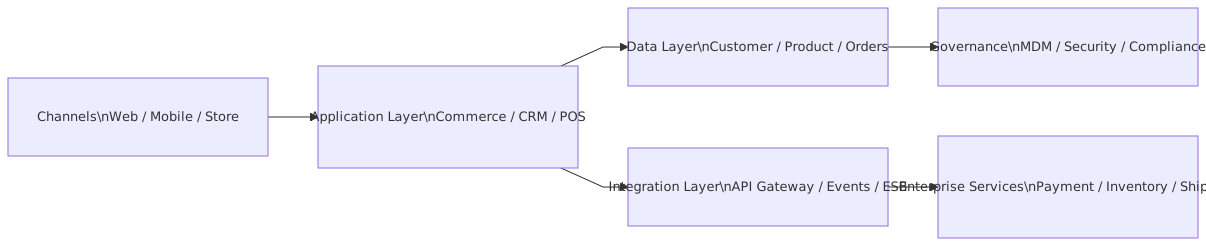
Example 1: Retail Enterprise Architecture
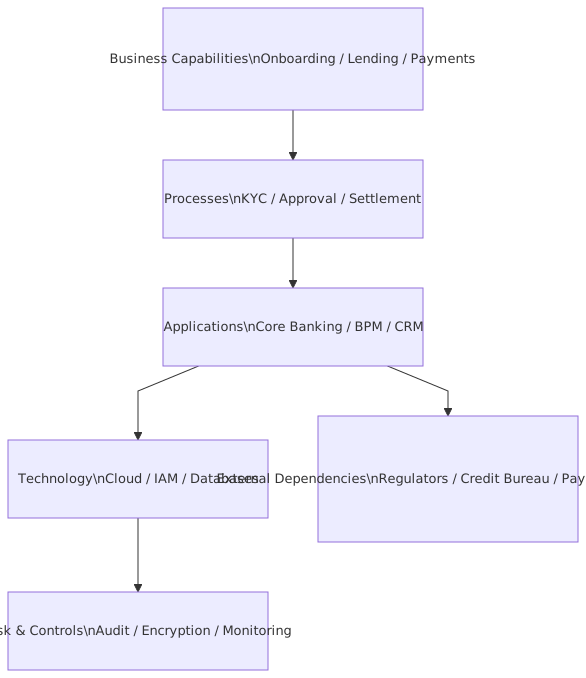
Example 2: Banking Capability-to-Technology Flow
Frequently Asked Questions
What is enterprise architecture?
Enterprise architecture is a discipline that aligns an organisation's strategy, business processes, information systems, and technology. Using frameworks like TOGAF and modeling languages like ArchiMate, it provides a structured view of how the enterprise operates and how it needs to change.
How does ArchiMate support enterprise architecture practice?
ArchiMate provides a standard modeling language that connects strategy, business operations, applications, data, and technology in one coherent model. It enables traceability from strategic goals through business capabilities and application services to the technology platforms that support them.
What tools are used for enterprise architecture modeling?
The main tools are Sparx Enterprise Architect (ArchiMate, UML, BPMN, SysML), Archi (free, ArchiMate-only), and BiZZdesign Enterprise Studio. Sparx EA is the most feature-rich option, supporting concurrent repositories, automation, scripting, and integration with delivery tools like Jira and Azure DevOps.