⏱ 20 min read
Most enterprise architecture tools are still very good at one thing: helping architects produce diagrams nobody uses.
That sounds harsh. It’s also true.
In 2026, the problem is not a lack of tooling. If anything, the market is crowded with platforms promising “strategy-to-execution traceability,” “AI-powered modeling,” “governance automation,” and every other phrase vendors discovered in the last two years. The problem is that many architecture teams still buy tools as if they’re buying a prettier Visio. Then six months later they wonder why delivery teams are ignoring the repository, why product leaders don’t trust the data, and why every “target state” looks suspiciously like a PowerPoint from last year.
So let’s make this simple early.
What is an enterprise architecture tool, really?
An enterprise architecture tool is software that helps an organization map, analyze, govern, and evolve its business capabilities, applications, data, technologies, and dependencies.
At minimum, a good EA tool should help you answer questions like:
- What systems support this business capability?
- Which applications are redundant?
- What depends on this Kafka cluster?
- Which IAM platform controls access to these critical banking services?
- What breaks if we retire this legacy integration layer?
- Are our cloud migrations reducing complexity or just moving it around?
That’s the SEO-friendly version. Fair enough.
But in real architecture work, the tool is not the architecture. It’s the operating model around it. A repository full of stale application records is not architecture. A capability map nobody funds against is not architecture. A “reference architecture” hidden in Confluence is not architecture either.
Real enterprise architecture happens when the tool becomes a decision system:
- for investment planning,
- for modernization,
- for risk management,
- for standards enforcement,
- and for explaining trade-offs in a language executives and engineers both understand.
That’s the standard I’m using in this comparison.
What actually matters in an EA tool in 2026
A lot of comparison articles still rank tools based on modeling notation support, dashboard aesthetics, or how many boxes you can color by lifecycle status. That’s not useless. It’s just not the hard part anymore.
In 2026, the best enterprise architecture tools need to perform in five areas.
1. Repository quality and relationship modeling
If the metamodel is weak, everything is weak. You need to model relationships that reflect reality:
- business capability to application
- application to data domain
- application to IAM pattern
- application to Kafka topics or event streams
- application to cloud platform services
- technology component to policy, risk, and lifecycle
If the tool can’t handle this cleanly, it will become a glorified inventory.
2. Integration with the delivery ecosystem
If your EA tool can’t connect to CMDBs, cloud inventories, identity systems, code repositories, ticketing tools, and data catalogs, you will lose. Manual architecture repositories decay fast. Faster than teams admit. TOGAF roadmap template
3. Governance without bureaucracy
Architects love control. Delivery teams hate waiting. The best tools support lightweight governance:
- standards catalogs
- exception workflows
- architecture reviews tied to change
- automated policy checks where possible
A tool that forces every change through a giant central architecture board is not modern governance. It’s just slow.
4. Strategic planning and portfolio visibility
You need more than diagrams. You need roadmaps, lifecycle views, investment heatmaps, technical debt visibility, and scenario analysis. Especially in banking, where “replace core system” is never one project. It’s usually ten years of compromise. TOGAF roadmap template
5. AI assistance that is useful, not theatrical
Yes, AI is in every platform now. Some of it is good. Some of it is pure conference-demo nonsense. Useful AI helps summarize impact, detect missing relationships, classify applications, and assist with rationalization. Useless AI writes generic architecture descriptions that sound polished and say nothing.
That distinction matters.
The best enterprise architecture tools in 2026
Here’s the short version before we go deeper.
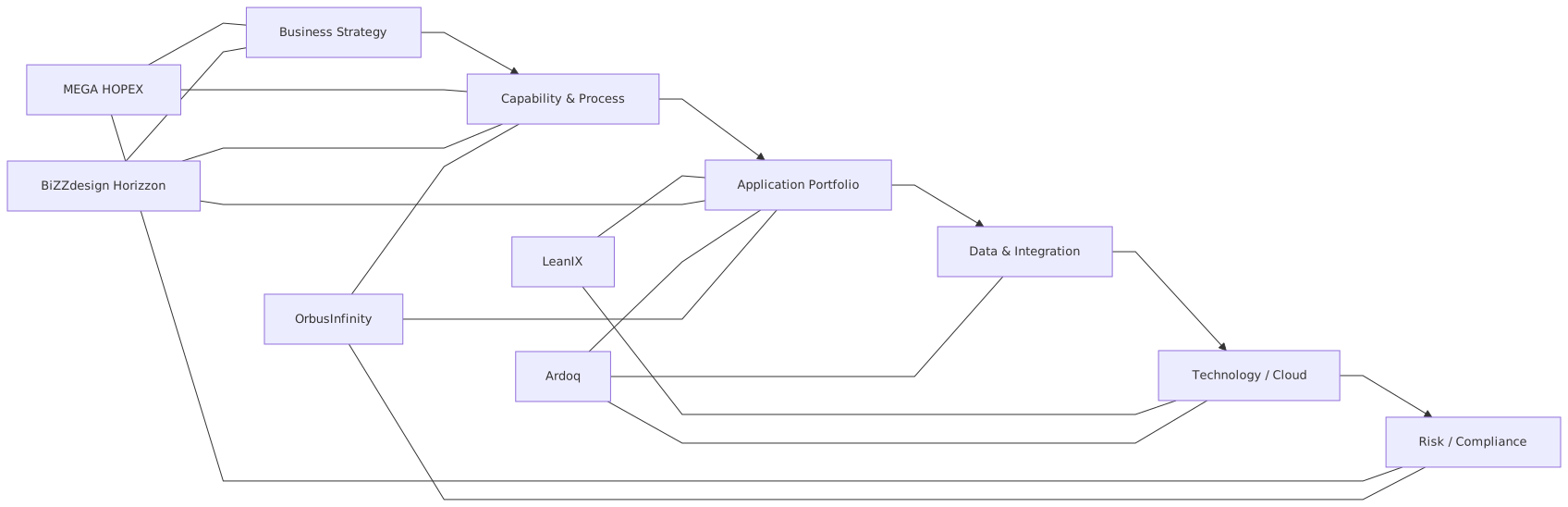
Now let’s talk about them like adults, not brochure writers.
1. LeanIX: the practical winner for most enterprises
If you force me to recommend one enterprise architecture tool for a typical large enterprise in 2026, I’d probably say LeanIX.
Not because it is the deepest. Not because it is the most academically pure. Because it gets used.
That matters more than architects sometimes want to admit.
LeanIX has been strong for years in application portfolio management, technology lifecycle, and pragmatic architecture governance. In 2026, that still matters because most enterprises are still trying to answer basic but painful questions:
- Which applications are duplicative?
- Which systems are out of support?
- Which cloud services are proliferating without standards?
- Which business capabilities are over-fragmented?
- Which IAM patterns are inconsistent across digital channels?
LeanIX tends to do well because the interface is approachable, the fact-sheet model is understandable, and the platform is good at creating an architecture inventory people can actually maintain.
Where LeanIX shines in real architecture work
Say you’re in a bank modernizing customer onboarding. You have:
- a legacy core banking platform,
- a CRM,
- Kafka for event streaming,
- a cloud-based document service,
- an IAM platform handling customer identity and workforce access separately,
- and five regional onboarding variants nobody wants to own.
LeanIX can help map:
- the business capability “Customer Onboarding”
- all supporting applications
- integrations via APIs and Kafka topics
- data classifications
- technical lifecycle states
- cloud hosting patterns
- and ownership
That lets the architecture team say something useful:
“We don’t have one onboarding architecture. We have five variants, three identity patterns, duplicate document validation, and 27 application dependencies. We should standardize IAM first, then event contracts, then onboarding workflow.”
That is architecture earning its keep.
Where LeanIX is weaker
If your team wants very deep formal metamodeling or highly customized analytical structures, LeanIX may feel constrained compared to ABACUS or Bizzdesign. That’s not always a flaw. Sometimes constraints are healthy. But if you’re in a very complex operating model, you may notice it.
Strong opinion
A lot of enterprises need LeanIX more than they need a “more powerful” platform. Because they don’t actually have a tool problem. They have an adoption problem.
2. Bizzdesign: excellent for serious transformation architecture
Bizzdesign is one of those tools architects respect for good reason. It has real depth. It supports capability mapping, strategic planning, roadmapping, impact analysis, and formal architecture modeling in a way that can genuinely support enterprise transformation.
If LeanIX is often the practical operator, Bizzdesign is often the strategist’s platform.
Why architects like it
Bizzdesign is strong when the architecture team is trying to connect:
- strategy
- capability gaps
- process change
- application transformation
- data implications
- technology standards
- and implementation roadmaps
That’s a big deal in large transformations.
Take a retail bank replacing its payments architecture. You’re not just swapping software. You’re changing:
- core payment orchestration,
- event flows on Kafka,
- fraud services,
- IAM trust boundaries,
- cloud deployment patterns,
- and operational resilience controls.
Bizzdesign can model these layers and support impact analysis in a way that helps you explain why one architecture choice creates downstream cost or risk elsewhere.
The catch
Bizzdesign works best when the architecture function is mature. If your team lacks discipline, ownership, and a clear metamodel, the platform can become a very expensive place to store half-finished abstractions.
This is a common pattern in enterprise architecture generally: sophisticated tools amplify both strengths and weaknesses.
Strong opinion
Bizzdesign is better than many teams deserve. I mean that sincerely. If your architecture practice is vague, politically weak, and mostly diagram-driven, you won’t unlock much value from it.
3. MEGA HOPEX: powerful, broad, and easy to overcomplicate
MEGA HOPEX has long appealed to large, regulated organizations that want architecture tied tightly to governance, risk, compliance, process, and control structures.
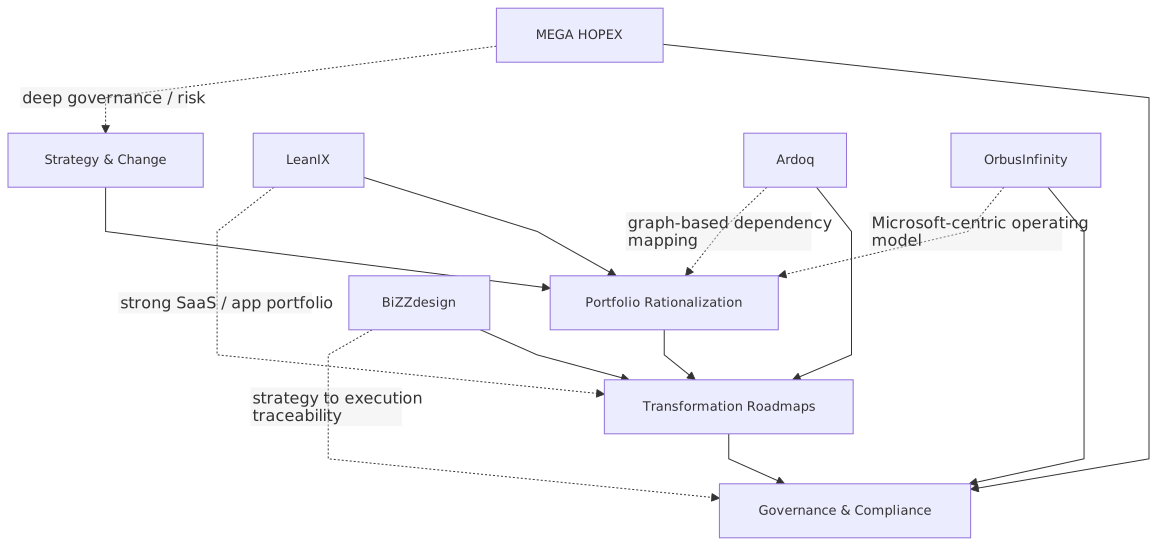
That makes sense in sectors like banking, insurance, government, and pharma.
Where it fits
If you need to align:
- architecture standards
- process architecture
- risk and control models
- compliance views
- technology transformation
- and governance workflows
HOPEX can be compelling.
For example, in a bank subject to strict operational resilience requirements, you may need to show:
- which critical business services depend on which applications,
- which applications depend on specific IAM components,
- which cloud regions they run in,
- which Kafka clusters support event propagation,
- and what resilience controls are in place.
HOPEX can support that kind of traceability.
Where it goes wrong
The danger is obvious: too much process, too much data model, too much administration.
Some organizations buy HOPEX because they want enterprise architecture to look “enterprise-grade,” then accidentally build a bureaucracy machine. Every artifact requires curation. Every relationship needs a steward. Every governance workflow gets another approval step. Then delivery teams route around architecture entirely.
That’s not the tool’s fault alone. But the tool can make it easier to indulge bad habits.
Strong opinion
If your culture already leans bureaucratic, HOPEX can make it worse. You need a very deliberate operating model to keep it useful.
4. Avolution ABACUS: for teams that really want analytical power
ABACUS is one of the most capable tools for architecture analysis. It has depth, flexibility, and a reputation for handling complex enterprise environments well. It is particularly suited to organizations that need rich scenario analysis and custom metamodeling.
This is a tool many architects admire and many casual stakeholders find less immediately friendly.
Real-world fit
Suppose you’re rationalizing a fragmented cloud and integration landscape across a multinational bank. You want to model:
- duplicate integration services,
- Kafka platform variants across regions,
- IAM policy enforcement inconsistencies,
- cloud tenancy sprawl,
- resilience exposures,
- and application concentration risk.
ABACUS can support deep analysis here. It’s especially strong when architecture is not just inventory management but actual decision support.
Why it’s not for everyone
ABACUS requires commitment. You don’t just install it and become architecture-led. You need:
- metamodel discipline,
- data stewardship,
- analytical intent,
- and practitioners who know what they are doing.
That sounds obvious, but many enterprises still buy tools hoping the vendor will compensate for weak architecture capability.
Strong opinion
ABACUS is one of the best platforms for real architecture analysis. It is also exactly the wrong tool if your executive sponsor mainly wants nicer dashboards.
5. OrbusInfinity: a solid fit for Microsoft-heavy enterprises
OrbusInfinity tends to resonate with organizations that are deeply invested in Microsoft 365, Azure, Power Platform, and familiar collaboration patterns.
That’s not a trivial niche. It’s a huge part of the market.
Why it works
Business users often engage more readily with Orbus because it feels closer to tools and workflows they already know. That can improve adoption across architecture, portfolio, and business stakeholders.
For enterprise architecture, that matters because architecture only creates value when non-architects can navigate it.
Where it helps
A bank running heavily on Azure might use Orbus to connect:
- business capabilities
- application portfolio views
- target-state roadmaps
- Azure service patterns
- IAM standards with Entra ID and customer identity layers
- and transformation initiatives
It can support practical planning and stakeholder communication well.
Limitations
Compared with the strongest specialist platforms, Orbus may feel less differentiated in deep analysis or advanced modeling rigor. It is competent. Sometimes very competent. But not always the first choice for highly complex analytical architecture work.
Strong opinion
Orbus is underrated by architects who confuse familiarity with weakness. Ease of engagement is a feature, not a compromise, if your goal is enterprise adoption.
6. Ardoq: modern, graph-native, and closer to living architecture
Ardoq has built momentum by leaning into graph-based architecture and collaborative discovery. That’s a smart direction. Enterprises are finally admitting that their landscapes are not hierarchical org charts with tidy boxes. They are networks of dependencies.
Graph thinking fits modern architecture.
Why Ardoq matters
If you’re trying to understand dynamic relationships across:
- business capabilities,
- microservices,
- APIs,
- Kafka topics,
- identity providers,
- cloud services,
- and ownership structures,
a graph-native approach is often more natural than forcing everything into static report structures.
Real architecture use case
Imagine a digital bank launching new lending products. Teams are deploying services across cloud platforms, publishing events to Kafka, integrating with fraud engines, and federating identity across workforce and customer IAM domains.
The question is not just “what applications do we have?”
It’s “what depends on what, and how fast can we assess change impact?”
Ardoq is good in that space. It supports collaborative architecture in a way that feels more alive than older repository-centric tools.
Caveat
Graph-native architecture is not magic. If governance is weak, the graph becomes another mess. Relationship-rich data is only valuable if people trust it.
Strong opinion
Ardoq is one of the more interesting EA platforms because it aligns better with how modern systems actually behave. But it still needs disciplined architecture ownership behind it.
7. Sparx Enterprise Architect: still relevant, still not enough on its own
Sparx Enterprise Architect is the old warhorse. Cheap, powerful, flexible, and still heavily used. Especially by solution architects, system architects, and teams doing detailed UML, BPMN, or design modeling.
I’m not dismissing it. It has real value.
But let’s be honest: Sparx is usually not a complete enterprise architecture operating platform for a large organization in 2026. Sparx EA best practices
Where it still helps
- detailed solution design
- interface modeling
- process modeling
- standards documentation
- architecture artifacts that need precision
Where it falls short for enterprise EA
- broad stakeholder accessibility
- modern governance workflows
- portfolio-level reporting
- easy repository curation at enterprise scale
- collaborative usage across business and technology audiences
A lot of organizations still try to run enterprise architecture on Sparx plus SharePoint plus determination. That can work for a while. Then complexity catches up. Sparx EA guide
Strong opinion
Sparx is excellent value. It is also often used as a substitute for having an actual EA platform. Those are not the same thing.
8. ServiceNow with EA extensions: process-led, not architecture-led
Some organizations already live inside ServiceNow for ITSM, CMDB, change, risk, and workflow. In those environments, extending ServiceNow into architecture can be attractive.
And sometimes sensible.
Why people choose it
- workflow is already there
- governance processes are already there
- CMDB alignment is already there
- stakeholders are already there
If your architecture function mainly needs to influence change governance, standards compliance, and process integration, ServiceNow can do useful work.
The issue
As a pure architecture platform, it usually feels secondary. You can make it do many things, but that doesn’t mean it is the best environment for architecture thinking.
This is one of those contrarian points people don’t say enough:
A tool that is convenient for governance administration is not automatically good for architecture analysis.
Strong opinion
Use ServiceNow as part of the architecture operating landscape if it makes sense. Just don’t pretend a workflow engine is the same thing as an enterprise architecture repository.
How this applies in real architecture work
This is where most articles get abstract. So let’s bring it back down to the floor.
In real enterprise architecture work, you are usually doing some combination of these:
- rationalizing application portfolios
- setting technology standards
- governing cloud adoption
- reducing integration sprawl
- modernizing identity and access management
- planning transformation roadmaps
- supporting mergers, divestitures, or regulatory change
- explaining technical debt in investment terms
The tool matters because it changes how fast and how credibly you can answer impact questions.
Example: banking modernization with Kafka, IAM, and cloud
Let’s say a bank has:
- legacy channels for retail banking
- a new mobile platform
- Kafka as the event backbone
- multiple IAM stacks from acquisitions
- workloads split across on-prem and two cloud providers
- and a mandate to improve operational resilience
An architecture team using a strong EA tool should be able to answer:
- Which customer-facing capabilities depend on which IAM platforms?
- Which services publish or consume regulated customer events on Kafka?
- Which applications still depend on legacy identity stores?
- Which workloads are in cloud regions that violate resilience or data residency patterns?
- What is the phased roadmap to simplify this without breaking customer journeys?
That’s not theory. That’s weekly architecture work in many banks.
A weak tool makes this a workshop exercise and a spreadsheet chase.
A strong tool makes it a managed decision process.
Common mistakes architects make when choosing EA tools
This part matters more than the product list.
1. Buying for notation instead of decisions
Some architects obsess over ArchiMate support or diagram elegance. Those things matter. But if the tool doesn’t improve decision-making, you’re decorating a repository. ArchiMate modeling best practices
2. Modeling too much too early
Classic mistake. Teams define a giant metamodel, launch a repository program, and then drown in empty fields. Start with decisions you need to support:
- rationalization
- lifecycle risk
- cloud governance
- IAM standardization
- integration simplification
Then model enough to answer those.
3. Treating the repository as a side project
If architecture data is not tied to budgeting, delivery governance, risk, or platform standards, it will go stale. Fast.
4. Ignoring integration
Manual updates don’t scale. Pull data from cloud inventories, CMDBs, identity tools, ticketing systems, and service catalogs wherever possible.
5. Confusing governance with approval theater
A good EA tool should reduce friction, not institutionalize it. If every architecture review becomes a committee ritual, teams will bypass you.
6. Letting architects own everything
This one is subtle. Architects should curate the model, not manually maintain every record. Ownership should be federated:
- app owners maintain app data
- platform teams maintain standards
- security teams maintain IAM controls
- domain teams validate dependencies
Otherwise the architecture team becomes a data-entry department.
A real enterprise example
A regional bank I’ll describe generically had grown through acquisition. Not unusual. The result was exactly the kind of mess architects know too well:
- three customer IAM solutions
- two workforce identity stacks
- four integration patterns
- one strategic Kafka platform, plus unofficial alternatives
- applications spread across private cloud, AWS, and Azure
- duplicate lending and onboarding systems by region
- weak visibility into which business capabilities depended on which platforms
The architecture team had documents. Lots of them. What they did not have was a trusted operating repository.
They adopted an EA platform primarily to support application portfolio management and target-state planning. The important move was not the software itself. It was the scope discipline.
They started with:
- business capabilities
- application inventory
- lifecycle status
- ownership
- cloud hosting
- IAM dependency
- integration dependency, including Kafka usage
- criticality and resilience classification
Not fifty entity types. Just enough to support decisions.
Within two planning cycles, they could identify:
- 18 duplicate applications across lending and onboarding
- critical customer journeys relying on deprecated IAM components
- Kafka consumers with no clear owner
- cloud workloads violating target landing zone patterns
- resilience concentration in a single region for payment-adjacent services
That changed funding conversations. Instead of saying “we need modernization,” the architecture team could say:
- retire these four systems first,
- standardize customer identity here,
- move these event consumers to the strategic Kafka platform,
- and refactor these cloud deployments to meet resilience policy.
That is what a good EA tool does. It turns architecture from commentary into leverage.
So which enterprise architecture tool is best in 2026?
Here’s the blunt version.
Choose LeanIX if:
You want the best balance of usability, portfolio visibility, practical governance, and enterprise adoption.
Choose Bizzdesign if:
You have a mature architecture function and need strong transformation modeling and traceability.
Choose MEGA HOPEX if:
You operate in a highly regulated, governance-heavy environment and can manage complexity without drowning in it.
Choose ABACUS if:
You need deep analytical power and have architects capable of using it properly.
Choose OrbusInfinity if:
Your enterprise is Microsoft-centric and stakeholder adoption matters as much as modeling depth.
Choose Ardoq if:
You want a more dynamic, graph-oriented approach to living architecture and dependency analysis.
Keep Sparx if:
You need detailed modeling, but don’t pretend it solves enterprise architecture by itself.
Use ServiceNow-based EA if:
Process integration and governance workflow are your top priority, not pure architecture elegance.
My strongest recommendation for most enterprises?
Start with the tool your organization can actually operationalize. Not the one that wins in an architect fantasy draft.
That may sound less glamorous, but architecture is a contact sport. The best tool is the one that survives budgeting, politics, incomplete data, changing ownership, and delivery pressure.
And one more contrarian thought before we close:
If your architecture team cannot clearly explain what decisions it wants to improve, you are not ready to buy an enterprise architecture tool. You are ready to buy expensive confusion.
FAQ
1. What is the best enterprise architecture tool for large enterprises in 2026?
For most large enterprises, LeanIX is the safest all-around choice because it balances usability, governance, integrations, and portfolio visibility. For deeper transformation modeling, Bizzdesign is a strong contender.
2. Which EA tool is best for banking and regulated industries?
MEGA HOPEX, Bizzdesign, and ABACUS are strong options for regulated environments. Banking teams should prioritize traceability across business capabilities, IAM, integration platforms like Kafka, cloud deployment, and resilience controls.
3. Are enterprise architecture tools worth it for cloud modernization?
Yes, if used properly. A good EA tool helps map application dependencies, cloud hosting patterns, technology lifecycle, IAM standards, and migration roadmaps. Without that, cloud modernization often becomes infrastructure relocation with no simplification.
4. Can ServiceNow replace a dedicated enterprise architecture tool?
Sometimes partially, especially if your focus is workflow and governance. But usually no. ServiceNow can support architecture processes, but it is not automatically the best platform for architecture analysis, modeling depth, or strategic roadmapping.
5. What is the biggest mistake when implementing an EA tool?
Trying to model everything from day one. Start with a small set of high-value questions: application rationalization, cloud governance, IAM standardization, integration dependency, and lifecycle risk. Build from there.
Enterprise Architecture Tools in 2026 — Compared
Frequently Asked Questions
What is enterprise architecture?
Enterprise architecture is a discipline that aligns an organisation's strategy, business processes, information systems, and technology. Using frameworks like TOGAF and modeling languages like ArchiMate, it provides a structured view of how the enterprise operates and how it needs to change.
How does ArchiMate support enterprise architecture practice?
ArchiMate provides a standard modeling language that connects strategy, business operations, applications, data, and technology in one coherent model. It enables traceability from strategic goals through business capabilities and application services to the technology platforms that support them.
What tools are used for enterprise architecture modeling?
The main tools are Sparx Enterprise Architect (ArchiMate, UML, BPMN, SysML), Archi (free, ArchiMate-only), and BiZZdesign Enterprise Studio. Sparx EA is the most feature-rich option, supporting concurrent repositories, automation, scripting, and integration with delivery tools like Jira and Azure DevOps.