⏱ 10 min read
Enterprise architecture has matured significantly in the past two decades. Organizations have standardized modeling notations, adopted layered architectures, implemented microservices, migrated to cloud-native platforms, and built event-driven systems. Yet semantic inconsistency remains one of the most persistent and expensive problems in large enterprises. Systems integrate syntactically but not semantically. enterprise cloud architecture patterns
"Customer" exists in dozens of systems, yet means something slightly different in each. "Account" may represent a ledger, a product, a digital identity, or a contractual construct depending on context. "Exposure" varies between risk, finance, and regulatory reporting. These inconsistencies are not technical defects — they are semantic fractures.
Ontology addresses this problem at its root. An enterprise ontology defines what concepts exist in the business domain, how those concepts relate to one another, what constraints govern valid states, and what logical inferences are permitted. Unlike application data models, ontology is not system-bound. It is not a database schema, not a JSON contract, not an API payload definition. It is a conceptual and logical representation of reality within the enterprise context. integration architecture diagram
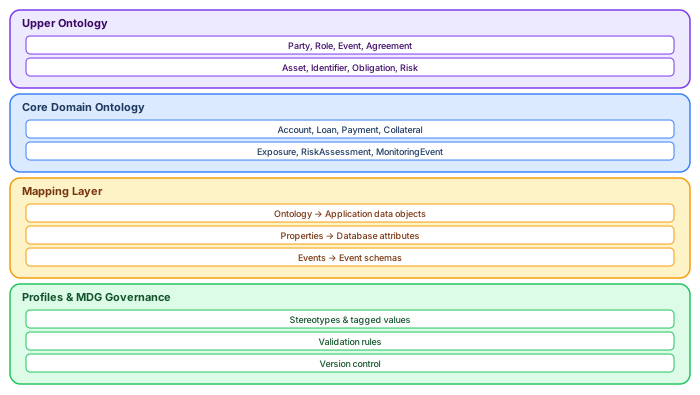
When implemented and governed correctly, ontology becomes a semantic backbone across systems, a regulatory consistency mechanism, a reasoning foundation for knowledge graphs, and a stabilization layer for integration. Using Sparx Enterprise Architect as the modeling and governance platform transforms ontology from an academic artifact into an operational enterprise asset. Sparx EA training
Ontology in the context of enterprise architecture
Ontology sits within Information Architecture but influences all layers of the stack — from Business Architecture through Application, Data, and Technology Architecture. Understanding how ontology differs from related artifacts is essential for positioning it correctly.
A logical data model defines entities and attributes for persistence, constrained by storage and performance considerations. Ontology defines conceptual classes and properties independent of implementation. A logical model might define a CUSTOMER table, an ACCOUNT table, and a CUSTOMER_ACCOUNT junction table. The equivalent ontology defines Party, Account, an owns object property, and a belongsTo inverse property. The ontology remains stable even if the physical data model changes from relational to document to graph.
A canonical model defines integration contracts for message exchange, optimized for interoperability between systems. Ontology defines semantic meaning. Canonical models should derive from ontology, not replace it. In regulated industries — banking, pharma, government — ontology becomes critical for regulatory reporting consistency, risk aggregation, AML traceability, data lineage clarity, and AI explainability. Ontology is not optional in highly complex domains. It is architectural control.
Modeling strategy in Sparx Enterprise Architect
Sparx EA provides capabilities uniquely suited for enterprise ontology engineering: centralized repository, baseline comparison, version control integration, profile and MDG customization, traceability matrices, and OCL constraint support. Two dominant strategies exist. Sparx EA best practices
UML-based ontology strategy. In many enterprise environments, UML class diagrams enhanced with custom stereotypes provide the most governance-friendly approach. Define stereotypes such as «OntologyClass», «ObjectProperty», «DataProperty», and «SemanticRule». Add tagged values for Definition, BusinessOwner, Status (Draft/Approved/Deprecated), Version, and SourceReference. This approach integrates seamlessly with enterprise governance processes.
OWL-based strategy. EA also supports OWL modeling through dedicated profiles — OWLClass, OWLObjectProperty, OWLDatatypeProperty, Restriction elements, and Individuals. OWL modeling allows direct export to semantic platforms. In mature enterprises, a hybrid approach is often used: UML for governance and integration with the architecture repository, OWL for reasoning and knowledge graph deployment.
Banking case study: upper ontology layer
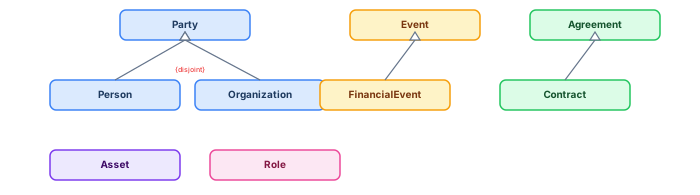
The upper ontology defines cross-domain abstractions that change rarely and anchor semantic stability: Party, Role, Event, Agreement, Asset, Identifier, Obligation, Risk. Person and Organization are disjoint subclasses of Party — an entity cannot be both simultaneously.
A critical modeling principle: Customer is not a subclass of Person. Instead, a Person plays a CustomerRole. This avoids subclass explosion and correctly represents the reality that the same Party can play multiple roles (Customer, Borrower, Guarantor) simultaneously or sequentially.
Account and ledger model

The account model connects financial primitives through well-defined relationships. An Account belongsTo exactly one Party, is governedBy one or more Agreements, and contains zero or more LedgerEntries. A FinancialTransaction debits one Account and credits another — with the constraint that debit and credit accounts must differ. Account balance is derived from LedgerEntry aggregation, not stored as a primitive attribute.
Payment modeling

Payments represent intent and operational realization, distinct from accounting impact. A PaymentInstruction is initiatedBy a Party and captures the payment intent. A PaymentExecution executes the instruction and resultsIn a FinancialTransaction. This separation is critical for regulatory reporting: the instruction (who requested the payment) and the execution (when it was processed) and the accounting impact (the ledger entries) are independently queryable and auditable.
Collateral and asset model
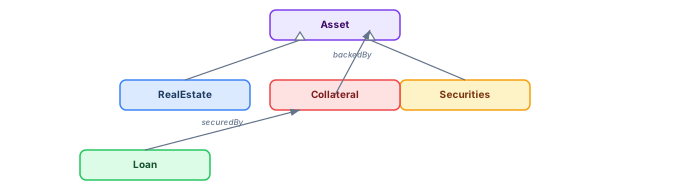
Asset is the abstract parent class with specializations like RealEstate and Securities. Collateral represents the pledged context of an asset — it is not the asset itself, but the relationship between an asset and a lending arrangement. A Loan is securedBy Collateral, which is backedBy an Asset. This distinction matters: the same RealEstate asset can serve as collateral for multiple loans, and the collateral value may differ from the asset's market value.
Risk and exposure

Exposure is derived, not primitive. It is attributedTo a Party, derivedFrom Loans and Accounts. This means exposure does not exist as a stored value — it is computed from the underlying financial positions. The ontology makes this derivation explicit, enabling consistent exposure aggregation across risk, finance, and regulatory reporting functions. When a reasoner processes this ontology, it can infer total Party exposure by traversing the derivation chain.
AML (Anti-Money Laundering) layer

AML constructs are meta-level semantic artifacts that operate on top of the core banking ontology. A MonitoringEvent monitors FinancialTransactions. A RiskIndicator evaluates a Party. A SuspiciousActivityReport concerns a Party. These constructs enable knowledge graph reasoning: given a transaction pattern flagged by a MonitoringEvent, the reasoner can traverse the graph to identify associated parties, their other transactions, and connected counterparties — building the network analysis that AML investigators require.
Advanced OCL constraint patterns
OCL (Object Constraint Language) adds formal precision to the ontology. Five essential patterns for banking ontology governance:
-- Cardinality: Account must have exactly one owner
context Account
inv SingleOwner: self.belongsTo->size() = 1

-- Derived value: Total exposure computed from loans
context Party
def: totalExposure: Real = self.loans.outstandingAmount->sum()

-- Business rule: Collateral must cover the loan
context Loan
inv CollateralSufficiency:
  self.collateral.value->sum() >= self.outstandingAmount

-- Role consistency: Borrower must be linked to their loan
context BorrowerRole
inv RoleConsistency: self.person.loans->includes(self.loan)

-- AML: Transactions over threshold must be flagged
context FinancialTransaction
inv HighAmountFlag:
  self.amount > 10000 implies
    self.monitoringEvent->exists(m | m.flagged = true)
OWL restriction modeling
For knowledge graph deployment, OWL restrictions formalize the same constraints in a reasoning-compatible format. Cardinality restrictions (Account SubClassOf: belongsTo exactly 1 Party) enforce structural rules. Existential restrictions (Loan SubClassOf: hasBorrower some Party) require relationship existence. Universal restrictions (Loan SubClassOf: securedBy only Asset) constrain relationship targets. Property chains (owns o records → participatesIn) enable transitive inference. Disjointness declarations (DisjointClasses: Person, Organization) prevent classification errors.
Knowledge graph deployment architecture

The deployment pipeline transforms the governed ontology into an operational reasoning platform. Sparx EA exports the ontology as OWL (using the built-in OWL export or custom scripts). The OWL file is loaded into a knowledge graph (Neo4j, Amazon Neptune, Stardog, or Apache Jena). A reasoning engine (Pellet, HermiT, or the graph database's native reasoner) processes the OWL restrictions to infer implicit facts. A semantic API (GraphQL, SPARQL endpoint, or REST) exposes the enriched graph to applications. Applications query the semantic API for answers that the raw data cannot provide directly. free Sparx EA maturity assessment
Three critical reasoning use cases: Exposure aggregation — the reasoner infers indirect exposure via property chains, computing total Party exposure across all instruments without manual aggregation. AML network detection — indirect associations between parties are inferred through the transaction graph, revealing suspicious patterns invisible in individual transaction analysis. Regulatory reporting — inference detects entities requiring enhanced due diligence based on risk indicator thresholds and relationship patterns.
EA Profile and MDG governance
To enforce ontology modeling standards across the enterprise, build an MDG Technology package in Sparx EA. Create a UML profile package defining the stereotypes («OntologyClass», «ObjectProperty», «DataProperty», «SemanticRule»). Add tagged values to each stereotype (Definition, BusinessOwner, Status, Version, SourceReference). Publish the UML profile within the repository. Generate the MDG Technology file from the profile. Deploy the MDG repository-wide so that all architects model ontology elements using consistent stereotypes and tagged values. Add validation rules that enforce required properties — no OntologyClass can reach Approved status without a Definition and BusinessOwner.
Anti-patterns to avoid
Six anti-patterns consistently undermine enterprise ontology efforts. Modeling tables instead of concepts — importing a database schema and calling it an ontology misses the point; ontology represents meaning, not storage. Mixing message formats with ontology — ISO 20022 message definitions are integration artifacts, not semantic models. Ignoring disjointness — without explicit disjointness declarations, a reasoner may classify an entity as both Person and Organization. Overusing inheritance — deep inheritance hierarchies create brittle models; prefer role-based composition. Embedding technical identifiers — primary keys, UUIDs, and system IDs belong in mappings, not in the ontology itself. Allowing uncontrolled extensions — without governance, domain teams create overlapping concepts that defeat the purpose of a shared ontology.
Frequently Asked Questions
What is Sparx Enterprise Architect used for?
Sparx Enterprise Architect (Sparx EA) is a comprehensive UML, ArchiMate, BPMN, and SysML modeling tool used for enterprise architecture, software design, requirements management, and system modeling. It supports the full architecture lifecycle from strategy through implementation.
How does Sparx EA support ArchiMate modeling?
Sparx EA natively supports ArchiMate 3.x notation through built-in MDG Technology. Architects can model all three ArchiMate layers, create viewpoints, add tagged values, trace relationships across elements, and publish HTML reports — making it one of the most popular tools for enterprise ArchiMate modeling.
What are the benefits of a centralised Sparx EA repository?
A centralised SQL Server or PostgreSQL repository enables concurrent multi-user access, package-level security, version baselines, and governance controls. It transforms Sparx EA from an individual diagramming tool into an organisation-wide architecture knowledge base.