⏱ 19 min read
Most advice about becoming an enterprise architect is useless.
It usually sounds like this: get certified, learn TOGAF, understand business strategy, improve communication skills. None of that is wrong. It’s just incomplete in the most damaging way possible. It makes enterprise architecture sound like a clean, orderly profession where smart people draw future-state diagrams and gently guide the company toward better decisions.
That is not the job.
Real enterprise architecture is messy. You walk into organizations with ten years of technical debt, five cloud strategies, three identity platforms, twelve integration patterns, and a leadership team that says they want standardization while rewarding local optimization. You are expected to create clarity where there is politics, ambiguity, and a lot of expensive software pretending to be strategy.
So if you want to start a career in enterprise architecture, here’s my strong opinion: do not start by trying to become “an architect.” Start by becoming the person who can connect business pain to technical decisions at enterprise scale. That is what the role actually is.
What enterprise architecture is, simply
Let’s make this simple early.
Enterprise architecture is the practice of helping an organization make better technology decisions across teams, systems, and time.
That’s the clean version.
A more realistic version: enterprise architecture is the discipline of deciding what should be standardized, what should stay flexible, what should be funded, what should be retired, and how all of that supports business outcomes without creating chaos.
An enterprise architect does not just design one system. They look across domains:
- business capabilities
- applications
- data
- integration
- security
- identity and access management
- infrastructure
- cloud platforms
- governance and risk
If a solution architect asks, “How should we build this platform?” the enterprise architect asks, “Should we even build this, where does it fit, what standards apply, what dependencies does it create, and what future mess are we accidentally funding?”
That’s the job.
The first hard truth: enterprise architecture is not an entry-level role
This is where I’m going to be a little contrarian.
A lot of people search for “how to become an enterprise architect” as if it’s a junior career path. It isn’t. Not really. Even if a company gives someone the title early, the real work still demands earned judgment. Enterprise architecture sits on top of experience. You need enough scar tissue to recognize bad decisions before they become expensive programs.
So if you’re early in your career, your goal should not be “get the EA title fast.” Your goal should be to build the raw material that makes the title credible later.
That raw material is usually some combination of:
- solution architecture
- software engineering
- platform engineering
- infrastructure or cloud architecture
- security architecture
- data architecture
- integration architecture
- delivery leadership
- business analysis with technical depth
The best enterprise architects I know were not generalists from day one. They were specialists first. They built depth somewhere, then learned to connect that depth to the wider enterprise.
The career path nobody likes hearing about
Here’s the practical path.
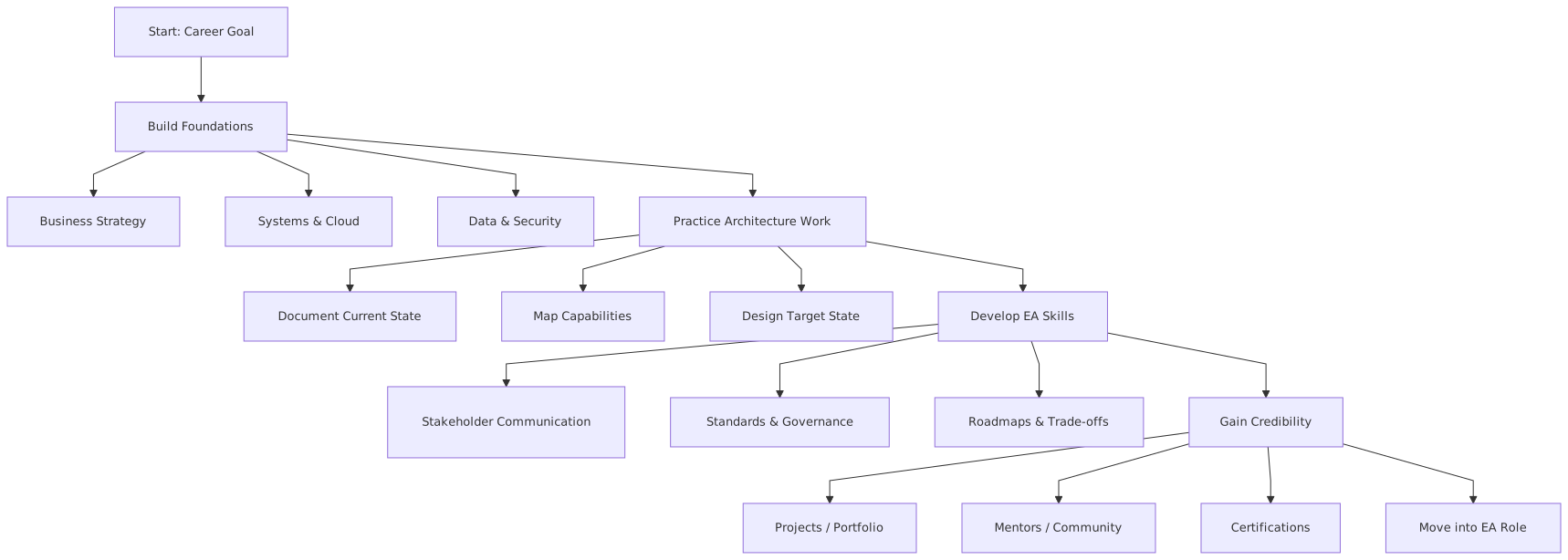
You usually become an enterprise architect by doing one of these:
- Engineer → senior engineer → solution/platform architect → enterprise architect
- Infrastructure/cloud engineer → cloud architect → domain architect → enterprise architect
- Security/IAM architect → security domain lead → enterprise architect
- Integration/data architect → principal architect → enterprise architect
- Consulting architect → internal architecture leadership → enterprise architect
There are exceptions, sure. But the pattern is consistent: first you learn how systems really work, then you learn how organizations really work, and only then do you become useful at enterprise scale.
That matters because enterprise architecture is not abstract thinking. It is applied judgment.
If you have never seen a Kafka cluster become a political argument, an IAM rollout stall because HR data is wrong, or a cloud migration derail because network segmentation was ignored, you are still learning. Which is fine. Just don’t pretend a framework replaces experience.
What skills actually matter
Let’s separate signal from noise.
People overrate frameworks and underrate operational credibility.
Here’s what actually matters if you want to start moving toward enterprise architecture.
If I had to reduce it further, I’d say this:
To become an enterprise architect, learn to answer four questions well:
- What problem are we actually solving?
- What is the enterprise impact of this decision?
- What future constraints are we creating?
- What is the simplest viable choice?
That last one is underrated. Too many architects are addicted to architectural significance. They want every decision to feel strategic. In real life, a lot of good architecture is just preventing unnecessary complexity.
Start with one domain and get dangerous there
If you’re serious about this career, pick a domain where enterprise concerns show up clearly. Banking is full of these. So are insurance, telecom, healthcare, and government.
A few especially good domains to grow from:
1. IAM
Identity and access management is one of the best training grounds for future enterprise architects.
Why? Because IAM sits at the intersection of:
- security
- compliance
- user experience
- HR data
- application integration
- cloud platforms
- third-party access
- operating model
An IAM architect quickly learns that the problem is never just SSO, MFA, or role design. The real problem is enterprise alignment. Who owns identities? What is the source of truth? How are joiner-mover-leaver processes handled? How do legacy apps fit? What access model works across cloud and on-prem? That is enterprise architecture in miniature.
2. Integration and event streaming, especially Kafka
Kafka is another excellent domain because it exposes the difference between buying technology and building capability.
A company says, “We need Kafka.” Usually what they actually need is:
- decoupled integration
- near real-time data movement
- event-driven processing
- resilience across domains
- replayability and auditability
But then the real architecture work starts:
- Who owns topics?
- What are the naming and retention standards?
- Where does schema governance live?
- What data is allowed on the platform?
- How do you handle PII?
- Is this integration backbone, analytics feed, or both?
- What operating model supports platform reliability?
A future enterprise architect learns a lot from watching teams misuse Kafka as glorified point-to-point messaging. It teaches you that architecture is less about tools and more about guardrails.
3. Cloud platform architecture
Cloud is full of enterprise architecture lessons because every cloud decision has cross-cutting impact.
A VPC design is not just networking.
A landing zone is not just infrastructure.
A cloud account model is not just administration. TOGAF roadmap template
These are enterprise choices involving:
- security boundaries
- cost management
- operational ownership
- regulatory controls
- deployment patterns
- data residency
- automation standards
If you can understand cloud beyond provisioning and into governance, operating model, and enterprise risk, you’re on the right path. ARB governance with Sparx EA
What this looks like in real architecture work
Let’s get out of theory.
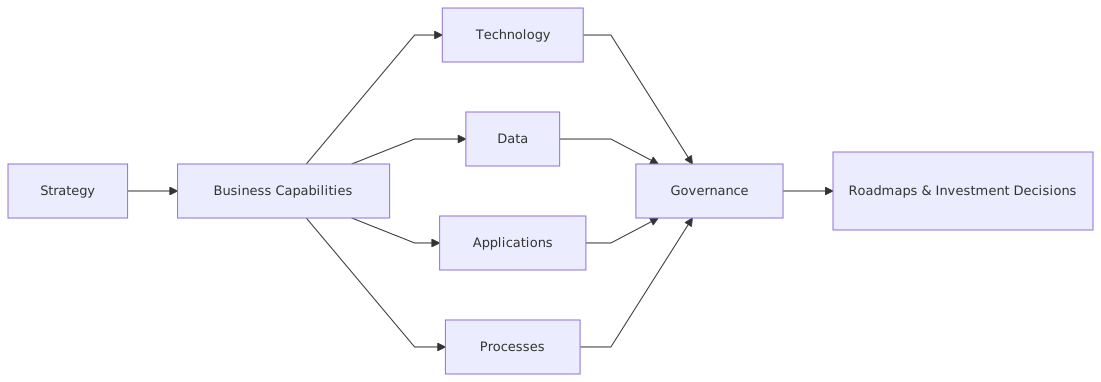
A lot of people imagine enterprise architects spend their days making target-state diagrams. In practice, the work is more like this:
- reviewing a proposal to move customer onboarding to a new SaaS platform
- identifying that the IAM model cannot support delegated administration for partner users
- noticing the platform wants direct database integration instead of event-based publishing via Kafka
- asking whether customer consent data becomes duplicated across systems
- checking whether the solution aligns with the cloud landing zone controls
- pushing the team to define which business capability actually owns the process
- deciding which deviations from enterprise standards are acceptable and which are not
- explaining to leadership why “faster delivery” today may create operational fragility tomorrow
That is architecture work. It’s connective tissue. It’s not glamorous. It’s often thankless. And it matters.
The architects who thrive are the ones who can move between detail and abstraction without becoming fake in either direction.
A real enterprise example: digital onboarding in a bank
Let’s use a realistic banking example.
A retail bank wants to modernize digital customer onboarding. The current process is fragmented:
- customer applies through web or mobile
- identity verification is handled by a third-party service
- customer profile is created in a CRM
- core banking account creation happens later through batch processing
- fraud checks run in multiple systems
- access to online banking is provisioned separately
- notifications are triggered inconsistently
Leadership wants a “modern, cloud-native onboarding platform.”
That phrase already tells you trouble is coming.
A weak architect hears “cloud-native” and starts drawing microservices.
A useful architect starts asking harder questions:
- What business outcome matters most: faster onboarding, lower fraud, better conversion, lower ops cost, or regulatory control?
- What systems are authoritative for customer identity, account status, and digital credentials?
- Should onboarding be orchestrated centrally or decomposed into domain events?
- What integration pattern should be standard: API calls, Kafka events, batch, or a mix?
- How will IAM work for customers, operations staff, fraud analysts, and third-party agents?
- What happens when verification succeeds but core account creation fails?
- Where is audit evidence stored?
- Which workloads can go to cloud, and what controls are mandatory?
Now let’s say the bank chooses this pattern:
- customer-facing onboarding services deployed in cloud
- event-driven process backbone using Kafka
- IAM integrated with centralized customer identity platform
- fraud, KYC, and AML checks exposed through APIs and event subscriptions
- core banking remains on-prem initially
- onboarding events published for downstream CRM, analytics, and notifications
- role-based and attribute-based access controls for internal operations users
- enterprise logging and audit patterns applied across all services
This sounds clean. It never is.
Here is where enterprise architecture earns its salary.
The real issues that appear
1. Kafka becomes everybody’s dumping ground.
Without governance, every team publishes whatever event shape they want. Topic sprawl begins. Retention policies vary. Sensitive data appears where it shouldn’t.
2. IAM is treated as a login problem.
But onboarding requires more than authentication. It needs identity proofing, customer lifecycle management, consent handling, privileged support access, and separation of duties for operations users.
3. Cloud controls are bolted on late.
Teams build quickly, then discover they violated encryption standards, secret management policies, or network segmentation requirements.
4. Core banking constraints dominate the timeline.
The “modern” architecture still depends on a legacy account creation flow that only processes certain updates in batches.
5. Business ownership is fuzzy.
Digital channels own the front end. Operations own exceptions. Security owns IAM standards. Core banking owns account creation. Nobody owns the end-to-end capability.
A real enterprise architect does not just document these issues. They force decisions.
For example:
- define canonical onboarding event standards
- classify data allowed in Kafka topics
- set IAM patterns for customer and workforce identities separately
- mandate cloud landing zone controls before production deployment
- establish a capability owner for onboarding
- create transition architecture acknowledging legacy core constraints
- define exception governance where standards cannot yet be met
That is the work. Not “drawing the future.” Making messy reality slightly more coherent without lying about trade-offs.
Common mistakes architects make
This section matters because architecture careers often stall for the same reasons.
1. Confusing frameworks with competence
TOGAF, Zachman, ArchiMate, capability maps, heatmaps, principles — all useful in the right hands. But none of them make you an architect. ArchiMate relationship types
A lot of junior architects hide behind method because they lack judgment. They can produce polished artifacts while adding almost no decision value.
Frameworks are tools. If you cannot influence a cloud account strategy, an IAM operating model, or a Kafka governance approach in a real program, your framework knowledge is mostly decorative. EA governance checklist
2. Being too abstract
This is the classic enterprise architect failure mode.
They speak in strategic language all day:
- alignment
- transformation
- target state
- capability uplift
- rationalization
Then the engineering teams ignore them because nothing they say helps with actual implementation choices.
Good enterprise architects stay close enough to delivery to understand constraints. They know when a topic naming standard matters. They know why a poorly designed IAM group model creates operational chaos. They know cloud network design can kill a migration long before the migration team notices.
3. Being too technical in the wrong way
The opposite failure also happens.
Some architects never stop being solution designers. They obsess over service decomposition, product selection, or implementation detail while missing enterprise concerns like funding model, ownership boundaries, control requirements, or platform reuse.
Enterprise architecture is not “senior solution architecture.” It is a broader decision horizon.
4. Acting like governance means saying no
Bad architects become blockers. They think their value is enforcing standards at all costs.
That’s lazy.
Real governance is about making trade-offs explicit. Sometimes the right answer is to approve a deviation because time-to-market matters and the risk is manageable. But that approval should come with conditions, a transition path, and ownership.
If your only move is “non-compliant,” you are not practicing architecture. You are doing procedural gatekeeping.
5. Ignoring operating model
This one is huge.
Architects love technology patterns and often neglect who will run them.
A Kafka platform without clear platform ownership, support model, schema governance, and producer onboarding process is not an architecture. It’s an incident backlog. architecture decision record template
An IAM platform without role lifecycle ownership, access review process, and identity data stewardship is not an architecture. It’s future audit findings.
Cloud without platform engineering and financial governance is just distributed spending.
6. Chasing trends instead of enterprise fit
Microservices, zero trust, event-driven architecture, data mesh, platform engineering, AI everywhere. Fine. Some of these are useful. Some are overused. All can be abused.
The contrarian thought here is simple: modern architecture is often just old mistakes with better branding.
Do not recommend a pattern because it is fashionable. Recommend it because the enterprise has the maturity, need, and operating model to sustain it.
What to do in the first 12–24 months if you want this career
If you are serious, here’s a practical plan.
Step 1: Build depth in one architecture-relevant area
Pick something like:
- IAM
- cloud platform
- integration/Kafka
- data architecture
- security architecture
- core application architecture
Become the person who understands not just the technology, but the standards, controls, failure modes, and operating implications.
Step 2: Learn how your company actually makes decisions
This is underrated.
Who approves standards?
Who funds platforms?
Who owns exceptions?
Who decides when legacy gets retired?
Who can say yes, and who can only complain?
Architecture in PowerPoint and architecture in org charts are different things. Learn the second one.
Step 3: Get close to one cross-functional initiative
You need exposure to enterprise trade-offs. Join a program where multiple domains collide.
Examples:
- customer identity modernization
- cloud migration of a regulated workload
- Kafka/event streaming platform rollout
- ERP replacement
- API platform standardization
These programs teach you more than isolated solution work ever will.
Step 4: Practice writing decision papers, not just diagrams
A good architect can write a sharp 2–3 page paper on:
- the problem
- options
- trade-offs
- recommendation
- risks
- transition implications
This is how influence works in many enterprises. Diagrams are useful. Decision framing is more useful.
Step 5: Learn to speak to executives without becoming vague
Executives do not need all the technical detail. But they do need real trade-offs.
Bad summary:
- “We recommend a strategic event-driven architecture to improve agility.”
Better summary:
- “If we standardize onboarding events through Kafka, we reduce duplicate integrations and improve auditability, but we must fund schema governance and platform operations or we will create uncontrolled data risk.”
That is architecture language with substance.
Certifications: useful, but don’t worship them
Another strong opinion: certifications are fine, but they are often overvalued in enterprise architecture.
TOGAF can help you with structure and vocabulary. Cloud certifications can help with credibility. Security and IAM certifications can be useful in regulated sectors. But none of them substitute for seeing how architecture decisions survive contact with delivery teams and risk functions.
If you want certs, do them strategically:
- cloud cert if your organization is cloud-heavy
- security/IAM cert if access and control are central
- TOGAF if your company values formal EA practice
- maybe Kafka or integration platform cert if that’s your domain
Just don’t confuse a badge with architectural maturity. Plenty of certified architects cannot make a useful recommendation under pressure.
How to build credibility before you have the title
This is probably the most practical section.
You can act like an enterprise architect before becoming one by doing these things consistently:
- map the business capability affected by your project
- identify upstream and downstream dependencies
- call out where data ownership is unclear
- flag IAM and security implications early
- ask whether a cloud pattern aligns with enterprise standards
- recommend reuse before net-new platforms
- document transition states, not just end states
- explain trade-offs in business terms
- challenge complexity even when it sounds sophisticated
That last point matters. Architects gain respect when they simplify.
A junior person who says, “We probably don’t need five event types here; two stable domain events may be enough,” is showing architectural thinking.
A senior architect who says, “We should not launch an enterprise IAM transformation until HR identity quality is fixed,” is doing the same thing at a larger scale.
The posture that makes people trust you
Titles help. Posture matters more.
Good enterprise architects tend to have a few habits:
- they are calm under ambiguity
- they ask sharp questions
- they avoid fake certainty
- they recommend, not just observe
- they understand constraints before criticizing teams
- they know where standardization helps and where it hurts
- they are willing to say, “This is not elegant, but it is the right transition step”
That last one is very real.
A lot of architecture damage comes from people trying to force ideal-state purity into organizations that are not ready for it. Transition architecture is not compromise because you are weak. It is discipline because reality exists.
Final advice: don’t become an architecture tourist
There is a type of aspiring architect who learns just enough about every topic to sound intelligent in meetings. They know the language of cloud, data, security, integration, and business architecture. They can survive in workshops. They produce decent slides.
But when a real trade-off appears, they collapse.
They don’t know enough to decide:
- whether Kafka is the right backbone or just an expensive detour
- whether IAM should be centralized or federated for a specific operating model
- whether a cloud control is non-negotiable or can be phased
- whether a legacy integration should be retired, wrapped, or tolerated
Don’t become that person.
Build depth. Then widen.
Learn one domain so well that your judgment becomes useful. Then spend the next few years understanding how that domain interacts with the rest of the enterprise. That’s how architects are made. Not by title inflation. Not by framework memorization. By accumulated, cross-domain judgment.
And if you remember only one thing from this article, remember this:
Enterprise architecture is not the art of drawing the future. It is the discipline of making better decisions in the present, with full awareness of enterprise consequences.
That’s the career. If that sounds exciting to you, good. You might actually be suited for it.
FAQ
1. Can I become an enterprise architect without being a developer?
Yes, but you still need real technical depth somewhere. Infrastructure, cloud, security, IAM, data, or integration can all be valid paths. What you cannot skip is understanding how technology decisions behave in production.
2. Is TOGAF required to start a career in enterprise architecture?
No. It can help, especially in large enterprises that like formal architecture processes. But it is not required to become effective. Practical judgment, communication, and cross-domain understanding matter more.
3. What is the best domain to specialize in first?
There is no single best one, but IAM, cloud platform architecture, integration/Kafka, and security are especially strong foundations because they naturally expose enterprise-wide dependencies and governance issues.
4. How is enterprise architecture different from solution architecture?
Solution architecture focuses on designing a specific solution or program. Enterprise architecture looks across solutions and asks whether the decisions fit the wider organization: standards, platforms, ownership, risk, cost, and long-term strategy.
5. What is the biggest mistake new architects make?
Trying to look strategic before they become useful. They jump to frameworks, target states, and abstract language without enough technical depth or operational understanding. Real credibility comes from helping teams make better decisions, not from sounding senior.
Frequently Asked Questions
What does an enterprise architect do?
An enterprise architect designs and governs an organisation's technology landscape to align with business strategy. Responsibilities include capability mapping, application portfolio management, architecture governance, technology roadmapping, and ensuring that delivery programs build toward a coherent target architecture rather than accumulating technical debt.
What is the average enterprise architect salary?
Enterprise architect salaries vary significantly by region, sector, and seniority. In Western Europe (UK, Belgium, Netherlands, Germany), senior enterprise architects typically earn €90,000–€150,000. In the US, salaries range from $130,000–$200,000+. Financial services, healthcare, and government are typically the highest-paying sectors.
What certifications are most valuable for enterprise architects?
The most recognised certifications are TOGAF (The Open Group Architecture Framework), ArchiMate (Foundation and Practitioner), and AWS/Azure/GCP cloud architecture certifications. For Sparx EA specialists, formal Sparx EA training and MDG development skills add significant market value.