⏱ 19 min read
Most Enterprise Architect implementations fail for a boring reason: not because the tool is weak, but because the organization treats it like Visio with extra buttons.
That’s the blunt truth.
Sparx Enterprise Architect is one of those platforms that can become either a serious architecture capability or a giant landfill of outdated diagrams, half-defined applications, and “future state” models nobody trusts. There’s not much middle ground. If you implement it badly, architects stop using it, delivery teams ignore it, and leadership concludes architecture has no operational value. If you implement it well, it becomes the place where strategy, delivery, risk, integration, and governance actually meet.
So let’s be clear early for SEO and for sanity: Sparx Enterprise Architect implementation services are the consulting, setup, governance, migration, integration, metamodel, repository, and operating-model activities required to turn Sparx EA from a software install into a working enterprise architecture capability.
That’s the simple version.
The deeper version is more interesting. Implementation services are not really about installing Sparx EA. The install is easy. The hard part is deciding what your enterprise needs the repository to mean, who owns the truth, how teams will use it in real change work, how standards are enforced, how solution architecture gets connected to enterprise architecture, and how the whole thing avoids becoming architecture theatre.
And yes, I have strong opinions here. Because I’ve seen too many organizations buy a powerful modeling platform, then cripple it with weak governance, generic metamodels, no integration strategy, and a fantasy that “if we build the repository, people will maintain it.” They won’t. Not unless the implementation is tied to real delivery pressure.
What Sparx Enterprise Architect implementation services actually are
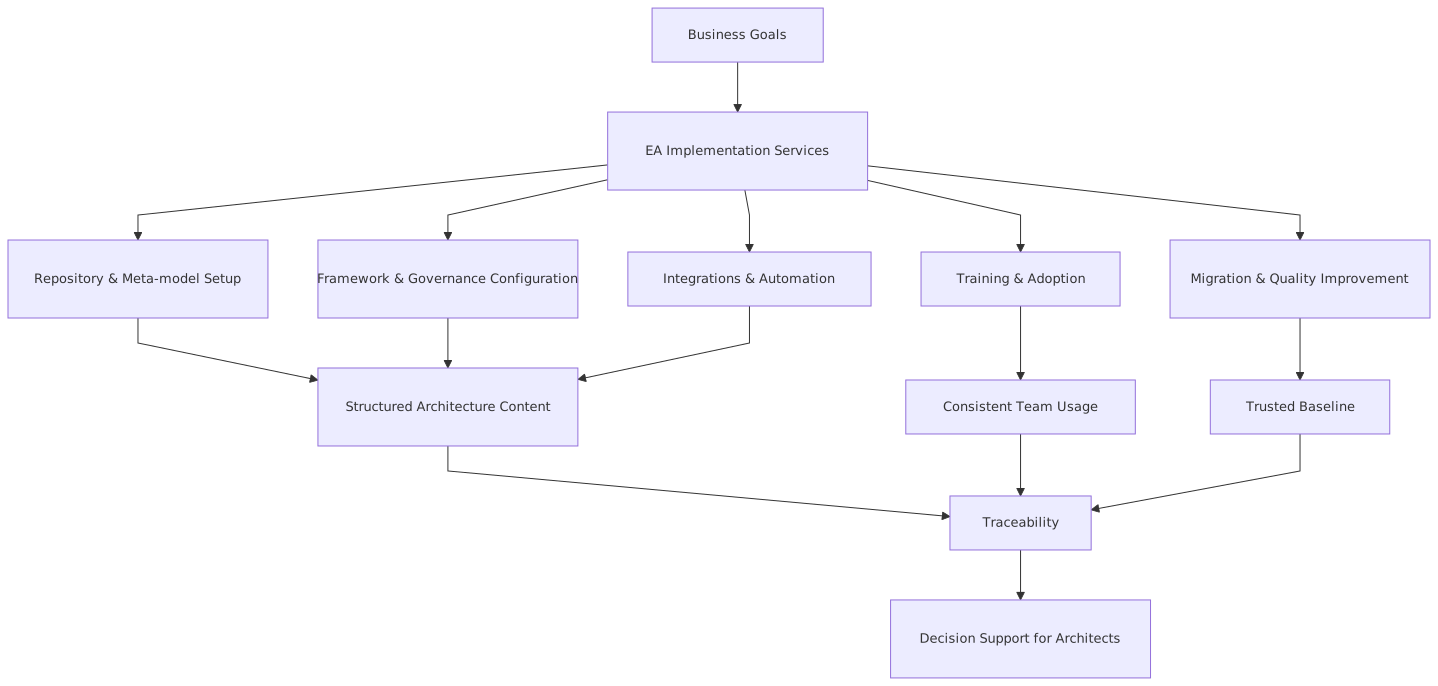
At the practical level, implementation services usually cover a set of workstreams like these:
- platform installation and environment setup
- repository design and hosting model
- security and access model
- metamodel and taxonomy design
- framework alignment (TOGAF, ArchiMate, BPMN, UML, custom)
- migration from spreadsheets, Visio, SharePoint, legacy repositories
- integration with CMDB, IAM, project portfolio, DevOps, cloud platforms
- governance workflow design
- reporting, dashboards, and publishing
- training and operating model setup
- pilot use cases and rollout
That sounds straightforward. It isn’t.
Because every one of those bullets hides a political and architectural decision.
Take the metamodel. On paper, it’s just defining what objects exist in the repository and how they relate. In reality, it’s where you decide whether “application” means a deployed product, a business capability enabler, a logical service, or all three depending on who is talking. If you don’t settle that, your reports become fiction.
Take integrations. Everyone says they want Sparx integrated with “the toolchain.” Fine. But what’s the source of truth for application ownership? CMDB? HR? IAM? Cloud tags? Finance? Some random Excel file maintained by one diligent architect in the insurance domain? If you don’t resolve those conflicts, automation just scales confusion. Sparx EA training
That’s why implementation services matter. You are not buying setup help. You are buying design decisions, governance discipline, and a path to institutional trust.
The mistake people make in the first month
The most common mistake is starting with diagrams.
Architects love diagrams. I do too. But if your implementation starts with “let’s define the viewpoints and make attractive heatmaps,” you are probably already drifting into vanity architecture.
Start with decisions and consumers, not pictures.
Ask:
- What business and technology decisions should this repository support?
- Who needs to trust the data?
- Which lifecycle events must update the repository?
- What can be manually maintained, and what must be automated?
- What architecture questions should be answerable in under five minutes?
If you can’t answer those, don’t start drawing.
A serious Sparx EA implementation begins with use cases such as:
- Which applications process customer PII in the bank?
- Which Kafka event streams are consumed by systems outside the regulated zone?
- Which IAM platform controls access to privileged admin functions in cloud-native services?
- Which applications are due for technology refresh in the next 18 months?
- Which business capabilities depend on a legacy core platform?
- Which projects are violating target-state integration patterns?
That’s architecture work. Not decoration.
Why Sparx EA still matters in a world full of “modern” tools
There’s a fashionable view that heavyweight architecture repositories are outdated, and everything should just live in code, cloud tags, wikis, and product team backlogs.
There’s some truth in that. Architecture teams absolutely over-model. They absolutely create stale repositories. And yes, if your enterprise is small, highly product-centric, and technically mature, you may not need a broad EA platform at all.
But large enterprises are not that simple. Especially banks. Especially regulated environments. Especially hybrid estates running mainframe, middleware, cloud, event streaming, vendor SaaS, IAM controls, and dozens of transformation programs at once.
In those environments, the contrarian point is this: a centralized architecture repository is not old-fashioned; it’s one of the few defenses against fragmentation.
Not because centralization is inherently good. Usually it isn’t. But because the enterprise still needs a place where cross-domain truth is assembled and governed. Delivery tools are local by design. Enterprise architecture exists precisely because some decisions are not local.
Sparx EA matters when you need to connect:
- business capability maps
- application portfolios
- data classifications
- integration patterns
- security controls
- technology standards
- project impacts
- target states
- governance decisions
And do it in a way that survives staff turnover and audit scrutiny.
The real layers of an implementation
A good implementation usually has five layers. Miss any one of them and the whole thing weakens.
1. Platform layer
This is the technical setup: repository hosting, environment design, backup, performance, connectivity, access control, publishing options, and administration.
You need to decide whether the platform is going to be lightly used by a small architecture team or become a broad enterprise service with solution architects, security architects, and governance stakeholders accessing it regularly.
This affects:
- repository structure
- environment segregation
- user provisioning
- auditability
- integration patterns
- performance expectations
A lot of implementations underinvest here. They assume architecture tools are low-volume and low-risk. But if Sparx EA becomes part of governance evidence, audit support, regulatory traceability, or investment planning, the platform itself becomes important infrastructure. Sparx EA guide
2. Information model layer
This is the heart of the implementation.
What are the objects?
How are they named?
What relationships are allowed?
What lifecycle states exist?
What fields are mandatory?
What is inherited from standards and what is customized?
This is where implementation services earn their money.
A generic metamodel is almost always too generic. But over-customization is just as dangerous. Architects sometimes build baroque structures that reflect every nuance of their internal worldview. That usually collapses under maintenance burden.
The right approach is disciplined pragmatism:
- model only what supports decisions
- prefer a small number of high-value relationships
- define ownership clearly
- avoid duplicate concepts with different names
- treat classifications as products, not side notes
3. Process and governance layer
If there is no process, there is no repository. There is only software.
You need to define:
- who can create and approve objects
- how architecture reviews update the repository
- how projects submit change impacts
- how standards exceptions are recorded
- how target-state changes are approved
- how stale content is detected and retired
This is where many implementations become performative. They define governance that sounds mature but is too heavy for delivery teams. Then teams bypass it.
Good governance is tight on meaning, light on friction.
4. Integration layer
This is where Sparx EA stops being isolated.
Typical integrations include:
- CMDB for infrastructure and service relationships
- IAM or HR systems for ownership and role data
- project portfolio tools for change initiatives
- cloud platforms for deployed resources or application metadata
- API catalogues and event-stream inventories
- document publishing and collaboration platforms
This is also where reality bites. Source systems disagree. Terms conflict. Ownership is incomplete. Timestamps lie. Data quality is inconsistent.
Implementation services should not promise magical synchronization. They should design a truth hierarchy and establish what is authoritative for each domain.
5. Adoption layer
This is the layer executives underestimate and architects sometimes dismiss.
A repository nobody updates is dead. A repository nobody trusts is worse than dead.
Adoption means:
- role-based training
- practical templates
- pilot domains
- office hours
- governance onboarding
- report design around real stakeholder questions
- active content stewardship
You don’t “launch” enterprise architecture tooling. You cultivate it.
What this looks like in real architecture work
Let’s make this concrete.
In real architecture work, Sparx EA implementation services matter because architects need to answer cross-cutting questions under pressure. Not in workshops. In live transformation.
Imagine a bank modernizing customer onboarding.
There’s a legacy onboarding platform, a new cloud-native workflow service, Kafka event streams for customer verification and fraud signals, an enterprise IAM platform handling workforce access, and separate customer identity services for digital channels. Compliance wants traceability for data movement. Security wants to know where privileged access exists. Integration teams want event ownership defined. Delivery wants fast approvals.
Without a proper architecture repository, these questions get answered through meetings, email chains, and someone’s memory. Which is to say, badly.
With a well-implemented Sparx EA environment, an architect should be able to trace:
- the business capability: customer onboarding
- the applications supporting it
- the data entities involved
- the Kafka topics carrying onboarding events
- the IAM dependencies for admin and service access
- the cloud deployment zones hosting the new services
- the standards governing integration and security patterns
- the projects changing those components
- the target-state roadmap replacing the legacy application
That is not theoretical value. That is operational architecture.
And this is the point many people miss: implementation services are valuable only if they support this kind of live traceability. If they stop at “we configured stereotypes and created a framework,” they have not really implemented anything useful.
A real enterprise example: retail banking modernization
Let’s walk through a realistic example.

A retail bank has these conditions:
- 450+ applications across retail, payments, lending, fraud, and operations
- hybrid infrastructure with on-prem core systems and cloud-native digital services
- Kafka used as the strategic event backbone
- a centralized IAM stack for workforce identity, with fragmented customer identity services
- regulatory pressure around data lineage, resilience, and access control
- multiple transformation programs running in parallel
The bank buys Sparx EA because leadership wants “a single architecture repository.” That phrase should always make you nervous, by the way. It usually means ten different expectations hidden inside one sentence.
The bad implementation path
The bank starts by importing application lists from spreadsheets and creating capability maps. A consulting team builds a very broad metamodel with hundreds of element types. Architects are trained on notation, not on operating discipline. Integration with CMDB is discussed but delayed. Kafka assets are modeled manually. IAM relationships are barely represented. Project teams are told to update the repository as part of architecture governance.
Six months later:
- application ownership is inconsistent
- half the capability mappings are disputed
- Kafka topics are out of date
- cloud services are not represented accurately
- solution architects see the repository as extra admin
- governance packs rely on PowerPoint exports, not live repository views
- leadership asks why they spent so much money for prettier diagrams
That is a very normal failure pattern.
The better implementation path
Now the same bank takes a more disciplined approach.
Phase 1 defines the decision use cases:
- identify applications handling customer financial data
- trace business capabilities to applications and projects
- map strategic integration patterns, including Kafka producers and consumers
- identify IAM dependencies for privileged and service-level access
- track cloud migration status by application domain
- support architecture review board decisions with live repository evidence
The implementation team then creates a lean metamodel:
- business capabilities
- business processes
- applications
- application services
- data entities and classifications
- integration interfaces
- Kafka topics and event domains
- IAM services and trust relationships
- technology components
- cloud deployment environments
- projects and roadmaps
- standards and exceptions
They define source-of-truth rules:
- application inventory from the application portfolio process
- infrastructure relationships from CMDB where reliable
- ownership from HR/IAM role mapping
- cloud deployment metadata from cloud tagging feeds
- Kafka topic inventory from the event platform catalogue
- manual architecture curation only for relationships not available elsewhere
Then they tie repository updates to governance events:
- no architecture review without application impact updates
- no target-state approval without standards alignment recorded
- no project closure without lifecycle status updates
- quarterly stewardship reviews for stale data
This is the difference between implementation and installation.
Within nine months, the bank can answer questions like:
- Which lending applications still depend on legacy synchronous integration instead of Kafka?
- Which cloud-hosted services process regulated customer data?
- Which systems depend on the workforce IAM platform for admin access?
- Which customer onboarding services are outside the approved target architecture?
- Which projects are touching the same event domain and may create collision risk?
That’s where Sparx EA starts paying for itself.
Common mistakes architects make
Let’s be honest. Tool implementations don’t fail only because of vendors or executives. Architects make predictable mistakes too.
Here are the big ones.
Mistake 1: Modeling everything
This is classic architect behavior. We see a flexible tool and immediately imagine a complete digital twin of the enterprise.
Don’t.
If you model everything, you maintain nothing. Enterprise architecture repositories win by selective depth, not total scope.
Mistake 2: Confusing framework compliance with usefulness
Some teams become obsessed with whether the repository perfectly reflects TOGAF, ArchiMate, BPMN, UML, or some internal taxonomy. ArchiMate modeling guide
Nobody outside the architecture team cares.
Frameworks are useful. But usefulness beats purity every time. If your model is framework-perfect and decision-useless, it has failed.
Mistake 3: No ownership model
If nobody owns data domains, the repository decays immediately.
You need named owners for:
- business capability taxonomy
- application inventory
- integration assets
- data classifications
- technology standards
- project-roadmap relationships
Not “the architecture team” as a vague collective. Named roles.
Mistake 4: Manual maintenance fantasy
Architects routinely underestimate how fast enterprise data changes.
Applications split.
Kafka topics proliferate.
Cloud services are redeployed.
IAM relationships change with restructures.
Projects slip.
Technology standards evolve.
If your implementation assumes architects will manually keep all that current, it is built on fiction.
Mistake 5: No integration strategy
A repository without integration becomes an annual cleanup exercise. That’s not architecture capability. That’s archaeology.
Mistake 6: Making governance punitive
If every update process feels like a compliance trap, delivery teams will work around you. They always do.
Architecture governance should reduce ambiguity, not create ceremony for its own sake.
Useful implementation priorities
Here’s a practical view of what to focus on first.
That table is more useful than half the implementation decks I’ve seen.
The Kafka angle: where repositories often fall apart
Kafka is a good example of why implementation quality matters.
Many organizations declare event-driven architecture as strategic. Then they model Kafka badly. They treat topics as just technical artifacts and fail to represent:
- event domains
- producer ownership
- consumer dependencies
- data classifications
- retention or compliance considerations
- target versus non-strategic integration patterns
As a result, architecture loses visibility into one of the most important integration layers in the enterprise.
In a solid Sparx EA implementation, Kafka-related modeling should help answer:
- Which applications publish customer-related events?
- Which topics cross trust boundaries?
- Which consumers are outside approved domains?
- Which events duplicate existing canonical information?
- Where are there hidden runtime dependencies between transformation programs?
That is highly relevant in banking, where event streams can carry regulated data and where resilience and traceability are not optional.
The IAM angle: usually neglected, always painful
IAM is another area architects often under-model.
Why? Because IAM sits awkwardly between security architecture, infrastructure, application design, and operating model. So everyone assumes someone else has it covered.
Bad assumption.
In real enterprise architecture work, IAM should be visible in the repository as a dependency structure:
- workforce identity providers
- customer identity services
- privileged access management
- service-to-service trust
- federation relationships
- application authentication and authorization dependencies
This matters especially in cloud transformations. Teams move applications to cloud platforms, modernize APIs, adopt managed services, and redesign admin models. Suddenly nobody can answer a simple question like: which critical banking applications still rely on legacy LDAP patterns for admin access? ArchiMate in TOGAF ADM
That’s not just a security issue. It’s architecture debt.
A mature Sparx EA implementation should make IAM visible enough to support planning, risk analysis, and transition architecture. Not every technical detail, but enough to drive decisions.
Cloud modeling: avoid the cartoon version
Another common failure is cloud modeling that looks good in steering committees and says almost nothing useful.
You know the type:
- one cloud icon
- arrows everywhere
- labels like “data lake” and “microservices platform”
- no deployment accountability
- no environment distinctions
- no resilience zones
- no operational dependencies
That’s poster architecture.
Real cloud modeling in Sparx EA should support things like:
- which applications are on which cloud platforms
- production versus non-production separation
- regional or resilience deployment patterns
- managed service dependencies
- data residency implications
- migration state and target platforms
- integration dependencies back to on-prem systems
Again, not because the repository should replace cloud-native tooling. It shouldn’t. But because enterprise decisions often happen above the level of individual deployments.
What good implementation services should deliver
If you are buying Sparx Enterprise Architect implementation services, here’s what I think you should expect.
Not a giant methodology pack.
Not just training.
Not a pile of sample diagrams.
You should expect:
- a clear architecture operating model tied to the repository
- a pragmatic metamodel tailored to your enterprise
- source-of-truth design for key data domains
- governance workflows connected to real change processes
- integration patterns for high-value data feeds
- role-based views and reporting that answer actual stakeholder questions
- pilot use cases proving value in live architecture work
- a sustainability model for stewardship, not just launch support
And here’s the contrarian bit: sometimes the best implementation service you can get is a partner willing to tell you to model less, customize less, and automate less than you initially wanted.
Because excess ambition kills these programs.
How to judge whether your implementation is working
Forget vanity metrics like number of diagrams created.
Look at these instead:
- Can architects answer impact questions faster than before?
- Do governance forums use live repository evidence?
- Are application and integration owners identified and trusted?
- Are standards exceptions traceable?
- Can transformation leaders see target-state progress?
- Is stale content detected and corrected routinely?
- Do solution architects see the repository as helpful, not ceremonial?
If the answer is no, the implementation is not working, regardless of how polished the platform looks.
Final thought
Sparx Enterprise Architect is not inherently elegant. It’s not trendy. It doesn’t sell itself with the language of product engineering cool. And frankly, that’s fine.
In serious enterprises, architecture tools do not need to be fashionable. They need to be dependable, adaptable, and disciplined. Sparx EA can absolutely be that, but only if implementation services focus on architecture as an operating capability, not a modeling exercise.
That’s the real explanation.
A good Sparx EA implementation creates shared meaning, traceable change, and usable governance across business, application, integration, security, and technology domains. A bad one creates diagrams and disappointment.
Architects should know the difference. And if we’re honest, we often don’t push hard enough on that distinction early enough.
FAQ
1. What are Sparx Enterprise Architect implementation services?
They are the services needed to configure, structure, govern, integrate, and operationalize Sparx EA so it works as an enterprise architecture repository, not just a diagramming tool. That includes platform setup, metamodel design, migration, integrations, governance workflows, reporting, and adoption support.
2. How long does a typical Sparx EA implementation take?
A basic technical setup can be done quickly, often in weeks. A real enterprise implementation usually takes several months for initial value and 6–12 months for stable adoption. Large regulated organizations, especially banks, often need phased rollout by domain.
3. What is the biggest mistake in implementing Sparx EA?
Trying to model everything before defining what decisions the repository must support. That leads to complexity, low adoption, and stale content. Start with high-value architecture use cases and a lean metamodel.
4. Can Sparx EA integrate with cloud, Kafka, CMDB, or IAM-related data?
Yes, but carefully. The challenge is less about technical connectivity and more about defining authoritative sources, reconciling conflicting data, and deciding what belongs in the architecture repository versus operational tools.
5. Is Sparx Enterprise Architect suitable for banking and other regulated industries?
Yes. In fact, it is often more valuable in regulated enterprises because they need traceability across applications, data, controls, projects, and target states. But it only works if governance, ownership, and data stewardship are designed properly from the start.
Frequently Asked Questions
What is enterprise architecture?
Enterprise architecture is a discipline that aligns an organisation's strategy, business processes, information systems, and technology. Using frameworks like TOGAF and modeling languages like ArchiMate, it provides a structured view of how the enterprise operates and how it needs to change.
How does ArchiMate support enterprise architecture practice?
ArchiMate provides a standard modeling language that connects strategy, business operations, applications, data, and technology in one coherent model. It enables traceability from strategic goals through business capabilities and application services to the technology platforms that support them.
What tools are used for enterprise architecture modeling?
The main tools are Sparx Enterprise Architect (ArchiMate, UML, BPMN, SysML), Archi (free, ArchiMate-only), and BiZZdesign Enterprise Studio. Sparx EA is the most feature-rich option, supporting concurrent repositories, automation, scripting, and integration with delivery tools like Jira and Azure DevOps.