⏱ 20 min read
Most architecture repositories are lying to you.
Not because people are malicious. Mostly because the model says one thing, the diagrams suggest another, the implementation did something else entirely, and the governance team still believes the metamodel is “stable.” It usually isn’t. It’s just frozen badly. EA governance checklist
That’s the uncomfortable truth behind metamodel evolution in UML: the hard part is not drawing the model. The hard part is changing the rules of the model over time without destroying consistency, traceability, and everyone’s patience. UML modeling best practices
And yes, this matters a lot more than many architects admit.
If your enterprise architecture practice uses UML, ArchiMate, custom repository schemas, or any modeling platform with stereotypes and profiles, then you are already managing a metamodel whether you call it that or not. The moment you define what a “service,” “domain event,” “application,” “identity provider,” or “regulated data store” means in your repository, you have a metamodel. The moment those meanings change, you have metamodel evolution. And the moment you ignore versioning, you create architectural debt at a level most teams don’t even know how to measure.
Let’s make it simple first
A metamodel is the model of your modeling language. In practical enterprise architecture terms, it defines:
- what kinds of things can exist in your architecture repository
- how those things relate to each other
- what attributes they must carry
- what constraints make the model valid
In UML, the metamodel sits underneath the diagrams. It defines elements like classes, components, dependencies, interfaces, associations, packages, and so on. In enterprise work, we often extend UML using profiles and stereotypes so we can represent things like:
<> <> <> <> <>
Now the problem: businesses change faster than the metamodel.
A bank that modeled “applications” five years ago now needs to model event streams, zero-trust identity boundaries, cloud landing zones, API products, AI services, and data sovereignty rules. If the metamodel does not evolve, the architecture repository becomes a museum. If it evolves carelessly, the repository becomes nonsense.
So the real challenge is this:
How do you change the metamodel over time, version it properly, and keep models consistent enough to still support decisions?
That’s the issue. And too many architecture teams still treat it like a tooling detail. It is not a tooling detail. It is governance, semantics, and operational architecture integrity.
Why metamodel evolution becomes painful in enterprises
In theory, UML gives you structure. In enterprise reality, people pile local meaning onto that structure until the repository starts wobbling.
A few examples:
- In one program, a “service” means a business capability exposed via API.
- In another, it means a Kubernetes deployment.
- In a security architecture model, “service” means an identity-protected workload.
- In a Kafka platform model, teams model topics as interfaces because there was no agreed event concept.
- In cloud architecture, some architects model AWS accounts as nodes, others as packages, others as organizations.
None of this is unusual. It’s what happens when architecture grows through delivery pressure rather than semantic discipline.
The metamodel evolves because reality forces it to evolve:
- new technology patterns emerge
- governance adds new controls
- regulations introduce mandatory metadata
- integration styles shift from request-response to event-driven
- IAM moves from directory-centric to policy-centric
- cloud introduces ephemeral infrastructure and platform-managed resources
The old metamodel cannot handle the new world. So people improvise.
Improvisation is where consistency goes to die.
The first contrarian point: stability is overrated
Architects love stability. They talk about “controlled vocabularies,” “canonical definitions,” and “single source of truth” like these are sacred outcomes. They’re not. Not by themselves.
A metamodel that never changes is usually not mature. It is usually abandoned.
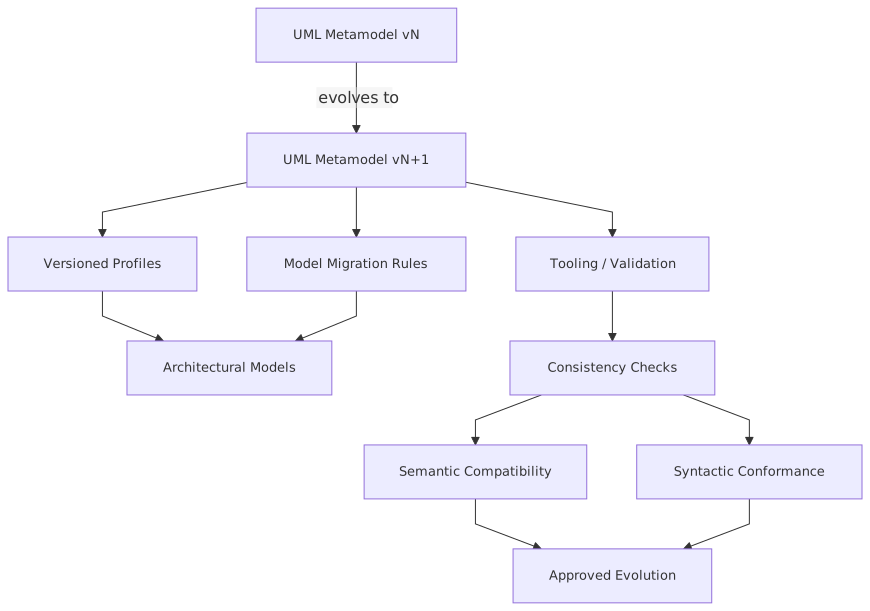
The goal is not metamodel stability. The goal is managed evolution.
That means:
- changing semantics deliberately
- versioning the metamodel explicitly
- migrating existing models safely
- preserving enough backward understanding to compare old and new states
- enforcing consistency where it matters, not everywhere equally
A lot of architecture teams make the mistake of trying to lock the metamodel too early. They want universal definitions before they have enough experience. That sounds disciplined. It is often just bureaucracy in nice clothes.
You do need standards. But not static standards. You need standards that can survive contact with cloud, streaming, identity federation, and regulation.
What versioning actually means in a UML metamodel context
When people say “versioning” in architecture, they often mean document versions. That’s not enough.
Metamodel versioning means the definition of modeling constructs themselves changes over time.
Examples:
- A
<stereotype is split into> <,> <, and> <> - A relationship once called
dependsOnis refined intopublishesTo,consumesFrom,authenticatesWith, andstoresDataIn - An element previously optional now requires metadata such as data classification, owner, and resilience tier
- A Kafka topic can no longer be modeled as a generic interface; it must be an event channel with retention, schema owner, and classification attributes
- IAM constructs move from basic user-group-role notation to explicit policy decision point, policy enforcement point, and trust boundary modeling
That is metamodel evolution.
And versioning means at least four things:
If you only version the profile file or the UML package and ignore migration and validation, you haven’t really versioned the metamodel. You’ve just renamed the problem. UML for microservices
Consistency: the word everyone uses badly
Consistency is another term architects throw around without enough precision.
There are at least four kinds of consistency in enterprise modeling:
- Syntactic consistency
The model conforms to UML syntax and profile constraints.
- Semantic consistency
The meaning of elements and relationships is coherent across teams and domains.
- Cross-view consistency
Application, integration, security, cloud, and data views describe the same reality, not parallel fantasies.
- Temporal consistency
The model remains interpretable when the metamodel changes over time.
Most architecture governance only checks the first one, maybe the second if they are unusually serious. But in real enterprise work, the third and fourth are where the pain lives.
A banking architecture repository can be perfectly valid UML and still be useless because:
- the application model says customer onboarding is a single service
- the Kafka model shows six event producers and nine consumers
- the IAM model says authentication is centralized
- the cloud deployment model reveals region-specific identity brokers and local policy enforcement
- the resilience model shows failover behavior that contradicts the process diagrams
That repository is “consistent” only if your standards are superficial.
Real architecture work: where this becomes unavoidable
Let’s stop talking abstractly. Here is how metamodel evolution shows up in real work.
1. Banking modernization
A retail bank starts with a traditional application portfolio model:
- core banking platform
- payments system
- CRM
- fraud engine
- digital channels
Then the bank modernizes:
- event-driven integration via Kafka
- customer identity federation across channels
- cloud-native onboarding services
- zero-trust segmentation
- data classification for regulated workloads
The old metamodel probably had:
- Application
- Interface
- Database
- Server
- User
That is nowhere near enough.
Now the architecture team needs concepts for:
- event topic
- event producer and consumer
- schema ownership
- identity trust domain
- privileged access boundary
- cloud account or subscription boundary
- managed platform service
- regulated data asset
- policy enforcement point
If they don’t evolve the metamodel, teams force these concepts into the wrong shapes. Kafka topics become interfaces. IAM trust boundaries become generic dependencies. Managed cloud services become servers. It gets ugly fast.
And once those shortcuts enter the repository, reporting becomes misleading:
- “How many systems consume customer-profile events?”
- “Which applications use privileged IAM roles?”
- “Which regulated data stores sit in public cloud managed services?”
- “What services depend on region-local identity brokers?”
You can’t answer those questions reliably if the metamodel is semantically weak.
2. Kafka platform architecture
Kafka is where weak metamodels get exposed brutally.
A lot of UML-based repositories were designed around request-response integration. They model APIs, interfaces, consumers, providers. Fine. Then event streaming arrives, and architects try to squeeze it into the old language.
Bad idea.
A Kafka topic is not just an interface. It has:
- retention behavior
- partitioning strategy
- schema contract
- ownership
- classification
- replay implications
- consumer group semantics
- ordering constraints
- platform tenancy context
Those are architecture-relevant semantics. If your metamodel treats a topic as a named connector and moves on, you are under-modeling a critical enterprise mechanism.
Worse, event-driven systems often need consistency across several views:
- business event taxonomy
- application ownership
- integration flow
- IAM access control
- data governance
- cloud platform deployment
This is exactly why metamodel evolution matters. A UML profile that was “good enough” in API-centric architecture becomes dangerously simplistic in streaming architecture.
3. IAM and identity architecture
Identity architecture also breaks simplistic metamodels.
Older repositories tend to model:
- user
- role
- system
- authentication dependency
That was barely enough even then. In modern IAM, especially in cloud-heavy enterprises, you need to model:
- identity provider
- relying party
- trust federation
- workload identity
- service principal
- role binding
- policy store
- policy decision point
- policy enforcement point
- privileged session boundary
- machine-to-machine credential path
If those constructs are not first-class in the metamodel, security architecture gets reduced to decorative diagrams.
And this is not academic. In real reviews, you need to answer questions like:
- Which Kafka consumers use workload identities versus shared secrets?
- Which cloud workloads trust the enterprise IdP directly?
- Where are privilege escalation paths hidden in service-to-service flows?
- Which onboarding services span multiple trust domains?
Without metamodel evolution, the repository cannot support these decisions.
Common mistakes architects make
This is where I’ll be blunt. Enterprise architects often create their own metamodel problems.
Mistake 1: Treating UML as if the standard metamodel is enough
It usually isn’t.
UML gives you a useful base, but enterprise architecture always requires domain semantics. If you refuse to extend the metamodel because you want to stay “pure UML,” you are choosing ambiguity over clarity.
Purity is not a virtue if it makes the model less useful.
Mistake 2: Adding stereotypes without lifecycle discipline
This one is everywhere.
Architects create stereotypes like:
<> <> <> <>
But they do not define:
- what the stereotype means
- mandatory attributes
- valid relationships
- deprecation rules
- migration rules when the concept changes
That is not metamodeling. That is label-making.
Mistake 3: Evolving the metamodel silently
This is probably the worst one.
Someone updates the profile or repository schema. New elements appear. Old ones become discouraged. No explicit version is published. No migration guidance exists. Teams continue modeling with mixed assumptions.
Now your repository contains:
- old semantics
- new semantics
- hybrid semantics
- undocumented local workarounds
At that point, “single source of truth” becomes marketing language.
Mistake 4: Over-engineering the metamodel before delivery pressure tests it
Another contrarian view: many architecture teams design metamodels that are too clever.
They define dozens of abstractions, inheritance trees, and relationship types because it feels methodical. Then no delivery team uses them correctly because the semantics are too fine-grained for actual project work.
A metamodel that cannot be used consistently by real architects under time pressure is not elegant. It is failed design.
Mistake 5: Confusing repository completeness with architectural truth
Not every architectural fact belongs in the metamodel. Some architects try to encode everything.
Don’t.
The metamodel should capture decision-relevant semantics. If the architecture team is modeling every Kafka partition count change manually in UML, they are probably doing platform inventory work, not architecture.
The trick is knowing what must be explicit and what can remain linked operational metadata.
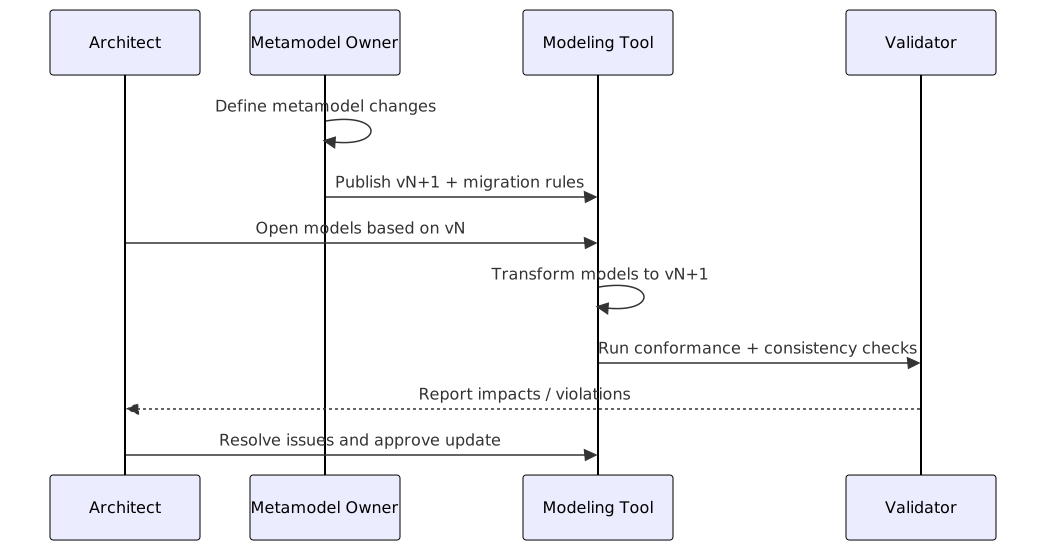
A practical approach to metamodel evolution
Here’s the approach I’ve seen work best in large enterprises.
1. Treat the metamodel as a product
This changes behavior immediately.
A metamodel product has:
- an owner
- a roadmap
- version numbers
- release notes
- change control
- migration guidance
- quality checks
- consumers
Most architecture teams do not do this. They treat the metamodel as a side effect of tooling. That’s one reason it degrades.
If your metamodel supports architecture governance, portfolio analysis, security traceability, and cloud control design, then it is a strategic internal product.
2. Separate core concepts from volatile extensions
Not everything changes at the same rate.
Your core may include:
- application
- business capability
- data asset
- interface
- actor
- deployment boundary
Your volatile extensions may include:
- Kafka stream constructs
- cloud provider-specific services
- IAM policy enforcement patterns
- AI service types
- resilience topology markers
This separation matters because it allows the core to remain stable while domain-specific profiles evolve faster.
That’s far healthier than rebuilding everything every 18 months.
3. Use explicit version states in the repository
At minimum, every model artifact should be interpretable against:
- metamodel version used
- validation rules applied
- migration status
- deprecation status of relevant constructs
I am amazed how many enterprise repositories still do not capture this cleanly.
If your model says “Customer Profile Service” and your repository cannot tell whether it was created under metamodel v2.1 or v3.0 semantics, your consistency claims are weak.
4. Define migration patterns, not just target states
Architects love target states. Operations lives in transition.
A good metamodel evolution practice defines migration patterns such as:
- replace generic
InterfacewithEventChannel - split
ApplicationintoBusinessApp,PlatformService,ManagedSaaS - convert
Rolerelationships into explicit trust and policy constructs - attach mandatory data classification to all regulated stores
- map generic cloud node to provider-aware deployment boundary
This is the practical part. Without migration patterns, every team reinvents conversion logic. That creates uneven models and governance conflict.
A real enterprise example: bank modernization with Kafka, IAM, and cloud
Let me give a realistic composite example based on patterns I’ve seen repeatedly.
A regional bank launches a modernization program for customer onboarding and fraud monitoring.
Initial state
The repository contains:
- monolithic onboarding application
- core banking system
- fraud engine
- identity platform
- branch channel
- mobile banking app
- integration middleware
The UML profile is old. It models:
- applications
- interfaces
- databases
- users
- servers
It does not model:
- Kafka topics
- event ownership
- cloud-native services
- workload identities
- trust boundaries
- managed platform services
- data classification
What changed in reality
The bank introduces:
- Kafka for customer onboarding events
- cloud-hosted onboarding microservices
- IAM federation between enterprise IdP and cloud workloads
- policy-based service authorization
- event-driven fraud scoring
- regional data residency controls
Now architecture questions become more specific:
- Which services publish KYC-complete events?
- Which consumers can replay customer identity events?
- What trust path allows the fraud service to access profile data?
- Which cloud services process PII in-region only?
- Which systems are dependent on the central IdP during onboarding?
The old metamodel cannot answer any of these reliably.
Metamodel evolution
The architecture team introduces version 3.0 of the profile with new constructs:
New element stereotypes
<> <> <> <> <> <> <> <>
New mandatory attributes
- data classification
- business owner
- platform owner
- resilience tier
- region
- trust domain
- schema owner
New relationship types
- publishesTo
- consumesFrom
- authenticatesVia
- authorizedBy
- storesRegulatedDataIn
- deployedWithin
Migration decisions
This is where mature teams differ from amateur ones.
They do not force a full repository rewrite immediately. Instead they:
- mark old
Interface-based event representations as deprecated - migrate high-risk domains first: onboarding, fraud, identity
- keep historical views readable
- publish mapping rules
- add validation checks for all new regulated workloads
- require new projects to use v3.0 semantics immediately
That balance matters. Purists will complain this leaves temporary inconsistency. They are right. But the alternative is often paralysis.
What improved
Within six months, the bank can answer architecture governance questions much faster:
- all Kafka topics carrying PII are identifiable
- consumer access paths are linked to IAM constructs
- cloud workload trust chains are visible
- resilience dependencies on identity services are explicit
- regulated data placement can be reviewed against region controls
That is the payoff. Not prettier diagrams. Better decision support.
How to keep consistency during evolution
This is the hard operational bit.
You will never get perfect consistency. Stop aiming for that. Aim for decision-grade consistency.
Here are the controls that matter most.
A few strong opinions here.
First, validation rules are not bureaucracy. They are mercy. They prevent the repository from becoming interpretive art.
Second, deprecation without enforcement is theater. If an obsolete stereotype remains available forever, teams will keep using it forever.
Third, consistency reviews must be cross-domain. If your IAM architecture is reviewed separately from your Kafka architecture, you will miss the real risk paths.
The second contrarian point: not every inconsistency is bad
Architects sometimes react to inconsistency like auditors react to missing signatures. Calm down.
Some inconsistency is a useful signal:
- the business changed faster than standards
- one domain discovered a missing concept first
- platform reality exposed a bad abstraction
- governance assumptions no longer fit delivery patterns
If a cloud team is modeling workload identity in ways the core metamodel cannot express, that may not mean the team is undisciplined. It may mean the metamodel is behind reality.
The wrong response is to reject the model because it breaks the standard.
The right response is to ask whether the standard is now obsolete.
This is where real architecture leadership shows up. Not in defending the existing metamodel, but in evolving it without losing coherence.
Versioning strategy that actually works
I recommend a simple model, not a heroic one.
Use semantic-style metamodel versions
- Major version: breaking semantic change
Example: Application split into multiple types; old relationship semantics retired
- Minor version: additive change
Example: new Kafka or IAM stereotypes added without invalidating old ones
- Patch version: clarification or constraint fix
Example: corrected validation rule, updated documentation, fixed attribute cardinality
This matters because not every change deserves organizational drama.
Publish four artifacts for every significant release
- Metamodel definition
- Change log
- Migration guide
- Validation rule set
If any of these are missing, the release is incomplete.
Maintain compatibility windows
Give teams a clear adoption window:
- new projects must use v3.x immediately
- existing in-flight projects can finish on v2.x for 90 days
- repository migration for critical domains by quarter end
- deprecated constructs blocked after sunset date
This is boring governance. And boring governance is often what saves architecture from chaos.
What architects should model explicitly versus infer from tooling
This boundary matters more now because cloud and platform tooling already hold a lot of truth.
Model explicitly when the concept affects:
- design decisions
- governance outcomes
- risk analysis
- regulatory compliance
- dependency analysis
- operating model clarity
Examples to model explicitly:
- Kafka topic ownership and classification
- IAM trust boundaries
- policy enforcement locations
- regulated data stores
- cloud deployment boundaries relevant to resilience or sovereignty
- business-critical service dependencies
Examples often better linked from tooling:
- individual container instances
- transient scaling events
- low-level Kafka broker metrics
- every cloud resource tag
- ephemeral infrastructure states
A metamodel should not become a poor substitute for runtime observability or CMDB data. That’s another common trap.
If you do nothing, here’s what happens
Let’s be honest about the failure mode.
Without disciplined metamodel evolution:
- architecture repositories become legacy storytelling platforms
- governance decisions are made from stale abstractions
- security reviews miss trust and identity complexity
- event-driven dependencies remain invisible
- cloud architecture is misrepresented as static infrastructure
- audit evidence becomes painful to assemble
- transformation roadmaps cannot be compared across time
In banking especially, that becomes expensive. Not philosophically expensive. Actually expensive.
You lose speed in change reviews. You increase risk in IAM design. You create ambiguity in data handling. You weaken resilience analysis. And eventually delivery teams stop trusting architecture altogether.
Once that trust is gone, architecture becomes a diagram service.
And honestly, a lot of architecture teams are closer to that outcome than they think.
Final thought
Metamodel evolution in UML is not a niche modeling concern. It is one of the hidden foundations of enterprise architecture credibility.
If the metamodel cannot evolve, the architecture practice cannot keep up with the enterprise.
If it evolves without versioning, the repository loses meaning.
If consistency is enforced blindly, innovation gets pushed outside the model.
If consistency is ignored, the model becomes decorative.
The answer is not more documentation. It is disciplined semantic change.
Treat the metamodel as a living enterprise asset. Version it. Migrate it. Validate it. Challenge it. And, when necessary, admit that the old abstractions no longer describe the business you actually have. ArchiMate in TOGAF ADM
That admission is not failure. It is architecture doing its job.
FAQ
1. What is the difference between a UML model and a UML metamodel in enterprise architecture?
A UML model describes your systems, services, data stores, interfaces, and relationships. The UML metamodel defines the rules behind those descriptions: what types of elements exist, what attributes they have, and what relationships are valid. In enterprise architecture, the moment you create stereotypes like < or <, you are extending the metamodel.
2. Why is metamodel versioning important in real architecture work?
Because enterprise concepts change. Cloud services, event streaming, IAM patterns, and regulatory controls all introduce new semantics. Without versioning, old models are reinterpreted incorrectly, repository content becomes inconsistent, and governance decisions are made on shaky meaning.
3. How do architects usually get metamodel evolution wrong?
The most common failures are silent changes, weak stereotype definitions, no migration plan, and trying to force new concepts like Kafka topics or workload identities into old generic constructs. Another big mistake is over-designing the metamodel so heavily that delivery teams cannot use it consistently.
4. Should every architecture repository enforce strict consistency at all times?
No. That sounds good, but in practice some inconsistency is a signal that the metamodel needs to catch up with reality. The goal is decision-grade consistency, especially for risk, compliance, dependency, and operating model concerns. Temporary inconsistency during managed migration is often acceptable.
5. What should be modeled explicitly for banking, Kafka, IAM, and cloud environments?
At minimum: event channels and ownership, regulated data classification, IAM trust boundaries, workload identities, policy enforcement points, cloud deployment boundaries relevant to sovereignty or resilience, and critical service dependencies. If those are missing, the repository will struggle to support meaningful enterprise decisions.
Frequently Asked Questions
What is a UML metamodel?
A UML metamodel is a model that defines UML itself — it specifies what element types exist (Class, Interface, Association, etc.), what relationships are valid between them, and what constraints apply. It uses the Meta Object Facility (MOF) standard, meaning UML is defined using the same modeling concepts it uses to define other systems.
Why does the UML metamodel matter for enterprise architects?
The UML metamodel determines what is and isn't expressible in UML models. Understanding it helps architects choose the right diagram types, apply constraints correctly, use UML profiles to extend the language for specific domains, and validate that models are internally consistent.
How does the UML metamodel relate to Sparx EA?
Sparx EA implements the UML metamodel — every element type, relationship type, and constraint in Sparx EA corresponds to a metamodel definition. Architects can extend it through UML profiles and MDG Technologies, adding domain-specific stereotypes and tagged values while staying within the formal metamodel structure.