⏱ 18 min read
Most architecture governance fails for a boring reason: people think governance is about approval gates, review boards, and slide decks. It isn’t. Governance is about making sure important architectural decisions are visible, testable, and hard to quietly ignore. And for that, most enterprise teams are still far worse than they think. ArchiMate for governance
Here’s the unpopular opinion: a lot of architecture teams don’t have a governance problem. They have a communication problem disguised as governance. They produce policies nobody reads, standards nobody can apply, and “target architectures” that look impressive on a wall and useless in delivery.
That’s where UML still matters.
Yes, UML. The thing many architects either worship like it’s 2004 or dismiss as dead because “we’re agile now.” Both positions are lazy. UML is not the architecture. It’s not governance by itself. But used properly, it gives governance something it often lacks: a shared, structured language for showing systems, responsibilities, dependencies, trust boundaries, and design intent. UML modeling best practices
Simple version first: UML supports architecture governance by making architectural decisions explicit, reviewable, and reusable across teams. It helps people answer basic governance questions:
- What are we building?
- How do parts interact?
- Where are the controls?
- Who owns what?
- What can change safely?
- What breaks compliance, security, resilience, or cost rules?
That’s the SEO-friendly version. The real story is a bit messier and more interesting.
In actual enterprise work, UML is useful because governance is never abstract. It shows up in painful places: a bank exposing customer data through the wrong API, a Kafka event stream with no ownership model, an IAM integration that quietly bypasses policy, a cloud platform where every team invents its own “standard” architecture. Governance lives in those details. UML helps drag those details into the light. UML for microservices
Governance Is Not the Same as Control
Let’s clear one thing up. Architecture governance is not the same as central control. Good governance does not mean every design goes through a committee of senior people who haven’t shipped anything in months. That model creates theater, not quality.
Real governance does three things:
If your governance process can’t tell a delivery team whether their proposed design violates a principle, creates a risk, or duplicates an existing capability, then it’s not governance. It’s administration. TOGAF roadmap template
UML helps because it turns vague architectural intent into inspectable models. Not perfect models. Not complete models. Just enough structure to support meaningful review.
That’s the key point many people miss: UML is useful when it reduces ambiguity, not when it increases modeling purity.
Why UML Still Has a Place in Enterprise Architecture
There’s always someone who says, “We don’t use UML, we use C4,” or “We just sketch in Miro,” or “Our code is the documentation.” Fine. Some of that is true and useful. But in large enterprises, governance usually needs more than informal pictures.
Why? Because governance operates across teams, domains, vendors, auditors, security functions, risk teams, and platform groups. Informal diagrams are great until people start interpreting them differently. Then you get the usual mess:
- one team thinks a service owns customer identity
- another assumes IAM owns profile data
- Kafka topics become de facto integration contracts with no lifecycle controls
- cloud networking assumptions are never documented
- auditors ask where personal data flows, and everyone points at different diagrams
UML gives you standard semantics. Not magic. Just consistency.
A deployment diagram means something. A sequence diagram means something. A component diagram means something. That matters when architecture review is not just among architects, but across engineering, operations, security, and risk.
And let me be blunt: architects who reject all formal modeling often end up replacing it with sloppy custom notation that only makes sense to them. That’s not pragmatism. That’s ego.
The Practical Role of UML in Governance
In real architecture governance, UML is not there to model every class or every endpoint. It’s there to support a few high-value review activities.
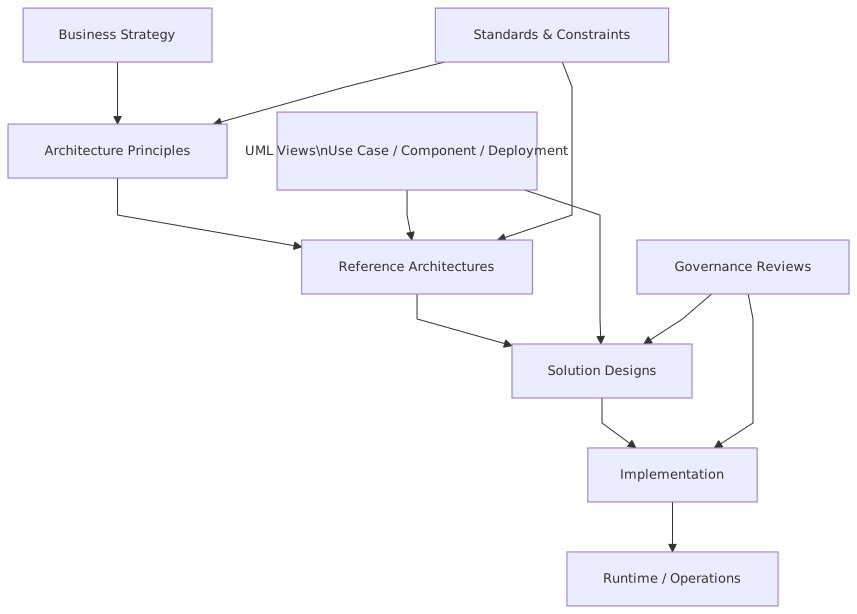
1. Making system boundaries visible
Governance starts with boundaries. If you can’t show where a system begins and ends, then you can’t govern ownership, compliance scope, resilience expectations, or integration policy.
A UML component or package diagram helps answer:
- What is inside the solution?
- What external systems does it depend on?
- What interfaces are exposed?
- Which dependencies are approved and which are accidental?
This sounds basic. It is basic. Enterprises still get it wrong all the time.
In banking especially, system boundaries matter because regulatory and risk obligations don’t spread evenly. A customer onboarding platform is not governed the same way as a marketing analytics tool. If your diagrams blur that line, your governance gets blurry too.
2. Showing behavior, not just structure
A lot of architecture artifacts are static. Boxes and arrows. Fine for a first pass, but governance often needs to understand sequence and timing.
That’s where UML sequence diagrams are genuinely useful. They show:
- call order
- sync vs async behavior
- authentication and authorization steps
- event production and consumption
- failure or retry paths
If you’re reviewing a Kafka-based architecture in a bank, a static diagram may show the event bus in the middle and make everyone feel modern. A sequence diagram will reveal whether a payment service publishes an event before a transaction commits, whether IAM tokens are validated at the edge or downstream, and whether fraud screening happens inline or eventually. Those are governance issues, not implementation trivia.
3. Mapping deployment and operational risk
Cloud architecture reviews often fail because logical design looks clean while runtime design is chaotic.
A UML deployment diagram helps governance ask harder questions:
- What runs where?
- What is managed service vs self-managed?
- Where are the trust zones?
- Where does data cross regions or accounts?
- Which runtime components depend on which cloud controls?
This is especially relevant in multi-account cloud setups. Teams say “it’s in AWS” as if that answers anything. It doesn’t. Governance needs to know if Kafka runs as MSK in a shared platform account, whether IAM federation is centralized, whether services sit in private subnets, where secrets are resolved, how cross-account access works.
A deployment view gives the review board something concrete to inspect.
4. Supporting traceability from principle to design
This is one of UML’s underrated strengths in governance. You can connect a principle to a model and ask if the design actually reflects it.
Example principles:
- All customer-facing APIs must authenticate through centralized IAM.
- Event contracts must have explicit ownership and versioning.
- Regulated data must remain in approved cloud regions.
- Critical services must degrade safely under dependency failure.
Without models, those principles stay abstract. With UML, you can point to the component, interaction, or deployment path and test compliance.
That changes architecture governance from opinion-based debate to evidence-based review.
What UML Artifacts Actually Matter
Let’s save time. In enterprise governance, you do not need every UML diagram type. Most teams should focus on a small set.
If I had to pick only three for architecture governance, I’d pick:
- component
- sequence
- deployment
That covers most meaningful review scenarios.
Class diagrams? Sometimes useful in data-heavy domains or platform design, but for governance they are often overkill. State diagrams? Excellent in specific cases like workflow engines, IAM lifecycle states, or payment processing, but not universally needed.
Again, this is where architects get lost. They think using UML means using all UML. It doesn’t. Good architecture work is selective.
A Real Enterprise Example: Retail Banking, Kafka, IAM, and Cloud
Let’s make this concrete.
Imagine a retail bank modernizing its customer servicing platform. The bank wants to move away from a monolithic CRM-style application and build domain services in the cloud. Core capabilities include:
- customer profile management
- account alerts
- digital onboarding
- fraud signals
- channel notifications
- identity and access integration with enterprise IAM
- event-driven integration through Kafka
This is exactly the kind of environment where governance goes wrong if models are weak.
The target setup
The bank creates several domain-aligned services:
- Customer Profile Service
- Notification Preference Service
- Alert Rules Service
- Fraud Signal Service
- Channel Delivery Service
- API Gateway
- Enterprise IAM
- Kafka event backbone
- Cloud observability and secrets platform
At first glance, everyone agrees on the principles:
- APIs fronted by gateway
- centralized authentication through IAM
- event-driven propagation through Kafka
- domain ownership of services
- deployment on cloud-managed infrastructure
Sounds mature. But then delivery starts.
What governance needed to see
A component diagram revealed the first issue: multiple teams treated customer profile data as locally cacheable and mutable. That violated the intended ownership model. The Customer Profile Service was supposed to be the system of record for profile changes, while other services could subscribe to updates through Kafka.
A sequence diagram revealed the second issue: during onboarding, the digital channel called IAM, then wrote customer profile data, then published an onboarding-completed event before fraud screening had actually finished. Operationally that meant downstream systems could act on a customer state that was not yet approved.
A deployment diagram revealed the third issue: the Fraud Signal Service and the Kafka consumers for notifications were deployed in different cloud accounts with a poorly defined cross-account trust model. Teams assumed IAM roles would be enough. Security review pointed out that topic access, secret retrieval, and encryption key permissions were not consistently controlled.
This is architecture governance in the real world. Not “is the design elegant,” but “does the design violate ownership, sequencing, and trust assumptions.”
How UML helped the bank govern better
The architecture team did not create giant model repositories. They used UML in a more disciplined way:
Component diagrams
- defined service ownership
- showed approved interfaces
- distinguished synchronous API dependencies from Kafka event dependencies
- marked systems of record explicitly
Sequence diagrams
- modeled onboarding, profile update, alert generation, and fraud escalation flows
- included auth token validation and propagation
- showed asynchronous event publication points
- captured failure and retry behavior where it mattered
Deployment diagrams
- showed cloud account boundaries
- mapped services to Kubernetes clusters and managed services
- identified IAM federation points, Kafka cluster placement, key management, and secret stores
- marked trust boundaries and private connectivity
The result was not just better documentation. It changed governance outcomes:
- review boards caught sequencing defects before production
- IAM policy design was standardized across services
- Kafka topic ownership became explicit
- teams stopped duplicating profile data uncontrolled
- cloud platform controls were tied to architecture review, not bolted on later
That’s what support looks like. UML didn’t “solve governance.” It made governance possible at the level where actual risk lived.
Common Mistakes Architects Make
This part matters because UML can absolutely make governance worse if used badly.
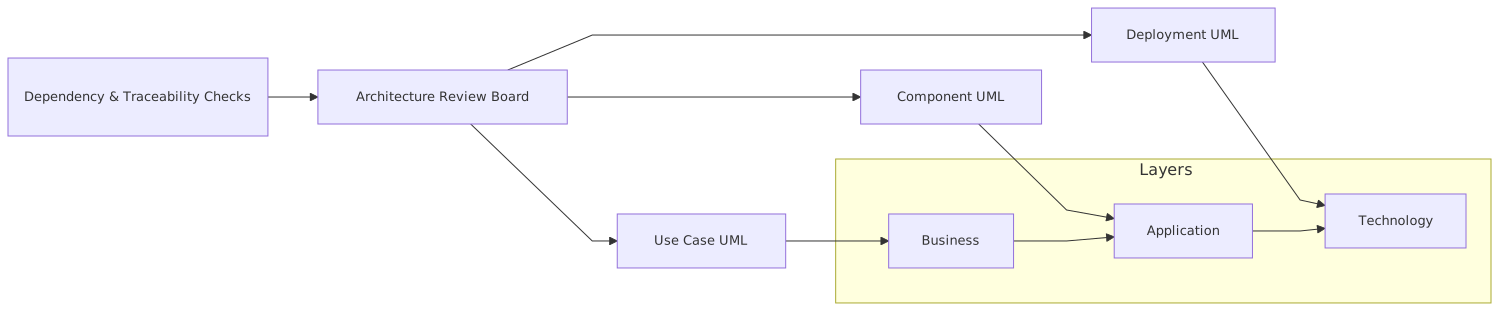
Mistake 1: Treating diagrams as deliverables instead of tools
This is the classic enterprise mistake. The architecture office demands diagrams because the process says so. Teams produce them to pass the gate. Nobody uses them afterwards.
If UML becomes a compliance artifact instead of a working design tool, it dies. And honestly, it deserves to.
A useful model is one that helps answer a real review question:
- Is the IAM flow safe?
- Does this Kafka integration preserve ownership?
- Where is sensitive data processed?
- What happens if this cloud dependency fails?
If the diagram doesn’t help answer something important, don’t draw it.
Mistake 2: Modeling too much
Architects love completeness. Governance does not need completeness. It needs clarity.
I’ve seen teams produce UML packs with 40 pages of diagrams and still fail to show one critical thing: who owns the event contract for customer status changes.
Too much modeling hides the important decisions. It creates visual fatigue. Reviewers stop reading carefully. Risks slip through.
Model the decisions, dependencies, and controls. Leave the rest.
Mistake 3: Using UML with no viewpoint discipline
Different stakeholders need different views. Security wants trust boundaries and auth flows. Platform teams want deployment and operational dependencies. Domain architects want ownership and interfaces. Delivery teams want interaction flow and constraints.
Many architects dump all concerns into one impossible diagram. That is not richness. That is confusion.
Governance works better when each diagram has a clear viewpoint and purpose.
Mistake 4: Ignoring runtime reality
A lot of UML is too clean because architects draw the idealized version. Real governance needs the ugly bits too:
- retries
- dead-letter topics
- token expiry
- fallback paths
- regional failover
- manual exception handling
If your sequence diagrams only show happy path, they are partly fiction. And governance based on fiction is dangerous.
This matters a lot in Kafka-heavy architectures. Event-driven systems look loosely coupled on paper and become operationally tangled in production. Governance should force visibility of those couplings.
Mistake 5: Confusing notation quality with architectural quality
A precise UML diagram can still describe a bad architecture. This sounds obvious, but some teams forget it.
Good governance doesn’t reward the best diagrammer. It tests whether the architecture is coherent, secure, resilient, and aligned to enterprise principles.
I’ve seen beautifully modeled systems with terrible IAM design. I’ve also seen rough but effective models that exposed exactly the right risks.
Don’t confuse polish with value.
UML and Governance in Cloud-Native Environments
There is a weird assumption that cloud-native architecture makes formal modeling less relevant. If anything, it makes it more relevant.
Cloud introduces more moving parts, not fewer:
- managed services
- ephemeral workloads
- network segmentation
- workload identity
- policy-as-code
- regional design choices
- service mesh or API gateway patterns
- event streaming platforms
- platform team abstractions
When teams say “the platform handles it,” governance should ask, “which part exactly?”
A UML deployment diagram in cloud context can reveal whether:
- workloads are in the right trust zones
- IAM integration is centralized or fragmented
- Kafka producers and consumers align with network and identity controls
- data flows cross regulated boundaries
- resilience assumptions depend on one region or one managed service
And yes, UML won’t capture everything. You still need infrastructure code, policy definitions, ADRs, threat models, and operational runbooks. But UML gives a governance-friendly abstraction layer between enterprise principles and implementation details.
That middle layer is often missing.
Contrarian View: Sometimes UML Is the Wrong Tool
Let’s be honest. UML is not always the best answer.
If a team needs a fast context model for a workshop, C4-style diagrams may be clearer.
If you’re describing data lineage, a data flow model may be more useful.
If governance is focused on cloud controls, architecture decision records plus platform reference patterns might carry more weight than formal UML.
And some UML diagrams are simply abused into irrelevance.
So no, I’m not arguing for UML everywhere. I’m arguing against the shallow modern habit of rejecting UML because it feels old, while replacing it with less disciplined diagramming that cannot support governance at scale.
In many enterprises, the right answer is hybrid:
- UML for structured architecture views
- ADRs for decision rationale
- threat models for security-specific analysis
- platform patterns for implementation constraints
- catalog metadata for ownership and lifecycle
That’s healthier than ideology.
How Architects Should Actually Use UML for Governance
If I were setting up architecture governance in a large enterprise today, I would use a lightweight but strict approach.
1. Define mandatory viewpoints, not mandatory diagram counts
Require teams to show:
- logical structure
- key runtime interactions
- deployment/trust model
Do not require “five UML diagrams” just because a template says so.
2. Tie each model to a governance question
For example:
- Component diagram: does ownership and dependency structure align with enterprise standards?
- Sequence diagram: does the interaction flow satisfy security, resilience, and eventing rules?
- Deployment diagram: does runtime placement comply with cloud and risk controls?
This keeps modeling honest.
3. Standardize notation just enough
You don’t need UML police. But you do need enough consistency that one review board can understand designs from multiple teams without relearning notation every time.
4. Model exceptions, not just ideals
Ask to see:
- failure paths
- retries
- fallback behavior
- auth failures
- delayed event handling
- dead-letter processing
That is where governance value increases fast.
5. Keep models living
The best architecture teams update UML when significant design decisions change. Not every sprint. Not every code commit. But when ownership, integration style, trust boundaries, or deployment shape changes, the model should too.
A stale architecture model is worse than no model because it creates false confidence.
Where UML Adds the Most Governance Value
If I had to be very practical, UML is most valuable in governance when the architecture has these characteristics:
- multiple teams and shared dependencies
- regulated or sensitive data
- centralized IAM and authorization patterns
- event-driven integration through Kafka or similar
- cloud runtime complexity across accounts, regions, or trust zones
- long-lived services with evolving ownership boundaries
That describes a lot of modern enterprises, especially banks.
In a bank, architecture governance is rarely just about technical neatness. It’s about proving that customer identity is handled correctly, event propagation is controlled, access is enforced consistently, and cloud deployment does not create hidden compliance or operational risk.
UML helps because it lets you show all that in a form that is structured enough for review and simple enough for cross-functional discussion.
That balance is why it still matters.
Final Thought
Architecture governance is only as strong as the visibility of the decisions it governs. If those decisions live only in architects’ heads, scattered Jira tickets, or vague diagrams, governance becomes ceremonial. Teams pass reviews and still build inconsistent, risky systems.
UML is not glamorous. It’s not trendy. Good. Enterprise architecture does not need more trendiness. It needs tools that help people see what matters.
Used badly, UML becomes bureaucracy with arrows.
Used well, it becomes one of the few practical ways to make architectural intent inspectable across delivery, security, platform, and risk.
That’s the real value. Not notation for its own sake. Governance with enough structure to actually govern.
And frankly, that’s harder to replace than many people admit. ArchiMate in TOGAF ADM
FAQ
1. Is UML still relevant for modern cloud-native architecture governance?
Yes, if used selectively. Component, sequence, and deployment diagrams are still highly useful for reviewing service boundaries, IAM flows, event-driven interactions, and cloud trust models. UML is less useful when teams try to model everything.
2. How does UML help with Kafka-based enterprise architectures?
It helps show event ownership, producer-consumer relationships, sequencing, and failure handling. This is critical in governance because Kafka can hide coupling behind “asynchronous” design. UML makes those dependencies visible.
3. What UML diagrams are most useful for architecture review boards?
Usually component diagrams for structure, sequence diagrams for behavior, and deployment diagrams for runtime and cloud controls. Those three cover most governance needs without overwhelming teams.
4. Can UML support security and IAM governance?
Absolutely. Sequence diagrams are especially useful for showing authentication, token propagation, authorization checks, and trust boundaries. Deployment diagrams also help show where IAM federation, secrets, and access controls apply in cloud environments.
5. What is the biggest mistake architects make when using UML in governance?
Treating UML as a documentation obligation instead of a decision-support tool. If the model doesn’t help answer a real governance question, it’s just diagram noise.
Frequently Asked Questions
What is architecture governance?
Architecture governance is the set of practices, processes, and standards that ensure architectural decisions are consistent, traceable, and aligned to organisational strategy. It includes architecture review boards (ARBs), modeling standards, lifecycle management, compliance checking, and exception handling.
How do you set up architecture governance in a large organisation?
Start with clear principles and a lightweight metamodel. Establish an Architecture Review Board with defined remit and cadence. Implement decision records (ADRs). Use a tool like Sparx EA to make governance evidence model-based rather than slide-based. Federate ownership — enterprise architects set standards, domain architects maintain their areas.
What is the role of ArchiMate in architecture governance?
ArchiMate supports governance by providing a standard language that makes architecture proposals comparable and reviewable. Governance decisions, principles, and compliance requirements can be modeled as Motivation layer elements and traced to the architectural choices they constrain — enabling reviews based on evidence, not opinion.