⏱ 20 min read
Most UML diagrams in banks are useless.
That sounds harsh, but it’s true. I’ve seen beautiful sequence diagrams that nobody trusted, immaculate component diagrams that described a system that no longer existed, and “enterprise models” so abstract they could have been about a retail chain, an airline, or a toaster factory. The problem is not UML itself. The problem is how banks use it: too late, too formally, too disconnected from the real architecture decisions that actually matter. UML modeling best practices
Here’s the simple version up front: UML is a visual language for describing software structure and behavior. In banking systems, it can help architects explain services, data flows, identities, integrations, controls, and operational boundaries. Used well, it reduces ambiguity. Used badly, it becomes corporate wallpaper.
And banking is exactly where this matters. Banks are full of systems that are old, regulated, distributed, politically sensitive, and operationally unforgiving. You don’t get to hand-wave architecture in that environment. If your payment orchestration service publishes the wrong Kafka event, or your IAM design leaks privilege across domains, or your cloud deployment diagram ignores data residency, the issue is not academic. It turns into outages, audit findings, customer harm, and very expensive executive calls.
So yes, UML still has a place in banking. But not as a ceremonial artifact. As a working tool. A decision tool. A communication tool. Sometimes even a survival tool.
First, what UML is actually good for in banking
Let’s keep the SEO-friendly explanation simple before we go deeper.
UML, or Unified Modeling Language, is a standardized way to represent systems visually. In banking architecture, the most useful UML diagram types are usually:
- Use case diagrams for showing actors and high-level interactions
- Sequence diagrams for showing request, event, and response flows
- Component diagrams for showing service boundaries and dependencies
- Deployment diagrams for showing runtime topology across cloud/on-prem environments
- Class or domain diagrams for clarifying business objects and relationships
That’s the textbook answer. The real answer is narrower.
In real banking architecture work, UML is most useful when you need to answer one of these questions: UML for microservices
- Who talks to whom?
- What happens in what order?
- Where does trust begin and end?
- What is deployed where?
- What changes if this service fails, scales, or moves to cloud?
If your diagram doesn’t help answer one of those, there’s a decent chance it shouldn’t exist.
That’s one of my stronger opinions: architects draw too many diagrams for completeness and not enough for decision-making. Banks are especially vulnerable to this because governance likes artifacts. But architecture is not a museum. A diagram should earn its keep.
Why UML survives in banking when other modeling approaches fade
People love declaring UML dead. Usually they mean “I don’t like bloated design documents.” Fair enough. But that’s not the same thing.
In banking, UML survives because banks have three characteristics that keep visual modeling relevant:
1. Banking systems are integration-heavy
A retail bank is not one system. It’s a negotiation between channels, core banking platforms, payment engines, fraud systems, customer master data, IAM platforms, reporting stacks, regulatory controls, and external networks. Add Kafka, APIs, SaaS platforms, cloud-native services, and batch processing, and the architecture becomes a web of dependencies.
You need a way to make that visible.
2. Banking systems cross organizational trust boundaries
A diagram in banking is rarely just about software. It’s also about ownership, risk, segregation of duties, data classification, and operational accountability.
A sequence diagram showing a customer onboarding flow is not just “step 1, step 2, step 3.” It’s showing where identity is established, where consent is captured, where sanctions screening occurs, where PII is stored, and which system becomes system of record.
3. Banks still run hybrid estates
No matter how many cloud strategy decks get approved, most banks are still hybrid for a long time. Core systems may remain on-prem or on a private platform. New customer-facing services may run in public cloud. Kafka may span multiple zones or exist in separate clusters by domain. IAM may combine legacy LDAP, modern identity federation, and cloud-native access controls.
Text alone is not enough for this. You need diagrams that can hold complexity without collapsing into prose.
The diagrams that actually matter in banking architecture
Not all UML diagrams are equal. Some are genuinely useful. Some are mostly theater.
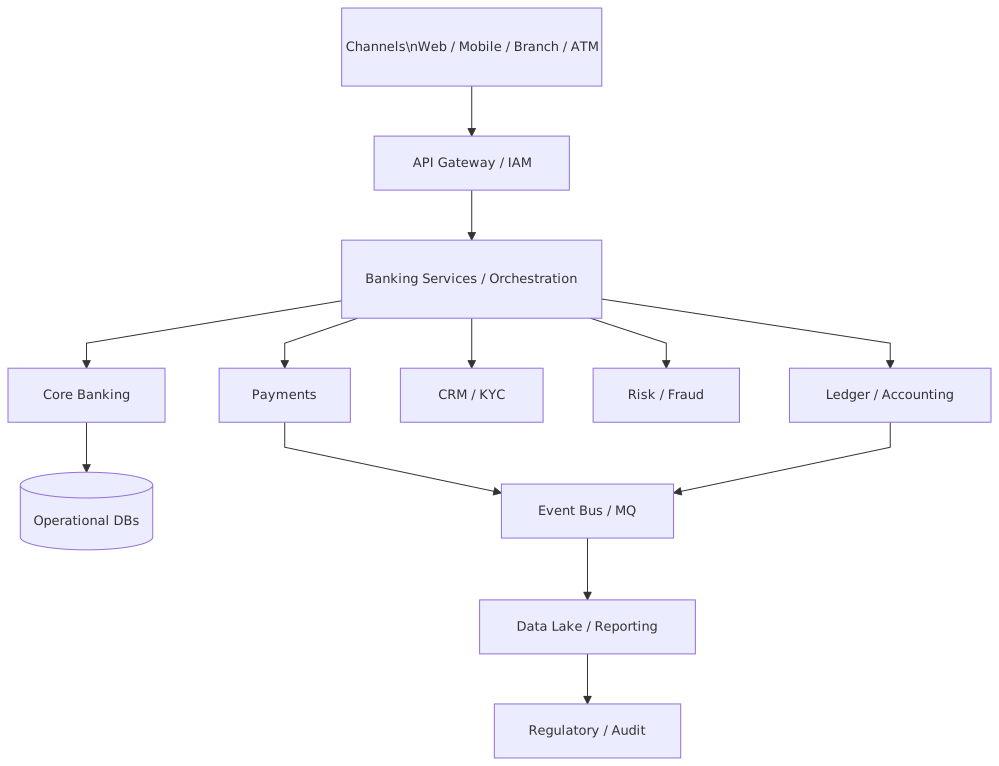
Here’s my practical view.
If I had to keep only three in a banking architecture toolkit, I’d keep:
- Sequence diagrams
- Component diagrams
- Deployment diagrams
That’s because those three map closest to actual architecture work: integration, boundaries, runtime reality.
UML is not for “the system.” It’s for the decision
This is where many architects go wrong. They try to produce a master diagram of everything. That is almost always a mistake.
A better pattern is this: draw the diagram around the decision being made.
Examples:
- If the question is whether to put fraud scoring before or after payment orchestration, use a sequence diagram.
- If the question is whether customer profile should be a shared service or domain-owned capability, use a component diagram.
- If the question is whether Kafka brokers can span regions or whether IAM tokens can be validated locally in cloud, use a deployment diagram.
This sounds obvious. Yet in large banks, architecture often becomes a compliance ritual. The architect is expected to “produce UML” as if UML were the outcome. It isn’t. The outcome is a better design, less ambiguity, and fewer nasty surprises in delivery or production. ArchiMate for governance
A real enterprise example: digital payments modernization in a bank
Let me give you a realistic enterprise example. Not a toy one.
A mid-to-large bank decides to modernize its payments platform. The existing estate looks familiar:
- Core account processing on legacy platforms
- Internet and mobile banking channels already partially modernized
- Payment initiation through an API layer
- Fraud and AML controls in separate systems
- IAM split across customer identity, workforce identity, and machine identities
- Some new services in cloud, but key systems still on-prem
- Kafka introduced as the event backbone for new services
The business goal sounds simple: faster payments, better observability, less batch dependency, and support for new payment products.
The architecture reality is not simple.
The first bad diagram
The first attempt is usually a giant component picture with arrows everywhere:
- Channel apps
- API gateway
- payment service
- fraud service
- notification service
- account service
- Kafka
- IAM
- data lake
- audit
- compliance
Looks impressive. Tells you almost nothing.
It doesn’t tell you:
- Which calls are synchronous versus event-driven
- Which service owns payment state
- Where idempotency is enforced
- How identity propagates from customer session to service authorization
- What happens when Kafka is unavailable
- Where audit events are immutable
- Which data can cross cloud boundaries
That’s the difference between architecture art and architecture work.
The diagrams that helped
In the real architecture effort, the useful UML set looked more like this:
1. Sequence diagram for payment initiation
This diagram showed:
- Customer authenticates through digital channel
- Channel receives token from customer IAM platform
- API gateway validates token and forwards request
- Payment orchestration service checks authorization scope
- Fraud service called synchronously for pre-check
- Payment orchestration publishes
PaymentInitiatedevent to Kafka - Ledger integration service consumes event and posts reservation
- Notification service consumes event independently
- Audit service receives immutable audit event
- Final payment status propagated back to channel through a mix of sync response and async update
This one diagram exposed three major issues:
- Fraud scoring latency would break channel SLAs if done synchronously for all flows
- Kafka event schema had no stable payment correlation model
- IAM token claims were too channel-centric and not sufficient for service-level authorization
That’s real architectural value. The diagram forced the hard questions early.
2. Component diagram for domain boundaries
The team then created a component diagram that made ownership explicit:
- Payment Orchestration Domain
- Fraud Decisioning Domain
- Customer Identity Domain
- Ledger Posting Domain
- Notification Domain
- Audit and Compliance Domain
Each component showed:
- owned data
- inbound and outbound interfaces
- event topics published or consumed
- owning team
- trust classification
This stopped the classic banking mistake of creating “shared services” that are really just central bottlenecks with no clear product ownership.
3. Deployment diagram for hybrid runtime
This was probably the most important of all.
It showed:
- API gateway and channel services in public cloud
- Kafka cluster in bank-controlled platform zone
- payment orchestration in cloud Kubernetes
- fraud engine on-prem
- ledger integration near core systems on-prem
- IAM token issuer in dedicated identity zone
- private connectivity between cloud and on-prem
- secrets management, certificate trust, and monitoring paths
That deployment view exposed a brutal truth: the architecture looked modern on paper, but the end-to-end latency and dependency chain still relied heavily on on-prem systems. The cloud story was only partially true.
This is another contrarian point: moving some services to cloud does not make the architecture cloud-native. In banking, many “cloud transformations” are just network diagrams with better branding.
How UML applies in real architecture work
Let’s get very practical. In actual enterprise architecture, UML is not something you do after the design. It’s something you use during the design.
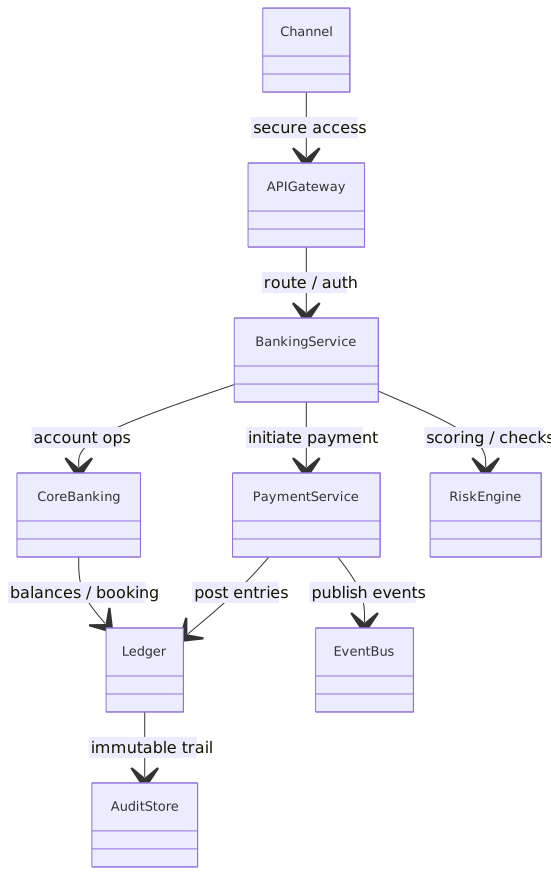
During discovery
At the start of a banking initiative, architects need to understand actors, systems, trust boundaries, and key flows. A lightweight use case or context diagram can help here, but don’t linger too long. The goal is to identify:
- customer actors
- internal operational actors
- external counterparties
- system boundaries
- regulated data touchpoints
This is where you find hidden actors like fraud analysts, payment operations teams, or compliance users who often get ignored in “digital-first” designs. EA governance checklist
During solution design
This is where sequence and component diagrams become the workhorses.
You use them to:
- test service decomposition
- identify chatty integrations
- model event choreography versus orchestration
- define IAM flows
- expose hidden coupling
- reason about failure handling
For example, if a banking service publishes Kafka events for customer profile changes, the sequence diagram should show:
- who can publish
- what event contract applies
- how ordering matters
- what retries do
- what duplicate processing means
If that sounds operational rather than conceptual, good. That’s exactly the point.
During governance and risk review
This is where many architects become too formal and too vague at the same time.
Risk, security, and audit stakeholders do not need twenty diagrams. They need the right few diagrams with the right semantics:
- where identities are asserted
- where authorization is enforced
- where data is encrypted
- where regulated data leaves a boundary
- what runtime dependencies exist
- what happens during partial failure
A good deployment diagram often does more for a security review than a 40-page architecture narrative.
During delivery
Good architects use UML as a shared language with engineering, not as a handoff artifact.
That means diagrams get updated when:
- service ownership changes
- Kafka topics split or merge
- IAM patterns evolve
- cloud landing zone decisions shift
- resilience strategies change
If the diagrams don’t survive contact with delivery, they were too fragile to begin with.
Common mistakes architects make with UML in banks
This is where I’ll be blunt.
1. They model the happy path only
This is probably the biggest mistake.
In banking, the architecture is defined as much by exception handling as by the primary flow. Timeouts, duplicate events, partial failures, reconciliation, fallback authorization, fraud review holds, downstream system lag — these are not edge cases. They are the system.
A sequence diagram that shows only success is often architecture fiction.
2. They ignore trust boundaries
Architects love showing systems. They are less disciplined about showing trust.
In a bank, you need to know:
- where customer identity is established
- where machine identity is established
- where token exchange happens
- where privilege changes
- where cross-domain access occurs
If your UML says “Service A calls Service B” but doesn’t show how that call is authenticated and authorized, the diagram is incomplete in a dangerous way.
3. They treat Kafka like a magic integration box
I’ve seen this too many times. Kafka appears in a component diagram as if it were just a neutral transport layer. It isn’t.
Kafka introduces architecture decisions around:
- event ownership
- schema evolution
- replay behavior
- consumer lag
- ordering guarantees
- failure isolation
- topic governance
A bank that adopts Kafka without modeling those decisions ends up with distributed coupling instead of distributed architecture.
4. They confuse logical and physical views
This is common in cloud programs.
A component diagram may show a clean domain model. Fine. But then the deployment reality includes:
- shared clusters
- cross-region dependencies
- legacy IAM connectors
- firewall constraints
- data residency controls
- central secrets platforms
- on-prem batch jobs still driving core state
If you don’t separate logical design from deployment reality, the architecture becomes misleading. In banks, misleading diagrams are worse than missing diagrams because they create false confidence.
5. They over-model domains too early
Banking architects sometimes disappear into domain modeling for months. Customer, account, party, arrangement, product, transaction, mandate. All important. But overdoing this early can become a form of procrastination.
You do not need a perfect enterprise canonical model to design a payment event flow. In fact, chasing one may delay useful decisions.
Another strong opinion: canonical models are often governance comfort blankets. Use them carefully.
6. They produce diagrams no engineer wants to use
If engineers don’t look at your diagrams after the review meeting, you have failed.
That doesn’t mean architects should draw code-level diagrams. It means the diagrams must be:
- specific enough to guide implementation
- honest enough to reflect constraints
- simple enough to stay current
Banks already have enough dead artifacts.
UML, IAM, and the architecture nobody models well enough
Identity and access management is one of the most under-modeled areas in banking architecture. Which is odd, because it is central to security, compliance, and customer experience. architecture decision record template
In many banks, IAM is split across several concerns:
- customer authentication and federation
- workforce identity
- privileged access management
- machine-to-machine identity
- cloud-native RBAC and policy enforcement
Yet UML diagrams often reduce this to a single box called “IAM.”
That’s not serious architecture.
A better approach is to model IAM explicitly in sequence and deployment views.
For example, in a retail banking loan application flow, show:
- customer authenticates through CIAM platform
- token issued with claims and assurance level
- API gateway validates token
- loan service exchanges token or derives service-level authorization context
- downstream document service uses machine identity
- underwriting engine checks user role and delegated authority
- audit trail captures identity chain
This matters because IAM errors in banking are rarely just technical bugs. They become control failures:
- over-entitlement
- broken segregation of duties
- unverifiable customer consent
- unauthorized data access
- weak traceability
And in cloud, this gets even trickier. You may have:
- workload identities for Kubernetes services
- cloud IAM roles for storage access
- enterprise secrets managers
- certificate-based service identity
- externalized policy engines
If your UML cannot express enough of that to make risk visible, you need better diagrams, not fewer.
Kafka in banking: sequence diagrams beat architecture slogans
Banks adopted Kafka because batch was too slow, point-to-point integration was too brittle, and digital channels needed event-driven responsiveness. All true.
But event-driven architecture in banking is not automatically better. It is often just differently difficult.
This is where sequence diagrams are massively underrated. They force clarity around:
- event publication timing
- transactional boundaries
- idempotency points
- compensating actions
- consumer responsibilities
Take a simple banking event: CustomerAddressChanged.
Looks harmless. But in reality:
- compliance systems may need immediate updates
- correspondence systems may tolerate delay
- fraud systems may need both old and new address
- some consumers require ordered events
- some downstream systems may still expect batch extracts
- privacy controls may limit event payload content
A proper UML sequence or interaction view can expose this complexity before the implementation becomes a mess.
One contrarian thought here: banks often overuse events for things that should remain synchronous commands. Architects sometimes chase asynchronous elegance at the expense of control. In highly regulated flows — payment confirmation, account closure, sanctions hold — clear command responsibility can be better than diffuse event choreography.
Not everything should be “event-first.” Sometimes that’s just architectural fashion.
Cloud changes the deployment diagram more than the component diagram
Another lesson from real banking work: cloud migrations often leave the logical architecture mostly intact while radically changing the operational architecture.
That’s why deployment diagrams matter so much.
A banking workload moving to cloud raises questions like:
- what stays on-prem because of latency or regulatory constraints
- how private connectivity is established
- where encryption keys live
- how observability crosses environments
- whether IAM trust extends cleanly
- how failover works across zones or regions
- what shared platform dependencies exist
A component diagram won’t answer those. A deployment diagram can.
And honestly, many enterprise architects underinvest here because deployment views feel “too technical.” That’s a mistake. In banking, runtime topology is architecture. If your service depends on an on-prem fraud engine over constrained network links, that is not implementation detail. That is a first-order architectural fact.
What good UML looks like in a bank
Good UML in banking has a few characteristics.
It is selective
Not every feature needs a diagram. Not every system needs six views. Focus on critical journeys, material risks, and consequential dependencies.
It is honest
Show the ugly parts:
- manual checks
- overnight batch dependencies
- legacy adapters
- token exchanges
- exception queues
- reconciliation jobs
Real architecture is rarely clean.
It is owned
Every useful diagram has an owner and a review cadence. Otherwise it decays.
It includes failure and control points
Especially in banks, diagrams should show:
- retries
- dead-letter paths
- approval steps
- audit emission
- authorization checks
- fallback behavior
It links to decisions
A diagram without decision context is just illustration. A diagram tied to an ADR, a risk item, or a design choice becomes architecture.
A practical modeling approach I recommend
If I were setting a minimum UML standard for a banking architecture team, it would be this:
For every material solution:
- One context/use case view
- actors
- system boundary
- external dependencies
- Two or three sequence diagrams
- one primary business flow
- one exception/failure flow
- one IAM/security-sensitive flow if relevant
- One component diagram
- domain ownership
- interfaces
- event topics
- systems of record
- One deployment diagram
- runtime locations
- network zones
- cloud/on-prem split
- trust boundaries
- resilience pattern
That’s enough for most banking solutions to be understandable, governable, and buildable.
More than that may be useful for especially complex domains. But start there.
Final lesson: UML is valuable when architects stop worshipping it
Here’s the core lesson from years of banking architecture work: UML is neither the problem nor the solution.
The problem is lazy abstraction, diagram inflation, and architecture that avoids operational truth.
The solution is disciplined modeling tied to real decisions:
- how payments flow
- how Kafka events behave
- how IAM trust is enforced
- how cloud deployment changes risk
- how teams own systems and data
Banks do not need more diagrams. They need better diagrams. Fewer, sharper, more honest.
And architects need to stop pretending that a polished model equals a sound architecture. It doesn’t. A sound architecture survives latency, audit, failure, politics, and delivery reality. If UML helps you get there, use it. If it doesn’t, cut it.
But don’t dismiss it just because some organizations turned it into ceremony. In the hands of a good architect, UML is still one of the fastest ways to expose weak thinking before weak thinking becomes production software.
That, in banking, is worth a lot.
FAQ
1. Is UML still relevant for modern banking systems using microservices and Kafka?
Yes. Especially sequence, component, and deployment diagrams. Modern banking is more distributed, not less. That increases the need for clear modeling of interactions, trust boundaries, and runtime dependencies.
2. Which UML diagrams are most useful for banking architecture?
In practice: sequence diagrams for flows, component diagrams for ownership and dependencies, and deployment diagrams for hybrid cloud reality. Use case diagrams can help early, but they’re rarely enough on their own.
3. How should UML represent IAM in banking systems?
Don’t hide IAM behind one generic box. Show authentication, token validation, token exchange, machine identity, authorization enforcement, and audit points explicitly. In regulated environments, identity flow is part of the architecture, not a side note.
4. What is the biggest mistake architects make with UML in banks?
Modeling only the happy path. Banking systems are defined by failures, controls, exceptions, reconciliation, and partial success. If the diagrams ignore those, the architecture is incomplete.
5. Should banks use UML or BPMN for process-heavy solutions?
Use the right tool for the question. BPMN can be better for business process modeling with human tasks and operational workflow. UML is often better for software architecture views like service interaction, deployment, and component boundaries. In real programs, you often need both.
Frequently Asked Questions
How is ArchiMate used in banking architecture?
ArchiMate is used in banking to model regulatory compliance (Basel III/IV, DORA, AML), integration landscapes (core banking, payment rails, channels), application portfolio rationalisation, and target architecture for transformation programs. Its traceability capabilities make it particularly valuable for regulatory impact analysis.
What enterprise architecture challenges are specific to banking?
Banking faces unusually complex EA challenges: decades of legacy core systems, strict regulatory change requirements (DORA, Basel IV, PSD2), fragmented post-M&A application landscapes, high-stakes integration dependencies, and the need for real-time operational resilience views. Architecture must be both accurate and audit-ready.
How does Sparx EA support banking enterprise architecture?
Sparx EA enables banking architects to model the full DORA ICT asset inventory, maintain integration dependency maps, track application lifecycle and vendor EOL, and generate compliance evidence directly from the model. Integration with CMDB and Jira keeps the model current without manual maintenance.