⏱ 19 min read
Most enterprise architecture transformations fail long before anyone admits they’ve started. TOGAF roadmap template
Not because the architects are bad. Not because the tooling is weak. Not even because the target architecture was wrong. They fail because the organization thinks architecture transformation is a diagram exercise when it is actually a control problem. A messy, political, expensive control problem.
That’s the part people don’t like to say out loud.
If your enterprise feels chaotic — too many platforms, duplicate capabilities, endless integration pain, security exceptions everywhere, cloud bills climbing, delivery teams improvising — then what you have is not an architecture problem in the abstract. You have a system of weak decisions. Architecture transformation is how you restore decision quality at scale.
That’s the simple version.
Enterprise architecture transformation means moving an organization from fragmented technology decisions to a deliberate operating model where platforms, integration, security, data, and delivery practices work together. Not perfectly. But intentionally. It is the shift from local optimization to enterprise control.
And yes, “control” is the right word. Not bureaucracy. Not central dictatorship. Control. The kind that lets teams move faster because they are not reinventing identity, eventing, observability, risk patterns, and cloud landing zones every quarter.
I’ve seen this in banks, insurers, retailers, and public sector programs. The pattern is almost always the same. Everyone says they want agility. What they actually create is unmanaged diversity. Then they are surprised when delivery slows down, incidents rise, compliance gets painful, and every merger or product launch becomes a six-month archaeology project.
So let’s talk about what enterprise architecture transformation really is, where architects get it wrong, and how to move from chaos to control without becoming the architecture police.
What enterprise architecture transformation actually means
Let’s keep the definition plain first.
Enterprise architecture transformation is the structured redesign of how business capabilities, applications, data, integration, security, and infrastructure are organized so the enterprise can execute strategy with less friction and less risk.
That sounds formal. In practice, it means things like:
- reducing duplicate systems
- standardizing integration patterns
- modernizing identity and access management
- moving from project-by-project cloud usage to governed cloud platforms
- making data ownership explicit
- defining which technology decisions are local and which are enterprise-wide
- connecting architecture to funding and delivery, not just standards documents
A lot of people hear “transformation” and imagine a giant target-state poster with hexagons and arrows. That’s part of it, but honestly, the poster is the least important thing. The real transformation is in the decisions the organization starts making differently.
For example:
- A bank stops letting each product team choose its own customer authentication flow and instead establishes enterprise IAM patterns with clear exceptions.
- An enterprise using Kafka moves from random topic creation and inconsistent event contracts to governed event domains with ownership, retention policies, and schema discipline.
- A cloud program stops measuring success by “applications migrated” and starts measuring by platform adoption, resilience, control coverage, and cost transparency.
That’s architecture transformation. Not prettier diagrams. Better constraints.
The hard truth: chaos is often tolerated because it helps people locally
This is the contrarian part.
Chaos survives because it benefits someone.
A business unit gets autonomy. A delivery lead avoids waiting for shared services. A vendor sells another platform. A security team patches around weak foundations with manual controls. A cloud team claims success by provisioning accounts while the application teams build snowflakes inside them.
So when leaders say, “We need enterprise architecture transformation,” what they often mean is, “The accumulated cost of everyone doing what they wanted has become impossible to ignore.”
That’s not cynical. That’s useful. If you don’t understand who benefits from the current disorder, you will design a transformation that looks sensible and dies in governance meetings. ArchiMate for governance
Real architects learn this eventually. The architecture is never just the technology landscape. It is the sum of technical choices, funding paths, policy exceptions, delivery incentives, and organizational habits.
That’s why transformation has to be designed as a change in operating model, not just a change in systems.
What chaos looks like in real enterprises
You can usually spot architectural chaos in the first week.
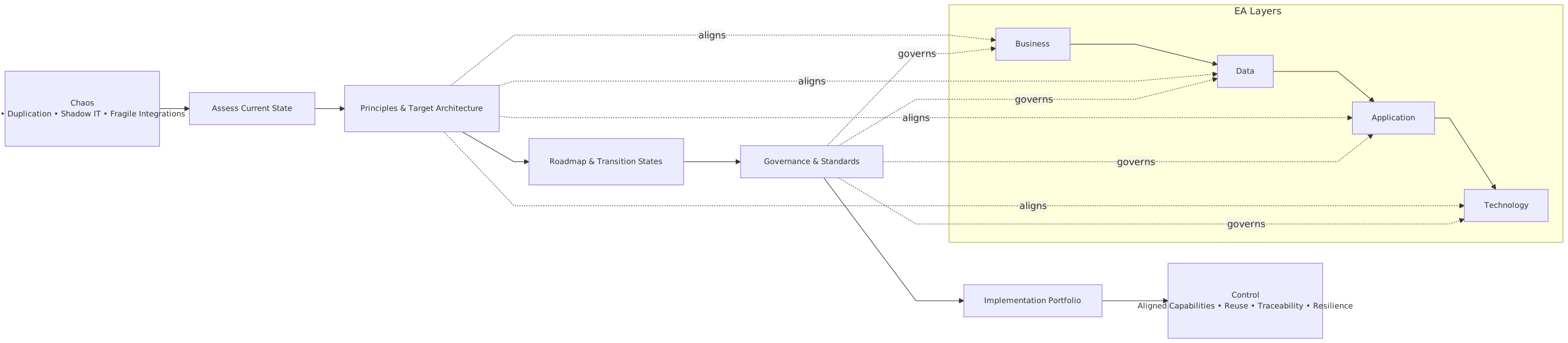
Here are some symptoms:
- the same customer data exists in five “golden” sources
- teams use REST, file drops, Kafka, direct database access, and batch exports for the same business process
- IAM is fragmented across Active Directory, cloud-native identity stores, SaaS-local accounts, and custom auth tables
- cloud environments exist, but no one can clearly explain account structure, guardrails, tagging discipline, or cost ownership
- architects produce standards that delivery teams ignore because the standards are disconnected from deadlines, tooling, and reality
- every critical initiative starts with “first we need to figure out what we already have”
In banking, these issues get amplified because regulation punishes ambiguity. If your payments platform emits events into Kafka without clear ownership, schema control, and access governance, that’s not just messy engineering. That can become an audit finding, a data leakage risk, or an operational resilience issue. EA governance checklist
And this is where enterprise architecture has to grow up. Architecture is not there to describe the mess elegantly. It is there to reduce the mess deliberately.
The transformation path: from standards theater to decision architecture
A lot of architecture teams get stuck in what I call standards theater.
They publish reference architectures. They create principles. They define target states. They run review boards. Everything looks mature. But the actual enterprise keeps drifting because the architecture function has influence without control.
Real transformation happens when architecture shapes the decisions that matter:
- investment approvals
- platform selection
- integration patterns
- security control models
- cloud operating boundaries
- lifecycle management
- technical debt prioritization
- exception handling
If architecture is not embedded in those mechanisms, it is advisory art.
That may sound harsh. It’s meant to.
An enterprise architecture transformation needs four things to work:
That table is the difference between transformation and architecture theater.
Start simple: what are you trying to control?
Before target architecture. Before roadmaps. Before capability heatmaps. Answer this: ArchiMate in TOGAF ADM
What decisions are currently uncontrolled that are hurting the enterprise?
Usually they fall into a few buckets:
- Application sprawl
Too many systems doing similar things. High cost, low clarity.
- Integration sprawl
Point-to-point APIs, unmanaged Kafka topics, brittle batch jobs, vendor-specific connectors.
- Identity sprawl
Inconsistent authentication, authorization, role models, privileged access, customer identity patterns.
- Cloud sprawl
Every team uses cloud differently. No consistent landing zones, network patterns, observability, or cost management.
- Data sprawl
Undefined ownership, conflicting definitions, uncontrolled replication.
If you can’t state the control problem clearly, your transformation effort will become generic. Generic architecture programs don’t survive budget pressure.
A real enterprise example: banking transformation with Kafka, IAM, and cloud
Let me make this concrete.
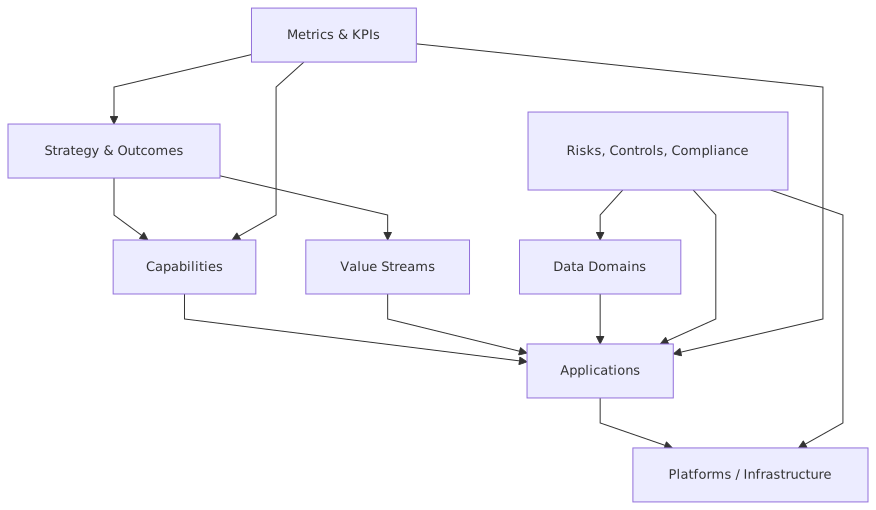
A regional bank I worked with — I’ll keep it generalized, but the patterns are real — had grown through acquisition. On paper, they had a digital transformation strategy. In reality, they had:
- three retail banking platforms
- two customer identity solutions
- separate IAM patterns for workforce and customer-facing applications
- Kafka in use by multiple teams, but no enterprise event model
- cloud adoption across AWS and Azure with inconsistent account/subscription structures
- duplicated fraud, notification, and customer profile capabilities
- architecture reviews that happened late and mostly produced waiver documents
The organization kept saying the problem was “legacy technology.” It wasn’t. The real problem was fragmented control.
What was happening on the ground
Retail banking teams were building event-driven services on Kafka. Good idea in principle. But each team created topics with its own naming conventions, retention settings, schema assumptions, and security model. Some treated Kafka as a high-speed integration bus. Others used it as a replayable source of truth. A few used it almost like a queue. There was no shared event taxonomy, no domain ownership model, and no disciplined schema governance. architecture decision record template
At the same time, IAM was split. Workforce identity was managed centrally with decent controls. Customer identity was partly outsourced, partly custom-built, and partly embedded in channels. Authorization models varied wildly. Some applications did role-based access in the app. Some used token claims. Some depended on legacy entitlements stored in databases no one wanted to touch.
Cloud made things worse before it made things better. Teams migrated workloads into cloud accounts quickly, but with different network designs, secrets handling, logging standards, and resilience assumptions. The cloud program was reporting success because migration numbers were up. The risk team was reporting concern because control consistency was down.
Classic enterprise mess. Very normal. Also very expensive.
What the transformation did differently
The turning point came when the bank stopped treating architecture as a documentation function and started using it to define enterprise control points.
They established three non-negotiable transformation streams:
1. Identity as an enterprise control plane
They redesigned IAM around enterprise patterns, not application preferences.
That meant:
- one strategic customer identity capability
- clear separation of authentication and authorization concerns
- standard token and policy patterns
- privileged access integrated into enterprise controls
- application onboarding patterns that teams could actually use
- explicit exception process with expiry dates, not permanent “temporary” waivers
This alone removed a huge amount of delivery friction. Teams no longer had to invent access patterns from scratch. Security reviews got faster because there was a known path.
2. Kafka as a governed event platform, not a free-for-all
The bank kept Kafka, but changed the operating model around it.
They introduced:
- domain-based event ownership
- mandatory schema governance
- topic naming and lifecycle standards
- data classification and access control patterns
- event design reviews for critical domains
- distinction between event notification, event-carried state transfer, and streaming analytics use cases
Here is the strong opinion: Kafka does not magically create good architecture. In undisciplined enterprises, it just lets bad integration spread faster. Event-driven architecture without ownership and semantics is distributed confusion.
Once the bank enforced domain ownership and platform rules, Kafka became valuable. Before that, it was architectural entropy with better throughput.
3. Cloud as a platform model, not a migration destination
Instead of celebrating workload migration, they defined cloud architecture around reusable controls:
- standardized landing zones
- guardrails for network, identity, logging, encryption, and tagging
- approved reference patterns for container workloads, data services, and integration components
- cost ownership tied to business units
- resilience patterns aligned with criticality tiers
- platform engineering support for delivery teams
This changed the conversation. Cloud was no longer “where applications run.” It became the governed environment in which enterprise patterns could be implemented consistently.
Results
Not overnight. Real transformations are slower than slide decks suggest. But within 18 months, the bank had:
- reduced identity pattern variation dramatically
- cut onboarding time for new digital services
- improved audit posture around access and event data handling
- reduced duplicated integration work
- clarified ownership of customer and transaction events
- improved cloud cost transparency and operational consistency
The biggest win was less visible: architecture decisions became easier to make. That’s the real signal of progress. When the enterprise no longer debates the same foundational questions in every program, control is improving.
How this applies in real architecture work
Let’s bring this out of theory and into the day job.
If you are an enterprise architect, transformation is not something you “own” in the abstract. It shows up in very practical work:
1. Portfolio rationalization
You need to identify where technology diversity is useful and where it is just waste. Not every duplicate system is bad. Some overlap is deliberate. But most enterprises carry accidental duplication far too long because no one wants the migration fight.
Your role is to separate strategic variation from unmanaged sprawl.
2. Platform definition
Architecture has to define what should be consumed as a platform versus built repeatedly by teams.
Typical enterprise platform candidates:
- IAM
- Kafka / event streaming
- API management
- observability
- CI/CD foundations
- cloud landing zones
- secrets and key management
If every team has to solve these independently, your architecture is failing at scale.
3. Decision rights
One of the most underrated architecture tasks is clarifying who gets to decide what.
For example:
- product teams may choose service internals
- enterprise architecture may define integration standards
- security may define mandatory IAM controls
- cloud platform teams may define landing zone guardrails
- domain owners may govern event semantics
Without this clarity, transformation stalls in endless negotiation.
4. Exception management
A mature architecture function does not try to eliminate exceptions. That’s fantasy. It makes exceptions visible, temporary, and expensive enough that people stop using them casually.
Permanent exceptions are how standards die.
5. Architecture embedded in delivery
If your standards are not reflected in backlog templates, reusable code, Terraform modules, API guidelines, Kafka topic onboarding, IAM integration kits, and review checkpoints, then teams will improvise.
And to be fair, they should. Teams under delivery pressure will always choose the path that exists over the path that is merely recommended.
That’s why I say architecture is a control problem. Controls have to be operable.
Common mistakes architects make during transformation
Architects make some very predictable mistakes. I’ve made a few myself.
Mistake 1: Designing the perfect target state
This is the classic error. The target architecture is clean, coherent, and almost irrelevant because it ignores transition costs, organizational politics, and delivery sequencing.
A good target state is useful. A perfect one is usually a distraction.
Mistake 2: Confusing principles with implementation
“Reuse before buy before build.” Fine. “Data is an enterprise asset.” Sure. Principles are easy to agree with because they are vague. Transformation needs enforceable patterns and practical choices.
What IAM product? What Kafka governance model? What cloud account pattern? What API auth standard? What decommission criteria?
That’s architecture work.
Mistake 3: Being neutral when the enterprise needs direction
Some architects try too hard to be facilitators. There is value in facilitation, but transformation requires judgment. Sometimes one platform really should win. Sometimes a local team should not get another exception. Sometimes “it depends” is just cowardice wearing a framework badge.
Strong architectures come from informed opinions.
Mistake 4: Starting with tooling
A repository tool, CMDB refresh, architecture modeling suite, or governance workflow engine will not fix weak decision-making. It may document it more nicely.
Tooling matters after you’ve clarified control points, ownership, and operating model.
Mistake 5: Ignoring IAM because it feels like security’s problem
This one is expensive. Identity and access management is foundational architecture. It shapes customer experience, workforce productivity, auditability, and integration trust boundaries. If IAM is fragmented, your enterprise architecture is fragmented, no matter how modern the apps look.
Mistake 6: Treating Kafka as just infrastructure
Kafka is not just middleware. In enterprise terms, it is a commitment to a style of integration and information flow. Without event ownership, schema discipline, and lifecycle rules, Kafka becomes another layer of hidden coupling.
Mistake 7: Equating cloud adoption with transformation
Moving workloads to cloud without changing platform governance, operating model, and engineering practices is just relocation. Sometimes useful. Rarely transformative.
Mistake 8: Failing to kill things
This is maybe the biggest one. Enterprises are very good at adding. Much worse at retiring. If your transformation roadmap contains twenty implementation workstreams and no serious decommission plan, you are building tomorrow’s complexity.
Contrarian thought: too much autonomy is often architectural debt
This is unpopular, especially in organizations that have spent years worshipping team autonomy.
Autonomy is good up to the point where shared complexity overwhelms local gains.
If every team can choose its own identity model, event design style, observability approach, cloud topology, and integration pattern, then the enterprise becomes a federation of mini-companies. That sounds modern until you try to secure it, audit it, operate it, or merge it.
Not every decision belongs at the team level.
Good enterprise architecture deliberately removes some choices so teams can focus on the choices that matter to customers. That is not anti-agile. It is what lets agility scale beyond a handful of teams.
A practical transformation model architects can actually use
Here’s a model I’ve found useful because it is simple enough to apply and strong enough to survive reality.
Phase 1: Expose the chaos
Map the current state, but do it with a bias toward decision pain, not encyclopedic completeness.
Focus on:
- application duplication
- integration patterns
- IAM fragmentation
- cloud platform inconsistency
- ownership gaps
- top exception categories
- major cost and risk concentrations
If you spend nine months trying to model everything, you’ve already lost.
Phase 2: Define enterprise control points
Pick the areas where standardization will create the biggest enterprise leverage.
Usually these are:
- IAM
- integration/eventing
- cloud platforms
- data ownership for critical domains
- observability and operational controls
Make explicit what is mandatory, what is recommended, and what is local choice.
Phase 3: Build the operating model around the architecture
This is where many transformations collapse.
You need:
- named platform owners
- review and approval mechanisms
- exception workflows
- funding alignment
- measurable adoption targets
- architecture participation in delivery governance
No operating model, no transformation.
Phase 4: Deliver through reference implementations
Teams do not adopt architecture because they admire it. They adopt it because it saves them time.
Provide:
- IAM integration kits
- Kafka topic onboarding patterns
- cloud landing zone templates
- standard CI/CD controls
- reusable policy definitions
- reference service architectures
This is where architecture starts becoming real.
Phase 5: Retire aggressively
Track:
- systems decommissioned
- integration patterns eliminated
- IAM variants reduced
- cloud account exceptions removed
- duplicate capabilities consolidated
Transformation is measured as much by subtraction as by implementation.
What leaders should expect from enterprise architects
If you’re a CIO, CTO, chief architect, or transformation lead, here’s what you should demand from your architecture team.
Not more diagrams.
Ask for:
- the top ten uncontrolled technology decisions harming the enterprise
- the platform choices that should become enterprise standards
- the specific capabilities that need rationalization
- the IAM model that will reduce risk and delivery friction
- the Kafka governance model that prevents event chaos
- the cloud control model that balances speed and oversight
- the decommission roadmap
- the exception backlog and who owns reducing it
If your architects cannot answer these concretely, they may be producing architecture artifacts without producing architecture outcomes.
That sounds brutal, but it’s fair.
Final thought: control is not the enemy of speed
One of the biggest myths in technology organizations is that control slows things down.
Bad control does. Pointless approval chains do. Detached governance does.
But good control — clear standards, reusable platforms, shared IAM patterns, governed Kafka usage, cloud guardrails, explicit ownership — is what lets large enterprises move repeatedly without breaking themselves.
That is the whole game.
Enterprise architecture transformation is not about making the enterprise elegant. Most enterprises are too complicated for elegance anyway. It is about making complexity governable. It is about replacing accidental architecture with intentional architecture.
From chaos to control.
Not total control. That’s fantasy. But enough control that strategy can survive contact with delivery.
And honestly, that’s already a big win.
FAQ
1. What is enterprise architecture transformation in simple terms?
It is the process of moving an organization from fragmented, inconsistent technology decisions to a more deliberate model where applications, data, integration, security, and cloud platforms are governed in a way that supports business goals.
2. How long does an enterprise architecture transformation usually take?
Longer than sponsors hope. Meaningful results often start appearing in 6–12 months, but real structural change usually takes 18–36 months. Especially in banking, where IAM, regulatory controls, and platform consolidation take time.
3. Why do so many architecture transformations fail?
Because they stay at the level of principles and target-state diagrams. They fail to change decision rights, funding, platform ownership, exception management, and delivery practices. In short, they describe a better future without creating the mechanisms to reach it.
4. How should Kafka be governed in enterprise architecture?
Treat Kafka as an enterprise event platform, not just messaging infrastructure. That means domain ownership, schema governance, topic lifecycle controls, access policies, retention standards, and clear distinctions between eventing use cases. Without that, Kafka can increase complexity instead of reducing it.
5. Why is IAM so central to enterprise architecture transformation?
Because identity sits across everything: customer channels, internal access, APIs, cloud platforms, audit controls, and security posture. Fragmented IAM creates friction, inconsistency, and risk everywhere else. If you don’t fix identity, the rest of the architecture remains unstable.
Frequently Asked Questions
What is enterprise architecture?
Enterprise architecture is a discipline that aligns an organisation's strategy, business processes, information systems, and technology. Using frameworks like TOGAF and modeling languages like ArchiMate, it provides a structured view of how the enterprise operates and how it needs to change.
How does ArchiMate support enterprise architecture practice?
ArchiMate provides a standard modeling language that connects strategy, business operations, applications, data, and technology in one coherent model. It enables traceability from strategic goals through business capabilities and application services to the technology platforms that support them.
What tools are used for enterprise architecture modeling?
The main tools are Sparx Enterprise Architect (ArchiMate, UML, BPMN, SysML), Archi (free, ArchiMate-only), and BiZZdesign Enterprise Studio. Sparx EA is the most feature-rich option, supporting concurrent repositories, automation, scripting, and integration with delivery tools like Jira and Azure DevOps.