⏱ 22 min read
Most architecture documents die the same way: not with a dramatic failure, but with a quiet drift into irrelevance. They begin life as a neat set of boxes, arrows, and promises. Six months later, the code has moved on, the platform team has improvised around the gaps, and operations is living inside the consequences. The architecture is still on Confluence, embalmed and respectable. The system, meanwhile, is doing something else entirely.
That gap is the real disease.
When people say “architecture as code,” they often mean Terraform modules, Kubernetes manifests, or a CI pipeline that can spin up environments. Useful, yes. But that is only the bottom of the stack. Infrastructure as code without domain thinking is just a disciplined way to automate the wrong thing. Real architecture as code is the explicit mapping from business model to application boundaries to runtime topology to infrastructure policy. It is not merely provisioning servers with better hygiene. It is making the architecture executable.
And in cloud systems, this matters more than ever. The cloud makes change cheap at the infrastructure layer and dangerously expensive at the semantic layer. You can create a queue in minutes. You can spend years unwinding what the queue meant, who owns it, and why five services think they are the source of truth.
So the useful question is not “How do we codify infrastructure?” It is “How do we codify the layers of intent, so that the system we run still resembles the business we claim to support?”
That is what this article is about: architecture as code as a set of layered mappings, from domain model to bounded contexts, from service contracts to event flows, from policy to deployment, and from operational reality back to design. We will talk about domain-driven design, cloud topology, Kafka, reconciliation, progressive strangler migration, and the tradeoffs that appear the moment theory meets a finance department, a regulator, and a legacy estate. event-driven architecture patterns
Because architecture is not the diagram. It is the set of decisions that survive contact with production.
Context
Enterprises now build systems in a landscape that is both more flexible and more fragmented than the one most architecture methods were designed for. Business capabilities are sliced into APIs, workflows spill across SaaS platforms, data moves through streams, and cloud platforms give teams enough power to create accidental complexity at industrial scale.
In that world, three things happen repeatedly.
First, domain semantics get diluted as systems are decomposed. A rich concept like customer exposure, shipment exception, or policy endorsement gets flattened into generic CRUD APIs and event topics with names that reveal implementation detail rather than business meaning. Teams ship software, but the architecture stops expressing the business.
Second, infrastructure choices become architecture by stealth. A Kafka topic design, an IAM policy, a retry rule, or a Kubernetes deployment pattern can harden into a business constraint. Suddenly the platform has decided what “eventual consistency” means for finance. Nobody intended that. It still happened.
Third, modernization programs underestimate the mapping problem. They move workloads to the cloud, break applications into microservices, or introduce event-driven architecture, but they fail to define the intermediate layers that connect business concepts to runtime behavior. The result is not agility. It is distributed ambiguity. microservices architecture diagrams
Architecture as code, done properly, addresses this by treating the architecture as a chain of representations:
- Domain model: the language of the business and its bounded contexts
- Application model: services, workflows, APIs, events, and ownership
- Platform model: runtime capabilities such as messaging, data stores, observability, security, and deployment patterns
- Infrastructure model: cloud resources, networking, policies, and environment definitions
- Operational model: SLOs, reconciliation jobs, alerting, failure handling, and change governance
The point is not to create more artifacts. The point is to make the mappings explicit and testable.
Problem
Most cloud architectures fail at the joins.
A domain model is created during discovery. Then solution design starts, and the language changes. “Order aggregate” becomes order-service. “Payment authorization” becomes a REST callback. “Shipment exception” becomes an entry in a shared data lake. By the time the infrastructure is provisioned, the design has become a loose collection of cloud services, microservices, and topics that no longer preserve domain intent.
That creates familiar pain:
- Service boundaries reflect team structure or database tables rather than bounded contexts
- Infrastructure modules are reused in places where domain constraints differ
- Event contracts are named after systems rather than business facts
- Shared schemas and canonical data models become a substitute for domain ownership
- Reconciliation is bolted on later because event chains are incomplete or unreliable
- Migration stalls because the target architecture is described as technology, not capability
The hidden cost is not only technical debt. It is organizational confusion. When a production issue occurs, teams ask the wrong questions. Who owns this concept? Which service is authoritative? What is the business consequence if the event is delayed? Is the discrepancy a bug, an acceptable lag, or a breach of compliance? If the architecture cannot answer those questions, the system may be modern, but it is not well-architected.
A codebase can survive some duplication. An enterprise cannot survive semantic drift forever.
Forces
The design space is shaped by several competing forces. Any useful architecture has to acknowledge them rather than pretending they can be optimized away.
1. Domain clarity versus delivery speed
DDD pushes us to invest in bounded contexts, ubiquitous language, and explicit ownership. Product teams under pressure often want the shortest path to production. Sometimes that means a service is created around a UI screen, or a stream is published because analytics asked for it. Shortcuts are not always foolish. But every shortcut at the semantic layer becomes a future migration project.
2. Cloud elasticity versus architecture sprawl
Cloud platforms make experimentation easy. Teams can provision databases, message brokers, and APIs with little friction. That is good. It is also how you end up with seven versions of the same pattern and three incompatible definitions of customer identity.
3. Autonomy versus coherence
Microservices promise team autonomy. Enterprises still need common controls: security baselines, auditability, data policies, and operational consistency. The tension is not between centralization and decentralization. It is between platform standardization and domain integrity.
4. Event-driven decoupling versus eventual consistency
Kafka and related platforms let us decouple producers and consumers elegantly. But the bill arrives in the form of ordering issues, idempotency, replay semantics, schema evolution, and reconciliation. Events are a superb integration style when the business can tolerate delay and divergence for a period. They are a terrible way to hide the lack of a clear source of truth.
5. Legacy reality versus target purity
No enterprise starts greenfield. There are core platforms, batch jobs, shared databases, vendor packages, reporting extracts, and hand-maintained operational scripts. The architecture has to support progressive migration, not just ideal-state diagrams.
These forces matter because architecture as code is not simply a technical method. It is a negotiating tool between business semantics, software design, and operational constraints.
Solution
The core idea is simple and worth stating bluntly: treat architecture as a layered model where each layer is expressed in code or machine-readable form, and where the mapping between layers is explicit, versioned, and governable.
This means we do not stop at infrastructure as code. We define architectural artifacts at several levels:
- Domain layer
- Bounded contexts
- Aggregates and key domain entities
- Commands, policies, and business events
- Ownership and source-of-truth rules
- Service and integration layer
- APIs and event contracts
- Service dependencies
- Data ownership
- Synchronous versus asynchronous interaction rules
- Platform policy layer
- Standard deployment patterns
- Messaging guarantees
- Security controls
- Observability requirements
- Resilience patterns
- Infrastructure layer
- Cloud resources
- Network segmentation
- Compute topology
- Storage and messaging configuration
- IAM and secrets management
- Operational behavior layer
- SLOs and error budgets
- Reconciliation jobs
- Backfill and replay controls
- Runbooks
- Operational event handling
This is not a monolith of metadata. It is a set of related models. The architecture lives in the mappings.
For example:
- A bounded context such as Billing maps to one or more services that own billing commands and billing events.
- Those services map to a Kafka topic namespace, database policy, and compliance controls.
- The runtime deployment maps to Kubernetes namespaces, cloud IAM roles, and observability dashboards.
- Reconciliation policies map to scheduled jobs and alerting thresholds because event-driven systems always need a way to prove consistency, not merely assume it.
That chain is what lets architecture remain true under change.
Here is a simple model-to-infrastructure view.
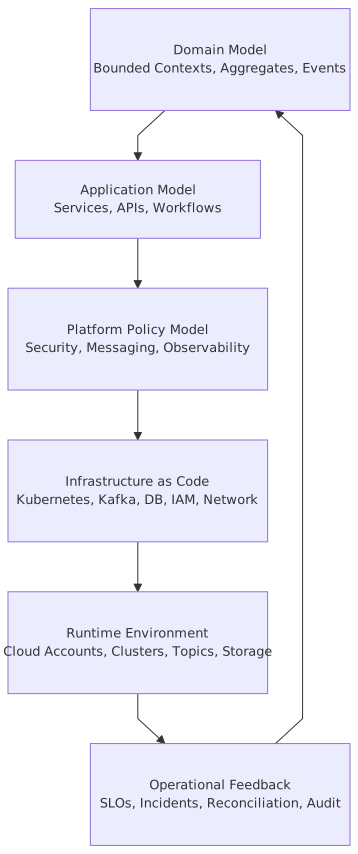
The feedback loop matters. Many architecture methods end at deployment. Mature systems do not. Runtime evidence must influence the model. If reconciliation constantly finds divergence between Order and Billing, that is not only an operational issue. It may indicate a flawed boundary, a missing event, or the wrong consistency choice.
Architecture
A practical architecture as code approach in the cloud usually has four structural principles.
1. Start from bounded contexts, not services
The service is not the unit of truth. The bounded context is. A bounded context defines a semantic boundary: a place where terms have precise meaning and ownership is clear. Services are an implementation choice inside that context.
This sounds obvious. It is rarely practiced consistently.
Take “Customer.” In a large enterprise, Customer in Sales, Customer in Billing, and Customer in Risk are not the same thing. If you create a single customer-service, you have built a semantic argument into your runtime. It will not end well. Better to acknowledge multiple customer-related bounded contexts and define integration contracts between them.
2. Make ownership explicit
Architecture as code should encode who owns a concept, which system is authoritative, and what downstream systems are allowed to cache, derive, or enrich.
This is especially important with Kafka and event-driven microservices. Events should announce facts from an owning context, not serve as a vague public export of internal state. “InvoiceIssued” is a fact. “BillingRecordUpdatedV7” is an implementation leak wearing a trench coat.
3. Separate interaction style from ownership
Synchronous APIs and asynchronous events are communication choices, not ownership models. A service can expose an API and still publish events. The important question is what business interaction is being modeled.
- Use synchronous calls when the requesting flow needs an immediate answer and the business process genuinely requires it.
- Use asynchronous events when consumers can react independently and the business can tolerate eventual consistency.
- Use commands carefully across bounded contexts. They often create hidden orchestration and tighter coupling than teams expect.
4. Build reconciliation in from the start
Any architecture involving streams, multiple datastores, retries, and microservices will produce drift. Not always because of bugs. Sometimes because of delayed consumers, schema mismatches, poison messages, duplicate deliveries, or operational interventions.
That means reconciliation is not a cleanup script. It is part of the architecture. It answers two hard questions:
- How do we detect that system state has diverged?
- How do we safely repair or re-drive the flow?
A cloud architecture that ignores reconciliation is like a bank that installs vault doors but no ledger.
Here is a typical layered architecture in enterprise cloud.
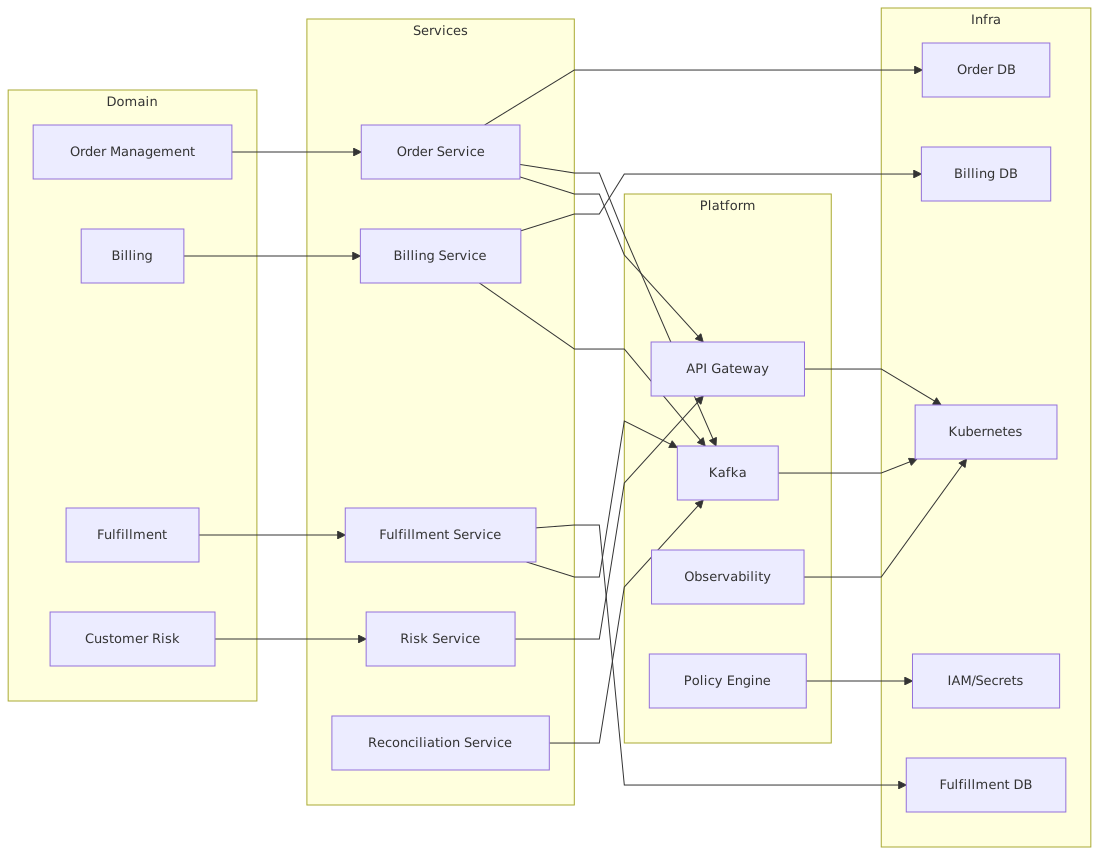
This diagram is simple by design. The point is to show the stack of intent: domain to service to platform to infrastructure.
Domain semantics and infrastructure mapping
This is the heart of the method. Not every bounded context deserves the same infrastructure profile.
A risk assessment service may need strict audit logging, immutable event retention, and region-specific data controls. A fulfillment notification service may optimize for throughput and retry behavior. If both are given the same generic service template, you have achieved platform consistency by erasing business difference.
Good platform engineering creates paved roads. Good enterprise architecture decides where the road should narrow, widen, or become a railway.
Examples of domain-driven infrastructure mapping:
- High-value financial events map to durable Kafka topics with longer retention, schema governance, replay controls, and stronger audit policies.
- Customer PII contexts map to tighter IAM boundaries, encryption policies, and constrained observability fields.
- Operational workflows with human intervention map to state stores and task queues that preserve recoverability and traceability.
- Reference data contexts may be served effectively through managed APIs and cached distribution patterns rather than heavy event choreography.
This is where architecture as code becomes useful rather than fashionable. It lets teams derive infrastructure from domain constraints instead of habit.
Migration Strategy
Most enterprises cannot replace a legacy core in a single motion. Nor should they. The safer path is progressive strangler migration, guided by domain seams and explicit reconciliation.
The strangler pattern is often described too romantically, as if one can gently grow a modern vine around a legacy tree until the old system naturally disappears. Real migration is rougher. Legacy systems continue to process transactions, downstream dependencies remain obscure, data semantics are inconsistent, and every cutover uncovers forgotten business rules.
Still, the strangler approach is the right default because it allows architecture to become true incrementally.
The migration sequence usually looks like this:
- Identify bounded contexts and high-value seams
- Choose capabilities that can be isolated semantically, not just technically.
- Good candidates are domains with clear ownership and painful change lead times in the legacy system.
- Establish anti-corruption layers
- Protect the new domain model from legacy data structures and semantics.
- Translate legacy states and events into domain language, even if awkwardly at first.
- Mirror and observe
- Publish events from the legacy estate or extract change data.
- Feed new services in shadow mode.
- Compare outcomes through reconciliation before making the new path authoritative.
- Shift specific commands or queries
- Start with read paths or low-risk write paths.
- Use routing at the edge or orchestration layer to move traffic gradually.
- Promote system of record deliberately
- Make authority explicit for each concept.
- Avoid partial authority with unclear fallback; that is where migrations go to die.
- Retire legacy behavior by capability, not by server
- Decommission business responsibilities one seam at a time.
- Infrastructure retirement follows domain retirement, not the other way around.
A migration diagram makes the pattern clearer.
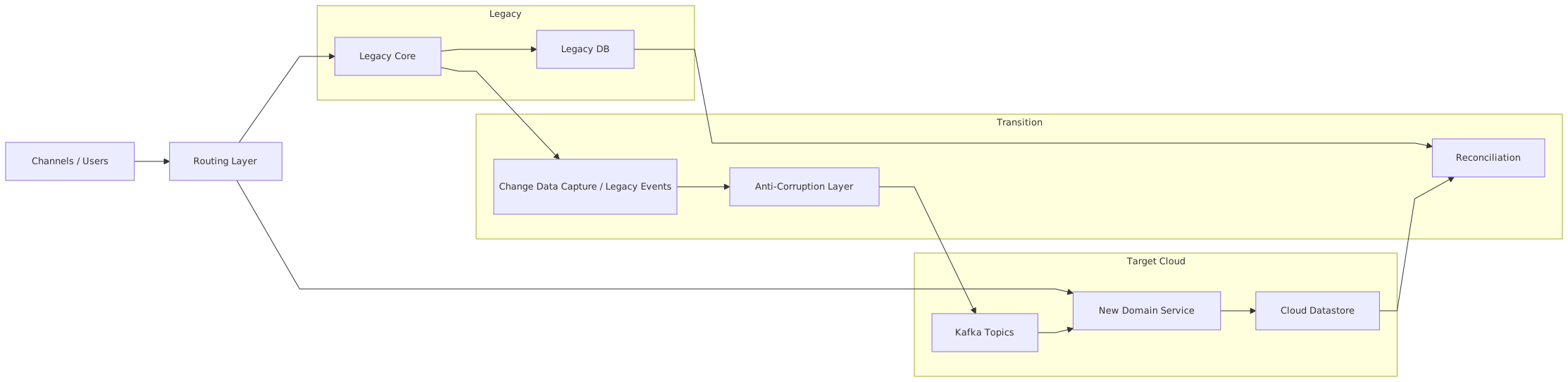
Progressive strangler in practice
A common mistake is strangling by interface rather than by domain. Teams put an API gateway in front of a legacy system and call it modernization. It is not. You have changed the facade, not the architecture.
A proper strangler move creates a new bounded context implementation, often fed initially from legacy data or events, and then gradually takes over one responsibility at a time. The migration must include business verification. This is where reconciliation earns its keep.
Reconciliation during migration
If you are moving from a monolith to event-driven microservices, reconciliation is the bridge between confidence and fantasy.
During migration, reconciliation should cover:
- Record counts and state parity
- Financial totals and aggregate balances
- Event completeness
- Processing lag
- Semantic mismatches between old and new status models
- Duplicate or missing business actions
You do not want to discover after cutover that the new Billing service correctly processed every Kafka event and still produced the wrong invoices because the legacy system embedded a discount rule in a nightly batch nobody documented.
Architecture as code can encode reconciliation policy as part of the migration blueprint: what to compare, at what frequency, what thresholds are acceptable, and which failures trigger rollback or manual review.
Enterprise Example
Consider a global insurance company modernizing its policy administration platform.
The legacy estate is a large package-based core running policy issuance, endorsements, renewals, and billing. Over the years, adjacent systems have grown around it: CRM, document generation, claims intake, regulatory reporting, and partner APIs. Every team says the same thing: “Policy is central.” They are all right, and that is the problem.
A naive microservices decomposition would create policy-service, customer-service, billing-service, and document-service with a shared canonical model. That would look clean for about three months.
A better DDD-informed approach identifies separate bounded contexts:
- Policy Lifecycle: issuance, endorsement, cancellation, renewal
- Billing and Collections
- Customer Relationship
- Regulatory Reporting
- Claims Intake
- Document Production
The company then defines architecture as code artifacts:
- Domain definitions with ownership and event taxonomy
- Service templates aligned to context types
- Kafka topic standards by business domain
- Data classification policies per context
- Reconciliation rules for premium, policy status, and billing balances
- Deployment blueprints for regulated versus non-regulated workloads
Migration begins with Document Production, a good seam because it consumes policy facts but does not own core policy decisions. Legacy policy changes are emitted through CDC, translated via an anti-corruption layer, and published as domain events like PolicyIssued, EndorsementApplied, and RenewalOffered.
A new document service in the cloud consumes those events and generates policy packs. It remains non-authoritative at first. Reconciliation compares generated outputs, document triggers, and policy version references against legacy behavior.
Once confidence is established, traffic for partner-facing document retrieval is shifted to the new service.
Next comes Billing and Collections, which is much harder. Billing owns money, and money is where architecture platitudes go to be disproven. The team uses Kafka for billing events, but they do not pretend event streams alone guarantee correctness. They implement:
- Idempotent consumers
- Business keys for de-duplication
- Ledger-style immutable billing events
- Scheduled reconciliation of premium due, collected amounts, and open balances
- Manual exception workflows for mismatches
The company avoids building a generic enterprise event mesh for all contexts. That restraint is wise. Not every domain needs the same event model. Regulatory Reporting, for example, consumes curated facts and snapshots rather than participating directly in operational workflows.
This is what mature enterprise architecture looks like: not maximum elegance, but controlled semantics under change.
Operational Considerations
Cloud architecture only becomes real when it enters production. That is where architecture as code either proves its value or becomes another governance ritual. EA governance checklist
Observability must reflect domain flows
Technical telemetry is necessary but insufficient. CPU, memory, and pod health do not tell you whether endorsements are stuck or invoices are duplicated.
You need domain-aware observability:
- Business event throughput by context
- End-to-end transaction traces across synchronous and asynchronous hops
- Lag by consumer group for material event streams
- Reconciliation exception rates
- Domain SLOs such as time from policy issuance to document availability
A good rule: if operations can see retries but not business impact, the observability model is incomplete.
Runtime policy enforcement
The platform should enforce architectural intent where possible:
- Service templates that embed security, logging, and tracing
- Topic naming and schema registry conventions
- IAM policies generated from context classification
- Deployment guardrails for region, resilience, and data handling
- Policy-as-code checks in CI/CD
But guardrails should not become a bureaucratic machine. The point is to prevent accidental architecture, not to stop delivery.
Replays and backfills
In Kafka-based architectures, replay is both a superpower and a loaded weapon. Replaying events can recover consumers or rebuild read models. It can also trigger duplicated downstream actions, financial errors, and compliance breaches if handlers are not designed carefully.
This is why replay policy belongs in the architecture. Define:
- Which topics are replayable
- Which consumers are safe for replay
- What business idempotency keys are required
- How replays are audited and approved
- What side effects must be suppressed during backfill
FinOps and resource shaping
Layered architecture also helps with cost control. Not every service requires the same resilience profile. Some can run serverless, some need steady containerized throughput, some need durable storage optimized for retention, and some should remain on a managed platform to reduce operational burden.
Architecture as code allows these choices to reflect domain criticality rather than engineering fashion.
Tradeoffs
There is no free lunch here. There is not even a cheap sandwich.
Benefit: semantic coherence
The big gain is that business meaning survives implementation and migration. Teams can reason about ownership, events, infrastructure, and operations with less ambiguity.
Cost: modeling discipline
This approach requires real domain work. Bounded contexts must be debated. Ownership must be assigned. Events must be named for business facts, not convenience. Some organizations want cloud modernization without semantic accountability. They will not enjoy this method.
Benefit: safer migration
Progressive strangler migration becomes more credible when target boundaries, anti-corruption layers, and reconciliation rules are explicit.
Cost: slower early momentum
The first few teams may feel slower because they are defining standards, contracts, and mappings. This is normal. You are paying down ambiguity before it compounds.
Benefit: stronger governance with less central drag
When architecture is encoded in templates, policies, and contracts, governance can shift left into delivery workflows.
Cost: risk of over-modeling
Some architects will overreact and build a giant meta-model nobody understands. That is a classic enterprise mistake: replacing accidental complexity with intentional complexity and calling it maturity.
The line to hold is simple: model what changes architecture decisions. Ignore the rest.
Failure Modes
This approach fails in predictable ways.
1. Turning bounded contexts into org charts
If your context map mirrors departmental politics rather than domain reality, the architecture will encode dysfunction.
2. Confusing event publication with event-driven design
Publishing every database mutation to Kafka is not event-driven architecture. It is a distributed audit trail looking for a purpose.
3. Shared canonical model relapse
Enterprises under integration pressure often drift back toward a universal data model. It promises reuse and delivers endless compromise.
4. Reconciliation treated as temporary
Teams say, “We’ll remove reconciliation once the architecture stabilizes.” Usually they should not. In distributed systems, reconciliation is not scaffolding. It is part of structural integrity.
5. Platform templates that erase domain differences
A standard service blueprint is useful until it imposes the same retry semantics, logging policy, and storage pattern on every context. Uniformity is not the same as coherence.
6. Migration with split authority
Nothing creates operational chaos faster than unclear authority during transition. If both legacy and new systems can change the same business fact without a clear arbitration rule, incidents are guaranteed.
When Not To Use
Architecture as code layers are powerful, but not universal.
Do not use this full approach when:
- You are building a small, short-lived application with limited integration and low business risk
- The domain is simple enough that a modular monolith is clearly the better fit
- The organization lacks the maturity to maintain service ownership, schema discipline, and operational controls
- The main problem is delivery basics, not architectural coherence
- Event-driven consistency and reconciliation overhead are unjustified by business needs
In many cases, a well-structured modular monolith with disciplined domain boundaries and infrastructure automation is the right answer. I would choose that over badly governed microservices every time. Distributed systems are a tax. Pay it only when the business actually benefits.
Related Patterns
Several related patterns work well with this approach.
- Bounded Contexts: the foundation for semantic boundaries and ownership
- Context Mapping: defines the relationships between domains, especially during migration
- Anti-Corruption Layer: critical when integrating or strangling legacy systems
- Strangler Fig Pattern: the practical migration shape for incremental modernization
- Event Sourcing: useful in some domains with strong audit needs, but not a default
- CQRS: effective when read and write concerns genuinely differ
- Outbox Pattern: important for reliable event publication from transactional systems
- Policy as Code: turns architecture guardrails into delivery-time enforcement
- Reconciliation Pattern: the enterprise counterpart to eventual consistency
One caution: related patterns are not a shopping list. Enterprises often assemble them like airport novels—thick, expensive, and not much use in an emergency. Use the patterns demanded by the domain and migration problem in front of you.
Summary
Architecture as code in cloud architecture is not just Terraform, Kubernetes YAML, or a neat CI/CD pipeline. It is the explicit, versioned mapping from domain meaning to software structure to platform policy to infrastructure and operations. cloud architecture guide
That mapping is what keeps architecture alive.
Start with domain-driven design. Define bounded contexts and ownership. Encode service contracts and event semantics around business facts. Use cloud platform standards, but do not let standardization flatten domain needs. Build reconciliation into the design, especially where Kafka, microservices, and eventual consistency are involved. Migrate progressively with strangler seams and anti-corruption layers. Let operational feedback reshape the architecture when reality exposes bad assumptions.
And remember the uncomfortable truth: cloud makes infrastructure easy to change. That is precisely why semantics matter more. When the plumbing becomes effortless, meaning becomes the bottleneck.
The best architectures are not the ones with the most diagrams. They are the ones where the code, the platform, and the business still tell the same story a year later.
Frequently Asked Questions
What is cloud architecture?
Cloud architecture describes how technology components — compute, storage, networking, security, and services — are structured and connected to deliver a system in a cloud environment. It covers decisions on scalability, resilience, cost, and operational model.
What is the difference between availability and resilience?
Availability is the percentage of time a system is operational. Resilience is the ability to recover from failures — absorbing disruption and returning to normal. A system can be highly available through redundancy but still lack resilience if it cannot handle unexpected failure modes gracefully.
How do you model cloud architecture in ArchiMate?
Cloud services (EC2, S3, Lambda, etc.) are Technology Services or Nodes in the Technology layer. Application Components are assigned to these nodes. Multi-region or multi-cloud dependencies appear as Serving and Flow relationships. Data residency constraints go in the Motivation layer.